
UNITED STATES
SECURITIES AND EXCHANGE COMMISSION
Washington, D.C. 20549
FORM 10-K
(Mark One)
Annual report pursuant to section 13 or 15(d) of the Securities Exchange Act of 1934 | |||||
For the fiscal year ended December 31 , 2025
or
Transition report pursuant to section 13 or 15(d) of the Securities Exchange Act of 1934 | |||||
For the transition period from ________ to _________
Commission File Number: 001-39095
(Exact name of registrant as specified in its charter)
 | ||||||||||||||||||||||||||
| (State or other jurisdiction of | (I.R.S. Employer | |||||||||||||||||||||||||
| incorporation or organization) | Identification No.) | |||||||||||||||||||||||||
(Address of principal executive offices) (Zip code)
(866 ) 279-0698
(Registrant’s telephone number, including area code)
Securities registered pursuant to Section 12(b) of the Act:
| Title of each class | Trading Symbol(s) | Name of each exchange on which registered | ||||||||||||
Securities registered pursuant to Section 12(g) of the Act: None
______________________________
Indicate by check mark if the registrant is a well-known seasoned issuer, as defined in Rule 405 of the Securities Act. Yes ☒ No ☐
Indicate by check mark if the registrant is not required to file reports pursuant to Section 13 or Section 15(d) of the Act. Yes ☐ No ☒
Note: Checking the box above will not relieve any registrant required to file reports pursuant to Section 13 or 15(d) of the Exchange Act from their obligations under those Sections.
Indicate by check mark whether the registrant (1) has filed all reports required to be filed by Section 13 or 15(d) of the Securities Exchange Act of 1934 during the preceding 12 months (or for such shorter period that the registrant was required to file such reports), and (2) has been subject to such filing requirements for the past 90 days. Yes ☒ No ☐
Indicate by check mark whether the registrant has submitted electronically every Interactive Data File required to be submitted pursuant to Rule 405 of Regulation S-T (§ 232.405 of this chapter) during the preceding 12 months (or for such shorter period that the registrant was required to submit such files). Yes ☒ No ☐
Indicate by check mark whether the registrant is a large accelerated filer, an accelerated filer, a non-accelerated filer, a smaller reporting company, or an emerging growth company. See the definitions of “large accelerated filer,” “accelerated filer,” “smaller reporting company,” and “emerging growth company” in Rule 12b-2 of the Exchange Act.
☒ | Accelerated filer | ☐ | ||||||||||||
| Non-accelerated filer | ☐ | Smaller reporting company | ||||||||||||
| Emerging growth company | ||||||||||||||
If an emerging growth company, indicate by check mark if the registrant has elected not to use the extended transition period for complying with any new or revised financial accounting standards provided pursuant to Section 13(a) of the Exchange Act. ☐
Indicate by check mark whether the registrant has filed a report on and attestation to its management's assessment of the effectiveness of its internal control over financial reporting under Section 404(b) of the Sarbanes-Oxley Act (15 U.S.C. 7262(b)) by the registered public accounting firm that prepared or issued its audit report. ☒
If securities are registered pursuant to Section 12(b) of the Act, indicate by check mark whether the financial statements of the registrant included in the filing reflect the correction of an error to previously issued financial statements. ☐
Indicate by check mark whether any of those error corrections are restatements that required a recovery analysis of incentive-based compensation received by any of the registrant’s executive officers during the relevant recovery period pursuant to §240.10D-1(b). ☐
Indicate by check mark whether the registrant is a shell company (as defined in Rule 12b-2 of the Exchange Act). Yes ☐ No ☒
As of June 30, 2025 (the last business day of the registrant’s second fiscal quarter), the registrant's aggregate market value of its voting and non-voting common equity held by non-affiliates was $3,632,545,757 .
As of February 20, 2026, there were 96,721,068 shares of Class A common stock outstanding and 46,136,333 shares of Class B common stock outstanding.
DOCUMENTS INCORPORATED BY REFERENCE
Portions of the registrant’s Proxy Statement for the 2026 Annual Meeting of Stockholders to be filed with the Securities and Exchange Commission within 120 days of the end of the fiscal year to which this report relates are incorporated by reference into Part III of this Form 10-K.
THE BALDWIN INSURANCE GROUP, INC.
INDEX
| Page | ||||||||||||||
Note Regarding Forward-Looking Statements
We have made statements in this Annual Report on Form 10-K, including matters discussed under Item 1A. Risk Factors, Item 3. Legal Proceedings, Item 7. Management’s Discussion and Analysis of Financial Condition and Results of Operations, and in other sections of this Annual Report on Form 10-K, that are forward-looking statements. In some cases, you can identify these statements by forward-looking words such as “may,” “might,” “will,” “should,” “expects,” “plans,” “anticipates,” “believes,” “estimates,” “predicts,” “potential” or “continue,” the negative of these terms and other comparable terminology. These forward-looking statements, which are subject to risks, uncertainties and assumptions about us, may include, but are not limited to: general economic and business conditions; trends in our business; our business strategy for expanding our presence in our industry; our expectations of revenue, operating costs and profitability; our expectations regarding our strategy and investments; the potential adverse impact on our financial condition and results of operations if we do not realize those expected benefits; our ability to successfully integrate businesses that we acquire, and to achieve the benefits we expect to realize as a result of such acquisitions; liabilities of the businesses that we acquire that are not known to us; our expectations regarding our business, including market opportunity, consumer demand and our competitive advantage; anticipated trends in our financial condition and results of operations; the impact of competition and technological change; existing and future regulations affecting our business; our ability to comply with the rules and regulations of the SEC and those other risks and uncertainties discussed in the reports we have filed with the SEC, including this Annual Report on Form 10-K. These statements are only predictions based on our current expectations and projections about future events. There are important factors that could cause our actual results, level of activity, performance or achievements to differ materially from the results, level of activity, performance or achievements expressed or implied by the forward-looking statements, including those factors discussed under Item 1A. Risk Factors.
Although we believe the expectations reflected in the forward-looking statements are reasonable, we cannot guarantee future results, level of activity, performance or achievements. Moreover, neither we nor any other person assumes responsibility for the accuracy and completeness of any of these forward-looking statements. We are under no duty to update any of these forward-looking statements after the date of this Annual Report on Form 10-K to conform our prior statements to actual results or revised expectations.
4
Commonly Used Defined Terms
The following terms have the following meanings throughout this Annual Report on Form 10-K unless the context indicates or requires otherwise:
| 2019 Stockholders Agreement | Stockholders Agreement between Baldwin and the applicable holders of LLC Units in Baldwin Holdings entered into on October 28, 2019 | |||||||
| 2024 Stockholders Agreement | Stockholders Agreement between Baldwin and the applicable holders of LLC Units in Baldwin Holdings entered into on October 30, 2024 | |||||||
| 2025 Refinancings | Amendment No. 2 and 3 to the JPM Credit Agreement, dated as of January 10, 2025 and September 18, 2025, which provided for incremental term loans of $175 million in the aggregate, repriced the term loan facility to term SOFR, plus an applicable margin of 250 bps, and repriced the revolving credit facility to term SOFR, plus a credit spread adjustment of 10 bps, plus an applicable margin of 175 bps to 250 bps | |||||||
| Amended LLC Agreement | Third Amended and Restated Limited Liability Company Agreement of Baldwin Holdings, as amended | |||||||
| API | Application programming interface | |||||||
| book of business | Insurance policies bound by us on behalf of our clients | |||||||
| bps | Basis points | |||||||
| Baldwin Holdings | The Baldwin Insurance Group Holdings, LLC, our operating company and a subsidiary of Baldwin | |||||||
| Baldwin | The Baldwin Insurance Group, Inc., our parent company, together, unless the context otherwise requires, with its consolidated subsidiaries, including Baldwin Holdings and its consolidated subsidiaries and affiliates | |||||||
| CAC Group | Cobbs Allen Capital Holdings, LLC, a January 2026 partnership | |||||||
| CAC Group Transaction | Our partnership with CAC Group, a nationally recognized specialty and middle-market insurance brokerage firm on January 1, 2026 | |||||||
| clients | Our insureds | |||||||
| colleagues | Our employees | |||||||
| core commissions | Commissions and fees revenue excluding profit-sharing revenue and other income | |||||||
| Exchange Act | Securities Exchange Act of 1934, as amended | |||||||
| GAAP | Accounting principles generally accepted in the United States of America | |||||||
| Hippo’s Homebuilder Distribution Network | Various entities comprising Hippo Holdings, Inc.'s homebuilder distribution network, a Mainstreet Insurance Solutions partner effective July 1, 2025 | |||||||
| insurance company partners | Insurance companies with which we have a contractual relationship | |||||||
| JPM Credit Agreement | Amended and Restated Credit Agreement, dated as of May 24, 2024, which is attached as Annex I to the Amendment and Restatement Agreement, dated May 24, 2024, between Baldwin Holdings, as borrower, JPMorgan Chase Bank, N.A., as the Administrative Agent, the Guarantors party thereto and the Lenders party thereto, as amended by Amendment No. 1 to Amended and Restated Credit Agreement, dated as of December 4, 2024, Amendment No. 2 to Amended and Restated Credit Agreement, dated as of January 10, 2025, Amendment No. 3 to Amended and Restated Credit Agreement, dated as of September 18, 2025, and Amendment No. 4 to Amended and Restated Credit Agreement, dated as of January 2, 2026 | |||||||
| JPM Credit Facility | The Revolving Facility and Term Loans established pursuant to the JPM Credit Agreement | |||||||
| LLC Units | Membership interests of Baldwin Holdings | |||||||
| MGA | Managing General Agent | |||||||
| MSI | Millennial Specialty Insurance, our MGA platform | |||||||
5
| MultiStrat | Entities used in the operation of Bermuda-based reinsurance underwriting platform MultiStrat Group, an Underwriting, Capacity & Technology Solutions partner effective April 1, 2025 | |||||||
| operating groups | Our reportable segments | |||||||
| partners | Companies that we have acquired, or in the case of asset acquisitions, the producers | |||||||
| partnerships | Strategic acquisitions made by the Company | |||||||
| Pre-IPO LLC Members | Trevor Baldwin, our Chief Executive Officer; Lowry Baldwin, our Chairman; BIGH, LLC, an entity controlled by Lowry Baldwin; Elizabeth Krystyn, one of our founders; Laura Sherman, one of our founders; Daniel Galbraith, President, The Baldwin Group and CEO, Retail Brokerage Operations; Brad Hale, our Chief Financial Officer; and The Villages Invesco, LLC, and certain other historical equity holders including equity holders in companies that we have acquired or producers | |||||||
| reinsurance company partners | Reinsurance companies with which we have a contractual relationship | |||||||
| risk advisors | Our producers | |||||||
| Revolving Facility | Our revolving credit facility under the JPM Credit Facility with commitments in an aggregate principal amount of $600 million, maturing May 24, 2029 | |||||||
| SEC | U.S. Securities and Exchange Commission | |||||||
| Securities Act | Securities Act of 1933, as amended | |||||||
| Senior Secured Notes | 7.125% senior secured notes with an aggregate principal amount of $600 million due May 15, 2031 | |||||||
| SOFR | Secured Overnight Financing Rate | |||||||
| Tax Receivable Agreement | Tax Receivable Agreement between Baldwin and certain holders of LLC Units in Baldwin Holdings entered into on October 28, 2019 | |||||||
| Term Loans | Our term loan facility under the JPM Credit Facility with a principal amount of $1.006 billion as of December 31, 2025, maturing May 24, 2031 | |||||||
| Westwood | Westwood Insurance Agency, a 2022 partner | |||||||
| Wholesale Business | Our specialty wholesale broker business, which was sold on March 1, 2024 | |||||||
6
PART I
ITEM 1. BUSINESS
The Company
The Baldwin Insurance Group, Inc. is a holding company and sole managing member of The Baldwin Insurance Group Holdings, LLC (“Baldwin Holdings”) and its sole material asset is its ownership interest in Baldwin Holdings, through which all of our business is conducted. In this Annual Report on Form 10-K, unless the context otherwise requires, the words “Baldwin,” the “Company,” “we,” “us” and “our” refer to The Baldwin Insurance Group, Inc., together with its consolidated subsidiaries, including Baldwin Holdings and its consolidated subsidiaries and affiliates.
Baldwin is an independent insurance distribution firm providing indispensable expertise and insights that strive to give our clients the confidence to pursue their purpose, passion and dreams. As a team of dedicated entrepreneurs and insurance professionals, we have come together to help protect the possible for our clients. We do this by delivering bespoke client solutions, services, and innovation through our comprehensive and tailored approach to risk management, insurance, and employee benefits. We support our clients, colleagues, insurance company partners and communities through the deployment of vanguard resources and capital to drive our organic and inorganic growth. When we consistently execute for these key stakeholders, we believe that the outcome is an increase in value for our stockholders. We are innovating the industry by taking a holistic and tailored approach to risk management, insurance and employee benefits. Our growth plan includes continuing to recruit, train and develop industry leading talent, continuing to add geographic representation, insurance product expertise and end-client industry expertise via our partnership strategy, and continuing to build out MSI, which delivers proprietary, technology-enabled insurance solutions to our internal risk advisors as well as to a growing channel of external distribution partners. We are a destination employer supported by an award-winning culture, powered by exceptional people and fueled by industry-leading growth and innovation.
We represent over three million clients across the United States and internationally. Our team now comprises approximately 5,000 colleagues—including those who joined us through our January 2026 partnerships. Among them are approximately 900 risk advisors, who are fiercely independent, relentlessly competitive and “insurance geeks.” We have approximately 125 offices in 24 states, all of which are equipped to provide diversified products and services to empower our clients at every stage through our three operating groups.
In 2011, we adopted the “Azimuth” as our corporate and cultural constitution. Named after a historical navigation tool used to find “true north,” the Azimuth asserts our core values, business basics and stakeholder promises. The ideals encompassed by the Azimuth support our mission to deliver indispensable, tailored insurance and risk management insights and solutions to our clients. We strive to be regarded as the preeminent insurance advisory firm—fueled by relationships, powered by people and exemplified by client adoption and loyalty. This type of environment is upheld by the distinct vernacular we use to describe our services and culture. We are a firm, instead of an agency; we have colleagues, instead of employees; and we have risk advisors, instead of producers/agents. We serve clients instead of customers and we refer to our strategic acquisitions as partnerships. We refer to insurance brokerages that we have acquired, or in the case of asset acquisitions, the producers, as partners.
Industry
Our core products include commercial property and casualty insurance, employee benefits insurance, personal lines insurance, wealth management and retirement services, and Medicare. As a distributor of these products, we compete on the basis of reputation, client service, industry insights and know-how, product offerings, ability to tailor our services to the specific needs of a client and, to a lesser extent, price of our services. In the United States, our industry is comprised of large, global participants alongside a highly fragmented group of regional and community participants that vary significantly in size and scope.
While the insurance brokerage industry has experienced recent consolidation, it remains highly fragmented, creating opportunities for us to continue acquiring high-quality partners.
7
Commission revenues are generally based on a percentage of the premiums paid by insureds and normally follow premium levels. Insurance premiums are cyclical in nature and may vary widely based on market conditions. Various factors, including competition for market share among underwriting enterprises, increased underwriting capacity and improved economies of scale following consolidations, can result in flat or reduced property/casualty premium rates (a “soft” market). A soft market tends to put downward pressure on commission revenues. Various countervailing factors, such as greater than anticipated loss experience, unexpected loss exposure and capital shortages, can result in increasing property/casualty premium rates (a “hard” market). A hard market tends to favorably impact commission revenues. Hard and soft markets may be broad-based or more narrowly focused across individual product lines or geographic areas. As markets harden, buyers of insurance (such as our brokerage clients), have historically tried to mitigate premium increases and the higher commissions these premiums generate, including by raising their deductibles and/or reducing the overall amount of insurance coverage they purchase. As the market softens, or costs decrease, these trends have historically reversed. During a hard market, buyers may switch to negotiated fee in lieu of commission arrangements to compensate us for placing their risks, or may consider the alternative insurance market, which includes self-insurance, captives, rent-a-captives, risk retention groups and capital market solutions to transfer risk.
Commercial Property and Casualty Industry
Commercial property and casualty brokers provide businesses with access to property, professional liability, workers’ compensation, management liability, commercial auto insurance products as well as risk-management services. In addition to negotiating competitive policy terms on behalf of clients, insurance brokers also serve as a distribution channel for insurers and often perform much of the administrative functions. Insurance brokers generate revenues through commissions, calculated as a percentage of total insurance premium, and through fees for management and consulting services. We have relationships with leading commercial writers, as well as regional insurers who have a presence in our target markets. We conduct commercial property and casualty business within all of our operating groups, which includes manufacturing our own proprietary products and captive solutions within our Underwriting, Capacity & Technology Solutions operating group. Current MGA products include commercial umbrella, commercial property, general liability and management liability, with several additional commercial lines products in our existing product pipeline.
Employee Benefits Industry
Employee benefit advisors provide businesses and their employees with access to individual and group medical, dental, life and disability coverage. In addition to functioning as distributors, employee benefits brokers also provide assistance with benefit plan design. Employee benefits brokers’ capabilities often enable middle-market businesses to fully outsource their employee benefits program design, management and administration without committing internal resources or investing substantial capital in systems. Employee benefit advisors generate revenues through commissions and fees for management and consulting services. In recent years, as a result of the Affordable Care Act (“ACA”), healthcare has become increasingly more complex, and the demand has grown for sophisticated employee benefits consultants. We expect this trend to continue and believe we remain well positioned as a result of our consistent investment in our employee benefits capabilities. We conduct employee benefits business within our Insurance Advisory Solutions and Mainstreet Insurance Solutions operating groups.
Personal Lines Industry
Personal lines brokers provide individual consumers with access to home, auto, umbrella and recreational insurance products. Similar to commercial lines agents, personal lines insurance agents generate revenues through commissions and fees for management and consulting services. In addition to negotiating competitive policy terms on behalf of clients, insurance brokers also serve as a distribution channel for insurers and often perform much of the administrative functions. We conduct personal lines business within all of our operating groups. We believe that embedded distribution will play a meaningful role in the future of personal lines—to that end, we have made deep investments in technology to enable our long-term vision of creating a one-stop, digital distribution platform for advisors, consumers and businesses alike. We believe our retail agency model, embedded technology, national distribution capabilities and ability to build proprietary products in our MSI platform uniquely position us to execute on this strategy.
Wealth Management and Retirement Services
Wealth management and retirement services is comprised of financial solutions for small and mid-sized businesses and certain individuals. Our specialties include risk management, employee benefits, and retirement plan consulting. We advise on corporate retirement plans and executive benefits focused on employee retention and engagement. We also provide comprehensive financial planning and wealth management services to high-net-worth individuals and families. Wealth management services can include investment advisory services, tax and financial planning, and other services. We conduct wealth management and retirement services within our Insurance Advisory Solutions operating group.
8
Medicare Industry
In the U.S., Medicare provides health insurance to retirees, who by definition lack coverage via an employer sponsored healthcare program. U.S. citizens typically become eligible for Medicare upon turning 65 years old. The Medicare market is split between the Original Medicare Plan, a fee-for-service plan managed by the federal government which represents approximately two-thirds of the market, and Medicare Advantage, a rapidly growing private Medicare option representing approximately one-third of the market. Medicare advisors within our Mainstreet Insurance Solutions operating group assist in determining optimal coverage and healthcare/doctor access based on an individual’s healthcare needs and spending limitations.
Business Strategy
Our business strategy is centered around using the results of outstanding service to clients to reinvest the vast majority of retained earnings into future growth, which we believe over time produces better and more sustainable results for all of our stakeholders, including our clients, colleagues, insurance company partners, the communities in which we work and live, and our stockholders. For our clients, our growth affords us the ability to provide better advice and an expanded and more cost-effective suite of insurance solutions. For our colleagues, our growth provides expanded career and development opportunities. For our insurance company partners, our growth facilitates expanded access to a more diversified universe of clients and more distributed pools of risk. For our communities, our growth facilitates enhanced economic contribution, and the ability of our colleagues to make charitable impacts. And for our stockholders, we believe that revenue growth, along with margin accretion over time, will generate significant adjusted free cash flow and growth in firm value.
We have taken, and will continue to take, a two-pronged approach to growing our business, which includes investing meaningfully into our existing businesses to drive organic growth, and driving inorganic growth via our partnership strategy.
Over time, our organic growth will be driven primarily by our ability to continue to win new business, our ability to offer and advise on a broader array of insurance solutions in an increasingly larger geographic footprint, and our ability to capture an increasingly larger portion of the economics associated with the sale of insurance. To achieve this, we have invested heavily in our sales leadership infrastructure and recruitment of sales talent, technology talent and solutions to better deliver insurance insights and solutions to our risk advisors and clients. In our MSI platform, we continue to deliver proprietary and technology-enabled insurance solutions that provide our risk advisors and select external distribution partners speed, ease of use, and certainty of execution, while also delivering Baldwin an enhanced share of the economics associated with the underlying insurance transaction. Factors contributing to our organic growth include net new business growth, fees, rate increases, retention, exposure unit growth, and contingent commissions. Contributions to organic revenue growth from recent partnerships begin after we have owned the partner firm for 12 months.
Our partnership strategy has contributed meaningful inorganic growth to Baldwin and we expect to remain active and opportunistic in pursuing potential transactions that will contribute to our long-term growth strategy. Adding new colleagues through partnerships can significantly bolster our geographic footprint, product expertise, and end-client industry expertise, while adding incremental industry-leading talent to our organization. We are uniquely focused on the industry’s best and fastest growing independent firms, and we believe we offer a truly differentiated value proposition to prospective partners relative to our more mature and/or private equity-backed peers, which includes retained business decision-making autonomy, leadership opportunities for new partners and an environment focused on entrepreneurialism and the continued growth of our partners’ businesses. We believe our success attracting high quality partners has validated our differentiated value proposition—we have consummated partnerships with 37 firms since the beginning of 2020, for a total of $909.0 million of acquired revenue, which includes nine “Top 100” firms since 2020, including our recently announced partnership with CAC Group, a nationally recognized specialty and middle-market insurance brokerage firm. We also have a highly systematic and regimented integration process for all new partners, which balances ensuring proper operational, financial and accounting, and technology and cybersecurity controls with business decision-making autonomy and impact on new colleagues.
We continue to make the investments designed to better service our clients and establish a competitive advantage in the industry. Ongoing investments to date focused on, but are not limited to, the continued buildout of our MSI platform, the continued buildout of our tech-enabled homeowners efforts (both in MSI and in our Mainstreet Insurance Solutions business), enterprise-wide technology initiatives, the continued buildout of alternative capacity solutions, and the continued hiring of risk advisors and sales leadership infrastructure in our Insurance Advisory Solutions and Mainstreet Insurance Solutions operating groups.
9
Operating Groups
Baldwin’s business is divided into three operating groups: Insurance Advisory Solutions, Underwriting, Capacity & Technology Solutions and Mainstreet Insurance Solutions.
Insurance Advisory Solutions Operating Group (“IAS”)
IAS provides expertly-designed commercial risk management, employee benefits and private risk management solutions for businesses and high-net-worth individuals, as well as their families. Risk management solutions typically involve the sale of a wide variety of both commercial and personal lines insurance products that mitigate risks for firms and individuals. Employee benefits solutions can include health plans, dental plans, and retirement accounts for firms and their employees. We are privileged to have partnered with some of the highest quality independent insurance brokers across the country with vast and varied strategic capabilities and expertise. We have been intentional in recognizing and elevating this talent across the organization to build world class industry-focused practice groups and product Centers of Excellence that can be leveraged by the entire firm.
Underwriting, Capacity & Technology Solutions Operating Group (“UCTS”)
UCTS consists of three distinct divisions—MSI, our Capacity Solutions group (which includes our reinsurance brokerage business, Juniper Re, our reinsurance MGA business, MultiStrat, and our captive management business), and the Captive business. Through MSI, we manufacture proprietary, technology-enabled insurance products that are then distributed (in many instances via technology and/or API integrations) internally via our risk advisors across our other operating groups and externally via select distribution partners, with a focus on sheltered channels where our products deliver speed, ease of use and certainty of execution. An example of this is our national embedded renters insurance product sold at point of lease via integrations with property management software providers. As a prominent growth driver for the Company, we have invested heavily in the expansion of our MGA product suite, which is now comprised of more than 20 products across commercial, personal and professional lines. In 2025, we launched two new middle market oriented commercial lines products, and continue to maintain a pipeline of new programs across personal, commercial and professional lines, with several slated to launch in 2026. UCTS’ Wholesale Business was sold in the first quarter of 2024 and its operations are included in our results through the end of February 2024.
In January 2025, we received final approval and a Certificate of Authority from the Texas Department of Insurance to form a Texas-domiciled reciprocal insurance exchange (the “Reciprocal”). Baldwin holds an investment in Builder Risk Management, LLC, which serves as the Attorney-in-Fact (the “AIF”) for the Reciprocal. The third-party led capitalization of the Reciprocal closed and funded in full on May 6, 2025, and we began writing business into the Reciprocal late in the second quarter of 2025. Based on the structure of the Reciprocal, we do not consolidate the Reciprocal’s financial results, and the AIF entity is treated as an equity method investment in UCTS.
UCTS includes TBG Assurance Company, LLC, a wholly-owned protected cell captive insurance company (“PCC”) domiciled in Tennessee, which was established to allow Baldwin to further participate in the underwriting results of a small portion of its MGA programs. The PCC allows for the creation of multiple independent cells (series) within a single legal entity, TBG Assurance Company, LLC (the “Core”). The initial series, MSI Multifamily Series Protected Cell (the “MSI Cell” and, collectively with the Core, the “Captive”) became effective January 1, 2025.
Mainstreet Insurance Solutions Operating Group ("MIS")
MIS offers personal insurance, commercial insurance and life and health solutions to individuals and businesses in their communities, with a focus on accessing clients via sheltered distribution channels, which include, but are not limited to, new home builders, realtors, mortgage originators/lenders, master planned communities, and various other community centers of influence. We have invested deeply in talent, technology and capabilities across MIS, including in Westwood's homeowners solutions that are embedded in many of the top home builders in the U.S., the national expansion of our distribution footprint through our National Mortgage and Real Estate Channel, and enhanced digital capabilities focused on improving the risk advisor and client experience. MIS also offers consultation for government assistance programs and solutions, including traditional Medicare, Medicare Advantage and Affordable Care Act, to seniors and eligible individuals through a network of primarily independent contractor agents.
10
Competition
The business of providing insurance products and services is highly competitive. We compete for clients on the basis of reputation, client service, program and product offerings, and our ability to tailor products and services to meet the specific needs of a client. We actively compete with numerous integrated financial services organizations as well as insurance companies and brokers, producer groups, individual insurance agents, investment management firms, independent financial planners and broker-dealers, including public participants, such as Aon plc, Marsh & McLennan Companies, Inc., Willis Towers Watson plc, Arthur J. Gallagher & Co. and Brown & Brown Inc.; private company participants, such as Hub International Limited and USI, Inc.; and in our personal lines business, Goosehead Insurance, Inc. and The Woodlands Financial Group.
Clients and Insurers
Our clients are highly diversified and include individuals, professionals, businesses, including those in niche industries, and specialty insurers. No material part of our business depends upon a single client or on a few clients. The loss of any one client would not have a material adverse effect on our operations. In 2025, our largest single client represented less than 1% of our core commissions and fees.
We have relationships with a significant number of insurance company partners who contribute to the commissions and fees we generate. While we do not have a dependency on any one insurance company partner, we derive a significant portion of our core commissions and fees from a limited number of insurance company partners. In 2025, two insurance company partners accounted for an aggregate of approximately 17% of our core commissions and fees.
Human Capital
Baldwin is an independent colleague-centric insurance solutions firm fueled by relationships, powered by people, and exemplified by our ability to cultivate teams with deep expertise to perpetuate a winning culture and drive our high-performing team dynamic to deliver the best of our firm to clients. Our success continues to be driven by our greatest asset, our talented team of colleagues, each of which plays a crucial role in helping us achieve our firm goals. We attract colleagues who share our passion for excellence and working collaboratively to harness the tremendous power in the collective expertise of our firm. Our colleagues are inspired by and deeply committed to the Best Team Wins approach outlined in our cultural guide, The Azimuth.
Powered by People
We now have approximately 5,000 colleagues, including those who joined us through our January 2026 partnerships, the vast majority of whom are full-time. We have 4,955 full-time colleagues (99% of total colleague population) and 65 part-time colleagues. The firm also partners with over 8,300 independent contracted agents, primarily supporting our Medicare business.
Baldwin is a place for colleagues to build a career, not just have a job, and we believe every colleague should feel a sense of ownership in the firm. To promote that connection, we grant all newly-hired colleagues shares of Baldwin common stock.
We highly value the powerful and innovative results that come from seeking and weighing a broad range of perspectives and we strive to hire and promote talent that brings wide ranging diversity of thought, background, and experience.
•Half of our executive leadership team joined Baldwin from other industries, bringing unique background and thoughtful insight on our continued best path to success.
•As of December 31, 2025, women comprise 59% of our colleague population and 52% of our leadership positions.
•We benefit from a wide age range and experience level within the firm. We have a robust mix of entry-level and post-college colleagues. This balanced representation fosters our talent strategy of providing great mentoring and learning opportunities for our developing colleagues.
•Our talent acquisition team continues to proactively source to engage culturally congruent candidates as part of our recruiting process for open roles. We hire based on competency, capability, and potential, while maintaining an ethos that values performance and rewards results.
Baldwin continues to focus on attracting and retaining the very best talent and creating an environment that is known to be a destination for top talent. We maintain a strong annual retention rate, which was 81% for 2025. Our commitment to rewarding our colleagues is evidenced by merit increases and bonuses we have continued to pay each year.
11
Culture and Belonging
Part of how we operate and support each other as a “Best Team” as outlined in our Azimuth, is by operating with transparency, fostering an environment where it’s easy for colleagues to know and trust each other, and striving to do the right thing in an open and authentic way. We actively seek out our colleagues’ input through our formal and anonymous Baldwin Engagement Pulse survey, asking for feedback on a variety of topics including career path opportunities, trust in team and leadership, and feeling valued. The results of this annual pulse check are always shared with colleagues and leadership so thoughtful and meaningful improvements can be made to enhance engagement.
Another way we aim to create a sense of belonging for our colleagues is vigilant focus on remaining a destination employer for top talent. We are continuously recognized for our people-first approach, our commitment to a culture of continuous learning, and for providing a place where our colleagues learn, grow, and thrive.
•Baldwin continued to be Great Place to Work-Certified™ and once again ranked as a Fortune Best Workplaces in Financial Services and Insurance™ in 2025.
•We were also recognized by Top Workplaces USA as a 2025 nationally recognized employer for making the world a better place to work by prioritizing a people-centered culture and giving employees a voice.
We have a variety of ways we promote our culture, support our communities, and take care of each other within the Baldwin family.
•We provide three days of Community Service PTO to promote our colleagues actively participating in community outreach.
•Our IAS International Aid and Development Practice enables International Development Organizations and Non-Governmental Organizations to operate safely and securely, helping the most vulnerable communities in some of the highest risk communities in the world.
•To help any qualifying colleague experiencing extraordinary hardship, we maintain The Baldwin Group True North Colleague Fund (operated by America’s Charities, a 501(c)(3) non-profit organization), to which colleagues can also contribute by making a donation. Baldwin has pledged up to $250,000 to the fund and is honored to provide an additional dollar-for-dollar match for colleague contributions up to another $250,000.
•We believe recognition should be visible, meaningful, and part of everyday work, and we reinforce that through Bravo, our social recognition platform, to celebrate contributions across the firm. Colleagues and leaders can send eCards, award points, boost recognition, and fuel motivation. Appreciation posts are further recognized during our quarterly all colleague Town Call meetings.
Nurture and Grow Talent
At Baldwin, we care about our colleagues and their families from a holistic perspective and take great care in supporting them in meaningful ways. We believe that by taking care of our colleagues, we empower them to live their best lives—both professionally and personally. To that end, we offer a comprehensive benefits package designed to enhance overall well-being. Our offerings include:
•Health & Wellness: Comprehensive medical coverage, mental health services, and an Employee Assistance Program (EAP)
•Retirement Savings: A competitive 401(k) plan with employer matching, aiding colleagues in future planning
•Flexible Time Off: Paid sick leave, recognition of 11 national holidays, and a Summer Friday Initiative providing half-days off during the summer season
•Parental & Family Support: Adoption Assistance Program and Parental Leave after one year of service
•Financial & Legal Guidance: Expert referral services for financial and legal planning
•Wellness & Fitness: The Baldwin Thrive Wellness Program by Personify in partnership with Aaptiv for customizable fitness benefits
•Health Savings Accounts (HSA): An employer contribution of $600+ to mitigate medical costs.
12
To promote an environment where all colleagues can learn, grow, and thrive, we provide education and training on a variety of topics, including technical, professional, business development, client experience, leadership, and regulatory and compliance. Some examples of the ways we continued to support colleague growth and colleague development in 2025 are listed below.
•Expansion of our Azimuth Institute: The Azimuth Institute is our formal program to provide foundational and progressive training for all of our IAS client-facing roles in the areas of job skills, system training, insurance acumen, power skills, business development and leadership training for leaders.
•Enhancement of two of our core sales training programs:
◦SCORE is a 10-week intensive training for new and developing risk advisors within our IAS business, offered across multiple modalities. In 2025, we added enhanced touch points for advisors with at least 18 months experience in their role to further support them while they develop a robust pipeline.
◦SCORE PRO is a 2-day advanced sales development program for established risk advisors interested in taking their business development skills to the next level.
•Ongoing leadership training and resources to support our leaders, including:
◦Leadership Essentials: A leadership program designed to support newly hired and promoted leaders. These instructor-facilitated workshops provide new leaders with tools and resources to help guide and support their efforts in interviewing and hiring, communication, coaching, and influencing others.
◦The Baldwin Group Leader Playbook: A comprehensive on-demand resource that helps leaders model Azimuth values, develop themselves as coaches, hire and onboard top talent, and execute their roles with excellence.
•Strategic Partnerships to offer robust curriculum for our colleagues and support their capabilities for professional and self-development.
◦The Institutes: We’re proud to partner with this premier educational purveyor of technical acumen to the insurance industry. Through this partnership, we provide access to over 400 courses, certification programs, and insurance-related designations, all of which are easily accessible through an integration with our Baldwin learning management system.
◦LinkedIn Learning: Through LinkedIn Learning, colleagues have access to thousands of skill-building courses across a broad array of topics. Enhanced with AI coaching, role guides, and data driven insights, this partnership broadens and deepens the resources available to our colleagues.
◦Continuing Education: We support the licensing, continuing education, and professional development needs of our colleagues by providing access to a variety of technical training certifications and designations. Dedicated landing pages for WebCE and The Institutes make navigating ongoing education seamless and keeps our colleagues on the vanguard of industry changes.
We also promote colleague growth and development through our continuous coaching ongoing performance model, including quarterly performance goal setting and check-ins, and a year-end performance check-in for all colleagues. Our agile continuous coaching framework ensures every colleague has clear alignment to our goals and priorities, and connects them with tools and resources to maximize their performance and development.
Cultivating an Ethical Environment for our Colleagues and Clients
We take our responsibility to operate with the highest level of integrity and foster an ethical environment for both our colleagues and clients very seriously. We have established numerous policies and procedures outlining our intention to live our values and do business in a responsible and ethical manner, including providing avenues for asking questions or reporting concerns about non-compliance. Many of these can be found publicly on our Company website at baldwin.com or our investor relations website at ir.baldwin.com. Documented policies and procedures include, but are not limited to:
•The Azimuth (our cultural and corporate constitution, available on our Company website);
•The Baldwin Equal Employment Opportunity Policy, Statement of Policy Concerning Harassment, Open Door Policy and internal formal employment complaint process;
•Code of Business Conduct and Ethics (available in the “Governance” section of our investor relations website);
•Whistleblower Policy, which governs reporting of concerns related to accounting, auditing and ethical violations (available in the “Governance” section of our investor relations website);
13
•Statement of Policy Concerning Trading in Company Securities, which prohibits colleagues from trading Baldwin securities while in possession of Material Non-Public Information (available in the “Governance” section of our investor relations website);
•Privacy Policy, which governs how we handle personal client information in a responsible manner (available at the bottom of our Company homepage);
•Transparency & Disclosure Statement, which sets forth our commitment to fair dealings with our clients (available at the bottom of our Company homepage); and
•Anti-Corruption Policy, which defines our commitment to adhere to the Foreign Corrupt Practices Act (“FCPA”) and avoid corrupt business practices (available in the “Governance” section of our investor relations website).
Seasonality
The insurance brokerage market is seasonal and our results of operations are somewhat affected by seasonal trends. Our adjusted EBITDA and adjusted EBITDA margins are typically highest in the first quarter and lowest in the fourth quarter. This variation is primarily due to fluctuations in our revenues, while overhead remains consistent throughout the year. Our revenues are generally highest in the first quarter due to a higher degree of first quarter policy commencements and renewals in certain IAS and MIS lines of business such as employee benefits, commercial and Medicare. In addition, a higher proportion of our first quarter revenue is derived from our highest margin businesses.
Partnerships can significantly impact adjusted EBITDA and adjusted EBITDA margins in a given year and may increase the amount of seasonality within the business, especially results attributable to partnerships that have not been fully integrated into our business or owned by us for a full year.
Regulation
Our activities in connection with insurance brokerage services are subject to regulation and supervision by state regulatory authorities. State insurance laws are often complex and generally grant broad discretion to supervisory authorities in adopting regulations and supervising regulated activities, which generally includes the licensing of insurance brokers and agents, intermediaries and third-party administrators. Our continuing ability to provide insurance brokerage in the states in which we currently operate is dependent upon our compliance with the rules and regulations promulgated by the regulatory authorities in each of these states.
The health insurance industry is heavily regulated by the ACA, Centers for Medicare & Medicaid Services (“CMS”) and state jurisdictions. Each jurisdiction has its own rules and regulations relating to the offer and sale of health insurance plans, typically administered by a department of insurance, department of financial services, or similar regulatory authority. We are required to maintain valid life or health agency or agent licenses in each jurisdiction in which we transact health insurance business.
Regulations and guidelines issued by CMS place a number of requirements on health insurance carriers and agents and brokers in connection with the marketing and sale of Medicare Advantage and Medicare Part D prescription drug plans. We are subject to similar requirements of state insurance departments with respect to our marketing and sale of Medicare Supplement plans. CMS and state insurance department regulations and guidelines include a number of prohibitions regarding the ability to contact Medicare-eligible individuals and place many restrictions on the marketing of Medicare-related plans. In addition, the laws and regulations applicable to the marketing and sale of Medicare-related plans are ambiguous, complex and, particularly with respect to regulations and guidance issued by CMS for Medicare Advantage and Medicare Part D prescription drug plans, change frequently.
We are subject to federal law and the laws of many states that require financial institutions to protect the security and confidentiality of certain sensitive client information, notify clients about their policies and practices relating to collection, disclosure and security of certain sensitive client information. The Health Insurance Portability and Accountability Act (“HIPAA”) and regulations adopted pursuant to HIPAA require us to maintain the privacy of protected health information that we collect on behalf of insurance company partners and employer-sponsored health plans, implement measures to safeguard such information and provide notification in the event of certain breaches in the privacy or confidentiality of such information. The use and disclosure of certain data that we collect from consumers is also regulated by the Gramm-Leach-Bliley Act (“GLBA”) and state statutes implementing GLBA, which generally require brokers to provide clients with notice regarding how their non-public personal health and financial information is used and the opportunity to “opt out” of certain disclosures before sharing such information with a third party, and which generally require safeguards for the protection of personal information.
14
In addition, we currently operate in the U.K. and Bermuda and as we continue to expand internationally, the global nature of our operations increases the complexity and cost of compliance with laws and regulations which adds to our cost of doing business. Many of these laws and regulations may have differing or conflicting legal standards across jurisdictions, increasing further the complexity and cost of compliance. See Item 1A. “Risk Factors—Risks Relating to Legal, Compliance and Regulatory Matters—Non-compliance with or changes in laws, regulations or licensing requirements applicable to us could restrict our ability to conduct our business and/or could adversely affect our business, financial condition and results of operations."
In addition, our portfolio of companies includes several registered investment advisors (“RIAs”), each of which are federally registered with the SEC. Our portfolio includes a limited purpose broker dealer (“LPBD”), registered with the SEC, and the Financial Industry Regulatory Authority (“FINRA”). These areas of our financial services business are also subject to rules formulated by the SEC under both the Investment Advisers Act of 1940 (the “40 Act”) and the Exchange Act, as well as by state securities regulators under applicable state law. Through a combination of the SEC, FINRA, the 40 Act and the Exchange Act, our RIAs and the LPBD are heavily regulated in the areas of duties to clients, disclosures, communications, contracting, fee sharing, oversight and audit.
As a publicly-traded company, we are required to file certain reports, and are subject to various marketing restrictions, among other requirements, in connection with the Exchange Act and SEC regulations.
Climate Change Risk Management
As an insurance distribution firm, our operations do not have a large environmental footprint or significant direct greenhouse gas emissions. However, we are committed to thoughtful stewardship of the environment and our resources while managing the impact on our business.
Through our strategic planning process and risk management framework, we identify and track a number of ways in which our industry, our clients, and our operations are being impacted by climate change issues today, or could be impacted by climate change issues in the medium-to-long-term. We take a number of actions to address relevant opportunities and risks.
•Evolving Client Solutions: Climate-related issues can have an impact on our clients in a number of ways, for which we can offer relevant risk management guidance.
•Promoting Client Safety: As a commitment to our clients’ safety and well-being, we provide resources and information to help prepare for and protect against severe weather events.
•Ensuring Operational Continuity: We recognize that workplace emergencies might result from extreme weather events, exacerbated by the impacts of climate change, including hurricanes, floods, tornados, and other natural or environmental disasters. In order to manage workplace emergencies, we have developed and implemented a company-wide Emergency Preparedness Plan, which describes the process by which we respond when a major event threatens to harm our organization, our stakeholders, or the general public. Critical elements of the Plan include assigned responsibilities, relevant operating procedures, crisis communication guidelines, and evacuation and recovery procedures.
In addition, we have prepared a California Climate Impact Statement in accordance with the recommended framework of the Task Force on Climate-related Financial Disclosures. The statement is available on our investor relations website under the “Governance” section, titled “Climate-Related Financial Risk Report.” Reference to the location of this financial risk report is being provided for informational purposes and shall not be deemed incorporated by reference into this Annual Report.
Our Corporate Structure
Baldwin is a holding company and its sole material asset is a controlling ownership interest in Baldwin Holdings. Baldwin has engaged to date only in activities relating to Baldwin Holdings. All of our business is conducted through Baldwin Holdings and its consolidated subsidiaries and affiliates, and the financial results of Baldwin Holdings and its consolidated subsidiaries are included in the consolidated financial statements of Baldwin.
15
Baldwin Holdings is currently taxed as a partnership for federal income tax purposes and, as a result, its members, including Baldwin, pay taxes with respect to their allocable shares of its net taxable income. We expect that redemptions and exchanges of LLC Units will result in increases in the tax basis in our share of the tangible and intangible assets of Baldwin Holdings that otherwise would not have been available. These increases in tax basis may reduce the amount of tax that we would otherwise be required to pay in the future. The Tax Receivable Agreement requires Baldwin to pay 85% of the amount of such cash savings, if any, in U.S. federal, state and local income tax or franchise tax that we actually realize to Baldwin Holdings’ applicable LLC Members that redeem and exchange LLC Units. Furthermore, payments under the Tax Receivable Agreement will give rise to additional tax benefits and therefore additional payments under the Tax Receivable Agreement itself.
Available Information
We make available free of charge on our website our Annual Reports on Form 10-K, Quarterly Reports on Form 10-Q and Current Reports on Form 8-K, and any amendments to those reports filed or furnished pursuant to Section 13(a) or 15(d) of the Exchange Act, as soon as reasonably practicable after those reports are electronically filed with, or furnished to, the SEC. To access these filings, go to our investor relations website at ir.baldwin.com, click on “Financials” and then click on “SEC Filings.” We also make available other reports filed with or furnished to the SEC under the Exchange Act, including our proxy statements and reports filed by officers and directors under Section 16(a) of the Exchange Act, as well as our Code of Business Conduct and Ethics, our Insider Trading and Whistleblower Policies, and charters for our Audit Committee, Compensation Committee, Nominating and Corporate Governance Committee, Technology and Cyber Risk Committee and Executive Committee. To access these filings, go to our investor relations website, click on “Governance” and then click on “Governance Overview.” In addition, our website may include disclosure relating to certain non-GAAP financial measures that we may make public orally, telephonically, by webcast, by broadcast or by similar means from time to time. The SEC also maintains an internet site that contains reports, proxy and information statements, and other information filed electronically by us with the SEC, which are available at www.sec.gov.
We may use our website as a channel of distribution of material company information. Financial and other material information regarding the Company is routinely posted on and accessible through our website. Any information on our or the SEC's website or obtained through any such website is not part of this Annual Report on Form 10-K.
Our Investor Relations Department can be contacted at ir@baldwin.com by going to our investor relations website, clicking on “Resources” and then “Contact IR,” or by telephone at (813) 259-8032.
ITEM 1A. RISK FACTORS
Summary Risk Factors
Some of the factors that could materially and adversely affect our business, financial condition, results of operations or prospects include the following:
•We may not have sufficient cash flows from operating activities, cash on hand and available capital sources to service any indebtedness, pay contingent earnout liabilities, or finance other working capital needs, which could force us to sell assets, cease operations or take other detrimental actions for our business.
•We have debt outstanding that could adversely affect our financial flexibility and subjects us to restrictions and limitations that could significantly impact our ability to effectively operate our business.
•We may incur significant additional indebtedness, which may affect our ability to satisfy our obligations under the JPM Credit Agreement and indenture governing our Senior Secured Notes.
•Downgrades in our credit ratings could increase future debt financing costs and limit the future availability of debt financing.
•Macroeconomic conditions, political events, other market conditions in the U.S. and around the world and a decline in economic activity could have a material adverse effect on our financial condition and results of operations.
•Volatility or declines in premiums or other adverse trends in the insurance industry may seriously undermine our profitability.
•Because the commissions and fees we earn on the sale of certain insurance products are based on premiums and commission rates set by our insurance company partners, any decreases in these premiums or commission rates, or actions by our insurance company partners seeking repayment of commissions, could result in commissions and fees decreases or expenses to us.
16
•Quarterly and annual variations in our commissions that result from the timing of policy renewals and the net effect of new and lost business production may have unexpected effects on our results of operations.
•Conditions impacting our insurance company partners or other parties with whom we do business may impact us.
•If we are unable to apply technology effectively in driving value for our clients through technology-based solutions or gain internal efficiencies through the application of technology and related tools, our results of operations, client relationships, growth and compliance programs could be adversely affected.
•We utilize artificial intelligence, which could expose us to liability or adversely affect our business.
•Competition in our industry is intense and, if we are unable to compete effectively, we may lose clients and our business, financial condition and results of operations may be negatively affected.
•Our inability to retain or hire qualified colleagues, as well as the loss of any of our executive officers or senior leaders, could negatively impact our reputation and/or ability to retain existing business and generate new business.
•The occurrence of natural or man-made disasters, health epidemics and pandemics, and associated governmental responses, could result in declines in business and increases in claims that could adversely affect our business, financial condition and results of operations.
•Our inability to successfully recover should we experience a disaster or other business continuity problem could cause material financial loss, loss of human capital, regulatory actions, reputational harm or legal liability.
•Our ownership of one or more protected cells in certain captive insurance companies (and/or other ownership or participation in similar risk-bearing structures or facilities) will subject us to limited underwriting risk through such ownership and/or participation and may also subject us to limited claims expenses.
•If our ability to enroll individuals during enrollment periods is impeded, our business, results of operations and financial condition could be harmed.
•Partnerships have been, and may in the future continue to be, important to our growth. We may not be able to successfully identify and acquire partners or integrate partners into our company, and we may become subject to certain liabilities assumed or incurred in connection with our partnerships that could harm our business, results of operations and financial condition.
•We are exposed to risk of impairment of goodwill. An impairment of goodwill could have a material adverse effect on our financial condition and results of operations.
•In connection with the implementation of our corporate strategies, we face risks associated with the entry into new lines of business and the growth and development of these businesses.
•Our business had historically been highly concentrated in the Southeastern United States. While we still maintain a concentration in the Southeastern United States, our rapid growth has resulted in our having several regional concentrations of our business, such that adverse economic conditions, natural disasters, loss trends or regulatory changes in one of these regions could adversely affect our financial condition.
•We derive a significant portion of our commissions and fees from a limited number of our insurance company partners, the loss of which could result in additional expense and loss of market share.
•Our business may be harmed if we lose our relationships with insurance and reinsurance company partners, referral partners or other trading partners, fail to maintain good relationships with insurance and reinsurance company partners, referral partners or other trading partners, become dependent upon a limited number of insurance and reinsurance company partners, referral partners or other trading partners, or fail to develop new insurance and reinsurance company partner, referral partner or other trading partner relationships.
•Our business, and therefore our results of operations and financial condition, may be adversely affected by conditions that result in reduced insurer and/or reinsurer capacity.
•We rely on third parties to perform key functions of our business operations, enabling our provision of services to our clients. These third parties may act in ways that could harm our business.
•We rely on a single vendor or a limited number of vendors to provide certain key products or services to us, and the inability of these key vendors to meet our needs could have a material adverse effect on our business.
•We have experienced significant growth in recent periods, and our recent growth rates may not be indicative of our future growth. As our costs increase, we may not be able to generate sufficient revenue to achieve and, if achieved, maintain profitability.
17
•Certain of our results of operations and financial metrics may be difficult to predict as a result of seasonality.
•E&O claims against us, and other incidents, claims, risks, exposures and/or liabilities that require us to make claims against our insurance policies, may negatively affect our business, financial condition and results of operations.
•Non-compliance with or changes in laws, regulations or licensing requirements applicable to us could restrict our ability to conduct our business and/or could adversely affect our business, financial condition and results of operations.
•Proposed tort reform legislation, if enacted, could decrease demand for casualty insurance, thereby reducing our commissions revenues.
•Our business depends on information processing systems. Data breaches or other security incidents with respect to our or our vendors’ information processing systems may hurt our business, financial condition and results of operations.
•We are a holding company with our principal asset being our 61% ownership interest in Baldwin Holdings, and our Pre-IPO LLC Members, whose interest in our business may be different from yours, have approval rights over certain transactions and actions taken by us or Baldwin Holdings.
•In certain circumstances, Baldwin Holdings will be required to make distributions to us and the other holders of LLC Units, and the distributions that Baldwin Holdings will be required to make may be substantial.
•We will be required to pay Baldwin Holdings’ LLC Members and any other persons that become parties to the Tax Receivable Agreement for certain tax benefits we may receive, and the amounts we may pay could be significant.
Risks Relating to our Business Operations and Industry
We may not have sufficient cash flows from operating activities, cash on hand and available capital sources to service any indebtedness, pay contingent earnout liabilities, or finance other working capital needs, which could force us to sell assets, cease operations or take other detrimental actions for our business.
As of December 31, 2025, our cash and cash equivalents were $123.7 million and we had $477.0 million of available borrowing capacity on the Revolving Facility under the JPM Credit Agreement. We will continue to expend substantial cash resources for the foreseeable future for servicing our debt obligations and future earnout payment liabilities. Following the successful refinancing of our Term Loan B on January 2, 2026, borrowings under our JPM Credit Agreement include $1.604 billion under the Term Loan B bearing interest of 6.25%, maturing May 2031. As of December 31, 2025, outstanding borrowings on the Revolving Facility were $107.0 million, bearing interest at 6.39% and maturing May 2029, and we had unused letters of credit issued under the Revolving Facility of $16.0 million. As of December 31, 2025, we had $600.0 million in aggregate principal amount of the 7.125% Senior Secured Notes due May 2031. In connection with certain prior partnerships and acquisitions of select books of business, we are required to pay contingent earnouts. Based on estimates of the partners’ future performance using financial projections for the earnout period, the aggregate estimated contingent earnout liabilities included on our consolidated balance sheet at December 31, 2025 was $23.3 million, of which $9.2 million must be settled in cash and the remaining $14.1 million can be settled in cash or stock at our option. The undiscounted estimated contingent earnout obligation at December 31, 2025 was $26.6 million, of which $9.2 million must be settled in cash and the remaining $17.4 million can be settled in cash or stock at our option. The maximum estimated exposure to the contingent earnout liabilities was $50.0 million at December 31, 2025. In addition, in connection with our partnership with CAC Group, a nationally recognized specialty and middle-market insurance brokerage firm on January 1, 2026 (the CAC Group Transaction), we are required to pay a deferred cash consideration payment of $70.0 million in 2030 and a contingent earnout of up to $250.0 million. On January 2, 2026, Baldwin Holdings entered into an amendment to the JPM Credit Agreement that provided for $600.0 million of incremental term B loans, the proceeds of which Baldwin Holdings has used, and intends to use, to finance or refinance the cash consideration paid in connection with the CAC Group Transaction and for other permitted purposes, and which has increased our overall leverage and debt service requirements. There is no assurance that we will have sufficient cash flows from operating activities, cash on hand and available capital sources to service any indebtedness or pay contingent earnout liabilities when due, or finance other working capital needs, and failure to do so may result in a material adverse effect on our business, operations, and financial condition. Refer to Item 7. Management’s Discussion and Analysis of Financial Condition and Results of Operations—Liquidity and Capital Resources—Contractual Obligations and Commitments for further discussion of our debt obligations and contingent earnout liabilities.
If our cash flows and capital resources are at any time insufficient to fund our obligations, we may be forced to reduce or delay investments and capital expenditures, or to sell assets, seek additional capital, restructure or refinance our indebtedness, or reduce or cease operations. There can be no assurance that additional capital or debt financing will be available to us at any time. Even if additional capital is available, we may not be able to obtain debt or equity financing on terms favorable to us. In the absence of such operating results and resources, we could face substantial liquidity problems and might be required to reduce or curtail our operations.
18
We have debt outstanding that could adversely affect our financial flexibility and subjects us to restrictions and limitations that could significantly impact our ability to effectively operate our business.
As of December 31, 2025, we had total consolidated debt outstanding of approximately $1.7 billion, collateralized by substantially all of Baldwin Holdings' assets, including a pledge of all equity securities Baldwin Holdings holds in each of its subsidiaries. During the year ended December 31, 2025, we had debt servicing costs of $279.1 million, inclusive of $163.2 million in principal repayments and $115.3 million of interest payments. On January 2, 2026, we incurred an additional $600.0 million of incremental term B loans under the JPM Credit Agreement, increasing our indebtedness and related debt service obligations.
The level of debt we have outstanding during any period could adversely affect our financial flexibility. We also bear risk at the time debt matures. Our ability to make interest and principal payments, to refinance our debt obligations and to fund our planned capital expenditures will depend on our ability to generate cash from operations. Our ability to generate cash from operations is, to a certain extent, subject to general economic, financial, competitive, legislative, regulatory and other factors that are beyond our control, such as a high interest rate environment. The need to service our indebtedness will also reduce our ability to use cash for other purposes, including earnouts, working capital, dividends to stockholders, acquisitions, capital expenditures, share repurchases and general corporate purposes. If we cannot service our indebtedness, we may have to take actions such as selling assets, raising additional equity or reducing or delaying capital expenditures, strategic acquisitions and investments, any of which could impede the implementation of our business strategy or prevent us from entering into transactions that would otherwise benefit our business. Additionally, we may not be able to effect such actions, if necessary, on favorable terms, or at all. We may not be able to refinance any of our indebtedness on favorable terms, or at all.
The JPM Credit Agreement and indenture governing the Senior Secured Notes contain covenants that, among other things, restrict our ability to make certain restricted payments, incur additional debt, engage in certain asset sales, mergers, acquisitions or similar transactions, create liens on assets, engage in certain transactions with affiliates, change our business or make certain investments and require us to comply with certain financial covenants. The restrictions in the JPM Credit Agreement and indenture governing the Senior Secured Notes may prevent us from taking actions that we believe would be in the best interest of our business and our stockholders and may make it difficult for us to execute our business strategy successfully or effectively compete with companies that are not similarly restricted. We may also incur future debt obligations that might subject us to additional or more restrictive covenants that could affect our financial and operational flexibility, including our ability to pay dividends. We cannot make any assurances that we will be able to refinance our debt or obtain additional financing on terms acceptable to us, or at all. A failure to comply with the restrictions under the JPM Credit Agreement and/or indenture governing the Senior Secured Notes could result in a default under the financing obligations or could require us to obtain waivers from our lenders for failure to comply with these restrictions. The occurrence of a default that remains uncured or the inability to secure a necessary consent or waiver could cause our obligations with respect to our debt to be accelerated and have a material adverse effect on our business, financial condition and results of operations.
We may incur significant additional indebtedness, which may affect our ability to satisfy our obligations under the JPM Credit Agreement and indenture governing our Senior Secured Notes.
Under the terms of the JPM Credit Agreement and indenture governing the Senior Secured Notes, we may be able to incur significant additional indebtedness, including secured indebtedness, in the future. For example, on January 2, 2026, we incurred $600.0 million of incremental term B loans under the JPM Credit Agreement in connection with the CAC Group Transaction. This could require us to dedicate a substantial portion of our cash flow from operations to payments on our indebtedness, reduce the availability of our cash flow to fund working capital and capital expenditures and execute on our partnership strategy, expose us to the risk of increased interest rates and increase our vulnerability to adverse economic or industry conditions. If new indebtedness is added to our current indebtedness levels, the related risks that we face could be increased, and we may not be able to meet all of our debt obligations. Furthermore, the terms of any future indebtedness we may incur could include more restrictive covenants, which could affect our financial and operational flexibility, including our ability to pay dividends.
Downgrades in our credit ratings could increase future debt financing costs and limit the future availability of debt financing.
The major rating agencies routinely evaluate our credit profile and assign credit ratings to us. If we need to raise capital in the future (for example, in order to maintain adequate liquidity, fund maturing debt obligations or finance acquisitions or other initiatives), credit rating downgrades would increase our financing costs, and could limit our access to financing sources. We may also face the risk of a credit rating downgrade if we do not retire or refinance the debt to levels acceptable to the credit rating agencies in a timely manner.
19
Macroeconomic conditions, political events, other market conditions in the U.S. and around the world and a decline in economic activity could have a material adverse effect on our financial condition and results of operations.
Macroeconomic conditions, political events and other market conditions in the U.S. and around the world, including the recent resurgence of inflation and interest rate increases, and the risk that the U.S. economy will decelerate into a recession, affect the financial services industry. These conditions may reduce demand for our services or depress pricing for those services, which could have a material adverse effect on our costs and results of operations. Changes in macroeconomic and political conditions, such as the impact from rising inflation and interest rates could also shift demand to services for which we do not have a competitive advantage, and this could negatively affect the amount of business that we are able to obtain. Any changes in U.S. trade policy could trigger retaliatory actions by affected countries, resulting in “trade wars,” which could affect the volume of economic activity in the U.S., including demand for our services.
For example, the demand for insurance policies may be depressed by higher levels of inflation. In addition, a significant portion of our operating expenses goes to employee compensation and benefits, which, in addition to other areas of our operating expenses, are sensitive to inflation. To maintain our ability to successfully compete for the best talent, rising inflation rates may require us to provide compensation increases beyond historical increases, which may significantly increase our compensation costs. Consequently, inflation is expected to increase our operating expenses (both compensation and non-compensation related) over time and may adversely impact our results of operations and cash flows.
Moreover, we have various agreements to lease office space located in 24 states throughout the U.S. and part of such leases contain effective annual rent escalations either fixed or indexed based on a consumer price index or other index. During higher inflationary periods, our rent expenses may increase significantly, which may adversely affect our business, financial condition, results of operations, and cash flows.
Furthermore, during inflationary periods, interest rates have historically increased, which would have a direct effect on the interest expense in case we decide to refinance our existing long-term borrowings, including the JPM Credit Agreement, or incur any additional indebtedness.
In addition to macroeconomic conditions, political events and other market conditions, other factors such as business commissions and fees, microeconomic conditions, and the volatility and strength of the capital markets, can affect our business and economic environment. The demand for insurance generally rises as the overall level of economic activity increases and generally falls as such activity decreases, affecting both the commissions and fees generated by our IAS, MIS and UCTS operating groups. Downward fluctuations in the year-over-year insurance premiums charged by our insurance company partners to protect against the same risk, referred to in the industry as softening of the insurance market, could adversely affect our business as a significant portion of the earnings are determined as a percentage of premium charged to our clients. Insolvencies and consolidations associated with an economic downturn could adversely affect our brokerage business through the loss of clients by hampering our ability to place insurance business. Also, some of our clients may experience liquidity problems or other financial difficulties in the event of a prolonged deterioration in the economy, or any segment or sub-segment of the economy, which could have an adverse effect on our collectability of receivables. Errors and omissions claims against us, which we refer to as E&O claims, may increase in economic downturns, adversely affecting our brokerage business. In addition, other incidents, claims, risks, exposures and/or liabilities that require us to make claims against our own policies of insurance may have a similar effect. Also, the volatility or decline of economic or other market conditions could result in the increased surrender of insurance products or cause individuals to forgo insurance, thereby impacting our contingent commissions, which are primarily driven by our insurance company partners’ growth and profitability metrics. A decline in economic activity could have a material adverse effect on our business, financial condition and results of operations.
Volatility or declines in premiums or other adverse trends in the insurance industry may seriously undermine our profitability.
We derive most of our commissions and fees from our brokerage and related services. We do not determine the insurance premiums on which our commissions are generally based. Moreover, insurance premiums are cyclical in nature and may vary widely based on market conditions. Because of market cycles for insurance product pricing, which we cannot predict or control, our brokerage commissions and fees and profitability can be volatile or remain depressed for significant periods of time. In addition, there have been and may continue to be—including as a result of substantial increases in insurance premiums— various trends in the insurance industry toward alternative insurance markets, including, among other things, greater levels of self-insurance, captives, rent-a-captives, risk retention groups and non-insurance capital markets-based solutions to traditional insurance and reinsurance needs. Our ability to generate premium-based commission revenue may also be challenged by the growing desire of some clients to compensate brokers based upon flat fees rather than a percentage of premium. This could negatively impact us because fees are generally not indexed for inflation and might not increase with premiums as commissions do or with the level of service provided.
20
As traditional risk-bearing insurance companies continue to outsource the production of premium commissions and fees to non-affiliated brokers or agents such as us, those insurance companies may seek to further minimize their expenses by reducing the commission rates payable to insurance brokers or agents. The reduction of these commission rates, along with general volatility or declines in premiums, may significantly affect our profitability. Because we do not determine the timing or extent of premium pricing changes, it is difficult to precisely forecast our commission and contingent commissions and fees, including whether they will significantly decline. As a result, we may have to adjust our budgets for future acquisitions, capital expenditures, dividend payments, loan repayments and other expenditures to account for unexpected changes in commissions and fees, and any decreases in premium rates may adversely affect our business, financial condition and results of operations.
Because the commissions and fees we earn on the sale of certain insurance products are based on premiums and commission rates set by our insurance and reinsurance company partners, any decreases in these premiums or commission rates, or actions by our insurance company partners seeking repayment of commissions, could result in commissions and fees decreases or expenses to us.
We derive commissions and fees from the sale of insurance products that are paid by our insurance and reinsurance company partners from whom our clients purchase insurance. Because payments for the sale of insurance products are processed internally by our insurance and reinsurance company partners, we may not receive a payment that is otherwise expected in any particular period until after the end of that period, which can adversely affect our ability to budget for significant future expenditures. Additionally, our insurance and reinsurance company partners or their affiliates may, under certain circumstances, seek the chargeback or repayment of commissions as a result of policy lapse, surrender, cancellation, rescission, default or upon other specified circumstances. As a result of the chargeback or repayment of commissions, we may incur an expense in a particular period related to commissions and fees previously recognized in a prior period and reflected in our financial statements. Such an expense could have a material adverse effect on our financial condition and results of operations, particularly if the expense is greater than the amount of related commissions and fees retained by us.
The commission rates are set by our insurance and reinsurance company partners and are based on the premiums that the insurance and reinsurance company partners charge. The potential for changes in premium rates is significant, due to pricing cyclicality in the insurance market. In addition, the insurance industry has been characterized by periods of intense price competition due to excessive underwriting capacity and periods of favorable premium levels due to shortages of capacity. Capacity could also be reduced by our insurance and reinsurance company partners’ failing or withdrawing from writing certain coverages and/or geographic areas that we offer our clients. Commission rates and premiums can change based on prevailing legislative, economic and competitive factors that affect our insurance company partners. These factors, which are not within our control, include the capacity of our insurance and reinsurance company partners to place new business, underwriting and non-underwriting profits of our insurance and reinsurance company partners, consumer demand for insurance products, the availability of comparable products from other insurance companies at a lower cost and the availability of alternative insurance products, such as government benefits and self-insurance products, to consumers. We cannot predict the timing or extent of future changes in commission rates or premiums or the effect any of these changes will have on our business, financial condition and results of operations.
Quarterly and annual variations in our commissions that result from the timing of policy renewals and the net effect of new and lost business production may have unexpected effects on our results of operations.
Our commission income (including profit-sharing contingent commissions and override commissions) can vary quarterly or annually due to the timing of policy renewals and the net effect of new and lost business production. We do not control the factors that cause these variations. Specifically, clients’ demand for insurance products can influence the timing of renewals, new business and lost business (which includes policies that are not renewed and cancellations). In addition, we rely on our insurance company partners for the payment of certain commissions. Quarterly and annual fluctuations in commissions and fees based on increases and decreases associated with the timing of new business, policy renewals and payments from our insurance company partners may adversely affect our financial condition, results of operations and cash flows.
21
Profit-sharing contingent commissions are special revenue-sharing override commissions paid by our insurance company partners based on the attainment of certain metrics such as the profitability, volume or growth of the business placed with such companies generally during the prior year. These are not guaranteed payments and our insurance company partners may change the calculations or potentially elect to stop paying them at all on an annual basis. Over the last two years contingent commissions generally have been in the range of 6.5% to 8.5% of the year’s total core commissions and fees. Increases in loss ratios experienced by our insurance company partners will result in a decreased profit to them and may result in decreases in payments of contingent or profit-sharing commissions to us. Due to, among other things, potentially poor macroeconomic conditions, the inherent uncertainty of loss in our clients’ industries and changes in underwriting criteria (including profitability, volume or growth thresholds), due in part to the high loss ratios experienced by our insurance company partners, we cannot predict the payment of these profit-sharing contingent commissions. Further, we have no control over the ability of our insurance company partners to estimate loss reserves, which affects our ability to make profit-sharing calculations. Override commissions are paid by our insurance company partners based on the attainment of certain metrics such as the profitability, volume or growth of the business that we place with them and are generally paid over the course of the year or in the beginning of the following year. Because profit-sharing contingent commissions and override commissions materially affect our commissions and fees, any decrease in their payment to us could adversely affect our results of operations, profitability and our financial condition.
See “—Our business had historically been highly concentrated in the Southeastern United States. While we still maintain a concentration in the Southeastern United States, our rapid growth has resulted in our having several regional concentrations of our business, such that adverse economic conditions, natural disasters, loss trends or regulatory changes in one of these regions could adversely affect our financial condition.”
Conditions impacting our insurance company partners or other parties with whom we do business may impact us.
We have a significant amount of accounts receivable from our insurance company partners with whom we place insurance. If those insurance company partners were to experience liquidity problems or other financial difficulties, we could encounter delays or defaults in payments owed to us, which could have a significant adverse impact on our financial condition and results of operations. The potential for one of our insurance company partners to cease writing insurance we offer our clients could negatively impact overall capacity in the industry, which in turn could have the effect of reduced placement of certain lines and types of insurance and reduced commissions and fees and profitability for us. Questions about one of our insurance company partners’ perceived stability or financial strength may contribute to such insurance company partners’ strategic decisions to focus on certain lines of insurance to the detriment of others. The failure of an insurance company partner with whom we place insurance could result in E&O claims against us by our clients, and the failure of our insurance company partners could make the E&O insurance we rely upon cost prohibitive or unavailable, which could have a significant adverse impact on our financial condition and results of operations. In addition, if any of our insurance company partners merge or if one of our large insurance company partners fails or withdraws from certain geographic areas or from offering certain lines of insurance, overall risk-taking capital capacity could be negatively affected, which could reduce our ability to place certain lines of insurance and, as a result, reduce our commissions and fees and profitability. Such failures or insurance withdrawals on the part of our insurance company partners could occur for any number of reasons, including large unexpected payouts related to climate events or other emerging risk areas.
22
If we are unable to apply technology effectively in driving value for our clients through technology-based solutions or gain internal efficiencies through the application of technology and related tools, our results of operations, client relationships, growth and compliance programs could be adversely affected.
Our future success depends, in part, on our ability to anticipate and respond effectively to the threat of, and the opportunity presented by, digital disruption and other technology change. These may include new applications or insurance-related services based on artificial intelligence, machine learning, robotics, blockchain or new approaches to data mining. We may be exposed to competitive risks related to the adoption and application of new technologies by established market participants (for example, through disintermediation) or new entrants such as technology companies, Insurtech start-up companies and others. We must also develop and implement technology solutions and technical expertise among our employees that anticipate and keep pace with rapid and continuing changes in technology, industry standards, client preferences and control standards. We may not be successful in anticipating or responding to these developments on a timely and cost-effective basis, and our ideas may not be accepted in the marketplace. Additionally, the effort to gain technological expertise and develop new technologies in our business may require us to incur significant expenses. Our technological development projects may also not deliver the benefits we expect once they are completed or may be replaced or become obsolete more quickly than expected, which could result in the accelerated recognition of expenses. If we cannot develop or implement new technologies as quickly as our competitors, or if our competitors develop more cost-effective technologies or product offerings, we could experience a material adverse effect on our results of operations, client relationships, growth and compliance programs. Our investments in new products and services may not generate the expected returns, which could hinder our ability to generate organic growth in the future.
We utilize artificial intelligence, which could expose us to liability or adversely affect our business.
We utilize artificial intelligence, machine learning, and similar tools and technologies that collect, aggregate, analyze or generate data or other materials or content (collectively, “AI”) in connection with our business. There are significant risks involved in utilizing AI and no assurance can be provided that our use of such AI will enhance our products or services or produce the intended results. For example, AI algorithms may be flawed, insufficient, of poor quality, reflect unwanted forms of bias, or contain other errors or inadequacies, any of which may not be easily detectable; AI has been known to produce false or “hallucinatory” inferences or outputs; AI can present ethical issues and may subject us to new or heightened legal, regulatory, ethical, or other challenges; and inappropriate or controversial data practices by developers and end-users, or other factors adversely affecting public opinion of AI, could impair the acceptance of AI solutions, including those incorporated in our products and services. If the AI tools that we use are deficient, inaccurate or controversial, we could incur operational inefficiencies, competitive harm, legal liability, brand or reputation harm, or other adverse impacts on our business and financial results. If we do not have sufficient rights to use the data or other material or content on which the AI tools we use rely, or the output of such AI tools, we also may incur liability through the violation of applicable laws and regulations, third-party intellectual property, privacy or other rights, or contracts to which we are a party.
In addition, regulation of AI is rapidly evolving as legislators and regulators are increasingly focused on these powerful emerging technologies and as they remain the object of intense geostrategic competition. The technologies underlying AI and its uses are subject to a variety of laws and regulations, including intellectual property, data privacy and cybersecurity, client protection, trade and export controls, competition, and equal opportunity laws, and are expected to be subject to increased regulation and new laws or new applications of existing laws and regulations. AI is the subject of ongoing review by various U.S. governmental and regulatory agencies, and various U.S. states are applying, or are considering applying, their platform moderation, data privacy and cybersecurity laws and regulations to AI or are considering general legal frameworks for AI. We may not be able to anticipate how to respond to these rapidly evolving frameworks, and we may need to expend resources to adjust our operations or offerings in certain jurisdictions if the legal frameworks are inconsistent across jurisdictions.
Competition in our industry is intense and, if we are unable to compete effectively, we may lose clients and our business, financial condition and results of operations may be negatively affected.
The business of providing insurance products and services is highly competitive and we expect competition to intensify. We compete for clients on the basis of reputation, client service, program and product offerings and our ability to tailor products and services to meet the specific needs of a client.
23
We actively compete with numerous integrated financial services organizations as well as insurance company partners and brokers, producer groups, individual insurance agents, investment management firms, independent financial planners and broker-dealers. Competition may reduce the fees that we can obtain for services provided, which would have an adverse effect on commissions and fees and margins. Many of our competitors have greater financial and marketing resources than we do and may be able to offer products and services that we do not currently offer and may not offer in the future. To the extent that banks, securities firms, insurance companies’ affiliates and the financial services industry may experience further consolidation, we may experience increased competition from insurance companies and the financial services industry, as a growing number of larger financial institutions increasingly, and aggressively, offer a wider variety of financial services, including insurance intermediary services. In addition, a number of insurance companies are engaged in the direct sale of insurance, primarily to individuals, and do not pay commissions to brokers or other market intermediaries. Furthermore, we compete with various other companies that provide risk-related services or alternatives to traditional insurance services, including Insurtech start-up companies, which are focused on using technology and innovation, including artificial intelligence (AI), digital platforms, data analytics, robotics and blockchain, to simplify and improve the client experience, increase efficiencies, alter business models and effect other potentially disruptive changes in the industries in which we operate. In addition, in recent years, private equity sponsors have invested tens of billions of dollars into the insurance sector, transforming existing players and creating new ones to compete with large brokers. These new competitors, alliances among competitors or mergers of competitors could emerge and gain significant market share, and some of our competitors may have or may develop a lower cost structure, adopt more aggressive pricing policies or provide services that gain greater market acceptance than the services that we offer or develop. With respect to our sale of Medicare-related insurance, we also compete with government-run health insurance exchanges. The federal government operates a website where Medicare beneficiaries can purchase Medicare Advantage and Medicare Part D prescription drug plans or be referred to carriers to purchase Medicare Supplement plans. We also compete with the original Medicare program. The Affordable Care Act exchanges have websites where individuals and small businesses can purchase health insurance, and they also have offline customer support and enrollment capabilities.
Competitors may be able to respond to the need for technological changes and innovate faster, or price their services more aggressively. They may also compete for skilled professionals, finance acquisitions, fund internal growth and compete for market share more effectively than we do. To respond to increased competition and pricing pressure, we may have to lower the cost of our services or decrease the level of services provided to clients, which could have an adverse effect on our business, financial condition and results of operations.
Some of our competitors may be able to sustain the costs of litigation more effectively than we can because they have substantially greater resources. In the event that any of such competitors initiates litigation against us, such litigation, even if without merit, could be time-consuming and costly to defend and may divert management’s attention and resources away from our business and adversely affect our business, financial condition and results of operations.
Similarly, any increase in competition due to new legislative or industry developments could adversely affect us. These developments include:
•increased capital-raising by insurance companies, which could result in new capital in the industry, which in turn may lead to lower insurance premiums and commissions;
•insurance companies selling insurance directly to the insured without the involvement of a broker or other intermediary;
•changes in our business compensation model as a result of legal, policy and/or regulatory developments;
•federal and state governments establishing programs to provide property insurance in catastrophe-prone areas or other alternative market types of coverage that compete with, or completely replace, insurance products offered by insurance companies;
•climate change regulation in the U.S. and around the world moving us toward a low-carbon economy, which could create new competitive pressures around innovative insurance solutions; and
•increased competition from new market participants such as banks, accounting firms, consulting firms and Internet or other technology firms offering risk management, insurance brokerage services or new distribution channels for insurance, such as payroll firms.
New competition as a result of these or other competitive or industry developments could cause the demand for our products and services to decrease, which could in turn adversely affect our business, financial condition and results of operations.
24
Our inability to retain or hire qualified colleagues, as well as the loss of any of our executive officers or senior leaders, could negatively impact our reputation and/or ability to retain existing business and generate new business.
Our success depends on our ability to attract and retain skilled and experienced personnel. There is significant competition from within the insurance industry and from businesses outside the industry for exceptional employees, especially in key positions. Our competitors may be able to offer a work environment with higher compensation or more opportunities than we can. Any new personnel we hire may not be or become as productive as we expect, as we may face challenges in adequately or appropriately integrating them into our workforce and culture. Our effort to retain and develop personnel may also result in significant additional expenses, which could adversely affect our profitability. We can make no assurances that qualified colleagues will continue to be employed or that we will be able to attract and retain qualified personnel in the future. If we are not able to successfully attract, retain and motivate our colleagues, whether as a result of an insufficient number of qualified applicants, difficulty in recruiting new colleagues, or inadequate resources to train, integrate, and retain qualified colleagues, our business, financial condition, results of operations and reputation could be materially and adversely affected.
In addition, we could be adversely affected if we fail to adequately plan for the succession of our senior leaders, including our founders and key executives, or if one or more of them is the victim of any accident, injury, illness or other ailment. In particular, our future success depends substantially on the continued service of our co-founder and Chairman, Lowry Baldwin, and our Chief Executive Officer, Trevor Baldwin. The loss of our senior managers or other key personnel (including the legacy management of certain joint ventures or acquired subsidiaries) in any circumstance, including any limitation on the performance of their duties or short- or long-term absence as a result of any accident, injury, illness or other ailment, or our inability to continue to identify, recruit and retain such personnel, could materially and adversely affect our business, financial condition and results of operations.
The occurrence of natural or man-made disasters, health epidemics and pandemics and associated governmental responses, could result in declines in business and increases in claims that could adversely affect our business, financial condition and results of operations.
We are exposed to various risks arising out of natural disasters, including earthquakes, hurricanes, fires, floods, landslides, tornadoes, typhoons, tsunamis, hailstorms, explosions, climate events or weather patterns and public health crises, epidemics or pandemic health events, as well as man-made disasters, including acts of terrorism, military actions, cyber-terrorism, explosions and biological, chemical or radiological events, and associated governmental responses. The continued threat of terrorism and ongoing military actions may cause significant volatility in global financial markets, and a natural or man-made disaster could trigger an economic downturn in the areas directly or indirectly affected by the disaster. These consequences could, among other things, result in a decline in business and may also subject any capitalized insurance facilities in which we choose to participate, to increased claims expenses from those areas. They could also result in reduced underwriting capacity of our insurance and reinsurance company partners, making it more difficult for our colleagues and contracted agents to place business. Disasters also could disrupt public and private infrastructure, including communications and financial services, which could disrupt our ordinary business operations. Any increases in loss ratios due to natural or man-made disasters could impact our contingent commissions, which are primarily driven by both growth and profitability metrics.
A natural or man-made disaster also could disrupt the operations of our counterparties or result in increased prices for the products and services they provide to us. Finally, a natural or man-made disaster could increase the incidence or severity of E&O claims against us, or other incidents, claims, risks, exposures and/or liabilities that require us to make claims against our insurance policies.
See “—Our business had historically been highly concentrated in the Southeastern United States. While we still maintain a concentration in the Southeastern United States, our rapid growth has resulted in our having several regional concentrations of our business, such that adverse economic conditions, natural disasters, loss trends or regulatory changes in one of these regions could adversely affect our financial condition.”
25
Our inability to successfully recover should we experience a disaster or other business continuity problem could cause material financial loss, loss of human capital, regulatory actions, reputational harm or legal liability.
Our operations are dependent upon our ability to protect our personnel, offices, and technology infrastructure against damage from business continuity events that could have a significant disruptive effect on our operations. Should we experience a local or regional disaster or other business continuity problem, such as an earthquake, hurricane, fire, terrorist attack, pandemic, protest or riot, security breach, power loss, telecommunications failure or other natural or man-made disaster, our continued success will depend, in part, on the availability of personnel, office facilities, and the proper functioning of computer, telecommunication and other related systems and operations. In events like these, we can experience near-term operational challenges in particular areas of our operations. We could potentially lose key executives, personnel, client data or experience material adverse interruptions to our operations or delivery of services to clients in a disaster recovery scenario. We may experience additional disruption due to system upgrades, outages, an increase in remote work or other impacts as a result of health epidemics or pandemics. Our inability to successfully recover should we experience a disaster or other business continuity problem, could materially interrupt our business operations and cause material financial loss, loss of human capital, regulatory actions, reputational harm, damaged client relationships, or legal liability. Our insurance coverage with respect to natural disasters is limited and is subject to deductibles and coverage limits. Such coverage may not be adequate, or may not continue to be available at commercially reasonable rates and terms.
Our ownership of one or more protected cells in certain captive insurance companies (and/or other ownership or participation in similar risk-bearing structures or facilities) will subject us to limited underwriting risk through such ownership and/or participation and may also subject us to limited claims expenses.
The Company currently owns, and may continue to own, from time to time, one or more protected cells in certain captive insurance companies (and/or otherwise have an ownership interest in or participate in similar risk-bearing structures or facilities) for the purpose of facilitating additional underwriting capacity for our clients and to participate in underwriting results. While the Company’s underwriting risk through any such captive insurance company (and/or similar risk-bearing structure or facility) would generally be limited (absent any regulatory requirement for the contribution of additional capital or contractual obligation to fund any underwriting losses in excess of contributed capital), we may be subject to claims expenses associated with any losses from these clients or programs, which could include losses from catastrophic weather events. Our results of operations may be negatively impacted if any such captive insurance company (and/or similar risk-bearing structure or facility) incurs claims expenses.
If our ability to enroll individuals during enrollment periods is impeded, our business, results of operations and financial condition could be harmed.
It is difficult for the health insurance risk advisors we employ and our systems and processes to handle the increased volume of health insurance transactions that occur in a short period of time during the healthcare reform annual open enrollment period and the Medicare annual enrollment period. We hire additional colleagues on a temporary or seasonal basis in a limited period of time to address the expected increase in the volume of health insurance transactions during the Medicare annual enrollment period. We must ensure that our health insurance risk advisors and those of outsourced call centers are timely licensed, trained and certified and have the appropriate authority to sell health insurance in a number of states and for a number of different health insurance companies. We depend on our own colleagues, state departments of insurance, government exchanges and insurance company partners for licensing, certification and appointment. If our ability to market and sell Medicare-related health insurance and individual and family health insurance is constrained during an enrollment period for any reason, such as technology failures, reduced allocation of resources, any inability to timely employ, license, train, certify and retain our colleagues and our contractors and their health insurance risk advisors to sell health insurance, interruptions in the operation of our website or systems or issues with government-run health insurance exchanges, we could acquire fewer members, suffer a reduction in our membership and our business, results of operations and financial condition could be harmed.
Partnerships have been, and may in the future continue to be, important to our growth. We may not be able to successfully identify and acquire partners or integrate partners into our company, and we may become subject to certain liabilities assumed or incurred in connection with our partnerships that could harm our business, results of operations and financial condition.
Strategic acquisitions to complement and further expand our business, which we refer to as partnerships, have been an important part of our competitive strategy. For example, on January 1, 2026, we completed the previously announced partnership with CAC Group, a nationally recognized specialty and middle-market insurance brokerage firm.
26
The acquisition landscape is competitive. However, we expect to remain active and opportunistic in pursuing potential transactions. Our ability to identify and complete acquisitions, or if we are inefficient or unsuccessful at integrating any partner into our operations, may impact our ability to achieve our planned rates of growth or improve our market share, profitability or competitive position in specific markets or services. The process of integrating a partner has created, and will continue to create, operating difficulties. The risks we face include:
•diversion of management time and focus from operating our core business to acquisition integration challenges;
•excessive costs of deploying our business support and financial management tools in acquired companies;
•delays in the successful integration of the partner into our operations;
•failure to successfully integrate the partner into our operations, including cultural challenges associated with integrating and retaining colleagues;
•failure to achieve anticipated efficiencies or benefits, including through the loss of key clients or personnel of the partner;
•failure to realize our strategic objectives for the partner or further develop the partner;
•the consequences of the conduct of our acquired companies prior to their acquisition by us, including the occurrence of data breaches or other cybersecurity attacks during the integration of information systems, as well as increased costs associated with implementing state and regulatory compliance procedures, including data privacy and cybersecurity protections; and
•failure to realize expected revenue synergies or other anticipated benefits from our partnerships, including the CAC Group Transaction, and the possibility that our experience operating such partnerships requires us to adjust our expectations regarding the impact of acquisitions on our operating results.
Furthermore, when regulatory approval of our proposed partnerships is required, our ability to complete such partnerships may be limited by an ongoing regulatory review or other issues with the relevant regulator.
There may be liabilities that we fail to discover while conducting due diligence, that we inadequately assess or that are not properly disclosed to us. In particular, to the extent that any partner (i) failed to comply with or otherwise violated applicable laws or regulations, (ii) failed to fulfill contractual obligations to clients, insurance company partners or other third parties such as vendors, service providers or contracted agents, or (iii) incurred material liabilities or obligations to clients that are not identified during the diligence process, we, as the successor owner, may be financially responsible for these violations, failures and liabilities and may suffer financial or reputational harm or otherwise be adversely affected. In addition, as part of a partnership, we may assume responsibilities and obligations of the partner pursuant to the terms and conditions of agreements entered by the acquired entity that are not consistent with the terms and conditions that we typically accept and require. We also may be subject to litigation or other claims in connection with a partner, including claims from colleagues, clients, stockholders or other third parties. Any material liabilities we incur that are associated with our partnerships could harm our business, results of operations and financial condition. In addition, we have made, and will continue to make, assumptions and estimates relating to our partnerships, including regarding CAC Group’s business, that involve significant judgment and may prove to be materially inaccurate, including assumptions regarding future revenue and earnings, expenses and expense allocation, and integration timelines and costs.
Our partnership strategy is also affected by our ability to secure additional debt or equity financing in the future to fund acquisitions. We may not be able to obtain such additional financing or, if available, it may not be in amounts and on terms acceptable to us. To the extent we finance acquisitions or related deferred or contingent consideration through additional indebtedness or the issuance of equity, our interest expense may increase and/or our stockholders may experience dilution. We cannot predict or guarantee that we will successfully identify suitable acquisition candidates, consummate any partnership or integrate any partner, including CAC Group. Any failure to do so could have an adverse impact on our business, results of operations and financial condition.
27
We are exposed to risk of impairment of goodwill. An impairment of goodwill could have a material adverse effect on our financial condition and results of operations.
When we acquire partners, we record goodwill and other intangible assets. As of December 31, 2025, we had $1.5 billion of goodwill recorded on our balance sheet, which represented 39% of our total assets. Goodwill is not amortized and is subject to assessment for impairment when the facts and circumstances suggest an impairment test is necessary, but in any event, at least annually. The identification and measurement of goodwill impairment involves the estimation of the fair value of our reporting units. We compare the fair value of each reporting unit with its carrying amount to determine if there is potential impairment of goodwill. The determinations of impairment indicators and the fair value are based on estimates and assumptions related to the amount and timing of future cash flows and future interest rates. Such estimates and assumptions could change in the future as more information becomes available, which could impact the amounts reported and disclosed. A significant and sustained decline in our stock price and market capitalization, a significant decline in our expected future cash flows, a significant adverse change in the business climate, or slower growth rates could result in the need to perform an additional impairment analysis prior to the next annual goodwill impairment test. If we were to conclude that a future impairment of our goodwill is necessary, we would then record the appropriate charge, which could result in material charges that are adverse to our operating results and financial position.
In connection with the implementation of our corporate strategies, we face risks associated with the entry into new lines of business and the growth and development of these businesses.
From time to time, either through partnerships or internal development, we may enter new lines of business or offer new products and services within existing lines of business. These new lines of business or new products and services may present additional risks, particularly in instances where the markets are not fully developed. Such risks include the investment of significant time and resources; the possibility that these efforts will not be successful; the possibility that the marketplace does not accept our products or services, or that we are unable to retain clients that adopt our new products or services; and the risk of additional liabilities associated with these efforts. Other risks include developing knowledge of and experience in the new lines of business, integrating the partner into our systems and culture, recruiting professionals and developing and capitalizing on new relationships with experienced market participants. External factors, such as compliance with new or revised regulations, competitive alternatives and shifting market preferences may also impact the successful implementation of a new line of business. Failure to manage these risks in the acquisition or development of new businesses could materially and adversely affect our business, financial condition and results of operations. In addition, if we dispose of or otherwise exit certain businesses, there can be no assurance that we will not incur certain disposition-related charges, or that we will be able to reduce overhead related to the divested assets. Our investments in new products and services may not generate the expected returns, which could hinder our ability to generate organic growth in the future.
Our business had historically been highly concentrated in the Southeastern United States. While we still maintain a concentration in the Southeastern United States, our rapid growth has resulted in our having several regional concentrations of our business, such that adverse economic conditions, natural disasters, loss trends or regulatory changes in one of these regions could adversely affect our financial condition.
A significant portion of our business remains concentrated in the Southeastern U.S., with several other regional concentrations. The insurance business is primarily a state-regulated industry, and therefore state legislatures may enact laws that adversely affect the insurance industry. Because our business is concentrated in several regions of the U.S., we face greater exposure to unfavorable changes in regulatory conditions in those regions than insurance intermediaries whose operations are more diversified through a greater number of states. In addition, the occurrence of adverse economic conditions, natural or other disasters, loss trends or other circumstances specific to or otherwise significantly impacting these states could adversely affect our financial condition, results of operations and cash flows. Increases in loss ratios, combined ratios and related costs experienced by our insurance company partners will result in a decreased profit to them and may result in decreases in payments of contingent or profit-sharing commissions to us. This trend may also cause one or more of our insurance company partners to reduce or cease writing insurance we offer our clients, whether in part, entirely or on a geographic basis, which in turn could reduce our ability to place certain lines of insurance and, as a result, reduce our commissions and fees and profitability.
In addition, we are susceptible to losses and interruptions caused by hurricanes (particularly in Florida, where our headquarters and numerous offices are located), earthquakes, tornadoes, power shortages, telecommunications failures, water shortages, floods, fire, extreme weather conditions, geopolitical events, such as terrorist acts, and other natural or man-made disasters. Hurricanes and wildfires in particular may have an outsized impact on the insurance industry. We expect to continue to grow our footprint throughout the country and beyond, but our plans to execute on this geographic diversification effort may not be successful.
28
We derive a significant portion of our commissions and fees from a limited number of our insurance company partners, the loss of which could result in additional expense and loss of market share.
For the year ended December 31, 2025, two insurance company partners accounted for an aggregate of approximately 17% of our total core commissions and fees. Should either of these insurance company partners seek to terminate their respective arrangements with us or in the case of material financial impairment of such insurance company partners, we could be forced to move our business to other insurance company partners and additional expense and loss of market share could possibly result.
Our business may be harmed if we lose our relationships with insurance and reinsurance company partners, referral partners or other trading partners, fail to maintain good relationships with insurance and reinsurance company partners, referral partners or other trading partners, become dependent upon a limited number of insurance and reinsurance company partners, referral partners or other trading partners or fail to develop new insurance and reinsurance company partner, referral partner or other trading partner relationships.
Our business typically enters into contractual agency relationships with insurance and reinsurance company partners that are sometimes unique to Baldwin, but nonexclusive and terminable on short notice by either party for any reason. In many cases, insurance and reinsurance company partners also have the ability to amend the terms of our agreements unilaterally, including commission rates on short notice. Our insurance and reinsurance company partners may be unwilling to allow us to sell their existing or new insurance products or may amend our agreements with them, for a variety of reasons, including for competitive or regulatory reasons or because of a reluctance to distribute their products through our platform. Our insurance company partners may decide to rely on their own internal distribution channels, choose to exclude us from their most profitable or popular products, or decide not to distribute insurance products in individual markets in certain geographies or altogether. The termination or amendment of our relationship with an insurance and reinsurance company partner could reduce the variety of insurance products we offer. We also could lose a source of, or be paid reduced commissions for, future sales and could lose renewal commissions for past sales. Our business could also be harmed if we fail to develop new insurance and reinsurance company partner relationships.
Similarly, our business enters into contractual agreements with referral partners and other trading partners. If we fail to maintain good relationships with our referral partners and other trading partners, referral partners and other trading partners may choose not to renew their contracts with us and develop their own insurance distribution channels, choose to work with another insurance broker and/or work directly with insurance carriers.
In the future, it may become necessary for us to offer insurance products from a reduced number of insurance and reinsurance company partners or to derive a greater portion of our commissions and fees from a more concentrated number of insurance and reinsurance company partners as our business and the insurance industry evolve. The number of referral and other trading partners we do business with could also be reduced in the future. Should our dependence on a smaller number of insurance and reinsurance company partners, referral partners or other trading partners increase, whether as a result of the termination of insurance and reinsurance company partner, referral partner or other trading partner relationships, the consolidation of insurance and reinsurance company partners, referral partners or other trading partners, or otherwise, we may become more vulnerable to adverse changes in our relationships with these counterparties, particularly in states where we offer insurance products from a relatively small number of insurance and reinsurance company partners, where a small number of insurance companies dominate the market, or where a significant portion of our commission and fees is directly or indirectly derived from our relationships with referral partners or other trading partners. The termination, amendment or consolidation of our relationship with our insurance and reinsurance company partners, referral partners or other trading partners could harm our business, financial condition and results of operations.
Our business, and therefore our results of operations and financial condition, may be adversely affected by conditions that result in reduced insurer and/or reinsurer capacity.
Our results of operations depend on the continued capacity of our insurance and reinsurance company partners to underwrite risk and provide coverage, which in turn depends on those insurance company partners’ ability to procure reinsurance. Capacity could also be reduced by insurance and reinsurance company partners failing or withdrawing from writing certain coverages that we offer to our clients. To the extent that reinsurance becomes less widely available or significantly more expensive, we may not be able to procure the amount or types of coverage that our clients desire, and the coverage we are able to procure for our clients may be more expensive or limited.
29
We rely on third parties to perform key functions of our business operations, enabling our provision of services to our clients. These third parties may act in ways that could harm our business.
We rely on third parties, and in some cases subcontractors, to provide services, data, and information, such as technology, information security, billing systems, funds transfers, data processing and administration and support functions, that are critical to our business operations. These third parties include correspondents, agents and other brokerage and intermediaries, insurance markets, data providers, plan trustees, payroll service providers, benefits administrators, software and system vendors, health plan providers, investment managers and providers of human resources, among others. As we do not fully control the actions of these third parties, we are subject to the risk that their decisions, actions or inactions may adversely impact us and replacing these service providers could create significant delays and expenses. Because we do not control our vendors and our ability to monitor their cybersecurity is limited, we cannot ensure the cybersecurity measures they take will be sufficient to protect any information we share with them or to which they may have access. Due to applicable laws and regulations or contractual obligations, we may be held responsible for security breaches, cyberattacks or other similar incidents attributed to our vendors as they relate to the information we share with them or to which we grant them access. A failure by third parties to comply with service level agreements or regulatory or legal requirements in a high-quality and timely manner, particularly during periods of our peak demand for their services, could result in economic and reputational harm to us. In addition, we face risks as we transition from in-house functions to third-party support functions and providers, or vice versa, that there may be disruptions in service or other unintended results that may adversely affect our business operations. These third parties face their own technology, operating, business, and economic risks, and any significant failures by them, including the improper use or disclosure of our confidential client, colleague, consumer, or Company information, could cause harm to our reputation. An interruption in or the cessation of service by any service provider as a result of systems failures, data breaches or other cybersecurity incidents, capacity constraints, financial difficulties, or for any other reason could disrupt our operations, impact our ability to offer certain products and services, and result in contractual or regulatory fines or penalties, liability claims from clients, or colleagues, damage to our reputation, and harm to our business.
We rely on a single vendor or a limited number of vendors to provide certain key products or services to us, and the inability of these key vendors to meet our needs could have a material adverse effect on our business.
Historically, we have contracted with and rely on a single vendor or a limited number of vendors to provide certain key products or services to us such as information technology support and billing systems. If these vendors are unable to meet our needs because they fail to perform adequately, are no longer in business, are experiencing shortages or supply chain issues or discontinue a certain product or service we need, our business, financial condition and results of operations may be adversely affected. By way of example, certain payment processing vendors of ours have in the past discontinued or threatened to discontinue, and may in the future discontinue or threaten to discontinue, certain payment processing products upon which we rely in certain parts of our business, which if executed upon could disrupt our ability to operate those certain parts of our business and/or could require us to make substantial additional investments to remediate.
While alternative sources for these products and services exist, in the event we are forced to rely on them, we may not be able to develop these alternative sources quickly and cost-effectively or at all, which could materially impair our ability to operate our business. Furthermore, our vendors may request changes in pricing, payment terms or other contractual obligations between the parties, which could require us to make substantial additional investments.
We have experienced significant growth in recent periods, and our recent growth rates may not be indicative of our future growth. As our costs increase, we may not be able to generate sufficient revenue to achieve and, if achieved, maintain profitability.
We have experienced significant revenue growth in recent periods. In future periods, we may not be able to sustain revenue growth consistent with recent history, or at all. We believe our revenue growth depends on a number of factors, including, but not limited to, our ability to:
•attract new clients, successfully deploy and implement our products, obtain client renewals and provide our clients with excellent client support;
•increase our network of insurance company partners and the profit-sharing, override and/or contingent commissions that we earn from such insurance company partners;
•adequately expand, train, integrate and retain our colleagues, including our executive officers and senior leaders, and maintain or increase our sales force’s productivity;
•improve our internal control over financial reporting and disclosure controls and procedures to ensure timely and accurate reporting of our operational and financial results;
30
•successfully introduce new products and enhance existing products;
•successfully deploy information technology assets for use by our colleagues and interaction with our clients and insurance company partners;
•adapt to the ever-changing regulatory and legal landscape;
•protect sensitive, personal and confidential information and data within Baldwin’s custody from third-party bad actors;
•successfully identify and acquire new partners;
•successfully integrate partnerships into the Company in an operationally efficient manner;
•service our existing indebtedness;
•access the capital markets or otherwise obtain access to capital to satisfy future needs of the Company;
•successfully introduce our products to new markets and geographies; and
•successfully compete against larger companies and new market entrants.
We may not successfully accomplish any of these objectives and ongoing macroeconomic and geopolitical uncertainty may impact our ability to successfully accomplish any of the above, and as a result, it is difficult for us to forecast our future results of operations. Our historical growth rate should not be considered indicative of our future performance and may decline in the future. In future periods, our revenue could grow more slowly than in recent periods or decline for any number of reasons, including those outlined above. If our revenue or revenue growth rates decline, investors’ perceptions of our business may be adversely affected and the market price of common stock could decline.
Certain of our results of operations and financial metrics may be difficult to predict as a result of seasonality.
We have presented, and may continue to present, certain non-GAAP financial measures, such as adjusted EBITDA and adjusted EBITDA margin, in filings with the SEC and other public statements. Any failure to accurately report and present our non-GAAP financial measures could cause us to fail to meet our reporting obligations and could cause investors to lose confidence in our reported financial and other information, which would likely have a negative effect on the trading price of our stock.
The insurance brokerage market is seasonal and our results of operations are somewhat affected by seasonal trends. Our adjusted EBITDA and adjusted EBITDA margins are typically highest in the first quarter and lowest in the fourth quarter. This variation is primarily due to fluctuations in our revenue, while overhead remains consistent throughout the year. Our revenues are generally highest in the first quarter due to the impact of contingent commission payments received in the first quarter from insurance company partners that we cannot readily estimate before receipt without the risk of significant reversal and a higher degree of first quarter policy commencements and renewals in certain IAS and MIS lines of business such as employee benefits, commercial and Medicare. In addition, a higher proportion of our first quarter revenue is derived from our highest margin businesses.
Partnerships can significantly impact adjusted EBITDA and adjusted EBITDA margins in a given year and may increase the amount of seasonality within the business, especially results attributable to partnerships that have not been fully integrated into our business or owned by us for a full year.
Damage to our reputation could have a material adverse effect on our business.
Our reputation is one of our key assets. We advise our clients on and provide services related to a wide range of subjects and our ability to attract and retain clients depends greatly on the external perceptions of our level of service, trustworthiness, business practices, financial condition and other subjective qualities. If a client is not satisfied with our services, it could cause us to incur additional costs and impair profitability or lose the client relationship altogether, which may negatively impact other clients’ perception regarding us. Our success is also dependent on maintaining a good reputation with existing and potential colleagues, investors, insurance company partners, vendors, regulators and the communities in which we operate. Negative perceptions or publicity regarding these or other matters, including our association with clients or business partners who themselves have a damaged reputation, or from actual or alleged conduct by us or our colleagues, could damage our reputation. Any of these matters could have a material adverse effect on our business, financial condition and results of operations.
31
Increasing scrutiny and changing expectations from investors, clients and our colleagues with respect to our environmental, social and governance (“ESG”) practices may impose additional costs on us or expose us to new or additional risks.
There is increased focus, including from governmental organizations, investors, employees and clients, on ESG issues such as environmental stewardship, climate change, diversity and inclusion, pay equity, racial justice, workplace conduct and cybersecurity and data privacy. There can be no certainty that we will manage such issues successfully, or that we will successfully meet society’s expectations as to our proper role. Negative public perception, adverse publicity or negative comments in social media, including as a result of actions taken by companies we acquire before the acquisition, could damage our reputation, or harm our relationships with investors, other stakeholders, regulators and the communities in which we operate, if we do not, or are not perceived to, adequately address these issues. Any harm to our reputation could impact colleague engagement and retention and the willingness of clients and insurance company partners to do business with us.
A variety of organizations have developed ratings to measure the performance of companies on ESG topics, and the results of these assessments are widely publicized. Investments in funds that specialize in companies that perform well in such assessments are increasingly popular, and major institutional investors have publicly emphasized the importance of such ESG measures to their investment decisions. Unfavorable ratings of Baldwin or our industry, as well as omission of inclusion of our stock into ESG-oriented investment funds may lead to negative investor sentiment and the diversion of investment to other companies or industries, which could have a negative impact on the price of our Class A common stock.
The provision of advisory services to clients with respect to captive insurance, and specifically, utilization of an 831(b) election, is subject to numerous, complex and frequently changing laws, regulations and governmental interpretations of the same, and non-compliance or changes in laws and regulations or governmental interpretations of the same, could harm our business, results of operations and financial condition.
We have an advisory services business that assists certain clients with establishment of captive insurance companies, for their own purposes, which leverage the benefits of Section 831(b) of the Internal Revenue Code of 1986, as amended, and which are subject to audit and oversight from the Internal Revenue Service (“IRS”). The IRS has conducted investigations, and may be conducting investigations, of certain peers of ours that also provide similar services, with respect to whether or not such third parties are acting as a tax shelter promoter in connection with those operations. We have no reason to believe that we have been or are currently a target of any such investigation. If the IRS were to disallow 831(b) elections, modify its guidance around 831(b) elections, or otherwise investigate our business and conclude that we are a tax shelter promoter, such actions, whether or not merited, could harm our business, results of operations and financial condition.
If we fail to manage future growth effectively, our business could be materially adversely affected.
We have experienced rapid growth. This growth has placed significant demands on management and our operational infrastructure. As we continue to grow, we must effectively integrate, develop and motivate a large number of new colleagues, while maintaining the beneficial aspects of our Company culture. If we do not manage the growth of our business and operations effectively, the quality of our services and efficiency of our operations could suffer and we may not be able to execute on our business plan, which could harm our brand, results of operations and overall business.
Our corporate culture has contributed to our success, and if we cannot maintain this culture, or if we experience a change in management, management philosophy or business strategy, our business may be harmed.
We believe that a significant contributor to our success has been our entrepreneurial and sales-oriented culture, as outlined in the Azimuth, our corporate constitution. As we grow, including from the integration of colleagues and businesses acquired in connection with previous or future partnerships, we may find it difficult to maintain important aspects of our corporate culture, which could negatively affect our profitability or our ability to retain and recruit people of the highest integrity and quality who are essential to our future success. We may face pressure to change our culture as we grow, particularly if we experience difficulties in attracting competent personnel who are willing to embrace our culture. In addition, as our organization grows and we are required to implement more complex organizational structures, or if we experience a change in management, management philosophy or business strategy, we may find it increasingly difficult to maintain the beneficial aspects of our corporate culture, which could negatively impact our future success.
32
Our results may be adversely affected by changes in the mode of compensation in the insurance industry.
In the past, state regulators have scrutinized the manner in which insurance brokers are compensated. For example, the Attorney General of the State of New York brought charges against members of the insurance brokerage community. These actions have created uncertainty concerning longstanding methods of compensating insurance brokers. Given that the insurance brokerage industry has faced scrutiny from regulators in the past over its compensation practices, and the transparency and discourse to clients regarding brokers’ compensation, it is possible that regulators may choose to revisit the same or other practices in the future. If they do so, compliance with new regulations along with any sanctions that might be imposed for past practices deemed improper could have an adverse impact on our future results of operations and inflict significant reputational harm on our business.
Climate risks, risks associated with the physical effects of climate events, and risks associated with governmental responses to climate risks, could adversely affect our business, results of operations and financial condition.
The effects of climate events continue to create an alarming level of concern. The U.S. Congress, state legislatures and federal and state regulatory agencies continue to propose numerous initiatives to supplement the global effort to address climate and climate-related events. If new legislation or regulation is enacted, we could incur increased costs and capital expenditures to comply with its limitations, which may impact our financial condition and operating performance.
In addition, the U.S. Federal Reserve has identified the climate as a systemic risk to the economy. It also reported that a gradual change in investor sentiment regarding climate risk introduces the possibility of abrupt tipping points or significant swings in sentiment, which could create unpredictable follow-on effects in financial markets. If this occurred, not only would we be negatively impacted by the general economic decline, but a drop in the stock market affecting the price of our Class A common stock could negatively impact our ability to grow through mergers and acquisitions financed using our common stock.
The transition to a low-carbon economy could harm specific industries or sectors such as oil and gas in ways that could impact our business. Our clients in certain industries may be more adversely affected by climate events and could go out of business or have reduced needs for insurance-related services, which could adversely impact our revenues. Negative publicity arising from our association with clients in disfavored businesses or industries, or the perception that we are not sufficiently focused on climate risks, could damage our reputation with investors, clients, colleagues and regulators. In addition, the transition to a low-carbon economy could give rise to the need for innovative insurance and risk management solutions for entirely new industries and companies, as well as advice and services to bolster climate resilience for existing companies. If we fail to innovate in response to these changes, we could lose market share to our competitors or new market entrants that do.
Moreover, if our insurance company partners fail or withdraw from offering certain lines of coverage because of large payouts related to climate events, overall risk-taking capital capacity could be negatively affected, which could reduce our ability to place certain lines of coverage and, as a result, reduce our revenues and profitability.
Furthermore, climate events may pose physical risks to our business, such as the frequency and intensity of unfavorable weather conditions, such as fires, hurricanes, tornadoes, drought, water shortages, rainfall, unseasonably warm. Overall, climate events, their effects and the resulting, unknown impact could have a material adverse effect on our financial condition and results of operations.
Risks Relating to Legal, Compliance and Regulatory Matters
E&O claims against us, and other incidents, claims, risks, exposures and/or liabilities that require us to make claims against our insurance policies, may negatively affect our business, financial condition and results of operations.
We have significant insurance agency and brokerage operations, and are subject to claims and litigation in the ordinary course of business resulting from alleged and actual E&O in placing insurance and rendering coverage advice. In addition, many of our colleagues regularly interact with clients and prospective clients in the field, which increases the risks of property and casualty claims arising from such interactions. Further, many of our office locations are in jurisdictions (such as California, Texas and Florida) that see higher incidents of climate events (such as hurricanes, other aggressive weather patterns and earthquakes). Dealing with any of these activities can involve the expenditure of substantial amounts of money. Since E&O claims against us may allege our liability for all or part of the amounts in question, claimants may seek large damage awards. These claims can involve significant defense costs. E&O could include failure to, whether negligently or intentionally, place coverage on behalf of clients, provide our insurance company partners with complete and accurate information relating to the risks being insured or appropriately apply funds that we hold on a fiduciary basis. It is not always possible to prevent or detect E&O and other types of claims, and the precautions we take may not be effective in all cases.
33
We have E&O insurance coverage to protect against the risk of liability resulting from our alleged and actual E&O. We also maintain a variety of other property and casualty policies of insurance providing varying degrees of protection against loss and damage to our property and liability for certain conduct of our colleagues. Prices for these policies of insurance and the scope and limits of the coverage terms available depend on our claims history as well as market conditions that are outside of our control. While we endeavor to purchase coverage that is appropriate to our assessment of our risk, we are unable to predict with certainty the frequency, nature or magnitude of claims for direct or consequential damages or whether our policies of insurance will cover such claims.
In establishing liabilities for claims, we utilize case level reviews by outside counsel and an internal analysis to estimate potential losses. The liability is reviewed annually and adjusted as developments warrant. Given the unpredictability of E&O and other claims and of litigation that could flow from them, it is possible that an adverse outcome in a particular matter could have a material adverse effect on our results of operations, financial condition or cash flow in a given quarterly or annual period.
Non-compliance with or changes in laws, regulations or licensing requirements applicable to us could restrict our ability to conduct our business and/or could adversely affect our business, financial condition and results of operations.
The industry in which we operate is subject to extensive regulation. We are subject to regulation and supervision at the federal level in the U.S., in each applicable local jurisdiction in the U.S. and internationally both in the U.K. and Bermuda, and would be subject to additional international regulations and supervision as we expand globally. In general, these regulations are designed to protect clients and the insured and to protect the integrity of the financial markets, rather than to protect stockholders or creditors. Our ability to conduct business in these jurisdictions depends on our compliance with the rules and regulations, including securities laws, promulgated by federal, state and other regulatory and self-regulatory authorities. Failure to comply with regulatory requirements, or changes in regulatory requirements or interpretations, could result in actions by regulators, potentially leading to fines and penalties, adverse publicity and damage to our reputation in the marketplace. There can be no assurance that we will be able to adapt effectively to any changes in law. Furthermore, in some areas of our business, we act on the basis of our own or the industry's interpretations of applicable laws or regulations, which may conflict from state to state. In the event those interpretations eventually prove different from the interpretations of regulatory authorities, we may be penalized. In extreme cases, revocation of a subsidiary’s authority to do business in one or more jurisdictions could result from failure to comply with regulatory requirements. Due to the complexity, periodic modification and differing interpretations of state insurance laws and regulations, we may not have always been, and we may not always be, in compliance with them. In addition, we could face lawsuits by clients, the insured and other parties for alleged violations of certain of these laws and regulations. It is difficult to predict whether changes resulting from new laws and regulations, as well as changes in interpretation of current laws and regulations, will affect the industry or our business and, if so, to what degree.
As we grow our global presence, a risk exists that our employees or third parties acting on our behalf in countries outside the U.S. could engage in business practices prohibited by applicable laws and regulations, including anti-bribery and anti-corruption laws, and sanctions laws such as those administered by the U.S. Department of the Treasury’s Office of Foreign Assets Control. Anti-bribery and anti-corruption laws, such as the FCPA and the U.K. Bribery Act, generally prohibit companies from making improper payments to foreign officials and require companies to keep accurate books and records and maintain appropriate internal controls. Trade and financial sanctions laws generally restrict the ability to engage in trade with, or provide goods or services, to designated governments or other parties, or may require freezing of such parties’ assets.
The complexity and cost of compliance with laws and regulations, including staffing needs, the development of new policies, procedures and internal controls and providing training to employees in multiple locations, will also increase as we grow our global presence, adding to our cost of doing business. Many of these laws and regulations may have differing or conflicting legal standards across jurisdictions, increasing further the complexity and cost of compliance. In emerging markets and other jurisdictions with less developed legal systems, local laws and regulations may not be established with sufficiently clear and reliable guidance to provide us with adequate assurance that we are aware of all necessary licenses to operate our business, that we are operating our business in a compliant manner, or that our rights are otherwise protected. In addition, major political and legal developments in jurisdictions in which we do business may lead to new regulatory costs and challenges.
Colleagues and principals who engage in the solicitation, negotiation or sale of insurance, or provide certain other insurance services, generally are required to be licensed individually. Insurance and laws and regulations govern whether licensees may share commissions with unlicensed entities and individuals. We believe that any payments we make to third parties are in compliance with applicable laws. However, should any regulatory agency take a contrary position and prevail, we will be required to change the manner in which we pay fees to such colleagues or principals or require entities receiving such payments to become registered or licensed.
34
State insurance laws grant supervisory agencies, including state departments of insurance, departments of financial services, and similar regulatory authorities, broad administrative authority. State insurance regulators and the National Association of Insurance Commissioners continually review existing laws and regulations, some of which affect our business. These supervisory agencies regulate many aspects of the insurance business, including the licensing of insurance brokers and agents and other insurance intermediaries, the handling of third-party funds held in a fiduciary capacity and trade practices, such as marketing, advertising and compensation arrangements entered into by insurance brokers and agents. This legal and regulatory oversight could reduce our profitability or limit our growth by increasing the costs of legal and regulatory compliance, and by limiting or restricting the products or services we sell, the markets we serve or enter, the methods by which we sell our products and services, and the form of compensation we can accept from our clients, insurance company partners and third parties. Moreover, in response to perceived excessive cost or inadequacy of available insurance, states have from time to time created state insurance funds and assigned risk pools, which compete directly, on a subsidized basis, with private insurance providers.
Federal, state and other regulatory and self-regulatory authorities have focused on, and continue to devote substantial attention to, the insurance industry as well as to the sale of products or services to seniors. Regulatory review or the issuance of interpretations of existing laws and regulations may result in the enactment of new laws and regulations that could adversely affect our operations or our ability to conduct business profitably. We are unable to predict whether any such laws or regulations will be enacted and to what extent such laws and regulations would affect our business.
Other legislative developments that could adversely affect us include: changes in our business compensation model as a result of regulatory developments (for example, the Patient Protection and Affordable Care Act), and federal and state governments establishing programs to provide health insurance or other alternative market types of coverage, that compete with, or completely replace, insurance products offered by insurance carriers. Also, as climate risk issues become more prevalent, the U.S. is beginning to respond to these issues. This increasing governmental focus on climate risks may result in new environmental regulations that cause us to incur additional compliance costs, which may adversely impact our results of operations and financial condition.
An increasing quantity of state legislatures and judiciaries, as well as the Federal Trade Commission, have begun promulgating laws, orders and regulations that reflect a shifting sentiment against the enforceability of certain types of restrictive covenant agreements, including non-compete agreements and non-solicitation agreements, that are core to our business. The further promulgation of such laws, orders and regulations could adversely affect our operations or our ability to conduct business profitably. We are unable to predict whether any such laws, orders or regulations will be enacted, and if enacted, enforceable, and to what extent such laws and regulations would affect our business.
Proposed tort reform legislation, if enacted, could decrease demand for casualty insurance, thereby reducing our commission revenues.
Legislation concerning tort reform has been considered, from time to time, in the United States Congress and in several state legislatures. Among the provisions considered in such legislation have been limitations on damage awards, including punitive damages, and various restrictions applicable to class action lawsuits. Enactment of these or similar provisions by Congress, or by states in which we sell insurance, could reduce the demand for casualty insurance policies or lead to a decrease in policy limits of such policies sold, thereby reducing our commission revenues.
Regulations affecting insurance company partners with which we place insurance affect how we conduct our operations.
Our insurance company partners are also regulated by state departments of insurance for solvency and other issues and are subject to reserve requirements. We cannot guarantee that all insurance company partners with which we do business comply with regulations instituted by state departments of insurance. We may need to expend resources to address questions or concerns regarding our relationships with these insurance company partners, which diverts management resources away from business operations.
35
Our business is subject to risks related to legal proceedings, regulatory investigations, and governmental inquiries and actions.
We are subject to litigation, regulatory investigations and claims arising in the ordinary course of our business operations. The risks associated with these matters often may be difficult to assess or quantify and the existence and magnitude of potential claims often remain unknown for substantial periods of time. While we have insurance coverage for some of these potential claims, others may not be covered by insurance, insurers may dispute coverage or any ultimate liabilities may exceed our coverage. We may be subject to actions and claims relating to the sale, solicitation and negotiation of insurance, including the suitability of such products and services, as well as denials of coverage from our insurance company partners. Actions and claims may result in the rescission of such sales; consequently, our insurance company partners may seek to recoup commissions paid to us, which may lead to legal action against us. The outcome of such actions cannot be predicted and such claims or actions could have a material adverse effect on our business, financial condition and results of operations.
We are subject to laws and regulations, as well as regulatory investigations. The insurance industry has been subject to a significant level of scrutiny by various regulatory bodies, including state Attorneys General offices and state departments of insurance, concerning certain practices within the insurance industry. These practices include, without limitation, the receipt of contingent commissions by insurance brokers and agents from insurance companies and the extent to which such compensation has been disclosed, the collection of agency fees, which we define as fees separate from commissions charged directly to clients for efforts performed in the issuance of new insurance policies, bid rigging and related matters. From time to time, our subsidiaries receive informational requests from governmental authorities.
There have been a number of revisions to existing, or proposals to modify or enact new, laws and regulations regarding insurance agents and brokers. These actions have imposed or could impose additional obligations on us with respect to our products sold. Some insurance companies have agreed with regulatory authorities to end the payment of contingent commissions on insurance products, which could impact our commissions that are based on the volume, consistency and profitability of business generated by us.
We cannot predict the impact that any new laws, rules or regulations may have on our business, financial condition and results of operations. Given the current regulatory environment and the number of our subsidiaries operating in local markets throughout the country, it is possible that we will become subject to further governmental inquiries and subpoenas and have lawsuits filed against us. Regulators may raise issues during investigations, examinations or audits that could, if determined adversely, have a material impact on us. The interpretations of regulations by regulators may change and statutes may be enacted with retroactive impact. We could also be materially adversely affected by any new industry-wide regulations or practices that may result from these proceedings.
Our involvement in any investigations and lawsuits would cause us to incur additional legal and other costs and, if we were found to have violated any laws, we could be required to pay fines, damages and other costs, perhaps in material amounts. Regardless of final costs, these matters could have a material adverse effect on us by exposing us to negative publicity, reputational damage, harm to client relationships or diversion of personnel and management resources.
In addition, we may from time to time be subject to certain litigation brought by one or more of our stockholders. The outcome of any such litigation, particularly class action lawsuits, is difficult to assess or quantify. Plaintiffs in these types of lawsuits may seek recovery of very large or indeterminate amounts, and the magnitude of the potential loss relating to such lawsuits, including the possibility of having attorney’s fees awarded, may remain unknown for substantial periods of time. The cost to defend such litigation may be significant. There may also be adverse publicity associated with litigation, regardless of whether the allegations are valid or whether we are ultimately found liable. As a result, litigation may materially adversely affect our businesses, financial condition and results of operations.
36
The marketing and sale of Medicare plans are subject to numerous, complex and frequently changing laws and regulations, and non-compliance or changes in laws and regulations could harm our business, results of operations and financial condition.
The marketing and sale of Medicare plans are subject to numerous laws, regulations and guidelines at the federal and state level. The marketing and sale of Medicare Advantage and Medicare Part D prescription drug plans are principally regulated by CMS. The marketing and sale of Medicare Supplement plans are principally regulated on a state-by-state basis by state departments of insurance. The laws and regulations applicable to the marketing and sale of Medicare plans are numerous, ambiguous and complex, and, particularly with respect to regulations and guidance issued by CMS for Medicare Advantage and Medicare Part D prescription drug plans, change frequently. The telephone calls on which we enroll individuals into Medicare Advantage and Medicare Part D prescription drug plans are required to be recorded. Health insurance companies audit these recordings for compliance and listen to them in connection with their investigation of complaints. In addition, Medicare eligible individuals may receive a special election period and the ability to change Medicare Advantage and Medicare Part D prescription drug plans outside the Medicare annual enrollment period in the event that the sale of the plan was not in accordance with CMS rules and guidelines. Given CMS’s scrutiny of Medicare product health insurance companies and the responsibility of the insurance company partners for actions that we take, insurance company partners may terminate our relationship with them or take other corrective action if our Medicare product sales, marketing and operations are not in compliance or give rise to too many complaints. The termination of our relationship with insurance company partners for this reason would reduce the products we are able to offer, could result in the loss of commissions for past and future sales and would otherwise harm our business, results of operations and financial condition.
As a result of the laws, regulations and guidelines relating to the sale of Medicare plans, we have altered, and likely will have to continue to alter, our websites and sales process to comply with several requirements that are not applicable to our sale of non-Medicare-related health insurance plans. For instance, many aspects of our online platforms and our marketing material and processes, as well as changes to these platforms, materials and processes, including call center scripts, must be filed on a regular basis with CMS and reviewed and approved by health insurance companies in light of CMS requirements. In addition, certain aspects of our Medicare plan marketing partner relationships have been in the past, and will be in the future, subjected to CMS and health insurance company review. Changes to the laws, regulations and guidelines relating to Medicare plans, their interpretation or the manner in which they are enforced could be incompatible with these relationships, our platforms or our sale of Medicare plans, which could harm our business, results of operations and financial condition.
Due to changes in CMS guidance or enforcement or interpretation of existing guidance applicable to our marketing and sale of Medicare products, or as a result of new laws, regulations and guidelines, CMS, state departments of insurance or insurance company partners may determine to object to or not to approve aspects of our online platforms or marketing material and processes and may determine that certain existing aspects of our Medicare-related business are not in compliance. As a result, the progress of our Medicare operations could be slowed or we could be prevented from operating aspects of our Medicare commissions and fees generating activities altogether, which would harm our business, results of operations and financial condition, particularly if it occurred during the Medicare annual enrollment period.
We have received, and may in the future receive, inquiries from CMS or state departments of insurance regarding our marketing and business practices and compliance with laws and regulations. Inquiries and proceedings initiated by the government could adversely impact our health insurance licenses, require us to pay fines, require us to modify marketing and business practices, result in litigation and otherwise harm our business, operating results or financial condition.
37
In May 2021, CMS changed its process for the submission and approval of marketing materials related to Medicare Advantage and Medicare Part D prescription drug plans. The practical application of the previous process allowed for a lead carrier to handle most of the review and filing of Medicare plan marketing materials with CMS. The new process requires each carrier to approve of each filed marketing material and has resulted in a more complicated and time consuming process to get our marketing material filed with CMS and through the process with carriers. In October 2021, CMS issued new guidance that significantly broadens the types of marketing materials that we are required to file with CMS, including the requirement to file certain generic marketing materials that refer to the benefits or costs of Medicare Advantage or Medicare Part D prescription drug plans but that do not specifically mention a health insurance carrier's name or a specific plan. As a result, we now submit to each Medicare Advantage and Medicare Part D prescription drug plan carrier with which we have a relationship a significantly larger number of marketing materials than we have in the past. We may not be able to use certain of our marketing materials and implement our marketing programs effectively if CMS or an insurance company partner has comments or disapproves of our marketing materials. If we do not timely file the additional marketing materials with CMS, if insurance company partners do not adapt to the new CMS requirements or increase the efficiency with which they review our marketing material, or if we or our marketing partners are not successful in timely receiving insurance company partner or CMS approval of our marketing materials, it could harm our sales and also harm our ability to efficiently change and implement new or existing marketing material, including call center scripts and our websites, which could impact negatively in our business, operating results and financial condition, particularly if such delay or non-compliance occurs during the Medicare annual enrollment period.
Efforts to reduce healthcare costs and alter healthcare financing practices could adversely affect our business.
The U.S. healthcare industry is subject to increased governmental regulation at both the federal and state levels. Certain proposals have been made at the federal and state government levels in an effort to control healthcare costs, including proposing to lower reimbursement under the Medicare program. These proposals include “single payor” government funded healthcare and price controls on prescription drugs. If these or similar efforts are successful, our business and operations could be materially adversely affected. In addition, changing political, economic and regulatory influences may affect healthcare financing and reimbursement practices. If the current healthcare financing and reimbursement system changes significantly, our business could be materially adversely affected. Congress periodically considers proposals to reform the U.S. healthcare system such as the Patient Protection and Affordable Care Act and the Health Care and Education Reconciliation Act in 2010. Our insurance company partners may react to these proposals and the uncertainty surrounding them by reducing or delaying purchases of services that we provide. We cannot predict what effect, if any, these proposals may have on our business. Other legislative or market-driven changes in the healthcare system that we cannot anticipate could also materially adversely affect our consolidated results of operations, consolidated financial position or consolidated cash flow from operations.
Risks Relating to Intellectual Property and Cybersecurity
Our business depends on information processing systems. Data breaches or other security incidents with respect to our or our vendors' information processing systems may hurt our business, financial condition and results of operations.
Our ability to provide insurance services to clients and to create and maintain comprehensive tracking and reporting of client accounts depends on our capacity to collect, store, retrieve and otherwise process data, manage significant databases and expand and periodically upgrade our information processing capabilities. As our operations evolve, we will need to continue to make investments in new and enhanced information systems. Additionally, as our information system providers revise and upgrade their hardware, software and equipment technology, we may encounter difficulties integrating these new technologies into our business. Interruption or loss of our information processing capabilities or adverse consequences from implementing new or enhanced systems could have a material adverse effect on our business, financial condition and results of operations.
In the course of providing financial services, we may electronically store, transmit or otherwise process personally identifiable information, such as social security numbers or credit card or bank information, of clients or employees of clients. Breaches in data security or infiltration of our network security by unauthorized persons could cause interruptions in operations and damage to our reputation, among other adverse impacts. While we maintain policies, procedures and technological safeguards designed to protect the security and privacy of this information, we cannot entirely eliminate the risk of, and have in the past experienced, improper access to or disclosure of personally identifiable information and related costs to mitigate the consequences from such events. Privacy laws, rules and regulations are matters of growing public concern and are continuously changing in the states in which we operate. The failure to adhere to or successfully implement procedures to respond to these laws, rules and regulations could result in legal liability or impairment to our reputation.
38
Further, despite security measures we and our vendors take, our systems and those of our vendors may be vulnerable to physical break-ins, unauthorized access, viruses or other disruptive problems. As we continue to expand our business through Partnerships, we may be exposed to increased vulnerability to data breaches, cybersecurity attacks and other security incidents during the integration of information systems. If our systems or facilities were infiltrated or damaged, our clients could experience data loss, financial loss and significant business interruption leading to a material adverse effect on our business, financial condition and results of operations. We may be required to expend significant additional resources to modify protective measures, to investigate and remediate vulnerabilities or other exposures or to make required notifications.
Our business depends on a strong brand, and any failure to maintain, protect, defend and enhance our brand would hurt our ability to grow our business, particularly in new markets where we have limited brand recognition.
We have developed, and will continue to develop, a strong brand that we believe has contributed significantly to the success of our business. Maintaining, protecting and enhancing those brands is critical to growing our business, particularly in new markets where we have limited brand recognition. If we do not successfully build and maintain a strong brand, our business could be materially harmed. Maintaining and enhancing the quality of our brand may require us to make substantial investments in areas such as marketing, community relations, outreach and employee training. We actively engage in advertisements, targeted promotional mailings and email communications, and engage on a regular basis in public relations and sponsorship activities. These investments may be substantial and may fail to encompass the optimal range of traditional, online and social advertising media to achieve maximum exposure and benefit to our brand. Moreover, our brand promotion activities may not generate brand awareness or yield increased revenue and, even if they do, any increased revenue may not offset the expenses we incur in building our brand. If we fail to successfully promote and maintain our brand or incur substantial expenses in an unsuccessful attempt to promote and maintain our brand, we may fail to attract new clients or retain our existing clients to the extent necessary to realize a sufficient return on our brand-building efforts.
We believe that our portfolio of trademarks (some of which are pending registration) have significant value and that these and other intellectual property are valuable assets that are critical to our success. Unauthorized uses or other infringement, misappropriation or violation of our trademarks, service marks or other intellectual property could diminish the value of our brand and may adversely affect our business. Effective intellectual property protection may not be available in every market in which we operate. Moreover, the laws of some countries do not protect intellectual property and proprietary rights to the same extent as the laws of the United States, and mechanisms for enforcement of intellectual property rights in some foreign countries may be inadequate. Additionally, we cannot guarantee that future trademark registrations for pending or future applications will issue, or that any registered trademarks will be enforceable or provide adequate protection of our intellectual property and other proprietary rights. The United States Patent and Trademark Office and various foreign trademark offices also require compliance with a number of procedural, documentary, fee payment and other similar provisions during the trademark registration process and after a registration has issued. There are situations in which noncompliance can result in abandonment or cancellation of a trademark filing, resulting in partial or complete loss of trademark rights in the relevant jurisdiction. If this occurs, our competitors might be able to enter the market under identical or similar brands.
Failure to adequately protect our intellectual property rights could damage our brand and impair our ability to compete effectively. Even where we have effectively secured statutory protection for our trademarks and other intellectual property, our competitors and other third parties may infringe, misappropriate or otherwise violate our intellectual property. In the course of litigation, or as a preventative measure, such competitors and other third parties may attempt to challenge the scope of our rights or invalidate our intellectual property. If such challenges were to be successful, it could limit our ability to prevent others from using similar marks or designs may ultimately result in a reduced distinctiveness of our brand in the minds of consumers. Defending or enforcing our trademark rights, branding practices and other intellectual property could result in the expenditure of significant resources and divert the attention of management, which in turn may materially and adversely affect our business and results of operations, even if such defense or enforcement is ultimately successful.
39
Failure to obtain, maintain, protect, defend or enforce our intellectual property rights, or allegations that we have infringed, misappropriated or otherwise violated the intellectual property rights of others, could harm our reputation, ability to compete effectively, business, financial condition and results of operations.
Our success and ability to compete depends in part on our ability to obtain, maintain, protect, defend and enforce our intellectual property. To protect our intellectual property rights, we rely on a combination of trademark and copyright laws in the United States and certain other jurisdictions (whether via international convention, treaty or otherwise), trade secret protection, confidentiality agreements and other contractual arrangements with our affiliates, colleagues, clients, partners and others. However, such measures provide only limited protection and the steps that we take to protect our intellectual property may be inadequate to deter infringement, misappropriation or other violation of our intellectual property or proprietary information. Policing unauthorized use of our intellectual property is difficult, expensive and time-consuming, particularly in countries where the laws may not be as protective of intellectual property rights as those in the United States and where mechanisms for enforcement of intellectual property rights may be weak. We may be required to spend significant resources to monitor and protect our intellectual property rights. In addition, we may be unable to detect the unauthorized use of our intellectual property rights.
Failure to protect our intellectual property adequately could harm our reputation and affect our ability to compete effectively. In addition, even if we initiate litigation against third parties, such as suits alleging infringement, misappropriation or other violation of our intellectual property, we may not prevail. Litigation brought to protect and enforce our intellectual property rights could be costly, time-consuming and distracting to management. Our efforts to enforce our intellectual property rights may be met with defenses, counterclaims and countersuits attacking the validity and enforceability of our intellectual property rights. Additionally, because of the substantial amount of discovery required in connection with intellectual property litigation, there is a risk that some of our confidential information could be compromised by disclosure during this type of litigation. An adverse determination of any litigation proceedings could put our intellectual property at risk of being invalidated or interpreted narrowly and could put our related intellectual property at risk of not issuing or being cancelled. There could also be public announcements of the results of hearings, motions, or other interim proceedings or developments. If securities analysts or investors perceive these results to be negative, it could have a material adverse effect on the price of our common stock. Any of the foregoing could adversely affect our business, financial condition and results of operations.
Meanwhile, third parties may assert intellectual property-related claims against us, including claims of infringement, misappropriation or other violation of their intellectual property, which may be costly to defend, could require the payment of damages, legal fees, settlement payments, royalty payments and other costs or damages, including treble damages if we are found to have willfully infringed, and could limit our ability to use or offer certain technologies, products or other intellectual property. Any intellectual property claims, with or without merit, could be expensive, take significant time and divert management’s resources, time and attention from other business concerns. Moreover, other companies, including our competitors, may have the capability to dedicate substantially greater resources to enforce their intellectual property rights and to defend claims that may be brought against them. Successful challenges against us could require us to modify or discontinue our use of technology or business processes where such use is found to infringe, misappropriate or otherwise violate the rights of others, or require us to purchase costly licenses from third parties, which may not be available on commercially reasonable terms, or at all. Even if a license is available to us, it could be non-exclusive thereby giving our competitors and other third parties access to the same technologies licensed to us, and we may be required to pay significant upfront fees, milestone payments or royalties, which would increase our operating expenses. Any of the foregoing could adversely affect our business, financial condition and results of operations.
Improper disclosure of confidential, personal or proprietary information, whether due to human error, misuse of information by colleagues, contractors, vendors or third-party bad actors, or as a result of cyberattacks or other security incidents with respect to our or our vendors’ systems, tools, information, processes or services, or failure to comply with applicable laws, rules, regulations, orders, industry standards and contractual obligations regarding data privacy, security and/or cybersecurity, could result in regulatory scrutiny, legal and financial liability, reputational harm, lost revenue, and remediation costs, and could have an adverse effect on our business and/or operations.
We maintain confidential, personal and proprietary information relating to our Company, our colleagues, our insurance company partners, our vendors and our actual and prospective clients. This information could include personally identifiable information, protected health information, such as information regarding the medical history of clients, financial information, and other categories of sensitive or protected information. We are subject to laws, rules, regulations, orders, industry standards, contractual obligations and other legal obligations relating to the collection, use, retention, security, transfer, storage, disposition and other processing of this information. These requirements may also apply to transfers of information among our affiliates, as well as to transactions we enter into with unaffiliated third-parties.
40
Cybersecurity risks have significantly increased in recent years, in part, because of the proliferation of new technologies, the use of the internet and telecommunications technologies to exchange information and conduct transactions, and the increased sophistication and activities of computer hackers, organized crime, terrorists, and other external parties, including foreign state actors. We have in the past and may in the future be subject to cyberattacks. Future cyberattacks could include computer viruses, malicious or destructive code, phishing attacks, social engineering attacks, denial of service or information, improper access by employees or third-party partners or other security breaches that have or could in the future result in the unauthorized release, gathering, monitoring, misuse, loss or destruction of our confidential, proprietary, personal, and other information concerning colleagues, clients, insurance company partners, vendors or consumers, or otherwise materially disrupt our network access or business operations.
Cybersecurity breaches, cyberattacks and other similar incidents, including, among other things, computer viruses, denial of service or information attacks, ransomware attacks, credential stuffing, social engineering, human error, fraud, unauthorized parties gaining access to our information technology systems, malware infections, phishing campaigns and vulnerability exploit attempts could disrupt the security of our internal systems and business applications or those of our vendors and impair our ability to provide services to our clients and protect the privacy of their data. Any such incidents may also compromise confidential business information, result in intellectual property or other confidential or proprietary information being lost or stolen, including client, colleague or Company data, which could harm our reputation, competitive position or otherwise adversely affect our business. Cyber threats are constantly evolving, which makes it more difficult to detect cybersecurity incidents, assess their severity or impact in a timely manner, and successfully defend against them. The hybrid and remote work environment is increasing the attack surface available to criminals, as more companies and individuals work remotely and otherwise work online. Consequently, the risk of a cybersecurity incident has increased, and as cybersecurity threats evolve, we may be required to expend significant additional resources to continue to modify or enhance our protective measures or to investigate or remediate any information security vulnerabilities, security breaches, cyberattacks or other similar incidents. We cannot provide assurances that our preventative efforts, or those of our vendors or service providers, will be successful, and we may not be able to anticipate all security breaches, cyberattacks or other similar incidents, detect or react to such incidents in a timely manner, implement guaranteed preventive measures against such incidents, or adequately remediate any such incident.
Although we maintain policies, procedures and technical safeguards designed to protect the security and privacy of confidential, personal and proprietary information, we cannot eliminate the risk of, and have in the past experienced, improper access to or disclosure of personally identifiable information and related costs to mitigate the consequences from such events. It is possible that the measures we implement, including our security controls over personal data and training of colleagues on data security, may not prevent improper access to, disclosure of or misuse of confidential, personal or proprietary information. This could cause harm to our reputation, create legal exposure or subject us to liability under laws that protect personal data, resulting in increased costs or loss of commissions and fees. In addition, improper access to or disclosure of personal and proprietary information could occur in a target we acquire prior to the acquisition or as a result of actions taken prior to the acquisition or during the integration period. Even if we receive indemnification for such events (which may not be the cure), such events could cause harm to our reputation, create legal exposure or subject us to liability under laws that protect personal data.
The occurrence of any security breach, cyberattack or other similar incident with respect to our or our vendors’ systems, or our failure to make adequate or timely disclosures to the public, regulators, law enforcement agencies or affected individuals, as applicable, following any such event, could cause harm to our reputation, subject us to additional regulatory scrutiny, expose us to civil litigation, fines, damages or injunctions or subject us to liability under applicable data privacy, cybersecurity and other laws, rules and regulations, resulting in increased costs or loss of commissions and fees, any of which could have a material adverse effect on our business, financial condition and results of operations. Additionally, we cannot be certain that our insurance coverage will be adequate for cybersecurity liabilities actually incurred, that insurance will continue to be available to us on economically reasonable terms, or at all, or that our insurer will not deny coverage as to any future claim.
We are subject to complex and frequently changing laws, rules and regulations in the various jurisdictions in which we operate relating to the collection, use, retention, security, transfer, storage, disposition and other processing of personal information. For example, legislators in the United States have passed new and more robust cybersecurity legislation in light of the recent broad-based cyberattacks at a number of companies. These and similar initiatives around the country could increase the cost of developing, implementing or securing our networks, tools, systems and other information technology assets and require us to allocate more resources to improved technologies, adding to our information technology and compliance costs. Ensuring that our collection, use, retention, security, transfer, storage, disposition and other processing of personal information complies with applicable laws, regulations, rules and standards regarding data privacy and cybersecurity in relevant jurisdictions can increase operating costs, impact the development of new products or services, and reduce operational efficiency.
41
At the federal level, we are subject to, among other laws, rules and regulations, the GLBA, which requires financial institutions to, among other things, periodically disclose their privacy policies and practices relating to sharing personal information and, in some cases, enables retail customers to opt out of the sharing of certain personal information with unaffiliated third parties. The GLBA also requires financial institutions to implement an information security program that includes administrative, technical and physical safeguards to ensure the security and confidentiality of nonpublic personal information, which can include customer records and information. We are also subject to the rules and regulations promulgated under the authority of the Federal Trade Commission, which regulates unfair or deceptive acts or practices, including with respect to data privacy and cybersecurity. Data privacy and cybersecurity are also areas of increasing state legislative focus and we are, or may in the future become, subject to various state laws and regulations regarding data privacy and cybersecurity. For example, the California Consumer Protection Act of 2018 (the “CCPA”), which became effective on January 1, 2020, applies to for-profit businesses that conduct business in California and meet certain revenue or data collection thresholds. The CCPA gives California residents the right to, among other things, request disclosure of information collected about them and whether that information has been sold to others, request deletion of personal information (subject to certain exceptions), opt out of the sale of their personal information, and not be discriminated against for exercising these rights. The CCPA contains several exemptions, including an exemption applicable to personal information that is collected, processed, sold or disclosed pursuant to the GLBA. Further, effective in most material respects starting on January 1, 2023, the California Privacy Rights Act (“CPRA”) has significantly modified the CCPA, including by expanding California residents’ rights with respect to certain sensitive personal information. The CPRA also creates a new state agency which will be vested with authority to implement and enforce the CCPA and the CPRA. Other states where we do business, or may in the future do business, or from which we otherwise collect, or may in the future otherwise collect, personal information of residents have adopted or are considering adopting similar laws. For example, Virginia and Colorado have recently adopted comprehensive data privacy laws similar to the CCPA, which went into effect in January and July of 2023, respectively. In addition, some states have passed laws that include affirmative data security obligations that may govern the ways in which we protect consumer information. For example, Massachusetts law requires, among other things, that covered entities develop, implement, and maintain a comprehensive, written information security program that is designed to protect personal information and that includes specific prescribed safeguards. Further, laws in all 50 U.S. states and U.S. territories generally require businesses to provide notice under certain circumstances to individuals (whether customers, prospects, employees, or otherwise) whose personal information has been improperly accessed, disclosed or otherwise compromised as a result of a data breach. Certain state laws and regulations may be more stringent, broader in scope, or offer greater individual rights, with respect to personal information than federal or other state laws and regulations, and such laws and regulations may differ from each other, which may complicate compliance efforts and increase compliance costs. Cybersecurity and data privacy laws are constantly evolving, and we may be required to modify our practices regularly in an effort to maintain our compliance with applicable law.
We are subject to the UK General Data Protection Regulation (“UK GDPR”) and may in the future be subject to the General Data Protection Regulation (“GDPR”), which protect the personal data of individuals residing in the United Kingdom and the European Union (whether customers, prospects, employees, or otherwise), respectively. Under the UK GDPR and the GDPR, we are required, as applicable, among other obligations, to protect personal data using appropriate technical, administrative, and organizational measures, to identify and maintain legal bases for processing personal data, to give effect to data subject rights (including, for example, deletion, correction, and objection to or restriction of processing in certain circumstances), to ensure that anyone we authorize to process personal data on our behalf is bound by appropriate duties of confidentiality, to engage subprocessors pursuant to written agreements obligating them to protect personal data in accordance with the UK GDPR or GDPR, as applicable, and controller instructions, and to transfer personal data solely pursuant to authorized transfer mechanisms, including, where required, the Standard Contractual Clauses.
We are also subject to Canada’s Personal Information Protection and Electronic Documents Act (“PIPEDA”), and its provincial analogues in British Columbia and Alberta. Under PIPEDA, and its provincial counterparts, we are required, among other things, to designate a privacy officer to be responsible for ensuring our compliance with relevant legislation, to notify data subjects of the purposes for which their personal information will be processed, to publicly disclose information about our policies and practices relating to the management of personal information, and to effect data subjects’ requests to exercise their rights.
We are also subject to Bermuda’s Personal Information Protection Act (“PIPA”). Under PIPA, we are required, among other things, to appoint a data protection officer responsible for ensuring compliance with PIPA, to effect data subject rights (including for example and under certain circumstances, the right to access, the right to correct, the right to erasure, and the right to object, etc.), to establish appropriate legal bases for processing personal data, and to assess the level of protection provided by an overseas third-party recipient of personal data in advance of any transfer to any such third party.
42
Further, while we strive to publish and prominently display privacy policies that are accurate, comprehensive, and compliant with applicable laws, regulations, rules and industry standards, we cannot ensure that our privacy policies and other statements regarding our practices will be sufficient to protect us from claims, proceedings, liability or adverse publicity relating to data privacy or cybersecurity. Although we endeavor to comply with our privacy policies, we may at times fail to do so or be alleged to have failed to do so. The publication of our privacy policies and other documentation that provide promises and assurances about privacy, data protection and cybersecurity can subject us to potential federal or state action if they are found to be deceptive, unfair, insufficient, or misrepresentative of our actual practices.
Any actual or perceived failure to adhere to, or successfully implement processes in response to, changing legal or regulatory requirements in this area or to comply with our privacy policies could result in legal liability, including litigation (including class actions), claims, proceedings, regulatory fines, penalties or other sanctions, governmental investigations, enforcement actions, the expenditure of substantial costs, time and other resources, damage to our reputation in the marketplace and other adverse impacts, any of which could have a material adverse effect on our business, financial condition and results of operations.
A failure or disruption of our operational processes or systems, whether due to technological error or human error or misconduct, could negatively impact our reputation, customers, clients, businesses or results of operations and financial condition.
We seek to maintain and develop new software or technology where appropriate to better serve our clients. This includes developing new software, technology, and automated systems (including, but not limited to, billing systems) to support our insurance products. Notwithstanding these upgrades and the proliferation of technology and technology-based risk and control systems, our businesses ultimately rely on people as our greatest resource, and, from time to time, they have in the past and may in the future make mistakes or engage in violations of applicable policies, laws, rules or procedures that are not always caught immediately by our technological processes or by our controls and other procedures, which are intended to prevent and detect such errors or violations. We have in the past and in the future could experience operational incidents caused by human error due to failure to properly utilize software or technology or adhere to applicable policies and procedures, calculation errors, mistakes in addressing emails, errors in software or model development or implementation, or simple errors in judgment.
Operational incidents could result in financial losses as well as misappropriation, corruption, or loss of confidential client specific information, including social security numbers, private health information, payment card numbers, or bank account information. Such an incident could significantly negatively impact our reputation, customers, clients, businesses or results of operations and financial condition. Cyber-related and other operational incidents can also result in legal and regulatory proceedings, fines, and other costs.
We rely on the availability and performance of information technology services provided by third parties.
While we maintain some of our critical information technology systems, we also depend on third-party service providers to provide important information technology services relating to, among other things, agency management services, sales and service support, network, device and event monitoring, cybersecurity, electronic communications and certain finance functions. If the service providers to which we outsource these functions do not perform effectively, we may not be able to achieve the expected cost savings and may have to incur additional costs to correct errors made by such service providers. Depending on the function involved, such errors may also lead to business disruption, processing inefficiencies, the loss of or damage to intellectual property through a security breach, the loss of sensitive, personal or confidential data through a security breach, or otherwise. While we and our third-party service providers have not experienced any significant disruption, failure or breach impacting our or their information technology systems, any such disruption, failure or breach could adversely affect our business, financial condition and results of operations.
Risks Relating to our Organizational Structure
We are a holding company with our principal asset being our 61% ownership interest in Baldwin Holdings, and our Pre-IPO LLC Members, whose interest in our business may be different from yours, have approval rights over certain transactions and actions taken by us or Baldwin Holdings.
We are a holding company, and our principal asset is our direct or indirect ownership of 61% of the outstanding LLC Units. We have no independent means of generating commissions and fees.
43
Further, we are a party to the 2019 Stockholders Agreement entered into in connection with the initial public offering with the Pre-IPO LLC Members. Pursuant to the terms of the 2019 Stockholders Agreement, so long as the Pre-IPO LLC Members and their permitted transferees (collectively, the “Holders”) beneficially own at least 10% of the aggregate number of outstanding shares of our common stock (the “Substantial Ownership Requirement”), the Holders have approval rights over certain transactions and actions taken by us and Baldwin Holdings, including:
•a merger, consolidation or sale of all or substantially all of the assets of Baldwin Holdings and its subsidiaries;
•any dissolution, liquidation or reorganization (including filing for bankruptcy) of Baldwin Holdings and its subsidiaries or any acquisition or disposition of any asset for consideration in excess of 5% of our and our subsidiaries' total assets on a consolidated basis;
•the incurrence, guarantee, assumption or refinancing of indebtedness, or grant of a security interest, in excess of 10% of total assets (or that would cause aggregate indebtedness or guarantees thereof to exceed 10% of total assets);
•the issuance of certain additional equity interests of the Company, Baldwin Holdings or any of their subsidiaries in an amount exceeding $10 million (other than pursuant to an equity incentive plan that has been approved by our board of directors);
•the establishment or amendment of any equity, purchase or bonus plan for the benefit of employees, consultants, officers or directors;
•any capital or other expenditure in excess of 5% of total assets;
•the declaration or payment of dividends on Class A common stock or distributions by Baldwin Holdings on LLC Units other than tax distributions as defined in the Amended LLC Agreement;
•changing the number of directors on our board of directors;
•hiring, termination or replacement of, establishment of compensation (including benefits) payable to, or making other significant decisions involving, our or Baldwin Holdings' senior management and key employees, including our Chief Executive Officer, including entry into or modification of employment agreements, adopting or modifying plans relating to any incentive securities or employee benefit plans or granting incentive securities or benefits under any existing plans;
•changing our or Baldwin Holdings’ jurisdiction of incorporation or organization;
•changing the location of our or Baldwin Holdings’ headquarters;
•changing our or Baldwin Holdings’ name;
•changing our or Baldwin Holdings’ fiscal year;
•changing our public accounting firm;
•amendments to our or Baldwin Holdings’ governing documents; and
•adopting a shareholder rights plan.
Furthermore, the 2019 Stockholders Agreement provides that, for so long as the Substantial Ownership Requirement is met, the Holders may designate the nominees for a majority of the members of our board of directors, including the Chairman of our board of directors.
Notwithstanding the rights afforded to the Holders under the 2019 Stockholders Agreement and in connection with the Lawsuit (as defined below), BIGH, LLC, an entity controlled by Lowry Baldwin, our Chairman, and the Holder of a majority of the shares of the Company's Class B common stock held by all of the Holders (the “Majority Holder”), and the Company entered into a consent and defense agreement (the “Consent Agreement”) pursuant to which the Majority Holder has irrevocably consented to and approved, on behalf of itself and the other Holders, certain transactions and actions taken by the Company and Baldwin Holdings (each, a “Specified Matter”) that the Independent Committee (as defined below) determines in good faith are in the best interests of the Company and its stockholders in their capacity as such, in satisfaction of the approval rights under the 2019 Stockholders Agreement with respect to such Specified Matter. Further, the Majority Holder irrevocably agreed, on behalf of itself and the other Holders, not to designate any nominee for election to service on our board of directors if the Independent Committee determines in good faith that action by our board of directors in furtherance of the nomination of such person to our board of directors would not be in the best interests of the Company and its stockholders in their capacity as such.
44
In connection with the Consent Agreement, our board of directors, with the consent of the Majority Holder under the 2019 Stockholders Agreement, has amended our By-laws to, among other things:
•create a committee of our board of directors, composed of all directors then in office who our board of directors determines both (i) qualify as an independent director under the corporate governance standards of Nasdaq (as defined in the 10-K) and (ii) have no relationship with the Company or any Holder that would interfere with the exercise of independent judgment in carrying out the responsibilities of a director (such committee, the “Independent Committee”); and
•empower the Independent Committee, acting unanimously, to make any and all determinations contemplated or required by the Consent Agreement, subject to any additional power and authority as may be delegated to the Independent Committee by our board of directors from time to time.
A group comprised of Lowry Baldwin, our Chairman; BIGH, LLC, an entity controlled by Lowry Baldwin; Elizabeth Krystyn; Laura Sherman; Trevor Baldwin, our Chief Executive Officer; Dan Galbraith, President, The Baldwin Group and CEO, Retail Brokerage Operations; Brad Hale, our Chief Financial Officer; and certain trusts established by such individuals, have entered into a Voting Agreement, as amended, with Lowry Baldwin, our Chairman, pursuant to which, in connection with any meeting of our stockholders or any written consent of our stockholders, each such person and trust party will agree to vote or exercise their right to consent in the manner directed by Lowry Baldwin. As of December 31, 2025, Lowry Baldwin through the Voting Agreement beneficially owns 16.98% of the voting power of our common stock.
Subsequent to the execution of the Consent Agreement, the Company and certain of the parties to the Stockholders Agreement entered into a new stockholders agreement on October 30, 2024 (the “2024 Stockholders Agreement”) in response to the Lawsuit (as defined and discussed in Note 22 to our consolidated financial statements included in Part II, Item 8. Financial Statements and Supplementary Data of this report). The 2024 Stockholders Agreement will go into effect if the final nonappeallable judgment in the Lawsuit does not find that the 2019 Stockholders Agreement is valid pursuant to its terms. Once the operative provisions of the 2024 Stockholders Agreement are in effect and for so long as the Substantial Ownership Requirement (as defined in the 2024 Stockholders Agreement) is met, the Holders will have essentially the same rights contemplated by the 2019 Stockholders Agreement, including approval rights over certain specified matters relating to us or Baldwin Holdings that must be satisfied prior to the occurrence of such specified matters, including: a merger, consolidation or sale of all or substantially all of the assets of Baldwin Holdings and its subsidiaries; any dissolution, liquidation or reorganization (including filing for bankruptcy) of Baldwin Holdings and its subsidiaries or any acquisition or disposition of any asset for consideration in excess of 5% of our and our subsidiaries’ total assets on a consolidated basis; the incurrence, guarantee, assumption or refinancing of indebtedness, or grant of a security interest, in excess of 10% of total assets (or that would cause aggregate indebtedness or guarantees thereof to exceed 10% of total assets); the issuance of certain additional equity interests of the Company, Baldwin Holdings or any of their subsidiaries for consideration in an amount exceeding $10 million (other than pursuant to an equity incentive plan that has been approved by our board of directors); the establishment or amendment of any equity, purchase or bonus plan for the benefit of employees, consultants, officers or directors; any capital or other expenditure in excess of 5% of total assets; the declaration or payment of dividends on Class A common stock or distributions by Baldwin Holdings on LLC Units other than tax distributions as defined in the Amended LLC Agreement; changing the number of directors on our board of directors (other than certain automatic changes pursuant to our certificate of incorporation); hiring, termination or replacement of, establishment of compensation (including benefits) payable to, or making other significant decisions relating to, our or Baldwin Holdings' senior management and key employees, including our Chief Executive Officer, including entry into or modification of employment agreements, adopting or modifying plans relating to any incentive securities or employee benefit plans or granting incentive securities or benefits under any existing plans; changing our or Baldwin Holdings’ jurisdiction of incorporation; changing the location of our or Baldwin Holdings’ headquarters; changing our or Baldwin Holdings’ name; changing our or Baldwin Holdings’ fiscal year; changing our public accounting firm; amendments to our or Baldwin Holdings’ governing documents; and adopting a shareholder rights plan. Furthermore, the 2024 Stockholders Agreement provides that, for so long as the Substantial Ownership Requirement is met, the Holders may designate the nominees for a majority of the members of our board of directors, including the Chairman of our board of directors.
This concentration of ownership and voting power may also delay, defer or even prevent an acquisition by a third party or other change of control of our Company, which could deprive you of an opportunity to receive a premium for your shares of Class A common stock and may make some transactions more difficult or impossible without the support of the Holders, even if such events are in the best interests of stockholders other than the Holders. Furthermore, this concentration of voting power with Holders may have a negative impact on the price of our Class A common stock. In addition, the Holders will have the ability to designate the nominees for a majority of the members of our board of directors, including the Chairman of our board of directors, until the Substantial Ownership Requirement is no longer met. As a result, the Holders may not be inclined to permit us to issue additional shares of Class A common stock, including for the facilitation of acquisitions, if it would dilute their holdings below the Substantial Ownership Requirement.
45
Furthermore, Holders’ interests may not be fully aligned with yours, which could lead to actions that are not in your best interests. Because the Holders hold a majority of their economic interests in our business through Baldwin Holdings rather than through Baldwin, they may have conflicting interests with holders of shares of our Class A common stock. For example, the Holders may be in a different tax position than holders of shares of our Class A common stock, which could influence their decisions regarding whether and when Baldwin Holdings should dispose of assets or incur new or refinance existing indebtedness, especially in light of the existence of the Tax Receivable Agreement, and whether and when we should undergo certain changes of control for purposes of the Tax Receivable Agreement or terminate the Tax Receivable Agreement. In addition, the structuring of future transactions may take into consideration these tax or other considerations even where no similar benefit would accrue to holders of shares of our Class A common stock. Pursuant to the Bipartisan Budget Act of 2015, for tax years beginning after December 31, 2017, if the IRS makes audit adjustments to Baldwin Holdings’ federal income tax returns, it may assess and collect any taxes (including any applicable penalties and interest) resulting from such audit adjustment directly from Baldwin Holdings. If, as a result of any such audit adjustment, Baldwin Holdings is required to make payments of taxes, penalties and interest, Baldwin Holdings’ cash available for distributions to us may be substantially reduced. These rules are not applicable to Baldwin Holdings for tax years beginning on or prior to December 31, 2017. In addition, the Holders’ significant ownership in us and approval rights under the 2019 Stockholders Agreement and/or the 2024 Stockholders Agreement may discourage someone from making a significant equity investment in us, or could discourage transactions involving a change in control, including transactions in which you as a holder of shares of our Class A common stock might otherwise receive a premium for your shares over the then-current market price.
In certain circumstances, Baldwin Holdings will be required to make distributions to us and the other holders of LLC Units, and the distributions that Baldwin Holdings will be required to make may be substantial.
Under the Amended LLC Agreement, Baldwin Holdings will generally be required from time to time to make pro rata distributions in cash to us and the other holders of LLC Units at certain assumed tax rates in amounts that are intended to be sufficient to cover the taxes on our and the other LLC Unit holders’ respective allocable shares of the taxable income of Baldwin Holdings. As a result of (i) potential differences in the amount of net taxable income allocable to us and the other LLC Unit holders, (ii) the lower tax rate applicable to corporations than individuals and (iii) the favorable tax benefits that we anticipate receiving from (a) previous acquisitions by Baldwin of LLC Units and future taxable redemptions or exchanges of LLC Units for shares of our Class A common stock or cash and (b) payments under the Tax Receivable Agreement, we expect that these tax distributions will be in amounts that exceed our tax liabilities and obligations to make payments under the Tax Receivable Agreement. Our board of directors will determine the appropriate uses for any excess cash so accumulated, which may include, among other uses, dividends, repurchases of our Class A common stock, the payment of obligations under the Tax Receivable Agreement and the payment of other expenses. We will have no obligation to distribute such cash (or other available cash other than any declared dividend) to our stockholders. No adjustments to the redemption or exchange ratio of LLC Units for shares of Class A common stock will be made as a result of either (i) any cash distribution by us or (ii) any cash that we retain and do not distribute to our stockholders. To the extent that we do not distribute such excess cash as dividends on our Class A common stock and instead, for example, hold such cash balances or lend them to Baldwin Holdings, holders of LLC Units would benefit from any value attributable to such cash balances as a result of their ownership of Class A common stock following a redemption or exchange of their LLC Units.
We will be required to pay Baldwin Holdings’ LLC Members and any other persons that become parties to the Tax Receivable Agreement for certain tax benefits we may receive, and the amounts we may pay could be significant.
Previous acquisitions by Baldwin of LLC Units from Baldwin Holdings' LLC Members and future taxable redemptions or exchanges by Baldwin Holdings’ LLC Members of LLC Units for shares of our Class A common stock or cash, as well as other transactions described herein, are expected to result in tax basis adjustments to the assets of Baldwin Holdings that will be allocated to us and thus produce favorable tax attributes. These tax attributes would not be available to us in the absence of those transactions. The tax basis adjustments are expected to reduce the amount of tax that we would otherwise be required to pay in the future.
The Tax Receivable Agreement with Baldwin Holdings’ LLC Members provides for the payment by us to Baldwin Holdings’ LLC Members of 85% of the amount of cash savings, if any, in U.S. federal, state and local income tax or franchise tax that we actually realize as a result of (i) any increase in tax basis in Baldwin’s assets resulting from (a) previous acquisitions by Baldwin of LLC Units from Baldwin Holdings’ LLC Members, (b) the purchase of LLC Units from Baldwin Holdings’ LLC Members using the net proceeds from any future offering, (c) redemptions or exchanges by Baldwin Holdings’ LLC Members of LLC Units for shares of our Class A common stock or cash or (d) payments under the Tax Receivable Agreement and (ii) tax benefits related to imputed interest resulting from payments made under the Tax Receivable Agreement. The payment obligations under the Tax Receivable Agreement are our obligations and not obligations of Baldwin Holdings.
46
The actual increases in tax basis with respect to future taxable redemptions, exchanges or purchases of LLC Units, as well as the amount and timing of any payments we are required to make under the Tax Receivable Agreement will depend on a number of factors, including the market value of our Class A common stock at the time of future redemptions or exchanges, the prevailing federal tax rates applicable to us over the life of the Tax Receivable Agreement (as well as the assumed combined state and local tax rate), the amount and timing of the taxable income that we generate in the future and the extent to which future redemptions, exchanges or purchases of LLC Units are taxable transactions.
Payments under the Tax Receivable Agreement are not conditioned on Baldwin Holdings’ LLC Members’ continued ownership of us. There may be a material negative effect on our liquidity if the payments under the Tax Receivable Agreement exceed the actual benefits we receive in respect of the tax attributes subject to the Tax Receivable Agreement and/or distributions to us by Baldwin Holdings are not sufficient to permit us to make payments under the Tax Receivable Agreement.
In addition, although we are not aware of any issue that would cause the IRS to challenge the tax basis increases or other benefits arising under the Tax Receivable Agreement, Baldwin Holdings’ LLC Members will not reimburse us for any payments previously made if such tax basis increases or other tax benefits are subsequently disallowed, except that any excess payments made to Baldwin Holdings’ LLC Members will be netted against future payments otherwise to be made under the Tax Receivable Agreement, if any, after our determination of such excess. As a result, in such circumstances, we could make payments to Baldwin Holdings’ LLC Members under the Tax Receivable Agreement that are greater than our actual cash tax savings and we may not be able to recoup those payments, which could negatively impact our liquidity.
In addition, the Tax Receivable Agreement provides that, upon certain mergers, asset sales or other forms of business combination, or certain other changes of control, our or our successor’s obligations with respect to tax benefits would be based on certain assumptions, including that we or our successor would have sufficient taxable income to fully utilize the increased tax deductions and tax basis and other benefits covered by the Tax Receivable Agreement. As a result, upon a change of control, we could be required to make payments under the Tax Receivable Agreement that are greater than the specified percentage of our actual cash tax savings, which could negatively impact our liquidity.
This provision of the Tax Receivable Agreement may result in situations where Baldwin Holdings’ LLC Members have interests that differ from or are in addition to those of our other stockholders. In addition, we could be required to make payments under the Tax Receivable Agreement that are substantial and in excess of our, or a potential acquirer’s, actual cash savings in income tax.
Our obligations under the Tax Receivable Agreement will also apply with respect to any person who is issued LLC Units in the future and who becomes a party to the Tax Receivable Agreement.
Finally, because we are a holding company with no operations of our own, our ability to make payments under the Tax Receivable Agreement depends on the ability of Baldwin Holdings to make distributions to us. The JPM Credit Agreement restricts the ability of Baldwin Holdings to make distributions to us, which could affect our ability to make payments under the Tax Receivable Agreement. To the extent that we are unable to make payments under the Tax Receivable Agreement for any reason, such payments will be deferred and will accrue interest until paid, which could negatively impact our results of operations and could also affect our liquidity in periods in which such payments are made.
We are dependent upon distributions from Baldwin Holdings to pay dividends, if any, and taxes, make payments under the Tax Receivable Agreement and pay other expenses.
As the sole managing member of Baldwin Holdings, we intend to cause Baldwin Holdings to make distributions to the holders of LLC Units and us, in amounts sufficient to (i) cover all applicable taxes payable by us and the holders of LLC Units, (ii) allow us to make any payments required under the Tax Receivable Agreement and (iii) fund dividends to our stockholders in accordance with our dividend policy, to the extent that our board of directors declares such dividends.
Deterioration in the financial conditions, earnings or cash flow of Baldwin Holdings and its subsidiaries for any reason could limit or impair their ability to pay such distributions. Additionally, to the extent that we need funds and Baldwin Holdings is restricted from making such distributions to us under applicable law or regulation, as a result of covenants in its debt agreements or otherwise, we may not be able to obtain such funds on terms acceptable to us, or at all, and, as a result, could suffer a material adverse effect on our liquidity and financial condition.
47
Risks Relating to Ownership of our Class A Common Stock
Some provisions of Delaware law and our certificate of incorporation and by-laws may deter third parties from acquiring us and diminish the value of our Class A common stock.
Our certificate of incorporation and by-laws provide for, among other things:
•division of our board of directors into three classes of directors, with each class as equal in number as possible, serving staggered three-year terms;
•until the Substantial Ownership Requirement is no longer met, the Holders may designate a majority of the nominees for election to our board of directors, including the nominee for election to serve as Chairman of our board of directors;
•our ability to issue additional shares of Class A common stock and to issue preferred stock with terms that our board of directors may determine, in each case without stockholder approval (other than as specified in our certificate of incorporation);
•the absence of cumulative voting in the election of directors; and
•advance notice requirements for stockholder proposals and nominations.
These provisions in our certificate of incorporation and by-laws may discourage, delay or prevent a transaction involving a change in control of our company that is in the best interest of our minority stockholders. Even in the absence of a takeover attempt, the existence of these provisions may adversely affect the prevailing market price of our Class A common stock if they are viewed as discouraging future takeover attempts. These provisions could also make it more difficult for stockholders to nominate directors for election to our board of directors and take other corporate actions.
Certain statutory provisions afforded to stockholders are not applicable to us.
Our certificate of incorporation and Stockholders Agreement provides that, to the fullest extent permitted by law, the doctrine of “corporate opportunity” under Delaware law will only apply against our directors and officers and their respective affiliates for competing activities related to insurance brokerage activities. This doctrine will not apply to any business activity other than insurance brokerage activities. Furthermore, the Pre-IPO LLC Members have business relationships outside of our business.
Provisions of state insurance law, applicable to the AIF and any protected cells we may own from time to time in certain captive insurance companies (and/or other ownership or participation in similar risk-bearing structures or facilities), requiring prior approval of change of control may render more difficult or discourage takeover attempts that you may believe are in your best interests or that might result in a substantial profit to you.
State insurance codes generally require prior approval for a change of control of an insurance holding company by the applicable state's department of insurance. Under such state insurance law, the acquisition of 10% or more of the outstanding voting stock of an insurer or its holding company is usually presumed to be a change in control. Approval may be withheld even if the transaction would be in the stockholders’ best interest if the state insurance department determines that the transaction would be detrimental to policyholders.
We may issue a substantial amount of our common stock in the future, which could cause dilution to investors and otherwise adversely affect the price of our Class A common stock.
A key element of our growth strategy is to make acquisitions. As part of our acquisition strategy, we may issue shares of our common stock, as well as LLC Units of Baldwin Holdings, as consideration for such acquisitions. These issuances could be significant. For example, we issued an aggregate of 23,951,021 shares of Class A common stock pursuant to various acquisition agreements we entered into in January 2026, including the CAC Group Transaction. To the extent that we make acquisitions and issue our shares of common stock as consideration, your equity interest in us will be diluted. Any such issuance will also increase the number of outstanding shares of common stock that will be eligible for sale in the future. Persons receiving shares of our common stock in connection with these acquisitions may be more likely to sell off their common stock, which may influence the price of our common stock. In addition, the potential issuance of additional shares in connection with anticipated acquisitions could lessen demand for our common stock and result in a lower price than might otherwise be obtained. We may issue a significant amount of our common stock in the future for other purposes as well, including in connection with financings, including to finance the cash portion of acquisition consideration to execute on our partnership strategy, for compensation purposes, in connection with strategic transactions or for other purposes.
48
We expect that the price of our Class A common stock will be volatile, which could cause the value of your investment to decline, and you may not be able to resell your shares for a profit.
Securities markets worldwide have experienced, and are likely to continue to experience, significant price and volume fluctuations. This market volatility, as well as general economic, market or political conditions, could reduce the market price of our Class A common stock regardless of our results of operations. The trading price of our Class A common stock is likely to be volatile and subject to wide price fluctuations in response to various factors, including:
•market conditions in the broader stock market in general, or in our industry in particular;
•actual or anticipated fluctuations in our quarterly financials and results of operations;
•introduction of new products and services by us or our competitors;
•issuance of new or changed securities analysts’ reports or recommendations;
•investor perceptions of us and the industries in which we or our clients operate;
•low trading volumes or sales, or anticipated sales, of large blocks of our Class A common stock, including those by our existing investors or our partners;
•concentration of Class A common stock ownership;
•additions or departures of key personnel;
•regulatory or political developments;
•litigation and governmental investigations;
•changing economic and political conditions;
•the perceived adequacy of our ESG efforts;
•our ability or perceived ability to:
◦attract new clients, successfully deploy and implement our products, obtain client renewals and provide our clients with excellent client support;
◦increase our network of insurance company partners and the profit-sharing, override and/or contingent commissions that we earn from such insurance company partners;
◦adequately expand, train, integrate and retain our colleagues, including our executive officers and senior leaders, and maintain or increase our sales force’s productivity;
◦improve our internal control over financial reporting and disclosure controls and procedures to ensure timely and accurate reporting of our operational and financial results;
◦successfully introduce new products and enhance existing products;
◦successfully deploy information technology assets for use by our colleagues and interaction with our clients and insurance company partners;
◦adapt to the ever-changing regulatory and legal landscape;
◦protect sensitive, personal and confidential information and data within Baldwin’s custody from third-party bad actors;
◦successfully identify and acquire new partners;
◦successfully integrate partnerships into the Company in an operationally efficient manner;
◦service our existing indebtedness;
◦access the capital markets or otherwise obtain access to capital to satisfy future needs of the Company;
◦successfully introduce our products to new markets and geographies; and
◦successfully compete against larger companies and new market entrants.
•announced or completed acquisitions of businesses or technologies by us or our competitors; and
•new laws or regulations or new interpretations of existing laws or regulations applicable to our business, including developments relating to the health care industry and the marketing and sale of Medicare plans.
49
These and other factors may cause the market price and demand for shares of our Class A common stock to fluctuate substantially, which may limit or prevent investors from readily selling their shares of Class A common stock and may otherwise negatively affect the liquidity of our Class A common stock. In addition, in the past, when the market price of a stock has been volatile, holders of that stock have sometimes instituted securities class action litigation against the company that issued the stock. If any of our stockholders brought a lawsuit against us, we could incur substantial costs defending the lawsuit. Such a lawsuit could also divert the time and attention of our management from our business, which could significantly harm our profitability and reputation.
Our ability to pay dividends to our Class A common stockholders may be limited by our holding company structure, contractual restrictions and regulatory requirements.
We are a holding company and have no material assets other than our ownership of LLC Units in Baldwin Holdings and we do not have any independent means of generating commissions and fees. We intend to cause Baldwin Holdings to make pro rata distributions to Baldwin Holdings’ LLC Members and us in an amount at least sufficient to allow us and Baldwin Holdings’ LLC Members to pay all applicable taxes, to make payments under the Tax Receivable Agreement and to pay our corporate and other overhead expenses. Baldwin Holdings is a distinct legal entity and may be subject to legal or contractual restrictions that, under certain circumstances, may limit our ability to obtain cash from them. If Baldwin Holdings is unable to make distributions, we may not receive adequate distributions, which could materially and adversely affect our dividends and financial position and our ability to fund any dividends to Class A common stock.
Our board of directors will periodically review the cash generated from our business and the capital expenditures required to finance our global growth plans and determine whether to declare periodic dividends to our stockholders. Our board of directors will take into account general economic and business conditions, including our financial condition and results of operations, capital requirements, contractual restrictions, including restrictions and covenants contained in the JPM Credit Agreement, business prospects and other factors that our board of directors considers relevant. In addition, the JPM Credit Agreement limits the amount of distributions that Baldwin Holdings can make to us and the purposes for which distributions could be made. Accordingly, we may not be able to pay dividends to our Class A common stockholders even if our board of directors would otherwise deem it appropriate. Refer to Item 7. Management’s Discussion and Analysis of Financial Condition and Results of Operations—Liquidity and Capital Resources for additional information.
Short selling could increase the volatility of the price of our Class A Common Stock.
Short selling is the practice of selling securities that the seller does not own but rather has borrowed or intends to borrow from a third party with the intention of buying identical securities at a later date to return to the lender. A short seller hopes to profit from a decline in the value of the securities between the sale of the borrowed securities and the purchase of the replacement shares, as the short seller expects to pay less in that purchase than it received in the sale. As it is therefore in the short seller’s interest for the price of the stock to decline, some short sellers publish, or arrange for the publication of, opinions or characterizations regarding the relevant issuer, its business prospects and similar matters, calculated to or which may create negative market momentum, and which may permit them to obtain profits for themselves as a result of selling the stock short. These opinions and characterizations may contain falsehoods, incomplete and deceptive statements and/or otherwise be misleading. Issuers whose securities have historically had limited trading volumes, and issuers who are susceptible to relatively high volatility levels, can be particularly vulnerable to such short seller attacks. In addition to impacting the pricing of our stock, such short seller attacks could also divert the time and attention of our management from our business, which could significantly harm our profitability and reputation.
If securities analysts do not publish research or reports about our business or if they publish negative evaluations of our Class A common stock, the price of our Class A common stock could decline.
The trading market for our Class A common stock will rely in part on the research and reports that industry or securities analysts publish about us or our business. We currently have research coverage by industry and securities analysts. If no or few analysts continue coverage of us, the trading price of our Class A common stock would likely decrease. If one or more of the analysts covering our business downgrade their evaluations of our Class A common stock, the price of our Class A common stock could decline. If one or more of these analysts cease to cover our Class A common stock, we could lose visibility in the trading market for our Class A common stock, which in turn could cause the price of our Class A common stock to decline.
50
If we experience material weaknesses or significant deficiencies in the future, or otherwise fail to maintain an effective environment of internal controls, we may not be able to accurately or timely report our financial condition or results of operations, which may adversely affect investor confidence in us and, as a result, the value of our common stock.
If we identify material weaknesses or significant deficiencies in our internal control over financial reporting in the future, or if we are unable to comply with the demands that will be placed upon us as a public company, including the requirements of Section 404 of the Sarbanes-Oxley Act, in a timely manner, we may be unable to accurately report our financial results, or report them within the timeframes required by the SEC. In addition, if we are unable to disclose that our internal control over financial reporting is effective, or if our independent registered public accounting firm is unable to express an opinion as to the effectiveness of our internal control over financial reporting, investors may lose confidence in the accuracy and completeness of our financial reports, we may face restricted access to the capital markets, and the price of our Class A common stock may be adversely affected.
ITEM 1B. UNRESOLVED STAFF COMMENTS
None.
ITEM 1C. CYBERSECURITY
We face significant and persistent cybersecurity risks due to: the scope of geographies, networks and systems we must defend against cybersecurity attacks; the complexity, technical sophistication, value, and widespread use of our systems, products and processes; the attractiveness of our systems, products and processes to threat actors (including state-sponsored organizations) seeking to inflict harm on us or our clients; and our use of third-party products, services and components .
To implement our cybersecurity strategy, we maintain various safeguards to secure the data we hold, including encrypting sensitive data, utilizing a robust 24/7/365 security monitoring system, regularly assessing product features for security vulnerabilities, conducting continuous internal penetration tests, and leveraging multi-factor authentication to help effectively protect sensitive information and appropriate access rights. We also have data and cybersecurity protection and control policies to facilitate a secure environment for sensitive information and to preserve the availability of critical data and systems. We have processes in place to assess and manage vendor cybersecurity risks, which include initial and periodic security program reviews through the use of third-party vendors who specialize in this subject matter. We have engaged our independent, internal audit team that reports directly to the Chair of the Audit Committee of our board of directors to audit our adherence to our cybersecurity policies. These audits help us assess our internal preparedness, guidance based on best practices and industry standards, and compliance with applicable laws and regulations as well as help us to identify areas for continued focus and improvement. We conduct annual information security awareness training for employees involved in the systems or processes connected to confidential and sensitive information. We also carry insurance that provides certain, limited protection against potential losses arising from a cybersecurity incident.
51
Our information security team for IAS, MIS and Corporate is led by our Retail Brokerage Chief Technology Officer (“Retail CTO”). Our Retail CTO reports to our President, The Baldwin Group & CEO, Retail Brokerage Operations. Our Retail CTO has served in the role since 2025 and has experience in application security, intrusion detection, penetration testing, Continuous Threat Exposure Management ("CTEM"), and unconventional cyber-attack vectors, having previously led technology teams at Players Health, Everest Reinsurance, Quanta Holdings, and Converium (now part of SCOR). Among other functions, our Retail CTO oversees a team of information security professionals who are devoted full time to assessing and managing cybersecurity threats on a day-to-day basis. Our Retail CTO attends each quarterly meeting of the TCRC to brief members on information security matters and discuss cybersecurity risks generally.
Our information security team for UCTS is led by our Chief Technology Officer—UCTS (“UCTS CTO”), who also serves as our CISO for UCTS. Our UCTS CTO/CISO reports to our President, The Baldwin Group & CEO, Underwriting, Capacity and Technology Operations. Our UCTS CTO/CISO has served in the role since 2024 and has experience in application security, intrusion detection, penetration testing, CTEM, and unconventional cyber-attack vectors, having previously led technology teams across various sectors, including financial services and travel management. Among other functions, our UCTS CTO/CISO oversees a team of information security professionals who are devoted full time to assessing and managing cybersecurity threats on a day-to-day basis. Our UCTS CTO/CISO also attends each quarterly meeting of the TCRC to brief members on information security matters and discuss cybersecurity risks generally.
In addition, our management team has established an internal Cyber Steering Committee (the “Cyber SteerCo”), which includes processes designed to identify, assess, categorize, and monitor key current and evolving risks facing us, including cybersecurity risks. Each of the Retail CTO and UCTS CTO/CISO sits on the Cyber SteerCo along with our General Counsel and CISO.
Management is made aware of current and evolving cybersecurity risks through the Cyber SteerCo reporting. Furthermore, in the event of a material or potentially material cybersecurity event, our process as designed is intended to result in senior members of management being promptly informed of such event and oversee triage, response, and disclosure efforts pursuant to the terms of a documented incident response plan.
ITEM 2. PROPERTIES
Our corporate headquarters is located in leased offices in Tampa, Florida. The leases consist of approximately 105,000 square feet and expire in August 2030. Our insurance brokerage business leases office space in approximately 125 operating locations located in 24 states throughout the U.S. These offices are generally located in shopping centers, small office parks and office buildings, with lease terms expiring through the next ten years. These facilities are suitable for our needs and we believe that they are well maintained.
ITEM 3. LEGAL PROCEEDINGS
Please refer to Note 22 to our consolidated financial statements included in Part II, Item 8. Financial Statements and Supplementary Data of this report for a discussion of legal proceedings to which the Company is subject.
ITEM 4. MINE SAFETY DISCLOSURES
Not applicable.
52
PART II
ITEM 5. MARKET FOR REGISTRANT’S COMMON EQUITY, RELATED STOCKHOLDER MATTERS AND ISSUER PURCHASES OF EQUITY SECURITIES
Our Class A common stock is listed on the Nasdaq Global Select Market (“Nasdaq”) under the symbol “BWIN.” Our Class B common stock is not listed nor traded on any stock exchange.
On February 20, 2026, there were 358 stockholders of record of our Class A common stock and 50 stockholders of record of our Class B common stock. The number of record holders does not include persons who held shares of our Class A common stock in nominee or “street name” accounts through brokers.
Dividend Policy
Subject to funds being legally available, we intend to cause Baldwin Holdings to make pro rata distributions to the holders of LLC Units and us in an amount at least sufficient to allow us and the holders of LLC Units to pay all applicable taxes, to make payments under the Tax Receivable Agreement and to pay our corporate and other overhead expenses. The declaration and payment of any dividends will be at the sole discretion of our board of directors, which may change our dividend policy at any time. We do not currently pay dividends outside of tax payments. Should that change, our board of directors will take into account:
•general economic and business conditions;
•our financial condition and operating results;
•our available cash and current and anticipated cash needs;
•our capital requirements;
•contractual, legal, tax and regulatory restrictions and implications on the payment of dividends by us to our stockholders or by our subsidiaries (including Baldwin Holdings) to us; and
•such other factors as our board of directors may deem relevant.
Baldwin is a holding company and has no material assets other than its ownership of LLC Units in Baldwin Holdings, and as a consequence, our ability to declare and pay dividends to the holders of our Class A common stock will be subject to the ability of Baldwin Holdings to provide distributions to us. If Baldwin Holdings makes such distributions, the holders of LLC Units will be entitled to receive equivalent distributions from Baldwin Holdings. However, because we must pay taxes, make payments under the Tax Receivable Agreement and pay our expenses, amounts ultimately distributed as dividends to holders of our Class A common stock are expected to be less than the amounts distributed by Baldwin Holdings to the holders of LLC Units on a per share basis.
Assuming Baldwin Holdings makes distributions to its members in any given year, the determination to pay dividends, if any, to our Class A common stockholders out of the portion, if any, of such distributions remaining after our payment of taxes, Tax Receivable Agreement payments and expenses (any such portion, an “excess distribution”) will be made by our board of directors. Because our board of directors may determine to pay or not pay dividends to our Class A common stockholders, our Class A common stockholders may not necessarily receive dividend distributions relating to excess distributions, even if Baldwin Holdings makes such distributions to us.
Sales of Unregistered Securities
None.
53
Issuer Purchases of Equity Securities
The following table provides information about our repurchase of shares of our Class A common stock during the three months ended December 31, 2025:
Total Number of Shares Purchased(1) | Average Price Paid per Share | Total Number of Shares Purchased as Part of Publicly Announced Plans or Programs | Maximum Value that may yet be Purchased under the Plans or Programs | ||||||||||||||||||||
| October 1, 2025 to October 31, 2025 | 75,791 | $ | 27.16 | — | $ | — | |||||||||||||||||
| November 1, 2025 to November 30, 2025 | 349 | 27.38 | — | — | |||||||||||||||||||
| December 1, 2025 to December 31, 2025 | 21,795 | 27.92 | — | — | |||||||||||||||||||
| Total | 97,935 | $ | 27.33 | — | $ | — | |||||||||||||||||
__________
(1) We purchased 97,935 shares during the three months ended December 31, 2025, which were acquired from our employees to cover required tax withholding on the vesting of shares granted under the Baldwin Omnibus Incentive and Partnership Inducement Award Plans.
Performance Graph
The following performance graph compares the cumulative total shareholder return of an investment in our Class A common stock from December 31, 2020 through December 31, 2025 to the cumulative total return of the Russell 2000 Index (“Russell 2000”) and the Standard & Poor Composite 1500 Insurance Brokers Index (“S&P 1500”). The graph assumes that $100 was invested on December 31, 2020 and the reinvestment of dividends, if any. The share price performance presented below is not necessarily indicative of future results.
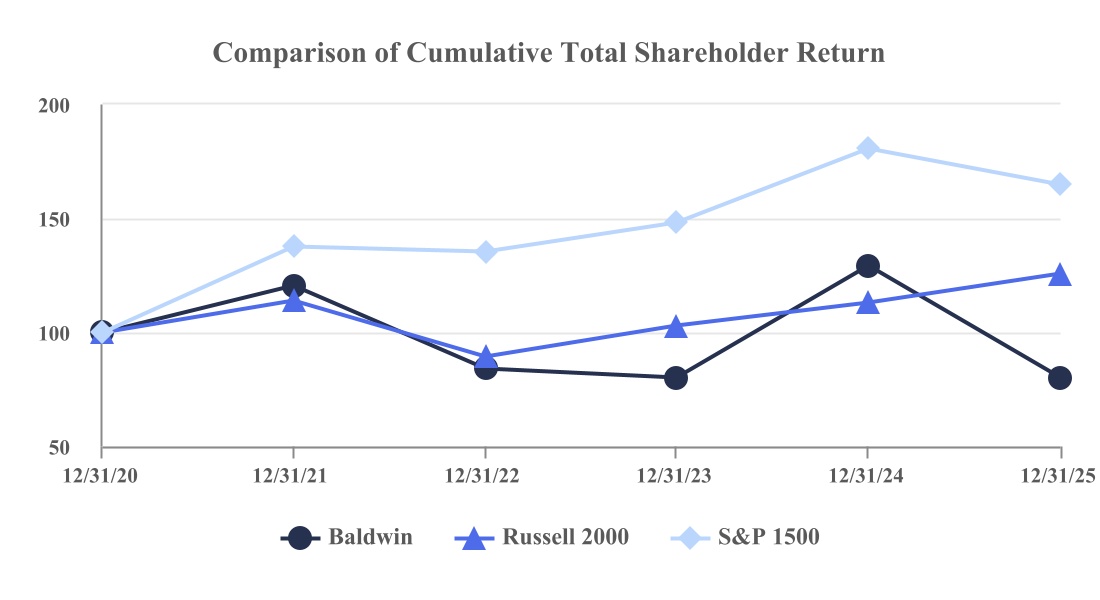
ITEM 6. RESERVED
54
ITEM 7. MANAGEMENT’S DISCUSSION AND ANALYSIS OF FINANCIAL CONDITION AND RESULTS OF OPERATIONS
The following discussion and analysis of our financial condition and results of operations should be read in conjunction with our consolidated financial statements and the related notes and other financial information included elsewhere in this Annual Report on Form 10-K. In addition to historical consolidated financial information, the following discussion contains forward-looking statements that reflect our plans, estimates, and beliefs. Our actual results may differ materially from those discussed in the forward-looking statements as a result of various factors, including those set forth in Item 1A. Risk Factors and included elsewhere in this Annual Report on Form 10-K.
See also “Note Regarding Forward-Looking Statements.”
EXECUTIVE SUMMARY OF 2025 FINANCIAL RESULTS
We are an independent insurance distribution firm providing indispensable expertise and insights that strive to give our clients the confidence to pursue their purpose, passion and dreams. The following is a summary of our 2025 financial results.
Revenues for the year ended December 31, 2025 were $1.5 billion, an increase of $115.8 million, or 8%, year over year. Core commissions and fees grew organically by $98.5 million as a result of new and renewal business from clients across industry sectors and continued outperformance from MSI. Commissions and fees contributed by partnership activity were $23.6 million. In addition, profit-sharing and other revenue grew organically by $1.5 million. This growth was offset in part by a decrease in commissions and fees of $5.8 million related to the divestiture of our Wholesale Business in the first quarter of 2024.
Operating expenses for the year ended December 31, 2025 were $1.4 billion, an increase of $102.6 million, or 8%, year over year. The increase in operating expenses was driven by higher other operating expenses, including increased technology outlay as we continue to invest in automation and efficiency and higher incurred losses and loss adjustment expense related to our newly established Captive business, as well as higher colleague compensation and benefits and outside commissions, largely reflecting the correlation between compensation and revenue growth, and increased amortization expense associated with our partnership activity.
Interest expense, net, for the year ended December 31, 2025 was $121.4 million, a decrease of $2.2 million, or 2%, year over year, as a result of lower average interest rates due to the 2025 Refinancings and federal rate reductions, offset in part by higher average borrowings. We expect interest expense to grow in the near term on a year-over-year basis due to higher borrowings under the JPM Credit Facility to fund partnership opportunities and the settlement of deferred payment obligations, offset slightly by lower expected average interest rates.
During the year ended December 31, 2025, we reported a loss on extinguishment and modification of debt of $6.2 million related to the 2025 Refinancings.
Net loss for the year ended December 31, 2025 was $54.2 million, or a $0.50 loss per fully diluted share, compared to a net loss of $41.1 million, or a $0.39 loss per fully diluted share, in the same period of 2024.
Adjusted EBITDA for the year ended December 31, 2025 was $341.5 million, an increase of $29.0 million year over year. Adjusted EBITDA margin was 22.7% for 2025, a 20 basis point expansion compared to 22.5% in 2024.
Adjusted net income for the year ended December 31, 2025 was $198.9 million, an increase of $22.0 million year over year. Adjusted diluted EPS was $1.67 for 2025, an increase of 11% over $1.50 for 2024.
Organic revenue for the year ended December 31, 2025 was $1.47 billion compared to $1.38 billion for the same period of 2024. Organic revenue growth was $100.0 million, or 7%, for 2025 compared to $196.9 million, or 17%, for 2024.
Refer to the Non-GAAP Financial Measures section below for reconciliations of adjusted EBITDA, adjusted EBITDA margin, adjusted net income, adjusted diluted EPS, organic revenue and organic revenue growth to the most directly comparable GAAP financial measures.
55
RECENT DEVELOPMENTS
Effective January 1, 2026, the Company acquired the outstanding equity interests of the business of CAC Group for aggregate consideration paid by the Company at closing consisting of $438.0 million of cash (subject to customary purchase price adjustments) and 23,200,000 shares of the Company's Class A common stock. The purchase consideration also includes a deferred payment of $70.0 million in cash, payable upon the fourth anniversary of the closing date of the CAC Group Transaction. CAC Group may be entitled to receive up to $250.0 million of additional contingent consideration payable in cash based upon the achievement of certain post-closing revenue focused performance measures. The partnership with CAC Group will significantly expand the specialty capabilities of the Company's IAS operating group and strengthen its specialty product lines and data and analytics platform.
RESULTS OF OPERATIONS FOR THE YEARS ENDED DECEMBER 31, 2025 AND 2024
For a discussion of our 2023 financial results and a comparison of financial results for the years ended December 31, 2024 to 2023, refer to Part II, Item 7. Management’s Discussion and Analysis of Financial Condition and Results of Operations of our Annual Report on Form 10-K filed with the SEC on February 25, 2025.
The following discussion and analysis of our financial condition and results of operations should be read in conjunction with our financial statements as of December 31, 2025 and 2024 and for the years ended December 31, 2025, 2024 and 2023 and the related notes and other financial information included in Item 8. Financial Statements and Supplementary Data of this Annual Report on Form 10-K.
In addition to historical financial information, the following discussion and analysis contains forward-looking statements that involve risks, uncertainties and assumptions. Our actual results and timing of selected events may differ materially from those anticipated in these forward-looking statements as a result of many factors, including those discussed under Item 1A. Risk Factors.
56
The following is a discussion of our consolidated results of operations for the years ended December 31, 2025 and 2024.
| For the Years Ended December 31, | Variance | |||||||||||||||||||||||||
| (in thousands, except percentages) | 2025 | 2024 | Amount | % | ||||||||||||||||||||||
Revenues: | ||||||||||||||||||||||||||
| Core commissions and fees | $ | 1,383,055 | $ | 1,268,790 | $ | 114,265 | 9 | % | ||||||||||||||||||
| Profit-sharing and other income | 110,625 | 108,326 | 2,299 | 2 | % | |||||||||||||||||||||
Commissions and fees | 1,493,680 | 1,377,116 | 116,564 | 8 | % | |||||||||||||||||||||
| Investment income | 11,204 | 11,921 | (717) | (6) | % | |||||||||||||||||||||
| Total revenues | 1,504,884 | 1,389,037 | 115,847 | 8 | % | |||||||||||||||||||||
Operating expenses: | ||||||||||||||||||||||||||
| Colleague compensation and benefits | 777,531 | 762,219 | 15,312 | 2 | % | |||||||||||||||||||||
| Outside commissions | 279,711 | 269,829 | 9,882 | 4 | % | |||||||||||||||||||||
| Other operating expenses | 240,282 | 192,366 | 47,916 | 25 | % | |||||||||||||||||||||
Amortization expense | 121,316 | 102,730 | 18,586 | 18 | % | |||||||||||||||||||||
Change in fair value of contingent consideration | 5,594 | (4,949) | 10,543 | n/m | ||||||||||||||||||||||
Depreciation expense | 6,514 | 6,194 | 320 | 5 | % | |||||||||||||||||||||
Total operating expenses | 1,430,948 | 1,328,389 | 102,559 | 8 | % | |||||||||||||||||||||
| Operating income | 73,936 | 60,648 | 13,288 | 22 | % | |||||||||||||||||||||
| Other income (expense): | ||||||||||||||||||||||||||
Interest expense, net | (121,428) | (123,644) | 2,216 | (2) | % | |||||||||||||||||||||
| Gain on divestitures | 290 | 38,953 | (38,663) | (99) | % | |||||||||||||||||||||
| Loss on extinguishment and modification of debt | (6,226) | (15,113) | 8,887 | (59) | % | |||||||||||||||||||||
| Other income (expense), net | 635 | (194) | 829 | n/m | ||||||||||||||||||||||
Total other expense | (126,729) | (99,998) | (26,731) | 27 | % | |||||||||||||||||||||
| Loss before income taxes and share of net earnings of equity method investee | $ | (52,793) | $ | (39,350) | $ | (13,443) | 34 | % | ||||||||||||||||||
__________
n/m not meaningful
Seasonality
The insurance brokerage market is seasonal and our results of operations are somewhat affected by seasonal trends. Our adjusted EBITDA and adjusted EBITDA margins are typically highest in the first quarter and lowest in the fourth quarter. This variation is primarily due to fluctuations in our revenues, while overhead remains consistent throughout the year. Our revenues are generally highest in the first quarter due to a higher degree of first quarter policy commencements and renewals in certain IAS and MIS lines of business such as employee benefits, commercial and Medicare. In addition, a higher proportion of our first quarter revenue is derived from our highest margin businesses.
Partnerships can significantly impact adjusted EBITDA and adjusted EBITDA margins in a given year and may increase the amount of seasonality within the business, especially results attributable to partnerships that have not been fully integrated into our business or owned by us for a full year.
57
Commissions and Fees
We earn commissions and fees by facilitating the arrangement between insurance company and reinsurance company partners and clients for the insurance and/or reinsurance company to provide insurance and/or reinsurance to the insured party. Our commissions are usually a percentage of the premium paid by the insured and generally depend on the type of insurance, the particular insurance or reinsurance company partner and the nature of the services provided. Under certain arrangements with clients, we earn pre-negotiated service fees for insurance placement services. Additionally, we earn policy fees for acting in the capacity of an MGA and fulfilling certain administrative functions on behalf of insurance or reinsurance company partners, including delivery of policy documents, processing payments and other administrative functions, and the Captive business earns revenue from assumed premium. We may also receive profit-sharing commissions, which represent forms of variable consideration paid by insurance company partners and reinsurance company partners associated with the placement of coverage. Profit-sharing commissions are generally based on underwriting results, but may also contain considerations for volume, growth or retention. Other revenue streams include other ancillary income, premium financing income, and marketing income based on negotiated cost reimbursement for fulfilling specific targeted Medicare marketing campaigns.
Commissions and fees increased $116.6 million, or 8%, year over year to $1.5 billion, driven by organic growth in core commissions and fees of $98.5 million related to new and renewal business across client industry sectors and continued outperformance from MSI, partnership activity of $23.6 million, and organic growth in profit-sharing and other revenue of $1.5 million. This growth was offset in part by a decrease in commissions and fees of $5.8 million related to the divestiture of our Wholesale Business in the first quarter of 2024.
Colleague Compensation and Benefits
Colleague compensation and benefits is our largest expense. It consists of (i) base compensation comprising salary, bonuses and benefits paid and payable to colleagues, and commissions paid to colleagues, and (ii) equity-based compensation associated with the grants of restricted and unrestricted stock awards to senior management, colleagues, risk advisors and directors. We expect to continue to experience a general rise in colleague compensation and benefits expense commensurate with expected revenue growth as our compensation arrangements with our colleagues and risk advisors contain significant bonus or commission components driven by the results of our operations. In addition, we operate in competitive markets for human capital and need to maintain competitive compensation levels as we expand geographically and create new products and services.
Colleague compensation and benefits expense increased $15.3 million, or 2%, year over year. Partnership activity contributed $8.2 million to the increase in colleague compensation and benefits in 2025, offset in part by a $1.4 million decrease related to our Wholesale Business, which was sold in the first quarter of 2024. After excluding colleague compensation and benefits expense related to our partnerships and divestitures, colleague compensation and benefits expense increased $8.5 million due to increases in colleague compensation of $33.8 million, inside advisor commissions of $8.9 million and benefits and other of $8.4 million as a result of the continued investment in our growth and elevated health plan costs, offset in part by a decrease in colleague earnout incentives of $43.7 million resulting from settlement activity in 2025.
Outside Commissions
Outside commissions increased $9.9 million, or 4%, year over year. After excluding outside commissions of $3.0 million earned by the Wholesale Business during 2024 for which there was no comparable expense in 2025, outside commissions increased $12.9 million, or 5%. Outside commissions increased at a lower rate than core commissions and fees primarily due to continued scaling of our UCTS business, product mix shift and contributions from the Capacity Solutions group (which generally does not have significant outside commissions).
Other Operating Expenses
Other operating expenses include travel, accounting, legal and other professional fees, placement fees, rent, office expenses and other costs associated with our operations. Our occupancy-related costs and professional services expenses, in particular, generally increase or decrease in relative proportion to the number of our colleagues and the overall size and scale of our business operations.
Other operating expenses increased $47.9 million year over year, driven by higher incurred losses and loss adjustment expense (“LAE”) of $19.1 million related to our newly established Captive business, professional fees of $14.0 million due to partnership activity and fees related to organizing the Reciprocal, technology and software-related costs of $4.4 million, advertising and marketing of $3.6 million in connection with the continued rollout of our rebranding, legal settlement expense of $2.1 million, and licenses and taxes of $2.1 million due to growth in the business.
58
Amortization Expense
Amortization expense increased $18.6 million year over year, driven by our 2025 partnership activity and an increase in capitalized software, offset in part by the acceleration of trade names amortization during 2024 in connection with rebranding within IAS.
Change in Fair Value of Contingent Consideration
Change in fair value of contingent consideration was a $5.6 million loss for the year ended December 31, 2025 compared to a $4.9 million gain for the same period of 2024. The fair value loss related to contingent consideration for the year ended December 31, 2025 was impacted by positive changes in revenue growth trends of certain partners and accretion of the contingent earnout obligations approaching their respective measurement dates, in addition to a loss recognized in reclassifying $1.8 million of earnouts from colleague earnout incentives.
Interest Expense, Net
Interest expense, net, decreased $2.2 million year over year as a result of lower average interest rates due to the 2025 Refinancings and federal rate reductions, offset in part by higher average borrowings. We expect interest expense to grow in the near term on a year-over-year basis due to higher borrowings under the JPM Credit Facility to fund partnership opportunities and the settlement of deferred payment obligations, offset slightly by lower expected interest rates.
Refer to Item 7A. Quantitative and Qualitative Disclosures About Market Risk for further discussion of the impact of interest rates on our results of operations, financial condition and cash flows.
Gain on Divestitures
Gain on divestitures decreased $38.7 million year over year, driven by a $35.1 million gain recorded during 2024 in connection with the sale of our Wholesale Business.
Loss on Extinguishment and Modification of Debt
Loss on extinguishment and modification of debt of $6.2 million for the year ended December 31, 2025 relates to the 2025 Refinancings. Loss on extinguishment and modification of debt of $15.1 million for the same period of 2024 relates to the JPM Credit Facility refinancing completed in May 2024.
FINANCIAL CONDITION—COMPARISON OF CONSOLIDATED FINANCIAL CONDITION AT DECEMBER 31, 2025 TO DECEMBER 31, 2024.
Our total assets and total liabilities increased $327.5 million and $251.9 million, respectively, year over year. The most significant changes in assets and liabilities are described below.
Assumed premiums, commissions and fees receivable, net increased $58.6 million as a result of overall revenue growth and the timing of cash collections.
Right-of-use assets and operating lease liabilities decreased $10.4 million and $10.1 million, respectively, due to ongoing measures to consolidate our facilities footprint in certain geographies.
Other assets increased $34.4 million driven by investments in third party businesses that support the growth of our business, higher deferred commission expense related to new business growth and capitalization of implementation costs related to new technology platforms.
Intangible assets, net increased $24.9 million driven by the intangible assets capitalized in conjunction with 2025 partnerships of $118.4 million, and capitalized software development costs related to infrastructure to support our business of $35.5 million, offset in part by amortization expense of $121.3 million.
59
Goodwill increased $104.8 million as a result of our 2025 partnerships.
Commissions payable decreased $22.2 million driven primarily by the timing of commission payments relative to the timing of collections from clients.
Accrued expenses and other current liabilities increased $86.7 million as a result of increases in accrued expenses relating, in part, to the timing of expenses incurred in connection with January 2026 partnerships, deferred payments relating to 2025 partnerships, and accrued compensation and benefits relating to our overall growth and increased health insurance costs.
Colleague earnout incentives decreased $32.8 million as a result of settlement activity in 2025.
The revolving line of credit increased $107.0 million driven by draws to support growth in our business, including the 2025 partnerships.
Long-term debt increased $172.2 million due to the 2025 Refinancings during which we upsized the Term Loans by $175.0 million in the aggregate to support growth in our business, including our 2025 partnerships.
Contingent earnout liabilities decreased $122.3 million resulting from settlements of $146.3 million, offset in part by issuances related to our 2025 partnerships of $18.4 million and an increase in fair value of contingent consideration of $5.6 million.
Fiduciary assets and liabilities increased $78.5 million and $79.0 million, respectively, attributable to overall growth in our business and higher volumes of agency bill premium activity, as well as the timing of cash collections and carrier payable settlements.
NON-GAAP FINANCIAL MEASURES
Adjusted EBITDA, adjusted EBITDA margin, organic revenue, organic revenue growth, adjusted net income and adjusted diluted earnings per share (“EPS”), are not measures of financial performance under GAAP and should not be considered substitutes for GAAP measures, including commissions and fees (for organic revenue and organic revenue growth), net income (loss) (for adjusted EBITDA and adjusted EBITDA margin), net income (loss) attributable to Baldwin (for adjusted net income) or diluted earnings (loss) per share (for adjusted diluted EPS), which we consider to be the most directly comparable GAAP measures. These non-GAAP financial measures have limitations as analytical tools, and when assessing our operating performance, you should not consider these non-GAAP financial measures in isolation or as substitutes for commissions and fees, net income (loss), net income (loss) attributable to Baldwin, diluted earnings (loss) per share or other consolidated income statement data prepared in accordance with GAAP. Other companies in our industry may define or calculate these non-GAAP financial measures differently than we do, and accordingly, these measures may not be comparable to similarly titled measures used by other companies.
We calculate organic revenue based on commissions and fees for the relevant period by excluding (i) the first 12 months of commissions and fees generated from new partners and (ii) commissions and fees from divestitures. Organic revenue growth is the change in organic revenue period-to-period, with prior period results adjusted to (i) include commissions and fees that were excluded from organic revenue in the prior period because the relevant partners had not yet reached the 12-month owned mark, but which have reached the 12-month owned mark in the current period, and (ii) exclude commissions and fees related to divestitures from organic revenue. For example, commissions and fees from a partner acquired on June 1, 2024 are excluded from organic revenue for 2024. However, after June 1, 2025, results from June 1, 2024 to December 31, 2024 for such partners are compared to results from June 1, 2025 to December 31, 2025 for purposes of calculating organic revenue growth in 2025. Organic revenue growth is a key metric used by management and our board of directors to assess our financial performance. We believe that organic revenue and organic revenue growth are appropriate measures of operating performance as they allow investors to measure, analyze and compare growth in a meaningful and consistent manner.
We define adjusted EBITDA as net income (loss) before interest, taxes, depreciation, amortization, change in fair value of contingent consideration and certain items of income and expense, including share-based compensation expense, transaction-related partnership and integration expenses, transformation costs, severance, and certain non-recurring items, including those related to raising capital. We believe that adjusted EBITDA is an appropriate measure of operating performance because it eliminates the impact of income and expenses that do not relate to business performance, and that the presentation of this measure enhances an investor’s understanding of our financial performance.
60
Adjusted EBITDA margin is calculated as adjusted EBITDA divided by total revenue. Adjusted EBITDA margin is a key metric used by management and our board of directors to assess our financial performance. We believe that adjusted EBITDA margin is an appropriate measure of operating performance because it eliminates the impact of income and expenses that do not relate to business performance, and that the presentation of this measure enhances an investor’s understanding of our financial performance. We believe that adjusted EBITDA margin is helpful in measuring profitability of operations on a consolidated level.
Adjusted EBITDA and adjusted EBITDA margin have important limitations as analytical tools. For example, adjusted EBITDA and adjusted EBITDA margin:
•do not reflect any cash capital expenditure requirements for the assets being depreciated and amortized that may have to be replaced in the future;
•do not reflect changes in, or cash requirements for, our working capital needs;
•do not reflect the impact of certain cash charges resulting from matters we consider not to be indicative of our ongoing operations;
•do not reflect the interest expense or the cash requirements necessary to service interest or principal payments on our debt;
•do not reflect share-based compensation expense and other non-cash charges; and
•exclude certain tax payments that may represent a reduction in cash available to us.
We define adjusted net income as net income (loss) attributable to Baldwin adjusted for depreciation, amortization, change in fair value of contingent consideration and certain items of income and expense, including share-based compensation expense, transaction-related partnership and integration expenses, transformation costs, severance, and certain non-recurring costs that, in the opinion of management, significantly affect the period-over-period assessment of operating results, and the related tax effect of those adjustments. We believe that adjusted net income is an appropriate measure of operating performance because it eliminates the impact of income and expenses that do not relate to business performance.
Adjusted diluted EPS measures our per share earnings excluding certain expenses as discussed above for adjusted net income and assuming all shares of Class B common stock were exchanged for Class A common stock on a one-for-one basis. Adjusted diluted EPS is calculated as adjusted net income divided by adjusted diluted weighted-average shares outstanding. We believe adjusted diluted EPS is useful to investors because it enables them to better evaluate per share operating performance across reporting periods.
Organic Revenue and Organic Revenue Growth
The following table reconciles organic revenue and organic revenue growth to commissions and fees, which we consider to be the most directly comparable GAAP financial measure:
| For the Years Ended December 31, | ||||||||||||||
| (in thousands, except percentages) | 2025 | 2024 | ||||||||||||
| Commissions and fees | $ | 1,493,680 | $ | 1,377,116 | ||||||||||
Partnership commissions and fees(1) | (23,588) | — | ||||||||||||
| Organic revenue | $ | 1,470,092 | $ | 1,377,116 | ||||||||||
Organic revenue growth(2) | $ | 100,049 | $ | 196,922 | ||||||||||
Organic revenue growth %(2) | 7 | % | 17 | % | ||||||||||
__________
(1) Includes the first 12 months of such commissions and fees generated from newly acquired partners.
(2) Organic revenue for the year ended December 31, 2024 used to calculate organic revenue growth for the year ended December 31, 2025 was $1.37 billion, which is adjusted to exclude commissions and fees from divestitures that occurred during 2025 and 2024.
61
Adjusted EBITDA and Adjusted EBITDA Margin
The following table reconciles adjusted EBITDA and adjusted EBITDA margin to net loss, which we consider to be the most directly comparable GAAP financial measure:
| For the Years Ended December 31, | ||||||||||||||
| (in thousands, except percentages) | 2025 | 2024 | ||||||||||||
| Revenues | $ | 1,504,884 | $ | 1,389,037 | ||||||||||
| Net loss | $ | (54,154) | $ | (41,081) | ||||||||||
| Adjustments to net loss: | ||||||||||||||
| Interest expense, net | 122,778 | 123,644 | ||||||||||||
| Amortization expense | 121,316 | 102,730 | ||||||||||||
| Share-based compensation | 71,113 | 65,503 | ||||||||||||
| Transaction-related partnership and integration expenses | 23,051 | 10,501 | ||||||||||||
Transformation costs(1) | 7,003 | — | ||||||||||||
| Severance | 6,790 | 5,756 | ||||||||||||
| Depreciation expense | 6,514 | 6,194 | ||||||||||||
| Loss on extinguishment and modification of debt | 6,226 | 15,113 | ||||||||||||
| Change in fair value of contingent consideration | 5,594 | (4,949) | ||||||||||||
Income and other taxes(2) | 4,255 | 7,184 | ||||||||||||
| Colleague earnout incentives | (1,779) | 41,917 | ||||||||||||
| Impairment of right-of-use assets | 1,275 | — | ||||||||||||
| Gain on divestitures | (290) | (38,953) | ||||||||||||
| Loss on interest rate caps | 18 | 244 | ||||||||||||
Other(3) | 21,762 | 18,682 | ||||||||||||
| Adjusted EBITDA | $ | 341,472 | $ | 312,485 | ||||||||||
| Net loss margin | (4) | % | (3) | % | ||||||||||
| Adjusted EBITDA margin | 22.7 | % | 22.5 | % | ||||||||||
__________
(1) Transformation costs represent certain non-recurring colleague compensation and technology-related expenses related to our $3B/30 Catalyst Program, which is designed to accelerate the infusion of automation, business process optimization and artificial intelligence to transform and elevate our workforce and unlock new avenues for growth.
(2) Income and other taxes include the Tax Receivable Agreement expense and other operating tax expense, such as state taxes, under GAAP.
(3) Other addbacks to adjusted EBITDA include certain income and expenses that are considered to be non-recurring or non-operational, including certain recruiting costs, professional fees, litigation costs and bonuses.
62
Adjusted Net Income and Adjusted Diluted EPS
The following table reconciles adjusted net income to net loss attributable to Baldwin and reconciles adjusted diluted EPS to diluted loss per share, which we consider to be the most directly comparable GAAP financial measures:
| For the Years Ended December 31, | ||||||||||||||
| (in thousands, except per share data) | 2025 | 2024 | ||||||||||||
Net loss attributable to Baldwin | $ | (33,813) | $ | (24,518) | ||||||||||
Net loss attributable to noncontrolling interests | (20,341) | (16,563) | ||||||||||||
| Amortization expense | 121,316 | 102,730 | ||||||||||||
| Share-based compensation | 71,113 | 65,503 | ||||||||||||
| Transaction-related partnership and integration expenses | 23,051 | 10,501 | ||||||||||||
Transformation costs(1) | 7,003 | — | ||||||||||||
| Severance | 6,790 | 5,756 | ||||||||||||
| Depreciation | 6,514 | 6,194 | ||||||||||||
| Loss on extinguishment and modification of debt | 6,226 | 15,113 | ||||||||||||
| Change in fair value of contingent consideration | 5,594 | (4,949) | ||||||||||||
| Other amortization/accretion, net | 4,190 | 5,841 | ||||||||||||
Income tax expense(2) | 2,172 | 6,537 | ||||||||||||
| Colleague earnout incentives | (1,779) | 41,917 | ||||||||||||
| Impairment of right-of-use assets | 1,275 | — | ||||||||||||
| Gain on divestitures | (290) | (38,953) | ||||||||||||
| Loss on interest rate caps, net of cash settlements | 18 | 2,544 | ||||||||||||
Other(3) | 21,762 | 18,682 | ||||||||||||
| Adjusted pre-tax income | 220,801 | 196,335 | ||||||||||||
Adjusted income taxes(4) | 21,859 | 19,437 | ||||||||||||
| Adjusted net income | $ | 198,942 | $ | 176,898 | ||||||||||
| Weighted-average shares of Class A common stock outstanding - diluted | 67,939 | 63,455 | ||||||||||||
| Dilutive weighted-average shares of Class A common stock | 3,229 | 3,598 | ||||||||||||
Exchange of Class B common stock(5) | 47,737 | 50,896 | ||||||||||||
| Adjusted diluted weighted-average shares outstanding | 118,905 | 117,949 | ||||||||||||
Diluted loss per share | $ | (0.50) | $ | (0.39) | ||||||||||
| Effect of exchange of Class B common stock and net loss attributable to noncontrolling interests per share | 0.04 | 0.04 | ||||||||||||
Other adjustments to loss per share | 2.31 | 2.01 | ||||||||||||
| Adjusted income taxes per share | (0.18) | (0.16) | ||||||||||||
| Adjusted diluted EPS | $ | 1.67 | $ | 1.50 | ||||||||||
___________
(1) Transformation costs represent certain non-recurring colleague compensation and technology-related expenses related to our $3B/30 Catalyst Program, which is designed to accelerate the infusion of automation, business process optimization and artificial intelligence to transform and elevate our workforce and unlock new avenues for growth.
(2) Income tax expense includes the Tax Receivable Agreement expense.
(3) Other addbacks to adjusted net income include certain income and expenses that are considered to be non-recurring or non-operational, including certain recruiting costs, professional fees, litigation costs and bonuses.
(4) Represents corporate income taxes at assumed effective tax rate of 9.9% applied to adjusted pre-tax income.
(5) Assumes the full exchange of Class B common stock for Class A common stock pursuant to the Amended LLC Agreement.
63
INSURANCE ADVISORY SOLUTIONS OPERATING GROUP RESULTS
IAS provides expertly-designed commercial risk management, employee benefits and private risk management solutions for businesses and high-net-worth individuals, as well as their families, through our national footprint, which has assimilated some of the highest quality independent insurance brokers in the country with vast and varied strategic capabilities and expertise.
| For the Years Ended December 31, | Variance | |||||||||||||||||||||||||
| (in thousands, except percentages) | 2025 | 2024 | Amount | % | ||||||||||||||||||||||
Revenues: | ||||||||||||||||||||||||||
| Core commissions and fees | $ | 661,590 | $ | 641,286 | $ | 20,304 | 3 | % | ||||||||||||||||||
| Profit-sharing and other income | 61,384 | 64,871 | (3,487) | (5) | % | |||||||||||||||||||||
Commissions and fees | 722,974 | 706,157 | 16,817 | 2 | % | |||||||||||||||||||||
| Investment income | 4,350 | 5,779 | (1,429) | (25) | % | |||||||||||||||||||||
| Total revenues | 727,324 | 711,936 | 15,388 | 2 | % | |||||||||||||||||||||
Operating expenses: | ||||||||||||||||||||||||||
| Colleague compensation and benefits | 510,028 | 523,370 | (13,342) | (3) | % | |||||||||||||||||||||
| Outside commissions | 11,431 | 11,009 | 422 | 4 | % | |||||||||||||||||||||
| Other operating expenses | 86,064 | 79,323 | 6,741 | 8 | % | |||||||||||||||||||||
Amortization expense | 56,702 | 60,222 | (3,520) | (6) | % | |||||||||||||||||||||
Change in fair value of contingent consideration | 5,544 | (10,458) | 16,002 | (153) | % | |||||||||||||||||||||
Depreciation expense | 1,255 | 1,485 | (230) | (15) | % | |||||||||||||||||||||
Total operating expenses | 671,024 | 664,951 | 6,073 | 1 | % | |||||||||||||||||||||
| Operating income | 56,300 | 46,985 | 9,315 | 20 | % | |||||||||||||||||||||
| Total other income, net | 1,656 | 5,172 | (3,516) | (68) | % | |||||||||||||||||||||
| Income before income taxes and share of net earnings of equity method investee | $ | 57,956 | $ | 52,157 | $ | 5,799 | 11 | % | ||||||||||||||||||
Commissions and Fees
IAS generates (i) commissions for placing insurance policies on behalf of its insurance company partners; (ii) profit-sharing income based on either the underlying book of business or performance, such as loss ratios; and (iii) fees from consulting and service fee arrangements, which are in place with certain clients for a negotiated fee.
IAS commissions and fees increased $16.8 million, or 2%, year over year to $723.0 million, primarily due to organic growth in core commissions and fees. Growth in our core commissions and fees of $20.3 million was driven by 19% sales velocity (new business as a percentage of prior year commissions and fees) compared to 21% in the prior year. Organic growth was pressured by 380 bps of headwind in underlying rate and exposure during the year, attributable to softening insurance rates, particularly in the property line of business, construction project work weakness and overall lower economic activity. This growth was offset by a decrease in profit-sharing and other income of $3.5 million resulting from rate softness and competition amongst insurance carriers. We expect rate softness to continue into 2026, with a focus on commercial property lines.
Colleague Compensation and Benefits
Colleague compensation and benefits expense for IAS decreased $13.3 million, or 3%, year over year primarily due to a decrease in colleague earnout incentives of $41.0 million resulting from settlement activity in 2025, partially offset by increases in colleague compensation of $14.6 million and inside advisor commissions of $7.6 million related to our growth, and benefits and other of $5.2 million related to elevated health plan costs.
64
Other Operating Expenses
Other operating expenses for IAS increased $6.7 million year over year, primarily due to continued investment in our growth and higher costs relating to professional fees of $5.2 million, legal settlement expense of $3.2 million and advertising and marketing of $1.8 million in connection with the continued rollout of our rebranding, partially offset by lower technology and software-related costs of $1.6 million and travel and entertainment of $1.4 million.
Amortization Expense
Amortization expense for IAS decreased $3.5 million year over year as a result of the acceleration of trade names amortization during 2024 in connection with rebranding within IAS.
Change in Fair Value of Contingent Consideration
Change in fair value of contingent consideration for IAS was a $5.5 million loss for the year ended December 31, 2025 compared to a $10.5 million gain for the same period of 2024. The fair value loss related to contingent consideration for the year ended December 31, 2025 was impacted by positive changes in revenue growth trends of certain IAS partners and accretion of the contingent earnout obligations approaching their respective measurement dates, in addition to a loss recognized in reclassifying $1.6 million of earnouts from colleague earnout incentives.
Total Other Income, Net
Total other income, net for IAS decreased $3.5 million year over year, driven by a $3.8 million gain on divestitures in 2024 related to the sale of certain books of business.
65
UNDERWRITING, CAPACITY & TECHNOLOGY SOLUTIONS OPERATING GROUP RESULTS
UCTS consists of three distinct divisions—MSI, our Capacity Solutions group (which includes our reinsurance brokerage business, Juniper Re; our reinsurance MGA business, MultiStrat; and our captive management business), and the Captive business. Through MSI, we manufacture proprietary, technology-enabled insurance products with a focus on sheltered channels where our products deliver speed, ease of use and certainty of execution, an example of which is our national embedded renters insurance product sold at point of lease via integrations with property management software providers. Our MGA product suite is now comprised of more than 20 products across personal, commercial and professional lines. UCTS’ Wholesale Business was sold in the first quarter of 2024, and its operations are included in our results through February 29, 2024.
| For the Years Ended December 31, | Variance | |||||||||||||||||||||||||
| (in thousands, except percentages) | 2025 | 2024 | Amount | % | ||||||||||||||||||||||
Revenues: | ||||||||||||||||||||||||||
| Core commissions and fees | $ | 527,245 | $ | 455,845 | $ | 71,400 | 16 | % | ||||||||||||||||||
| Profit-sharing and other income | 17,345 | 13,032 | 4,313 | 33 | % | |||||||||||||||||||||
Commissions and fees | 544,590 | 468,877 | 75,713 | 16 | % | |||||||||||||||||||||
| Investment income | 4,862 | 4,062 | 800 | 20 | % | |||||||||||||||||||||
| Total revenues | 549,452 | 472,939 | 76,513 | 16 | % | |||||||||||||||||||||
Operating expenses: | ||||||||||||||||||||||||||
| Colleague compensation and benefits | 116,504 | 101,513 | 14,991 | 15 | % | |||||||||||||||||||||
| Outside commissions | 264,910 | 260,204 | 4,706 | 2 | % | |||||||||||||||||||||
| Other operating expenses | 75,452 | 41,313 | 34,139 | 83 | % | |||||||||||||||||||||
Amortization expense | 21,114 | 14,950 | 6,164 | 41 | % | |||||||||||||||||||||
Change in fair value of contingent consideration | (1,405) | 5,085 | (6,490) | (128) | % | |||||||||||||||||||||
Depreciation expense | 656 | 568 | 88 | 15 | % | |||||||||||||||||||||
Total operating expenses | 477,231 | 423,633 | 53,598 | 13 | % | |||||||||||||||||||||
| Operating income | 72,221 | 49,306 | 22,915 | 46 | % | |||||||||||||||||||||
| Total other income (expense), net | (426) | 34,107 | (34,533) | (101) | % | |||||||||||||||||||||
| Income before income taxes and share of net earnings of equity method investee | $ | 71,795 | $ | 83,413 | $ | (11,618) | (14) | % | ||||||||||||||||||
Commissions and Fees
UCTS generates (i) commissions for underwriting and placing insurance policies and/or treaties on behalf of its insurance company partners and reinsurance company partners; (ii) policy fee and installment fee revenue for acting in the capacity of an MGA and fulfilling certain administrative functions on behalf of insurance or reinsurance company partners, including delivery of policy documents, processing payments and other administrative functions; (iii) profit-sharing income, generally based on the profitability of the underlying book of business of the policies it generates on behalf of its insurance company partners and reinsurance company partners; (iv) fees from service fee arrangements, which are in place with certain clients for a negotiated fee; and (v) assumed premium earned in the Captive business.
UCTS commissions and fees increased $75.7 million, or 16%, year over year to $544.6 million, primarily due to organic growth in core commissions and fees. Total growth in our core commissions and fees of $71.4 million was driven by continued outperformance in MSI (accounting for $41.2 million of the increase in core commissions and fees), the introduction of the Captive (accounting for $22.6 million of the increase in core commissions and fees), and building momentum in our Capacity Solutions group (accounting for $13.9 million of the increase in core commissions and fees). Total growth in our core commissions and fees includes the partnership contribution of $6.8 million, as well as the impact of the divestiture of our Wholesale Business in the first quarter of 2024 of $(5.5) million. In addition, profit sharing and other increased $4.3 million in 2025. Core commissions and fees growth, excluding amounts related to the Wholesale Business during 2024, was 17%.
66
Colleague Compensation and Benefits
Colleague compensation and benefits expense for UCTS increased $15.0 million, or 15%, year over year. Partnership activity contributed $6.4 million to the increase in colleague compensation and benefits in 2025, offset in part by a $1.4 million decrease related to the divestiture of our Wholesale Business during 2024. After excluding colleague compensation and benefits expense related to partnership and divestiture activity, colleague compensation and benefits increased $10.0 million, or 10%, as a result of the continued investment in UCTS' growth and elevated health plan costs.
Outside Commissions
Outside commissions for UCTS consist of outside commissions paid to partners that distribute our MGA products. Outside commissions for UCTS increased $4.7 million, or 2%, year over year. After excluding outside commissions of $3.0 million attributable to the Wholesale Business during 2024 for which there was no comparable expense in 2025, outside commissions for UCTS increased $7.7 million, or 3%. Outside commissions for 2025 increased at a lower rate than core commissions and fees due to continued scaling of the business, product mix shift and increased contributions from the Capacity Solutions group (which generally does not have significant outside commissions).
Other Operating Expenses
Other operating expenses for UCTS increased $34.1 million year over year, driven by higher incurred losses and LAE of $19.1 million related to our newly established Captive business, professional fees of $4.4 million due to partnership activity and fees related to the setup of the Reciprocal, advertising and marketing of $1.8 million due to growth in the business, licenses and taxes of $1.7 million and technology and software-related costs of $1.5 million.
Amortization Expense
Amortization expense for UCTS increased $6.2 million year over year, driven by an increase in capitalized software and our 2025 partnership activity.
Change in Fair Value of Contingent Consideration
The change in fair value of contingent consideration for UCTS was a $1.4 million gain for the year ended December 31, 2025 compared to a $5.1 million loss for the same period of 2024. The fair value gain related to contingent consideration for the year ended December 31, 2025 was impacted by negative changes in revenue growth trends of certain UCTS partners.
Total Other Income (Expense), Net
Total other income (expense), net for UCTS decreased $34.5 million year over year, driven by a $35.1 million gain recorded during 2024 in connection with the sale of our Wholesale Business.
67
MAINSTREET INSURANCE SOLUTIONS OPERATING GROUP RESULTS
MIS offers personal insurance, commercial insurance, and life and health solutions to individuals and businesses in their communities, with a focus on accessing clients via sheltered distribution channels, which include, but are not limited to, new home builders, realtors, mortgage originators/lenders, master planned communities, and various other community centers of influence. MIS also offers consultation for government assistance programs and solutions, including traditional Medicare, Medicare Advantage and Affordable Care Act, to seniors and eligible individuals through a network of primarily independent contractor agents.
| For the Years Ended December 31, | Variance | |||||||||||||||||||||||||
| (in thousands, except percentages) | 2025 | 2024 | Amount | % | ||||||||||||||||||||||
Revenues: | ||||||||||||||||||||||||||
| Core commissions and fees | $ | 265,283 | $ | 250,825 | $ | 14,458 | 6 | % | ||||||||||||||||||
| Profit-sharing and other income | 32,265 | 30,423 | 1,842 | 6 | % | |||||||||||||||||||||
Commissions and fees | 297,548 | 281,248 | 16,300 | 6 | % | |||||||||||||||||||||
| Investment income | 199 | 35 | 164 | n/m | ||||||||||||||||||||||
| Total revenues | 297,747 | 281,283 | 16,464 | 6 | % | |||||||||||||||||||||
Operating expenses: | ||||||||||||||||||||||||||
| Colleague compensation and benefits | 104,707 | 98,374 | 6,333 | 6 | % | |||||||||||||||||||||
| Outside commissions | 74,802 | 77,782 | (2,980) | (4) | % | |||||||||||||||||||||
| Other operating expenses | 39,167 | 35,593 | 3,574 | 10 | % | |||||||||||||||||||||
Amortization expense | 41,078 | 26,452 | 14,626 | 55 | % | |||||||||||||||||||||
Change in fair value of contingent consideration | 1,455 | 424 | 1,031 | n/m | ||||||||||||||||||||||
Depreciation expense | 732 | 715 | 17 | 2 | % | |||||||||||||||||||||
Total operating expenses | 261,941 | 239,340 | 22,601 | 9 | % | |||||||||||||||||||||
| Operating income | 35,806 | 41,943 | (6,137) | (15) | % | |||||||||||||||||||||
| Total other expense, net | (593) | (15) | (578) | n/m | ||||||||||||||||||||||
| Income before income taxes and share of net earnings of equity method investee | $ | 35,213 | $ | 41,928 | $ | (6,715) | (16) | % | ||||||||||||||||||
__________
n/m not meaningful
Commissions and Fees
MIS generates (i) commissions for placing insurance policies on behalf of its insurance company partners; (ii) profit-sharing income based on either the underlying book of business or performance, such as loss ratios; and (iii) commissions and fees in the form of marketing income, which is earned through co-branded marketing campaigns with our insurance company partners.
MIS commissions and fees increased $16.3 million, or 6%, year over year to $297.5 million. MIS core commissions and fees grew $14.5 million in total resulting from the recently acquired Hippo’s Homebuilder Distribution Network (accounting for $15.8 million of the increase in core commissions and fees), our national mortgage and real estate channel (accounting for $2.6 million of the increase in core commissions and fees), our Westwood business (accounting for $1.5 million of the increase in core commissions and fees), and our legacy Mainstreet business (accounting for $0.8 million of the increase in core commissions and fees), partially offset by lower core commissions and fees from our Medicare business of $5.0 million. Overall growth in MIS core commissions and fees was negatively impacted by headwinds in the health business and continued pressure in our legacy Mainstreet business. MIS profit-sharing and other revenue increased $1.8 million driven by overall growth in the MIS business.
Effective May 1, 2025, we are receiving reduced commissions from QBE Insurance Corporation and its affiliates on the portion of our builder-sourced homeowners book of business we are in the process of migrating to the Reciprocal; a temporary headwind that is expected to persist through the first half of 2026 before reversing into a tailwind over time.
68
Colleague Compensation and Benefits
Colleague compensation and benefits expense for MIS increased $6.3 million, or 6%, year over year. After excluding colleague compensation and benefits expense of $1.8 million related to partnership activity, colleague compensation and benefits increased $4.5 million, which is in line with the prior year as a percentage of our core commissions and fees.
Other Operating Expenses
Other operating expenses for MIS increased $3.6 million year over year, driven by higher legal settlement expense and rent expense of $0.7 million each, and technology-related costs and professional fees of $0.6 million each.
Amortization Expense
MIS amortization expense increased $14.6 million year over year, driven by our 2025 partnership activity and an increase in capitalized software.
CORPORATE AND OTHER RESULTS
| For the Years Ended December 31, | Variance | |||||||||||||||||||||||||
| (in thousands, except percentages) | 2025 | 2024 | Amount | % | ||||||||||||||||||||||
Revenues: | ||||||||||||||||||||||||||
Commissions and fees | $ | (71,432) | $ | (79,166) | $ | 7,734 | (10) | % | ||||||||||||||||||
| Investment income | 1,793 | 2,045 | (252) | (12) | % | |||||||||||||||||||||
| Total revenues | (69,639) | (77,121) | 7,482 | (10) | % | |||||||||||||||||||||
Operating expenses: | ||||||||||||||||||||||||||
| Colleague compensation and benefits | 46,292 | 38,962 | 7,330 | 19 | % | |||||||||||||||||||||
| Outside commissions | (71,432) | (79,166) | 7,734 | (10) | % | |||||||||||||||||||||
| Other operating expenses | 39,599 | 36,137 | 3,462 | 10 | % | |||||||||||||||||||||
Amortization expense | 2,422 | 1,106 | 1,316 | 119 | % | |||||||||||||||||||||
Depreciation expense | 3,871 | 3,426 | 445 | 13 | % | |||||||||||||||||||||
Total operating expenses | 20,752 | 465 | 20,287 | n/m | ||||||||||||||||||||||
| Operating loss | (90,391) | (77,586) | (12,805) | 17 | % | |||||||||||||||||||||
| Other income (expense): | ||||||||||||||||||||||||||
Interest expense, net | (120,975) | (123,642) | 2,667 | (2) | % | |||||||||||||||||||||
| Loss on divestitures | (1,611) | — | (1,611) | — | % | |||||||||||||||||||||
| Loss on extinguishment and modification of debt | (6,226) | (15,113) | 8,887 | (59) | % | |||||||||||||||||||||
| Other income (expense), net | 1,446 | (507) | 1,953 | n/m | ||||||||||||||||||||||
| Total other expense, net | (127,366) | (139,262) | 11,896 | (9) | % | |||||||||||||||||||||
| Loss before income taxes and share of net earnings of equity method investee | $ | (217,757) | $ | (216,848) | $ | (909) | — | % | ||||||||||||||||||
__________
n/m not meaningful
Commissions and Fees
Corporate and Other records the elimination of intercompany commission revenue from the operating groups. During 2025, IAS recorded commission revenue shared with other operating groups of $0.4 million and UCTS recorded commission revenue shared with other operating groups of $71.1 million.
69
Colleague Compensation and Benefits
Colleague compensation and benefits expense in Corporate and Other increased $7.3 million year over year, driven by an increase in colleague compensation in IT to support our continued growth and technology investments, as well as elevated health plan costs.
Outside Commissions
Outside commissions for Corporate and Other results from the elimination of intercompany commission expense from the operating groups.
Other Operating Expenses
Other operating expenses in Corporate and Other increased $3.5 million year over year primarily due to higher professional fees of $3.8 million due to partnership activity.
Interest Expense, Net
Interest expense, net, in Corporate and Other decreased $2.7 million year over year as a result of lower average interest rates due to the 2025 Refinancings and federal rate reductions, offset in part by higher average borrowings. We expect interest expense to grow in the near term on a year-over-year basis due to higher borrowings under the JPM Credit Facility to fund partnership opportunities and the settlement of deferred payment obligations, offset slightly by lower expected interest rates.
Loss on Extinguishment and Modification of Debt
Loss on extinguishment and modification of debt in Corporate and Other of $6.2 million for year ended December 31, 2025 relates to the 2025 Refinancings. Loss on extinguishment and modification of debt of $15.1 million for the same period of 2024 relates to the JPM Credit Facility refinancing completed in May 2024.
LIQUIDITY AND CAPITAL RESOURCES
Our primary liquidity needs for the foreseeable future will include cash to (i) provide capital to facilitate the organic growth of our business and to fund future partnerships, (ii) pay operating expenses, including cash compensation to our colleagues and expenses related to being a public company, (iii) make payments under the Tax Receivable Agreement, (iv) pay interest and principal due on borrowings under the JPM Credit Facility and Senior Secured Notes, (v) pay contingent earnout liabilities, (vi) pay income taxes, and (vii) fund potential investments in third party businesses that support the growth of our business, which may include sponsorship of, and a minority, non-controlling interest in, other investment funds, the purpose of which may include facilitating the establishment of additional and alternative capacity that supports the growth of our MSI business.
We have historically financed our operations and funded our debt service through the sale of our insurance products and services, and we have financed significant cash needs to fund growth through the acquisition of partners through debt and equity financing.
As of December 31, 2025, the JPM Credit Agreement provides for senior secured credit facilities in an aggregate principal amount of $1.606 billion, which consisted of (i) a term loan facility in the principal amount of $1.006 billion, bearing interest at a rate of term SOFR, plus an applicable margin of 250 bps, maturing May 24, 2031 (the loans thereunder, the “Term Loans”) and (ii) a revolving credit facility with commitments in an aggregate principal amount of $600.0 million, bearing interest at term SOFR plus 185 bps to term SOFR plus 260 bps based on total net leverage ratio, maturing May 24, 2029 (the “Revolving Facility”). As of December 31, 2025, we had $107.0 million outstanding under our Revolving Facility and $16.0 million of undrawn letters of credit issued thereunder.
As of December 31, 2025, Baldwin Holdings also had $600.0 million outstanding of 7.125% Senior Secured Notes due May 15, 2031. Refer to Note 12 to our consolidated financial statements included in Part II, Item 8. Financial Statements and Supplementary Data of this report for more information relating to the terms of the Senior Secured Notes and JPM Credit Facility.
On January 2, 2026, the Company entered into Amendment No. 4 to the JPM Credit Agreement (the “January 2026 Refinancing”) to provide for $600.0 million of incremental term B loans (the “Incremental Term Loans”), increasing the aggregate principal amount of outstanding term loans under the JPM Credit Agreement to approximately $1.604 billion. The Company has used, and intends to use, the net proceeds for cash consideration in connection with partnership opportunities, to pay down outstanding borrowings under the Revolving Facility, and any remaining proceeds for general corporate purposes.
70
During September 2025, we entered into a floating-to-fixed interest rate swap agreement with a notional amount of $500.0 million, which exchanges the variable rate of the Term Loans, which are indexed to 1-month term SOFR, for a fixed rate of 3.244%. Interest payments will be made on a monthly basis commencing on October 14, 2025 through the termination date of September 14, 2028. The objective of the swap, for which we elected hedge accounting, is to manage our exposure to interest rate risk by converting a portion of the floating rate cash flows of the Term Loans into fixed rate payments.
In the near term, we intend to fund our earnout obligations with cash and cash equivalents, including unused proceeds from the issuance of the Incremental Term Loans, cash flow from operations and available borrowings under the Revolving Facility. From time to time, we will consider raising additional debt or equity financing if and as necessary to support our growth, including in connection with the exploration of partnership opportunities or to refinance existing obligations on an opportunistic basis.
In addition, we continue to evaluate our capital structure and current market conditions related to our capital structure. In addition to exploring partnership or refinancing opportunities, our Board of Directors has authorized the repurchase of up to $250 million of our outstanding common stock, pursuant to which we may repurchase our common stock in open market or privately negotiated transactions. Refer to Item 9B. Other Information for more information regarding the repurchase program. We have broad discretion over the deployment of our capital and these initiatives may not be successful or could limit our liquidity otherwise available.
As of December 31, 2025, our cash and cash equivalents were $123.7 million and we had $477.0 million of available borrowing capacity on the Revolving Facility. We believe that our cash and cash equivalents, cash flow from operations and available borrowings will be sufficient to fund our working capital and meet our commitments for the next 12 months and beyond.
See Item 1A. “Risk Factors—Risks Relating to our Business Operations and Industry—Partnerships have been, and may in the future continue to be, important to our growth. We may not be able to successfully identify and acquire partners or integrate partners into our company, and we may become subject to certain liabilities assumed or incurred in connection with our partnerships that could harm our business, results of operations and financial condition.”
Contractual Obligations and Commitments
The following table represents our contractual obligations and commitments, aggregated by type, at December 31, 2025:
| Payments Due by Period | |||||||||||||||||||||||||||||
| (in thousands) | Total | Less than 1 year | 1-3 years | 3-5 years | More than 5 years | ||||||||||||||||||||||||
Operating leases(1) | $ | 85,889 | $ | 21,723 | $ | 36,953 | $ | 22,182 | $ | 5,031 | |||||||||||||||||||
Debt obligations payable(2) | 2,298,087 | 124,499 | 242,080 | 335,452 | 1,596,056 | ||||||||||||||||||||||||
Undiscounted estimated contingent earnout obligations(3) | 26,594 | 8,814 | 14,571 | 1,680 | 1,529 | ||||||||||||||||||||||||
| USF Grant | 2,496 | 864 | 1,632 | — | — | ||||||||||||||||||||||||
| Total | $ | 2,413,066 | $ | 155,900 | $ | 295,236 | $ | 359,314 | $ | 1,602,616 | |||||||||||||||||||
__________
(1) Represents noncancelable operating leases for our facilities. Operating lease expense was $20.8 million and $21.5 million for the years ended December 31, 2025 and 2024, respectively.
(2) Represents scheduled debt obligation and estimated interest payments for our Senior Secured Notes, Term Loans and the Revolving Facility.
(3) Represents the total expected future payments to be made to partners and colleagues for earnout-related obligations at December 31, 2025.
Our contractual obligations and commitments are comprised of operating lease obligations, principal and interest payments on our borrowings under the Senior Secured Notes, Term Loans and Revolving Facility, estimated payments of contingent earnout liabilities and our commitment to the University of South Florida (“USF”).
Our operating lease obligations represent noncancelable agreements for our corporate headquarters and office space for our insurance brokerage business. Our operating lease agreements expire through August 2035. These obligations do not include leases with an initial term of 12 months or less, which are expensed as incurred. We may extend, terminate or otherwise modify or sub-lease facilities as needed to best suit the needs of our business. The lease term is the non-cancelable period of the lease and includes options to extend or terminate the lease when it is reasonably certain that an option will be exercised.
71
Our debt obligations at December 31, 2025 include borrowings outstanding under the Senior Secured Notes of $600.0 million, the Term Loan of $1.004 billion and the Revolving Facility of $107.0 million. Estimated interest payments for outstanding borrowings under the Senior Secured Notes, Term Loans, and Revolving Facility in the table above were calculated based on the applicable interest rates at December 31, 2025 of 7.125%, 6.25%, and 6.39%, respectively, through their respective maturity dates of May 15, 2031, May 24, 2031, and May 24, 2029.
Substantially all of our partnerships and certain acquisitions of select books of business that do not constitute a complete business enterprise include contractual earnout provisions. We record an estimation of the fair value of the contingent earnout obligations at the partnership date as a component of the consideration paid. Our contingent earnout obligations are measured at fair value each reporting period based on the present value of the expected future payments to be made to partners in accordance with the provisions outlined in the respective purchase agreements. The recorded obligations are based on estimates of the partners’ future performance using financial projections for the earnout period. The aggregate estimated contingent earnout liabilities included on our condensed consolidated balance sheet of $23.3 million at December 31, 2025 includes $9.2 million that must be settled in cash and the remaining $14.1 million can be settled in cash or stock at our option. The undiscounted estimated contingent earnout obligation presented in the table above represents the total expected future payments to be made to the partners. The undiscounted estimated contingent earnout obligation of $26.6 million at December 31, 2025 includes $9.2 million that must be settled in cash and the remaining $17.4 million can be settled in cash or stock at our option. The maximum estimated exposure to the contingent earnout liabilities was $50.0 million at December 31, 2025. In January 2026, the Company completed additional partnerships that give rise to additional potential contingent earnout obligations based on varying metrics. For example, in connection with the CAC Group Transaction, we may be obligated to pay up to $250.0 million of contingent consideration payable in cash in accordance with the terms of the post-closing earnout based upon achievement of certain net commission and fee thresholds.
As of December 31, 2025, we have a remaining commitment to USF to donate $2.5 million through October 2028. The gift will provide support for the School of Risk Management and Insurance in the USF Muma College of Business. It is currently anticipated that Lowry Baldwin, the Company's Chairman, will fund half of this commitment.
Effects of Inflation
Certain of our lease agreements feature annual rent escalations either fixed or based on a consumer price index or other index, which, historically, have not had a material impact on our results of operations, including our results of operations for the years ended December 31, 2025, 2024 and 2023. Although we have recently sustained high levels of inflation, we do not anticipate the inflation rates for 2026 to have a material impact on our results of operations. We have monitored and will continue to monitor the components of compensation costs and operating expenses for the potential impact of inflation.
Off-Balance Sheet Arrangements
We do not invest in any off-balance sheet vehicles that provide liquidity, capital resources, market or credit risk support, or engage in any activities that expose us to any liability that is not reflected in our consolidated financial statements except for those described under this Liquidity and Capital Resources section.
Dividend Policy
Assuming Baldwin Holdings makes distributions to its members in any given year, the determination to pay dividends, if any, to our Class A common stockholders out of the portion, if any, of such distributions remaining after our payment of taxes, Tax Receivable Agreement payments and expenses (any such portion, an “excess distribution”) will be made at the sole discretion of our board of directors. Our board of directors may change our dividend policy at any time. Refer to Item 5. Market for Registrant’s Common Equity, Related Stockholder Matters and Issuer Purchases of Equity Securities—Dividend Policy for additional information.
Tax Receivable Agreement
Baldwin is a party to the Tax Receivable Agreement with Baldwin Holdings’ LLC Members that provides for the payment by Baldwin to Baldwin Holdings’ LLC Members of 85% of the amount of cash savings, if any, in U.S. federal, state and local income tax or franchise tax that Baldwin actually realizes as a result of (i) any increase in tax basis in Baldwin Holdings assets resulting from (a) previous acquisitions by Baldwin of LLC Units from Baldwin Holdings’ LLC Members, (b) the acquisition of LLC Units from Baldwin Holdings’ LLC Members using the net proceeds from any future offering, (c) redemptions or exchanges by Baldwin Holdings’ LLC Members of LLC Units and the corresponding number of shares of Class B common stock for shares of Class A common stock or cash or (d) payments under the Tax Receivable Agreement, and (ii) tax benefits related to imputed interest resulting from payments made under the Tax Receivable Agreement.
72
Holders of LLC Units (other than Baldwin) may, subject to certain conditions and transfer restrictions described above, redeem or exchange their LLC Units for shares of Class A common stock of Baldwin on a one-for-one basis. Baldwin Holdings intends to make an election under Section 754 of the Internal Revenue Code of 1986, as amended, and the regulations thereunder (the “Code”) effective for each taxable year in which a redemption or exchange of LLC Units for shares of Class A common stock occurs, which is expected to result in increases to the tax basis of the assets of Baldwin Holdings at the time of a redemption or exchange of LLC Units. The redemptions or exchanges are expected to result in increases in the tax basis of the tangible and intangible assets of Baldwin Holdings. These increases in tax basis may reduce the amount of tax that Baldwin would otherwise be required to pay in the future. The Tax Receivable Agreement with Baldwin Holdings’ LLC Members provides for the payment by us to Baldwin Holdings’ LLC Members of 85% of the amount of cash savings, if any, in U.S. federal, state and local income tax or franchise tax that Baldwin actually realizes as a result of the transactions listed in the preceding paragraph. This payment obligation is an obligation of Baldwin and not of Baldwin Holdings. For purposes of the Tax Receivable Agreement, the cash tax savings in income tax will be computed by comparing the actual income tax liability of Baldwin (calculated with certain assumptions) to the amount of such taxes that Baldwin would have been required to pay had there been no increase to the tax basis of the assets of Baldwin Holdings as a result of the redemptions or exchanges and had Baldwin not entered into the Tax Receivable Agreement. Estimating the amount of payments that may be made under the Tax Receivable Agreement is by its nature imprecise, insofar as the calculation of amounts payable depends on a variety of factors. The actual increase in tax basis, as well as the amount and timing of any payments under the Tax Receivable Agreement, will vary depending upon a number of factors, including the timing of redemptions or exchanges, the price of shares of our Class A common stock at the time of the redemption or exchange, the extent to which such redemptions or exchanges are taxable, the amount and timing of our income, the tax rates then applicable and the portion of our payments under the Tax Receivable Agreement constituting imputed interest. We account for the effects of these increases in tax basis and associated payments under the Tax Receivable Agreement arising from future redemptions or exchanges as follows:
•we record an increase in deferred tax assets for the estimated income tax effects of the increases in tax basis based on enacted federal and state tax rates at the date of the redemption or exchange;
•to the extent we estimate that we will not realize the full benefit represented by the deferred tax asset, based on an analysis that will consider, among other things, our expectation of future earnings, we reduce the deferred tax asset with a valuation allowance; and
•we record 85% of the estimated realizable tax benefit (which is the recorded deferred tax asset less any recorded valuation allowance) as an increase to the liability due under the Tax Receivable Agreement and the remaining 15% of the estimated realizable tax benefit as an increase to additional paid-in capital.
All of the effects of changes in any of our estimates after the date of the redemption or exchange will be included in net income. Similarly, the effect of subsequent changes in the enacted tax rates will be included in net income.
During 2025, we exchanged 2,848,868 LLC Units of Baldwin Holdings on a one-for-one basis for shares of Class A common stock and cancelled the corresponding shares of Class B common stock. We receive an increase in our share of the tax basis in the net assets of Baldwin Holdings due to the interests being redeemed. We have assessed the realizability of the net deferred tax assets and in that analysis have considered the relevant positive and negative evidence available to determine whether it is more likely than not that some portion or all of the deferred tax assets will be realized. We have recorded a full valuation allowance against the deferred tax assets at Baldwin as of December 31, 2025, which will be maintained until there is sufficient evidence to support the reversal of all or some portion of these allowances.
As of December 31, 2025 and 2024, we have recorded a Tax Receivable Agreement liability of $4.5 million and $4.8 million, respectively, associated with the payments to be made to current or former Baldwin Holdings’ LLC Members subject to the Tax Receivable Agreement.
Deferred Tax Assets
To determine the realizability of our deferred tax assets, we analyzed all evidence – both positive and negative. This includes, but is not limited to, history and/or projections of future earnings, future reversals of existing temporary tax differences and tax planning strategies. The Company has a history of cumulative losses over a three-year period (2023, 2024 and 2025), which indicates significant negative evidence. Based on the weight of evidence, the Company has determined that its deferred tax assets are not more likely than not to be realized. Accordingly, we maintain a full valuation allowance against our deferred tax assets. As the Company emerges from its cumulative loss position, we will reassess the realizability of our deferred tax assets and the necessity for a full valuation allowance.
73
Sources and Uses of Cash
The following table summarizes our cash flows from operating, investing and financing activities for the periods indicated:
| For the Years Ended December 31, | Variance | ||||||||||||||||
| (in thousands) | 2025 | 2024 | |||||||||||||||
| Net cash provided by (used in) operating activities | $ | (29,418) | $ | 51,453 | $ | (80,871) | |||||||||||
| Net cash provided by (used in) investing activities | (140,276) | 13,299 | (153,575) | ||||||||||||||
| Net cash provided by financing activities | 203,822 | 21,054 | 182,768 | ||||||||||||||
| Net increase in cash and cash equivalents and fiduciary cash | 34,128 | 85,806 | (51,678) | ||||||||||||||
| Cash and cash equivalents and fiduciary cash at beginning of period | 312,769 | 226,963 | 85,806 | ||||||||||||||
| Cash and cash equivalents and fiduciary cash at end of period | $ | 346,897 | $ | 312,769 | $ | 34,128 | |||||||||||
Operating Activities
The primary sources and uses of cash for operating activities are net loss adjusted for non-cash items and changes in assets and liabilities, or operating working capital, and payment of contingent earnout consideration. Net cash used in operating activities increased $80.9 million year over year, primarily as a result of a $62.4 million increase in payments of contingent earnout consideration in excess of purchase price accrual.
Investing Activities
The primary sources and uses of cash for investing activities relate to cash consideration paid to fund partnerships, proceeds from divested assets, and other investments to grow our business. Net cash used in investing activities increased $153.6 million year over year, driven by an increase in cash consideration paid for partnership activity of $85.7 million, a decrease in cash proceeds from divestitures, net of cash transferred of $55.1 million, relating primarily to the sale of our Wholesale Business during 2024, and an increase in investments in and loans to business ventures, net of repayments of $14.3 million related to our investment in the Reciprocal in 2025.
Financing Activities
The primary sources and uses of cash for financing activities relate to the issuance of our Class A common stock, debt servicing costs in connection with our long-term debt and revolving line of credit, payment of contingent earnout consideration, and other equity transactions. Net cash provided by financing activities increased $182.8 million year over year driven by an increase in net proceeds from borrowings on our credit facilities of $196.6 million primarily resulting from the 2025 Refinancings and borrowings on the Revolving Facility to fund partnerships and the payment of our earnout obligations during 2025, and a decrease in payments of contingent earnout consideration of $32.5 million. This increase was partially offset by a decrease in cash of $50.2 million related to the change in fiduciary receivables and liabilities.
RECENT ACCOUNTING PRONOUNCEMENTS
Please refer to Note 1 to our consolidated financial statements included in Item 8. Financial Statements and Supplementary Data of this Annual Report on Form 10-K for a discussion of recent accounting pronouncements that may impact us.
74
CRITICAL ACCOUNTING POLICIES AND ESTIMATES
Our consolidated financial statements are prepared in accordance with GAAP, which requires management to make estimates, judgments and assumptions that affect the reported amounts of assets and liabilities and disclosures of contingent assets and liabilities at the date of the financial statements and the reported amounts of revenues and expenses during the reporting period. Our estimates, judgments and assumptions are continually evaluated based on historical experience, known or expected trends, independent valuations and other factors we believe to be reasonable under the circumstances. As future events and their effects cannot be determined with precision, actual results could differ significantly from these estimates. Our most critical accounting policies and estimates, as discussed below, govern the more significant judgments and estimates used in the preparation of our consolidated financial statements and could have a material impact on our financial condition or results of operations.
Critical Accounting Policies
Revenue Recognition
Commission revenue is earned at a point in time upon the effective date of bound insurance coverage, as no performance obligation exists after coverage is bound. The Company makes its best estimate of direct bill commissions at the policy effective date, particularly in employee benefits within IAS, which is subject to change based on enrollment and other factors over the policy period.
Commission revenue is recorded net of an allowance for estimated policy cancellations. The allowance for estimated policy cancellations is determined based on an evaluation of historical and current cancellation data.
Medicare contracts in MIS are multi-year arrangements in which we are entitled to renewal commissions. However, we have applied a constraint to renewal commissions that limits revenue recognized when a risk of significant reversals exists based on: (i) historical renewal patterns; and (ii) the influence of external factors outside of our control, including policyholder discretion over plans and insurance company partner relationship, political influence, and a contractual provision, which limits our right to receive renewal commissions to ongoing compliance and regulatory approval of the relevant insurance company partner and compliance with the Centers for Medicare and Medicaid Services.
Profit-sharing commissions represent a form of variable consideration, which includes additional commissions over base commissions received from insurance company partners. A constraint of variable consideration is necessary when commissions and fees are subject to significant reversal. Profit-sharing commissions associated with loss performance are uncertain, and therefore, are subject to significant reversal as loss data remains subject to material change. Management estimates profit-sharing commissions using historical outcomes and known trends impacting premium volume or loss ratios, subject to a constraint. The constraint is relieved when management estimates commissions and fees that are not subject to significant reversal, which often coincides with the earlier of written notification from the insurance company partner that the target has been achieved or cash collection. Year-end amounts incorporate estimates subject to a constraint or where applicable, are based on confirmation from insurance company partners after calculation of premium volume or loss ratios that are impacted by catastrophic losses.
Costs to obtain contracts include compensation in the form of producer commissions paid on new business. These incremental costs are capitalized as deferred commission expense and amortized over five years, which represents management’s estimate of the average period over which a client maintains its initial coverage relationship with the original insurance company partner.
The nature of estimates used in recognizing commissions and fees revenue do not involve a significant level of subjectivity, judgment, or estimation uncertainty that could have a material impact on the Company's results of operations.
Critical Accounting Estimates
We have determined that there are significant judgments and uncertainties included in the application of guidance for the valuation of acquired relationships, impairment of intangible assets and goodwill, valuation of contingent consideration and valuation allowance for deferred tax assets. The nature of the estimates and assumptions used and the impact the estimates and assumptions could have on our actual results are discussed in the tables below.
75
| Description | Judgments and Uncertainties | Effect if Actual Results Differ from Assumptions | ||||||||||||
| Valuation of Acquired Relationships | ||||||||||||||
We acquire significant intangible assets in connection with our strategic acquisitions of a business. The valuation of the acquired business includes determining the fair value of the assets acquired and liabilities assumed on the acquisition date. We anticipate that for most acquisitions, we will exercise significant judgment in estimating the fair value of intangible assets. In a typical acquisition, acquired relationships are our most significant definite-lived intangible asset. In valuing these relationships, we engage a third-party valuation expert to fair value these assets using a version of the income approach known as the “excess earnings method.” The excess earnings method uses a discounted cash flow approach that is derived from historical information, future revenue and operating profit margins, contributory asset charges, and the selection of an appropriate discount rate. We consider this approach the most appropriate valuation technique because the inherent value of these assets is their ability to generate current and future income. | Future revenue growth, future operating performance margin as a percentage of revenues, attrition rate, and discount rate applied are the significant assumptions used in the excess earnings method to determine the fair value of the relationships. These assumptions are influenced by many factors, including historical financial information, estimated retention rates, and management's expectations for future growth as a combined company. Another estimate that impacts the valuation is the contributory charge for (i) the acquired workforce, which involves management assumptions based on historical experience, including interview time and new hire productivity, and (ii) the use of trade names or technology, which involves the selection of an appropriate royalty rate for the use of these intangible assets. The estimated life is determined by calculating the number of years necessary to obtain 95% of the value of the discounted cash flows of the relationships and is directly tied to the accuracy of the above assumptions. | During the last three years, we have not made any changes in the accounting methodology used to value acquired relationships. If the subsequent actual results and updated projections of the underlying business activity change compared with the assumptions and projections used to develop the values of the identifiable intangible assets, then we could record material impairment losses. With all other assumptions held constant, a 10% increase in the calculated fair value of the acquired relationships from Hippo’s Homebuilder Distribution Network would have increased our annualized amortization expense by $1.3 million in 2025. | ||||||||||||
76
| Description | Judgments and Uncertainties | Effect if Actual Results Differ from Assumptions | ||||||||||||
| Impairment of Intangible Assets | ||||||||||||||
We evaluate our definite-lived intangible assets for impairment whenever events or changes in circumstances indicate that the carrying amount of such assets may not be recoverable. These events and circumstances include, but are not limited to: higher than expected attrition for relationships; a current expectation that an intangible asset will be disposed of significantly before the end of its previously estimated useful life, such as when we classify a business as held for sale; or a significant adverse change in the extent or manner in which we use an intangible asset. Undiscounted cash flow analyses are used to determine if impairment exists; if impairment is determined to exist, the loss is calculated based on estimated fair value. | Our impairment evaluations require us to apply judgment in determining whether a triggering event has occurred, including the evaluation of whether it is more-likely-than-not that an intangible asset will be disposed of significantly before the end of its previously estimated useful life. Incorrect estimation of useful lives may result in inaccurate amortization charges over future periods leading to future impairment. Our impairment loss calculations contain uncertainties because they require management to make assumptions and to apply judgment to estimate future cash flows and asset fair values, including forecasting useful lives of the assets and selecting the discount rate that reflects the risk inherent in future cash flows. | During the last three years, we have not made any changes in the accounting methodology used to evaluate the impairment of intangible assets or to estimate the useful lives of our intangible assets. At December 31, 2025, we had $978.4 million of intangible assets, which are recorded in each asset class at the following amounts: Acquired relationships—$908.4 million Software—$68.0 million Trade Names—$2.1 million We performed a qualitative analysis for each of our asset classes as of October 1, 2025 and determined that there were no events or changes in circumstances that had occurred to indicate that the carrying amount of our intangible assets may not be recoverable. The Company also determined there were no triggering events through December 31, 2025 that would cause the Company to perform an interim period analysis. We did not record impairment charges for intangible assets in 2025, 2024 or 2023. | ||||||||||||
77
| Description | Judgments and Uncertainties | Effect if Actual Results Differ from Assumptions | ||||||||||||
| Impairment of Goodwill | ||||||||||||||
Goodwill is not amortized but rather tested at least annually for impairment, or more often if events or changes in circumstances indicate it is more-likely-than-not that the carrying amount of the asset may not be recoverable. Goodwill is tested for impairment at the reporting unit level. Goodwill is tested for impairment by either performing a qualitative evaluation or a quantitative test. The qualitative evaluation is an assessment of factors to determine whether it is more-likely-than-not that the fair value of a reporting unit is less than its carrying amount, including goodwill. We may elect not to perform the qualitative assessment for some or all of our reporting units and instead perform a quantitative impairment test. We estimate the fair value of each reporting unit using a combination of the income approach and the market approach. The income approach incorporates the use of a discounted cash flow method in which the estimated future cash flows and terminal value are calculated for each reporting unit and then discounted to present value using an appropriate discount rate. The market approach estimates fair value of a reporting unit by using market comparables for reasonably similar public companies. | Our impairment evaluations require us to apply judgment in determining whether a triggering event has occurred. The valuation of our reporting units requires significant judgment in evaluation of recent indicators of market activity and estimated future cash flows, discount rates, and other factors. Our impairment analyses contain inherent uncertainties due to uncontrollable events that could positively or negatively impact anticipated future economic and operating conditions. In making these estimates, the weighted-average cost of capital is utilized to calculate the present value of future cash flows and terminal value. Many variables go into estimating future cash flows, including estimates of our future revenue growth and operating results. When estimating our projected revenue growth and future operating results, we consider historical performance, industry trends, economic data, and our competitive advantage. | During the last three years, we have not made any changes in the accounting methodology used to evaluate impairment of goodwill. At December 31, 2025, we had $1.5 billion of goodwill. Our goodwill is included in each of our operating groups at the following amounts: Insurance Advisory Solutions—$932.5 million Underwriting, Capacity & Technology Solutions—$241.9 million Mainstreet Insurance Solutions—$342.8 million On October 1, 2025, we performed an impairment evaluation for each of our reporting units beginning with a qualitative assessment. We determined that based on the overall results of the qualitative analysis and the outlook of our reporting units, company and industry, there was no indication of goodwill impairment. Therefore, no further testing was required. We did not record goodwill impairment charges during 2025, 2024 or 2023. | ||||||||||||
78
| Description | Judgments and Uncertainties | Effect if Actual Results Differ from Assumptions | ||||||||||||
| Valuation of Contingent Consideration | ||||||||||||||
Substantially all of our partnerships and certain acquisitions of select books of business that do not constitute a complete business enterprise include contingent consideration arrangements, which are based on the acquired company achieving thresholds related to future revenues, EBITDA or retention rates. The structure of these contingent earnout arrangements can reduce the risk of overpaying for acquisitions if the projected financial results are not achieved. The fair values of these contingent consideration arrangements are included as part of the purchase price of the acquired companies on their respective acquisition dates. For each transaction, we estimate the fair value of contingent earnout payments as part of the initial purchase price and record the estimated fair value of contingent consideration as a liability on the consolidated balance sheets. The fair values of the earnout arrangements are estimated by discounting the expected future contingent payments to present value using a variation of the income approach, specifically using a Monte Carlo Simulation approach. We have five partners with a corresponding contingent consideration liability still outstanding at December 31, 2025. | The fair value of the contingent consideration arrangements is estimated by simulating the metrics corresponding to a payment using a Monte Carlo Simulation approach and discounting the expected future contingent payments to present value. The key assumptions used in our valuation were: (i) forecast of revenue, EBITDA or retention rates, (ii) the volatility associated with the revenues, EBITDA or retention rates, (iii) risk-adjusted discount rate applied to forecasted revenues, EBITDA or retention rates, and (iv) the credit-adjusted discount rate related to the payment of the contingent consideration. These estimates are influenced by many factors, including historical financial information, guideline public company data, and management's expectations for future revenue, EBITDA or retention rates of the acquired businesses, as well as market conditions, economic conditions and the company’s performance. Changes in these inputs could have a significant impact on the fair value of the contingent consideration liability. | During the last three years, we have not made any changes in the accounting methodology used to value contingent consideration. We review and re-assess the estimated fair value of contingent consideration on a quarterly basis, and the updated fair value could be materially different from the initial estimates or prior quarterly amounts; however, the fair value of contingent consideration liabilities becomes less uncertain as partners approach their respective measurement dates. Any changes in the estimated fair value of contingent consideration and adjustments to the estimated fair value related to unobservable inputs will be recognized within change in fair value of contingent consideration in the consolidated statements of comprehensive loss. We recognized a $5.6 million expense related to the change in fair value of contingent consideration in 2025. At December 31, 2025, we recorded $23.3 million of contingent consideration liabilities related to the five contingent consideration arrangements still outstanding and the total potential maximum of the remaining contingent consideration payments is $50.0 million. If all remaining revenue, EBITDA and retention rate targets were to be achieved, our partners would be entitled to payments of up to $39.0 million in calendar year 2026 for achieving targets through September 30, 2026; and $5.5 million in calendar year 2027 for achieving targets through September 30, 2027; and $5.5 million in calendar year 2028 for achieving targets through September 30, 2028. If the actual achievement of contingent consideration payments in 2026 through 2028 was at the maximum target amounts, we would record an additional $26.7 million of expense over the next three years. This analysis does not take into account the assumed obligation from Hippo's Homebuilder Distribution Network, which does not have a maximum. | ||||||||||||
79
| Description | Judgments and Uncertainties | Effect if Actual Results Differ from Assumptions | ||||||||||||
Valuation Allowance for Deferred Tax Assets | ||||||||||||||
We record a tax provision for the anticipated tax consequences of the reported results of operations. We compute the provision for income taxes using the asset and liability method, under which deferred tax assets and liabilities are recognized for the expected future tax consequences of temporary differences between the financial reporting and tax bases of assets and liabilities, and for operating losses and tax credit carryforwards. We measure deferred tax assets and liabilities using the currently enacted tax rates in each jurisdiction that applies to taxable income in effect for the years in which those tax assets are expected to be realized or settled. We are required to establish a valuation allowance for deferred tax assets and record a charge to income if it is determined, based on available evidence at the time the determination is made, that it is more likely than not that some portion or all of the deferred tax assets will not be realized. | Our evaluation of the realizability of the deferred tax assets contains uncertainties because it requires management to make assumptions and to apply judgment to estimate future taxable income or loss. Many variables go into estimating future taxable income or loss, including estimates of our future revenue growth and management's expectations of ongoing investments. Our evaluation also requires management to consider significant, objective evidence to determine if it is more likely than not that we will be able to realize our deferred tax assets in the future. Considerations include recent results of operations, projected future taxable income, tax-planning strategies, potential changes in tax law and rates, and future reversals of existing taxable temporary differences. | During the last three years, we have not made any changes in the accounting methodology used to evaluate the realizability of the deferred tax assets. We review and re-assess our cumulative three-year loss before income taxes on a quarterly basis. Deferred tax assets have been reduced by a full valuation allowance at December 31, 2025 due to a determination that it is more likely than not that all of the deferred tax assets will not be realized based on the weight of all available evidence. If we had concluded that it was more likely than not that the full deferred tax assets will be realized, our valuation allowance would have been reversed and we would have recognized deferred tax assets of approximately $210.7 million, before indirect tax considerations, on our consolidated balance sheet at December 31, 2025. If we did not have a valuation allowance established, we would have recognized an income tax benefit of approximately $13.7 million, before indirect tax considerations, for the year ended December 31, 2025. | ||||||||||||
80
ITEM 7A. QUANTITATIVE AND QUALITATIVE DISCLOSURES ABOUT MARKET RISK
Market risk is the potential loss arising from adverse changes in market rates and prices, such as premium amounts, interest rates and equity prices. We are exposed to market risk through our investments and borrowings under the JPM Credit Facility. We use derivative instruments to mitigate our risk related to the effect of rising interest rates on our cash flows. However, we do not use derivative instruments for trading or speculative purposes.
Our invested assets are held primarily as cash and cash equivalents and fiduciary cash. To a lesser extent, we may also utilize certificates of deposit, U.S. treasury securities and professionally managed short duration fixed income funds. These investments are subject to market risk. The fair values of our invested assets at December 31, 2025 and 2024 approximated their respective carrying values due to their short-term duration and therefore, such market risk is not considered to be material.
In January 2025, the JPM Credit Agreement was amended to provide for $100 million of incremental term B loans. In September 2025, the JPM Credit Agreement was amended to (i) reprice the Existing 2025 Term Loans with interest at term SOFR, plus an applicable margin of 250 bps; (ii) provide for $75 million of incremental term B loans; and (iii) reduce the applicable margin for the Revolving Facility to term SOFR, plus a credit spread adjustment of 10 bps, plus an applicable margin of 175 bps to 250 bps based on total net leverage ratio.
Also in September 2025, we entered into a floating-to-fixed interest rate swap agreement with a notional amount of $500 million, which exchanges the variable rate of the Term Loans, which are indexed to 1-month term SOFR, for a fixed rate of 3.244%. The objective of the swap, for which we elected hedge accounting, is to manage our exposure to interest rate risk by converting a portion of the floating rate cash flows of the Term Loans into fixed rate payments. This strategy provides predictability in interest expense and aligns with our risk management policy.
At December 31, 2025, we had outstanding borrowings of $1.004 billion under the Term Loans and $107.0 million under our Revolving Facility. Taking the interest rate swap into consideration, an increase of 100 basis points on the term SOFR rate at December 31, 2025 would have increased our annual interest expense under the JPM Credit Facility by $6.1 million.
Other than the amendments to the JPM Credit Agreement to increase the aggregate principal amount of the Term Loans to $1.006 billion and reprice the Term Loans and Revolving Facility, and entering into the interest rate swap agreement, there have been no material changes in market risk from the information presented in Part II, Item 7A. Quantitative and Qualitative Disclosures About Market Risk in our Annual Report on Form 10-K for the year ended December 31, 2024.
81
ITEM 8. FINANCIAL STATEMENTS AND SUPPLEMENTARY DATA
| Page | ||||||||
Report of Independent Registered Public Accounting Firm (PCAOB ID: | ||||||||
| The Baldwin Insurance Group, Inc. Consolidated Financial Statements | ||||||||
| Consolidated Balance Sheets | ||||||||
| Consolidated Statements of Comprehensive Loss | ||||||||
| Consolidated Statements of Stockholders’ Equity and Mezzanine Equity | ||||||||
| Consolidated Statements of Cash Flows | ||||||||
| Notes to Consolidated Financial Statements | ||||||||
| 1. Business and Basis of Presentation | ||||||||
| 2. Significant Accounting Policies | ||||||||
| 3. Business Combinations | ||||||||
| 4. Business Divestitures | ||||||||
| 5. Variable Interest Entities | ||||||||
| 6. Revenue | ||||||||
| 7. Contract Assets and Liabilities | ||||||||
| 8. Deferred Commission Expense | ||||||||
| 9. Property and Equipment, Net | ||||||||
| 10. Intangible Assets, Net and Goodwill | ||||||||
| 11. Accrued Expenses and Other Current Liabilities | ||||||||
| 12. Long-Term Debt | ||||||||
| 13. Derivative Instruments and Hedging | ||||||||
| 14. Leases | ||||||||
| 15. Stockholders' Equity and Noncontrolling Interest | ||||||||
| 16. Related Party Transactions | ||||||||
| 17. Share-Based Compensation | ||||||||
| 18. Retirement Plan | ||||||||
| 19. Income Taxes | ||||||||
| 20. Earnings (Loss) Per Share | ||||||||
| 21. Fair Value Measurements | ||||||||
| 22. Commitments and Contingencies | ||||||||
| 23. Segment Information | ||||||||
| 24. Captive Insurance Operations | ||||||||
| 25. Subsequent Events | ||||||||
Report of Independent Registered Public Accounting Firm
To the Board of Directors and Stockholders of The Baldwin Insurance Group, Inc.
Opinions on the Financial Statements and Internal Control over Financial Reporting
We have audited the accompanying consolidated balance sheets of The Baldwin Insurance Group, Inc. and its subsidiaries (the "Company") as of December 31, 2025 and 2024, and the related consolidated statements of comprehensive loss, of stockholders' equity and mezzanine equity and of cash flows for each of the three years in the period ended December 31, 2025, including the related notes (collectively referred to as the "consolidated financial statements"). We also have audited the Company's internal control over financial reporting as of December 31, 2025, based on criteria established in Internal Control - Integrated Framework (2013) issued by the Committee of Sponsoring Organizations of the Treadway Commission (COSO).
In our opinion, the consolidated financial statements referred to above present fairly, in all material respects, the financial position of the Company as of December 31, 2025 and 2024, and the results of its operations and its cash flows for each of the three years in the period ended December 31, 2025 in conformity with accounting principles generally accepted in the United States of America. Also in our opinion, the Company maintained, in all material respects, effective internal control over financial reporting as of December 31, 2025, based on criteria established in Internal Control - Integrated Framework (2013) issued by the COSO.
Basis for Opinions
The Company's management is responsible for these consolidated financial statements, for maintaining effective internal control over financial reporting, and for its assessment of the effectiveness of internal control over financial reporting, included in Management’s Annual Report on Internal Control Over Financial Reporting appearing under Item 9A. Our responsibility is to express opinions on the Company’s consolidated financial statements and on the Company's internal control over financial reporting based on our audits. We are a public accounting firm registered with the Public Company Accounting Oversight Board (United States) (PCAOB) and are required to be independent with respect to the Company in accordance with the U.S. federal securities laws and the applicable rules and regulations of the Securities and Exchange Commission and the PCAOB.
We conducted our audits in accordance with the standards of the PCAOB. Those standards require that we plan and perform the audits to obtain reasonable assurance about whether the consolidated financial statements are free of material misstatement, whether due to error or fraud, and whether effective internal control over financial reporting was maintained in all material respects.
Our audits of the consolidated financial statements included performing procedures to assess the risks of material misstatement of the consolidated financial statements, whether due to error or fraud, and performing procedures that respond to those risks. Such procedures included examining, on a test basis, evidence regarding the amounts and disclosures in the consolidated financial statements. Our audits also included evaluating the accounting principles used and significant estimates made by management, as well as evaluating the overall presentation of the consolidated financial statements. Our audit of internal control over financial reporting included obtaining an understanding of internal control over financial reporting, assessing the risk that a material weakness exists, and testing and evaluating the design and operating effectiveness of internal control based on the assessed risk. Our audits also included performing such other procedures as we considered necessary in the circumstances. We believe that our audits provide a reasonable basis for our opinions.
83
As described in Management’s Annual Report on Internal Control Over Financial Reporting, management has excluded two partnerships (MultiStrat and Hippo’s Homebuilder Distribution Network) from its assessment of internal control over financial reporting as of December 31, 2025 because they were acquired by the Company in purchase business combinations during 2025. We have also excluded these two partnerships from our audit of internal control over financial reporting. These partnerships are wholly-owned entities whose total assets and total revenues excluded from management’s assessment and our audit of internal control over financial reporting collectively represent less than 1% and approximately 2%, respectively, of the related consolidated financial statement amounts as of and for the year ended December 31, 2025.
Definition and Limitations of Internal Control over Financial Reporting
A company’s internal control over financial reporting is a process designed to provide reasonable assurance regarding the reliability of financial reporting and the preparation of financial statements for external purposes in accordance with generally accepted accounting principles. A company’s internal control over financial reporting includes those policies and procedures that (i) pertain to the maintenance of records that, in reasonable detail, accurately and fairly reflect the transactions and dispositions of the assets of the company; (ii) provide reasonable assurance that transactions are recorded as necessary to permit preparation of financial statements in accordance with generally accepted accounting principles, and that receipts and expenditures of the company are being made only in accordance with authorizations of management and directors of the company; and (iii) provide reasonable assurance regarding prevention or timely detection of unauthorized acquisition, use, or disposition of the company’s assets that could have a material effect on the financial statements.
Because of its inherent limitations, internal control over financial reporting may not prevent or detect misstatements. Also, projections of any evaluation of effectiveness to future periods are subject to the risk that controls may become inadequate because of changes in conditions, or that the degree of compliance with the policies or procedures may deteriorate.
Critical Audit Matters
The critical audit matter communicated below is a matter arising from the current period audit of the consolidated financial statements that was communicated or required to be communicated to the audit committee and that (i) relates to accounts or disclosures that are material to the consolidated financial statements and (ii) involved our especially challenging, subjective, or complex judgments. The communication of critical audit matters does not alter in any way our opinion on the consolidated financial statements, taken as a whole, and we are not, by communicating the critical audit matter below, providing a separate opinion on the critical audit matter or on the accounts or disclosures to which it relates.
Acquisition of Hippo’s Homebuilder Distribution Network - Valuation of Acquired Relationships
As described in Notes 2 and 3 to the consolidated financial statements, on July 1, 2025, the Company acquired Hippo’s Homebuilder Distribution Network for an aggregate purchase price of $104.8 million. Of the assets acquired, the Company recognized an intangible asset, acquired relationships, with a fair value of $111.2 million. The principal valuation technique and assumptions used by management to measure the fair value of the acquired relationships was the income approach, which uses assumptions related to revenue and expense growth rates, customer attrition rates and discount rates.
The principal considerations for our determination that performing procedures relating to the valuation of the acquired relationships in the acquisition of Hippo’s Homebuilder Distribution Network is a critical audit matter are (i) the significant judgment by management when developing the fair value estimate of the acquired relationships; (ii) a high degree of auditor judgment, subjectivity, and effort in performing procedures and evaluating management’s significant assumptions related to revenue and expense growth rates, customer attrition rates and discount rates; and (iii ) the audit effort involved the use of professionals with specialized skill and knowledge.
84
Addressing the matter involved performing procedures and evaluating audit evidence in connection with forming our overall opinion on the consolidated financial statements. These procedures included testing the effectiveness of controls relating to the acquisition accounting, including controls over management’s valuation of the acquired relationships and the development of the significant assumptions related to revenue and expense growth rates, customer attrition rates and discount rates. These procedures also included, among others, (i) reading the purchase agreement; (ii) testing management’s process for developing the fair value estimate of the acquired relationships; (iii) testing the completeness and accuracy of the underlying data used in the income approach; and (iv) evaluating the reasonableness of the significant assumptions used by management related to revenue and expense growth rates. Evaluating management’s significant assumptions related to revenue and expense growth rates involved considering the historical performance of the acquired partnership, the historical performance of the Company, as well as industry and economic performance and forecasts. Professionals with specialized skill and knowledge were used to assist in evaluating (i) the appropriateness of the income approach used by management and (ii) the reasonableness of the significant assumptions used by management related to customer attrition rates and discount rates.
/s/ PricewaterhouseCoopers LLP
February 26, 2026
We have served as the Company’s auditor since 2019.
85
THE BALDWIN INSURANCE GROUP, INC.
Consolidated Balance Sheets
| December 31, | ||||||||||||||
| (in thousands, except share and per share data) | 2025 | 2024 | ||||||||||||
| Assets | ||||||||||||||
| Current assets: | ||||||||||||||
| Cash and cash equivalents | $ | $ | ||||||||||||
| Fiduciary cash | ||||||||||||||
| Assumed premiums, commissions and fees receivable, net | ||||||||||||||
| Fiduciary receivables | ||||||||||||||
| Prepaid expenses and other current assets | ||||||||||||||
| Total current assets | ||||||||||||||
| Property and equipment, net | ||||||||||||||
| Right-of-use assets | ||||||||||||||
| Other assets | ||||||||||||||
| Intangible assets, net | ||||||||||||||
| Goodwill | ||||||||||||||
| Total assets | $ | $ | ||||||||||||
Liabilities, Mezzanine Equity and Stockholders’ Equity | ||||||||||||||
| Current liabilities: | ||||||||||||||
| Fiduciary liabilities | $ | $ | ||||||||||||
| Commissions payable | ||||||||||||||
| Accrued expenses and other current liabilities | ||||||||||||||
| Related party notes payable | ||||||||||||||
| Colleague earnout incentives | ||||||||||||||
| Current portion of contingent earnout liabilities | ||||||||||||||
| Total current liabilities | ||||||||||||||
| Revolving line of credit | ||||||||||||||
| Long-term debt, less current portion | ||||||||||||||
| Contingent earnout liabilities, less current portion | ||||||||||||||
| Operating lease liabilities, less current portion | ||||||||||||||
| Other liabilities | ||||||||||||||
| Total liabilities | ||||||||||||||
| Commitments and contingencies (Note 22) | ||||||||||||||
| Mezzanine equity: | ||||||||||||||
| Redeemable noncontrolling interest | ||||||||||||||
| Stockholders’ equity: | ||||||||||||||
Class A common stock, par value $ | ||||||||||||||
Class B common stock, par value $ | ||||||||||||||
| Additional paid-in capital | ||||||||||||||
| Accumulated deficit | ( | ( | ||||||||||||
| Accumulated other comprehensive income | ||||||||||||||
| Total stockholders’ equity attributable to Baldwin | ||||||||||||||
| Noncontrolling interest | ||||||||||||||
| Total stockholders’ equity | ||||||||||||||
| Total liabilities, mezzanine equity and stockholders’ equity | $ | $ | ||||||||||||
See accompanying Notes to Consolidated Financial Statements.
86
THE BALDWIN INSURANCE GROUP, INC.
Consolidated Balance Sheets (Continued)
The following table presents the assets and liabilities of the Company’s consolidated variable interest entities, which are included on the consolidated balance sheets above. The assets in the table below include those assets that can only be used to settle obligations of the consolidated variable interest entities.
| December 31, | ||||||||||||||
| (in thousands) | 2025 | 2024 | ||||||||||||
Assets of Consolidated Variable Interest Entities That Can Only be Used to Settle the Obligations of Consolidated Variable Interest Entities: | ||||||||||||||
| Cash and cash equivalents | $ | $ | ||||||||||||
| Assumed premiums, commissions and fees receivable, net | ||||||||||||||
| Prepaid expenses and other current assets | ||||||||||||||
Total current assets | ||||||||||||||
| Right-of-use assets | ||||||||||||||
| Other assets | ||||||||||||||
| Intangible assets, net | ||||||||||||||
| Goodwill | ||||||||||||||
Total assets | $ | $ | ||||||||||||
Liabilities of Consolidated Variable Interest Entities for Which Creditors Do Not Have Recourse to the Company: | ||||||||||||||
| Commissions payable | $ | $ | ||||||||||||
| Accrued expenses and other current liabilities | ||||||||||||||
| Total current liabilities | ||||||||||||||
| Operating lease liabilities, less current portion | ||||||||||||||
Total liabilities | $ | $ | ||||||||||||
See accompanying Notes to Consolidated Financial Statements.
87
THE BALDWIN INSURANCE GROUP, INC.
Consolidated Statements of Comprehensive Loss
| For the Years Ended December 31, | ||||||||||||||||||||
| (in thousands, except share and per share data) | 2025 | 2024 | 2023 | |||||||||||||||||
Revenues: | ||||||||||||||||||||
Commissions and fees | $ | $ | $ | |||||||||||||||||
| Investment income | ||||||||||||||||||||
| Total revenues | ||||||||||||||||||||
Operating expenses: | ||||||||||||||||||||
| Colleague compensation and benefits | ||||||||||||||||||||
| Outside commissions | ||||||||||||||||||||
| Other operating expenses | ||||||||||||||||||||
Amortization expense | ||||||||||||||||||||
Change in fair value of contingent consideration | ( | |||||||||||||||||||
Depreciation expense | ||||||||||||||||||||
Total operating expenses | ||||||||||||||||||||
| Operating income (loss) | ( | |||||||||||||||||||
Other income (expense): | ||||||||||||||||||||
Interest expense, net | ( | ( | ( | |||||||||||||||||
| Gain on divestitures | ||||||||||||||||||||
| Loss on extinguishment and modification of debt | ( | ( | ||||||||||||||||||
| Other income (expense), net | ( | ( | ||||||||||||||||||
Total other expense | ( | ( | ( | |||||||||||||||||
| Loss before income taxes and share of net earnings of equity method investee | ( | ( | ( | |||||||||||||||||
| Share of net earnings of equity method investee | ||||||||||||||||||||
| Loss before income taxes | ( | ( | ( | |||||||||||||||||
| Income tax expense | ||||||||||||||||||||
| Net loss | ( | ( | ( | |||||||||||||||||
| Less: net loss attributable to noncontrolling interests | ( | ( | ( | |||||||||||||||||
| Net loss attributable to Baldwin | $ | ( | $ | ( | $ | ( | ||||||||||||||
| Basic and diluted loss per share | $ | ( | $ | ( | $ | ( | ||||||||||||||
Basic and diluted weighted-average shares of Class A common stock outstanding | ||||||||||||||||||||
| Net loss | $ | ( | $ | ( | $ | ( | ||||||||||||||
| Other comprehensive income | ||||||||||||||||||||
| Comprehensive loss | ( | ( | ( | |||||||||||||||||
| Less: comprehensive loss attributable to noncontrolling interests | ( | ( | ( | |||||||||||||||||
| Comprehensive loss attributable to Baldwin | $ | ( | $ | ( | $ | ( | ||||||||||||||
See accompanying Notes to Consolidated Financial Statements.
88
THE BALDWIN INSURANCE GROUP, INC.
Consolidated Statements of Stockholders’ Equity and Mezzanine Equity
| Stockholders' Equity | Mezzanine Equity | |||||||||||||||||||||||||||||||||||||||||||||||||||||||||||||||||||
| Class A Common Stock | Class B Common Stock | Additional Paid-in Capital | Accumulated Deficit | Stockholder Notes Receivable | Accumulated Other Comprehensive Income | Non-controlling Interest | Total | Redeemable Non-controlling Interest | ||||||||||||||||||||||||||||||||||||||||||||||||||||||||||||
| (in thousands, except share data) | Shares | Amount | Shares | Amount | ||||||||||||||||||||||||||||||||||||||||||||||||||||||||||||||||
| Balance at December 31, 2022 | $ | $ | $ | $ | ( | $ | ( | $ | $ | $ | $ | |||||||||||||||||||||||||||||||||||||||||||||||||||||||||
| Net income (loss) | — | — | — | — | — | ( | — | — | ( | ( | ||||||||||||||||||||||||||||||||||||||||||||||||||||||||||
| Share-based compensation, net of forfeitures | — | — | — | — | — | |||||||||||||||||||||||||||||||||||||||||||||||||||||||||||||||
| Redemption and cancellation of Class B common stock | ( | — | — | — | ( | — | ||||||||||||||||||||||||||||||||||||||||||||||||||||||||||||||
| Cancellation of Class A common stock | ( | ( | — | — | ( | — | — | — | — | — | ||||||||||||||||||||||||||||||||||||||||||||||||||||||||||
| Tax distributions to Baldwin Holdings' LLC Members | — | — | — | — | — | — | — | — | ( | ( | — | |||||||||||||||||||||||||||||||||||||||||||||||||||||||||
| Repayment of stockholder notes receivable | — | — | — | — | — | — | — | — | — | |||||||||||||||||||||||||||||||||||||||||||||||||||||||||||
| Distributions to variable interest entities | — | — | — | — | — | — | — | — | — | — | ( | |||||||||||||||||||||||||||||||||||||||||||||||||||||||||
| Balance at December 31, 2023 | ( | |||||||||||||||||||||||||||||||||||||||||||||||||||||||||||||||||||
| Net income (loss) | — | — | — | — | — | ( | — | — | ( | ( | ||||||||||||||||||||||||||||||||||||||||||||||||||||||||||
| Share-based compensation, net of forfeitures | — | — | — | — | — | — | ||||||||||||||||||||||||||||||||||||||||||||||||||||||||||||||
| Redemption of Class B common stock | ( | — | — | — | — | ( | — | |||||||||||||||||||||||||||||||||||||||||||||||||||||||||||||
| Tax distributions to Baldwin Holdings' LLC Members | — | — | — | — | — | — | — | — | ( | ( | — | |||||||||||||||||||||||||||||||||||||||||||||||||||||||||
| Distributions to variable interest entities | — | — | — | — | — | — | — | — | — | — | ( | |||||||||||||||||||||||||||||||||||||||||||||||||||||||||
| Balance at December 31, 2024 | ( | |||||||||||||||||||||||||||||||||||||||||||||||||||||||||||||||||||
| Net income (loss) | — | — | — | — | — | ( | — | — | ( | ( | ||||||||||||||||||||||||||||||||||||||||||||||||||||||||||
| Equity issued in business combinations | — | — | — | — | — | — | — | |||||||||||||||||||||||||||||||||||||||||||||||||||||||||||||
| Noncontrolling interest acquired in business combinations | — | — | — | — | — | — | — | — | — | |||||||||||||||||||||||||||||||||||||||||||||||||||||||||||
| Share-based compensation, net of forfeitures | — | — | — | — | — | — | ||||||||||||||||||||||||||||||||||||||||||||||||||||||||||||||
| Redemption of Class B common stock | ( | — | — | — | — | ( | — | |||||||||||||||||||||||||||||||||||||||||||||||||||||||||||||
| Distributions to variable interest entities | — | — | — | — | — | — | — | — | ( | ( | ( | |||||||||||||||||||||||||||||||||||||||||||||||||||||||||
| Other comprehensive income | — | — | — | — | — | — | — | — | ||||||||||||||||||||||||||||||||||||||||||||||||||||||||||||
| Balance at December 31, 2025 | $ | $ | $ | $ | ( | $ | $ | $ | $ | $ | ||||||||||||||||||||||||||||||||||||||||||||||||||||||||||
See accompanying Notes to Consolidated Financial Statements.
89
THE BALDWIN INSURANCE GROUP, INC.
Consolidated Statements of Cash Flows
| For the Years Ended December 31, | ||||||||||||||||||||
| (in thousands) | 2025 | 2024 | 2023 | |||||||||||||||||
Cash flows from operating activities: | ||||||||||||||||||||
| Net loss | $ | ( | $ | ( | $ | ( | ||||||||||||||
| Adjustments to reconcile net loss to net cash provided by (used in) operating activities: | ||||||||||||||||||||
| Depreciation and amortization | ||||||||||||||||||||
| Payment of contingent earnout consideration in excess of purchase price accrual | ( | ( | ( | |||||||||||||||||
| Share-based compensation expense | ||||||||||||||||||||
| Change in fair value of contingent consideration | ( | |||||||||||||||||||
| Amortization of deferred financing costs | ||||||||||||||||||||
| Gain on divestitures | ( | ( | ||||||||||||||||||
| Loss on extinguishment of debt | ||||||||||||||||||||
| Other operating activity | ( | |||||||||||||||||||
| Changes in operating assets and liabilities, net of effect of acquisitions and divestitures: | ||||||||||||||||||||
| Assumed premiums, commissions and fees receivable, net | ( | ( | ( | |||||||||||||||||
| Prepaid expenses and other current assets | ( | ( | ( | |||||||||||||||||
| Right-of-use assets | ||||||||||||||||||||
| Accounts payable, accrued expenses and other current liabilities | ( | ( | ||||||||||||||||||
| Colleague earnout incentives | ( | |||||||||||||||||||
| Operating lease liabilities | ( | ( | ( | |||||||||||||||||
| Net cash provided by (used in) operating activities | ( | |||||||||||||||||||
Cash flows from investing activities: | ||||||||||||||||||||
Cash consideration paid for business combinations, net of cash received | ( | |||||||||||||||||||
| Capital expenditures | ( | ( | ( | |||||||||||||||||
| Investments in and loans to business ventures | ( | ( | ( | |||||||||||||||||
| Proceeds from divestitures, net of cash transferred | ||||||||||||||||||||
| Cash consideration paid for asset acquisitions | ( | ( | ( | |||||||||||||||||
| Proceeds from repayment of loans to business ventures | ||||||||||||||||||||
| Net cash provided by (used in) investing activities | ( | ( | ||||||||||||||||||
Cash flows from financing activities: | ||||||||||||||||||||
| Change in fiduciary assets and liabilities, net | ||||||||||||||||||||
| Payment of contingent earnout consideration up to amount of purchase price accrual | ( | ( | ( | |||||||||||||||||
| Proceeds from revolving line of credit | ||||||||||||||||||||
| Payments on revolving line of credit | ( | ( | ( | |||||||||||||||||
| Proceeds from refinancing of long-term debt | ||||||||||||||||||||
| Payments relating to extinguishment and modification of long-term debt | ( | ( | ||||||||||||||||||
| Payments on long-term debt | ( | ( | ( | |||||||||||||||||
| Payments of deferred financing costs | ( | ( | ( | |||||||||||||||||
| Proceeds from the sale and settlement of interest rate caps | ||||||||||||||||||||
| Tax distributions to Baldwin Holdings' LLC Members | ( | ( | ||||||||||||||||||
| Other financing activity | ( | ( | ( | |||||||||||||||||
| Net cash provided by financing activities | ||||||||||||||||||||
| Net increase (decrease) in cash and cash equivalents and fiduciary cash | ( | |||||||||||||||||||
| Cash and cash equivalents and fiduciary cash at beginning of period | ||||||||||||||||||||
| Cash and cash equivalents and fiduciary cash at end of period | $ | $ | $ | |||||||||||||||||
See accompanying Notes to Consolidated Financial Statements.
90
THE BALDWIN INSURANCE GROUP, INC.
Consolidated Statements of Cash Flows (Continued)
| For the Years Ended December 31, | ||||||||||||||||||||
| (in thousands) | 2025 | 2024 | 2023 | |||||||||||||||||
| Supplemental schedule of cash flow information: | ||||||||||||||||||||
| Cash paid for interest | $ | $ | $ | |||||||||||||||||
| Cash paid for taxes | ||||||||||||||||||||
| Disclosure of non-cash investing and financing activities: | ||||||||||||||||||||
| Noncontrolling interest acquired in business combinations | $ | $ | $ | |||||||||||||||||
| Deferred payment obligations recognized in business combinations | ||||||||||||||||||||
| Contingent earnout liabilities assumed in business combinations and asset acquisitions | ||||||||||||||||||||
| Right-of-use assets obtained in exchange for operating lease liabilities | ||||||||||||||||||||
| Capital expenditures incurred but not yet paid | ||||||||||||||||||||
| Right-of-use assets increased through lease modifications and reassessments | ||||||||||||||||||||
| Equity interest issued in business combinations | ||||||||||||||||||||
| Conversion of contingent earnout liability to related party notes payable | ||||||||||||||||||||
| Decrease in goodwill resulting from measurement period adjustments for prior year business combinations | ( | |||||||||||||||||||
See accompanying Notes to Consolidated Financial Statements.
91
THE BALDWIN INSURANCE GROUP, INC.
Notes to Consolidated Financial Statements
1. Business and Basis of Presentation
The Baldwin Insurance Group, Inc. was incorporated in the state of Delaware on July 1, 2019 as BRP Group, Inc. and, on May 2, 2024, was renamed The Baldwin Insurance Group, Inc.
The Baldwin Insurance Group, Inc. is a holding company and sole managing member of The Baldwin Insurance Group Holdings, LLC (“Baldwin Holdings”) and its sole material asset is its ownership interest in Baldwin Holdings, through which all of its business has been and is conducted. In these consolidated financial statements, unless the context otherwise requires, the words “Baldwin,” and the “Company” refer to The Baldwin Insurance Group, Inc., together with its consolidated subsidiaries, including Baldwin Holdings and its consolidated subsidiaries and affiliates.
Baldwin is a diversified insurance agency and services organization that markets and sells insurance products and services to its clients throughout the U.S. A significant portion of the Company’s business is concentrated in the Southeastern U.S., with several other regional concentrations. Baldwin and its subsidiaries operate through three reportable segments (“operating groups”), including Insurance Advisory Solutions, Underwriting, Capacity & Technology Solutions and Mainstreet Insurance Solutions, which are discussed in more detail in Note 23.
Principles of Consolidation
The consolidated financial statements include the accounts of Baldwin and its wholly-owned subsidiaries. All intercompany transactions and balances have been eliminated in consolidation.
As the sole manager of Baldwin Holdings, Baldwin operates and controls all the business and affairs of Baldwin Holdings, and has the sole voting interest in, and controls the management of, Baldwin Holdings. Accordingly, Baldwin consolidates Baldwin Holdings in its consolidated financial statements, resulting in a noncontrolling interest related to the membership interests of Baldwin Holdings (the “LLC Units”) held by Baldwin Holdings’ members in the Company’s consolidated financial statements.
The Company has prepared these consolidated financial statements in accordance with Accounting Standards Codification (“ASC”) Topic 810, Consolidation (“Topic 810”). Topic 810 requires that if an enterprise is the primary beneficiary of a variable interest entity, the assets, liabilities, and results of operations of the variable interest entity should be included in the consolidated financial statements of the enterprise. The Company has recognized certain entities as variable interest entities, of which the Company is the primary beneficiary, and has included the accounts of these entities in the consolidated financial statements. Refer to Note 5 for additional information regarding the Company’s variable interest entities.
Topic 810 also requires that the equity of a noncontrolling interest shall be reported on the consolidated balance sheets within total equity of the Company. Certain redeemable noncontrolling interests are reported on the consolidated balance sheets as mezzanine equity. Topic 810 also requires revenues, expenses, gains, losses, net income or loss, and other comprehensive income or loss to be reported in the consolidated financial statements at consolidated amounts, which include amounts attributable to the owners of the parent and the noncontrolling interests. Refer to the Redeemable Noncontrolling Interest and Noncontrolling Interest sections of Note 2 for additional information.
Use of Estimates
The preparation of consolidated financial statements in conformity with accounting principles generally accepted in the United States of America (“GAAP”) requires management to make estimates and assumptions that affect the reported amounts of assets and liabilities, disclosures of contingent assets and liabilities at the date of the consolidated financial statements and the reported amounts of revenue and expenses during the reporting period. Actual results could differ from these estimates. Significant estimates underlying the accompanying consolidated financial statements include the application of guidance for revenue recognition, impairment of intangible assets and goodwill, the valuation of acquired relationships, the valuation of contingent consideration and the valuation allowance for deferred tax assets.
92
Recently Issued Accounting Standards
In November 2024, the Financial Accounting Standards Board (“FASB”) issued Accounting Standards Update (“ASU”) No. 2024-03, Income Statement—Reporting Comprehensive Income—Expense Disaggregation Disclosures (Subtopic 220-40)—Disaggregation of Income Statement Expenses ("ASU 2024-03") to improve the disclosures about a public business entity's expenses and supply more detailed information about the types of expenses in commonly presented expense captions. These expense captions include purchases of inventory, employee compensation, depreciation, amortization, and depletion in commonly presented expense captions such as cost of sales, selling, general and administrative expense, and research and development. This guidance is effective for annual reporting periods beginning after December 15, 2026 and interim reporting periods beginning after December 15, 2027. The Company expects the adoption of this standard to expand its expense disclosures, but otherwise have no impact on the consolidated financial statements.
In May 2025, the FASB issued ASU No. 2025-03, Business Combinations (Topic 805) and Consolidation (Topic 810): Determining the Accounting Acquirer in the Acquisition of a Variable Interest Entity (“ASU 2025-03”). This ASU amends the guidance for identifying the accounting acquirer in a business combination effected primarily by exchanging equity interests when the legal acquiree is a variable interest entity (“VIE”) that meets the definition of a business. Under the new guidance, entities must consider the factors in ASC 805-10-55-12 through 55-15—such as relative voting rights, composition of the governing body and management, and size of the combining entities—regardless of whether the legal acquiree is a VIE. This change is intended to improve consistency and comparability in financial reporting for economically similar transactions. The guidance is effective for annual reporting periods beginning after December 15, 2026, and interim periods within those annual periods, with early adoption permitted. The Company will apply the amendments prospectively to business combinations occurring after the initial application. The Company expects the adoption of this standard to change how it evaluates the accounting acquirer in future business combinations involving a VIE, but otherwise have no impact on the consolidated financial statements.
In September 2025, the FASB issued ASU No. 2025-06, Intangibles—Goodwill and Other—Internal-Use Software (Subtopic 350-40): Targeted Improvements to the Accounting for Internal-Use Software (“ASU 2025-06”). ASU 2025-06 updates the accounting framework for internal-use software development costs to better reflect modern development practices, including agile methodologies. Key changes include replacing the traditional project stage model with a capitalization threshold based on management’s authorization and commitment to fund the project, along with a requirement that completion of the project be probable. ASU 2025-06 also supersedes guidance on website development costs. This guidance is effective for fiscal years beginning after December 15, 2027 and interim periods within those fiscal years. The Company is currently evaluating the impact this standard will have on the interim or annual consolidated financial statements.
Recently Adopted Accounting Standards
In December 2023, the FASB issued ASU No. 2023-09, Income Taxes (Topic 740)—Improvements to Income Tax Disclosures (“ASU 2023-09”) to enhance the transparency and usefulness of income tax disclosures. ASU 2023-09 requires disclosure of specific categories and disaggregation of information in the rate reconciliation table using both percentages and reporting currency amounts. ASU 2023-09 also requires disclosure of disaggregated information related to income taxes paid, income or loss from continuing operations before income tax expense or benefit, and income tax expense or benefit from continuing operations. The requirements of ASU 2023-09 became effective for the Company January 1, 2025, at which time it was adopted. The Company has included the new disclosures in Note 19 as required.
93
Changes in Presentation
Certain prior year amounts have been reclassified to conform to current year presentation, including the addition of a new operating expense classification, outside commissions, to provide more detailed information about the Company’s expenses. With the exception of the change in presentation for fiduciary assets and liabilities as discussed below, these reclassifications had no impact on the Company’s previously reported consolidated financial position, results of operations or cash flows.
Change in Presentation for Fiduciary Assets and Liabilities
Beginning January 1, 2025, the Company is presenting assets and liabilities that arise from activities in which the Company engages as an intermediary, where we collect premiums from insureds to remit to insurance companies, as fiduciary assets and fiduciary liabilities on the consolidated balance sheets. Premiums receivable are no longer presented in the same caption with uncollected commissions and fees, but rather represented in a separate caption as fiduciary receivables. Premiums payable to insurance companies are now presented as fiduciary liabilities. In addition, restricted cash is now reflected as fiduciary cash along with non-restricted fiduciary cash balances previously reported within cash and cash equivalents. Fiduciary cash represents funds in the Company’s possession that have been collected from customers to be remitted to insurance companies.
The net change in fiduciary cash is represented by the net change in fiduciary receivables and liabilities and is presented as cash flows from financing activities in the consolidated statements of cash flows. Previously, the net change in cash balances held to remit to insurance carriers was presented as cash flows from operating activities. All prior period amounts and related disclosures included in these financial statements have been recast to conform to the current basis of presentation.
The table below presents the changes in the relevant balance sheet captions at December 31, 2024 from amounts as previously reported to the revised presentation.
| At December 31, 2024 | ||||||||||||||||||||
| (in thousands) | As Previously Reported | Change in Presentation | As Revised | |||||||||||||||||
| Cash and cash equivalents | $ | $ | ( | $ | ||||||||||||||||
| Restricted cash | ( | |||||||||||||||||||
| Fiduciary cash | ||||||||||||||||||||
| Total | $ | $ | $ | |||||||||||||||||
| Premiums, commissions and fees receivables, net | $ | $ | ( | $ | ||||||||||||||||
| Assumed premiums, commissions and fees receivable, net | ||||||||||||||||||||
| Fiduciary receivables | ||||||||||||||||||||
| Total | $ | $ | $ | |||||||||||||||||
| Premiums payable to insurance companies | $ | $ | ( | $ | ||||||||||||||||
| Fiduciary liabilities | ||||||||||||||||||||
| Total | $ | $ | $ | |||||||||||||||||
94
The tables below present the changes in the relevant statement of cash flow captions for the years ended December 31, 2024 and 2023 from amounts as previously reported to the revised presentation.
| For the Year Ended December 31, 2024 | ||||||||||||||||||||
| (in thousands) | As Previously Reported | Change in Presentation | As Revised | |||||||||||||||||
| Cash flows from operating activities: | ||||||||||||||||||||
| Changes in operating assets and liabilities: | ||||||||||||||||||||
| Premiums, commissions and fees receivable, net | $ | ( | $ | $ | ||||||||||||||||
| Assumed premiums, commissions and fees receivable, net | ( | ( | ||||||||||||||||||
| Accounts payable, accrued expenses and other current liabilities | ( | ( | ||||||||||||||||||
| Cash flows from financing activities: | ||||||||||||||||||||
| Change in fiduciary assets and liabilities, net | ||||||||||||||||||||
| Total represented changes in cash flows | $ | $ | $ | |||||||||||||||||
| For the Year Ended December 31, 2023 | ||||||||||||||||||||
| (in thousands) | As Previously Reported | Change in Presentation | As Revised | |||||||||||||||||
| Cash flows from operating activities: | ||||||||||||||||||||
| Changes in operating assets and liabilities: | ||||||||||||||||||||
| Premiums, commissions and fees receivable, net | $ | ( | $ | $ | ||||||||||||||||
| Assumed premiums, commissions and fees receivable, net | ( | ( | ||||||||||||||||||
| Accounts payable, accrued expenses and other current liabilities | ( | |||||||||||||||||||
| Cash flows from financing activities: | ||||||||||||||||||||
| Change in fiduciary assets and liabilities, net | ||||||||||||||||||||
| Total represented changes in cash flows | $ | $ | $ | |||||||||||||||||
2. Significant Accounting Policies
Revenue Recognition
The Company generally recognizes revenue in accordance with ASC Topic 606, Revenue from Contracts with Customers (“Topic 606”).
The Company earns commission revenue by providing insurance placement services to insureds or insurance companies (“clients”) under direct bill and agency bill arrangements with insurance company partners or reinsurance company partners for private risk management, commercial risk management, employee benefits and Medicare insurance types. Commission revenues are usually a percentage of the premium paid by clients and generally depend upon the type of insurance, the insurance company partner or reinsurance company partner, and the nature of the services provided. In some cases, the Company shares commissions with other agents or brokers who have acted jointly with the Company in a transaction. The Company controls the fulfillment of the performance obligation and its relationship with its insurance company partners, reinsurance company partners, and the outside agents. Commissions shared with downstream agents or brokers are recorded in outside commissions in the consolidated statements of comprehensive loss.
Commission revenue is recorded net of allowances for estimated policy cancellations, which are determined based on an evaluation of historical and current cancellation data.
Commissions for brokerage services may be invoiced near the effective date of the underlying policy or over the term of the arrangement in installments during the policy period. However, regardless of the payment terms, commissions are recognized at a point in time upon the effective date of bound insurance coverage, as no performance obligation exists after coverage is bound.
95
The Company earns service fee revenue for providing insurance placement services to clients for a negotiated fee, and consulting revenue is earned by providing specialty insurance consulting and other advisory services. Service fee and consulting revenues from certain agreements are recognized over time depending on when the services within the contract are satisfied and when the Company has transferred control of the related services to the customer.
Profit-sharing commissions represent bonus-type revenue that is earned by the Company as a sales incentive provided by certain insurance company partners and reinsurance company partners. The Company receives profit-sharing commissions based primarily on underwriting results, but may also contain considerations for volume, growth, loss performance or retention. Profit-sharing commissions associated with relatively predictable measures are estimated and recognized over time. The profit-sharing commissions are recorded as the underlying policies that contribute to the achievement of the metric are placed with any adjustments recognized when payments are received or as additional information that affects the estimate becomes available. Profit-sharing commissions associated with loss performance are uncertain, and therefore, are subject to significant reversal as loss data remains subject to material change. Management estimates profit-sharing commissions using historical outcomes and known trends impacting premium volume or loss ratios, subject to a constraint. The constraint is relieved when management estimates the revenue is not subject to significant reversal, which often coincides with the earlier of written notice from the insurance company partner that the target has been achieved, or cash collection. Year-end and quarter-end amounts incorporate estimates subject to a constraint or where applicable, are based on confirmation from insurance company partners after calculation of premium volume or loss ratios that are impacted by catastrophic losses.
The Company earns policy fee revenue for acting in its capacity as a managing general agent (“MGA”) on behalf of the insurance company partner and fulfilling certain services, including delivery of policy documents, processing payments and other administrative functions during the term of the insurance policy. Policy fee revenue is deferred and recognized over the life of the policy. These deferred amounts are recognized as contract liabilities, which are included as a component of accrued expenses and other current liabilities on the consolidated balance sheets. The Company earns installment fee revenue for payment processing services performed on behalf of the insurance company partner related to policy premiums paid on an installment basis. The Company recognizes installment fee revenue in the period the services are performed.
The Company pays an incremental amount of compensation in the form of producer commissions on new business. These incremental costs are capitalized as deferred commission expense and amortized over five years, which represents management’s estimate of the average benefit period for new business. The Company has concluded that this period is consistent with the transfer to the client of the services to which the asset relates.
With respect to costs to fulfill a contract, because costs relating to unsatisfied performance obligations are not able to be distinguished from those relating to satisfied performance obligations, such costs are expensed as incurred.
The Company recognizes revenue for the Captive business (as defined further below) in accordance with ASC Topic 944, Financial Services—Insurance, in the form of assumed premium earned. Assumed premium earned is recognized ratably over the associated policy periods.
The Company also earns investment income, which primarily consists of interest earnings on available cash invested in treasury money market funds. The Company recognizes investment income in the period the revenue is earned.
Captive Insurance Operations
The Company’s Underwriting, Capacity & Technology Solutions operating group includes TBG Assurance Company, LLC, a wholly-owned protected cell captive insurance company (“PCC”) domiciled in Tennessee, which was established to allow Baldwin to further participate in the underwriting results of a small portion of its MGA programs. The PCC allows for the creation of multiple independent cells (series) within a single legal entity, TBG Assurance Company, LLC (the “Core”).
Effective January 1, 2025, the initial series, MSI Multifamily Series Protected Cell (the “MSI Cell” and, collectively with the Core, the “Captive”), was licensed and participates as a quota share reinsurer on two of MSI’s multifamily programs, renters and master tenant legal liability, for the purpose of further participating in the programs’ underwriting results. The reinsurance quota share contracts feature an adjustment to assumed premium based on the loss ratio performance of the business ceded.
Assumed premiums are recognized as income over the coverage period of the related policies. Unearned premiums represent the portion of premiums written that relate to the unexpired terms of the policies in force and are determined on a pro rata basis. Assumed premium earned is recorded to commissions and fees in the consolidated statements of comprehensive loss. Assumed premiums receivable are included as a component of assumed premiums, commissions and fees receivable, net on the consolidated balance sheets. Unearned premiums are included as a component of accrued expenses and other current liabilities on the consolidated balance sheets.
96
The Company establishes its assumed insurance loss reserves for the estimated total unpaid costs of losses, including the loss adjustment expense (“LAE”). Loss and LAE reserves reflect management’s best estimate of the total cost of (i) claims that have been incurred, but not yet paid in full, and (ii) claims that have been incurred but not yet reported to the Company. Reserves established by management represent an estimate of the outcome of future events and, as such, cannot be considered an exact calculation of the Company’s liability. Rather, loss and LAE reserves represent management’s best estimate of the Company’s liability based on the application of actuarial techniques and other projection methodologies and taking into consideration other facts and circumstances known at the balance sheet date.
The Company engages the services of an outside actuarial consulting firm (the “Actuary”) to assist on an annual basis to render an opinion on the sufficiency of the Company’s estimates for unpaid losses and related LAE reserves. The Actuary utilizes both industry experience and the Company’s own experience to develop estimates of those amounts as of year-end. These estimated liabilities are subject to the impact of future changes in claim severity, frequency and other factors. Despite the variability inherent in such estimates, management believes that the liabilities for unpaid losses and related LAE reserves are adequate. Unpaid losses and LAE reserves are included as a component of accrued expenses and other current liabilities on the consolidated balance sheets.
Cash and Cash Equivalents
The Company defines cash equivalents as highly liquid short-term investments with original maturities of three months or less. These investments include money market funds, which are carried at cost and approximate fair value.
Fiduciary Cash, Fiduciary Receivables, and Fiduciary Liabilities
The Company engages in intermediary activities in which it collects insurance premiums from insureds for remittance to insurance or reinsurance companies and receives funds from insurance or reinsurance companies to distribute to insureds for covered claims or as policy refunds. Assets and liabilities arising from these activities are recorded as fiduciary assets and fiduciary liabilities.
Fiduciary receivables represent premiums due from clients when the Company acts in its capacity as insurance agent or broker on behalf of the insurance or reinsurance company partner. In an agency bill contract, the Company typically collects premiums from clients and, after deducting its authorized commissions, remits the net premiums to the appropriate insurance or reinsurance company partners. Fiduciary liabilities represent amounts payable to insurance or reinsurance companies and premium deposits or refunds due to clients.
Fiduciary cash represents funds held by the Company on behalf of others, including premiums collected from clients for remittance to insurance or reinsurance companies and claims or refund proceeds received from insurance or reinsurance companies for distribution to insureds. Changes in fiduciary cash are driven by changes in fiduciary receivables and fiduciary liabilities and are presented as financing activities in the consolidated statements of cash flows.
Unremitted net insurance premiums are held in a fiduciary capacity until disbursed. The use of these funds is restricted by applicable laws in certain jurisdictions and by contractual arrangements with certain insurance or reinsurance companies. Where permitted by law, the Company may invest these funds in cash and money market funds. In jurisdictions where the Company operates, the use and investment of these funds may be further regulated by state laws and governmental agencies. Interest income earned on such funds, where allowed by law, is reported as investment income in the consolidated statements of comprehensive loss.
Assumed Premiums, Commissions and Fees Receivable, Net
Assumed premiums receivable represent premiums due from clients in connection with the Company's captive insurance operations. Commissions receivable reflect commissions due from insurance or reinsurance company partners for direct bill contracts, wherein the insurance or reinsurance company partners collect the premiums directly from clients and remit the applicable commissions to the Company. Fees receivable represent policy fees, consulting fees, service fees and other related amounts due from clients in service transactions.
Assumed premiums, commissions and fees receivable are reported net of allowances for estimated policy cancellations of $22.3 million and $18.7 million at December 31, 2025 and 2024, respectively. The allowance for estimated policy cancellations, which is established through a charge to revenues, represents a reserve for future reversals in commission and fee revenues related to the potential cancellation of client insurance policies that were in force as of each year end. The allowance for estimated policy cancellations is offset in part by a producer commissions chargeback of $10.5 million and $10.3 million at December 31, 2025 and 2024, respectively. The producer commissions chargeback is established through a charge to colleague compensation and benefits expense and is netted against producer commissions payable on the consolidated balance sheets.
97
The Company recognizes an allowance for credit losses that reflects the Company's estimate of expected credit losses for its assumed premiums, commissions and fees receivable. This allowance is not significant during any periods presented.
Property and Equipment, Net
Property and equipment is stated at cost less accumulated depreciation. For financial reporting purposes, depreciation of property and equipment is calculated using the straight-line method over the estimated useful lives of the assets as follows:
| Useful Life (in Years) | ||||||||
| Leasehold improvements | ||||||||
| Furniture | ||||||||
| Equipment | ||||||||
| Other | ||||||||
Leasehold improvements are amortized on a straight-line basis over the shorter of their estimated useful life or the reasonably assured lease term at inception of the lease. When assets are retired or otherwise disposed of, the cost and related accumulated depreciation are removed from the accounts. The difference between the net book value of the assets and proceeds from disposal is recognized as a gain or loss on disposal, which is included in other income (expense), net in the consolidated statements of comprehensive loss. Routine maintenance and repairs are charged to expense as incurred, while costs of improvements and renewals are capitalized.
Property and equipment is evaluated for impairment whenever events or changes in circumstances indicate that the carrying value may not be recoverable. An asset is considered to be impaired when the sum of the undiscounted future net cash flows expected to result from the use of the asset and its eventual disposition does not exceed its carrying amount. The amount of the impairment loss, if any, is measured as the amount by which the carrying value of the asset exceeds its fair value.
Capitalized Software
The Company capitalizes certain costs to develop software for internal use as capitalized software in accordance with ASC Topic 350-40, Internal-Use Software (“Subtopic 350-40”). Costs incurred during the preliminary project stage and post-implementation stage of an internal-use software project are expensed as incurred while costs incurred during the application development stage of an internal-use software project are capitalized. Costs related to updates and enhancements to the software are only capitalized if they result in additional functionality to the Company. Capitalized software is included as a component of software under intangible assets, net on the consolidated balance sheets. The Company amortizes capitalized software on the straight-line basis over estimated useful lives of to five years . At December 31, 2025 and 2024, capitalized software had a gross carrying value of $92.3 million and $66.9 million, respectively, and accumulated amortization of $32.9 million and $10.3 million, respectively.
Intangible Assets, Net and Goodwill
The Company has recognized separately identifiable intangible assets in connection with strategic acquisitions made by the Company (“partnerships”), as well as those related to software purchased and developed for internal use. Intangible assets identified in a partnership are recorded at fair value on the acquisition date. The excess of the purchase price in a business combination over the fair value of the identifiable tangible and intangible assets acquired and liabilities assumed is assigned to goodwill.
Intangible assets are stated at cost, less accumulated amortization, and consist of acquired relationships, software and trade names. Acquired relationships and trade names are being amortized based on a pattern of economic benefit over estimated useful lives of 10 to 20 years and to five years , respectively. Software is amortized on the straight-line basis over estimated useful lives of to five years .
The principal valuation technique and assumptions used by management to measure the fair value of acquired relationships, software and trade names was the income approach, which uses assumptions related to revenue and expense growth rates, customer attrition rates and discount rates.
The Company reviews its definite-lived intangible assets and other long-lived assets for impairment whenever an event occurs that indicates the carrying amount of an asset may not be recoverable. No impairment was recorded for the years ended December 31, 2025, 2024 or 2023.
98
Goodwill is subject to an impairment assessment on an annual basis or whenever indicators of impairment are present. On October 1, 2025, the Company performed an impairment evaluation for each of its reporting units beginning with a qualitative assessment. The qualitative factors we considered included general economic conditions, limitations on accessing capital, industry and market considerations, cost factors such as commissions expense that could have a negative effect on future cash flows, overall financial performance including declining cash flows and a decline in actual or anticipated commissions and fees, earnings or key statistics, and other entity-specific events such as changes in management and loss of key personnel or clients. We determined that based on the overall results of the qualitative analysis and the outlook of our reporting units, company and industry, there was no indication of goodwill impairment. As such, no further testing was required. No impairment was recorded for the years ended December 31, 2025, 2024 and 2023.
Cloud Computing Arrangements
The Company capitalizes implementation costs associated with hosting arrangements that are service contracts in accordance with ASC Subtopic 350-40. Amortization of the implementation costs is calculated using the straight-line method based on the term of the service contract and commence once the module or component is ready for its intended use, regardless of whether the hosted software has been placed into service, and will be recognized over the remaining life of the service contract. Capitalized costs associated with cloud computing arrangements, which are recorded within other assets on the consolidated balance sheets, were $7.5 million as of December 31, 2025.
Deferred Financing Costs, Net
Deferred financing costs consist of origination fees and debt issuance costs related to obtaining and amending credit facilities. The Company has recorded these costs as an asset and liability on the consolidated balance sheets in accordance with ASC Topic 835-30, Interest. Deferred financing costs associated with revolving credit facilities are included in other assets on the consolidated balance sheets while those related to term loans and senior secured notes are recorded as an offset to long-term debt. At December 31, 2025 and 2024, deferred financing costs included in other assets were $9.5 million and $9.5 million, net of accumulated amortization of $5.7 million and $4.6 million, respectively. Deferred financing costs and original issue discount included in long-term debt totaled $45.3 million and $45.1 million, net of accumulated amortization of $20.3 million and $15.8 million, at December 31, 2025 and 2024, respectively. Such costs are amortized using the effective interest method over the terms of the respective debt. Amortization of deferred financing costs, which is included in interest expense, net in the accompanying consolidated statements of comprehensive loss, was approximately $5.7 million, $5.8 million and $5.1 million for the years ended December 31, 2025, 2024 and 2023, respectively.
Derivative Instruments
The Company utilizes derivative financial instruments, including, from time to time, interest rate caps and swaps, to manage the Company’s interest rate exposure. The Company does not use derivative instruments for trading or speculative purposes. Derivative instruments are recognized as assets or liabilities at fair value on the consolidated balance sheets. The Company's interest rate swap has been designated as a cash flow hedge under ASC Topic 815, Derivatives and Hedging (“Topic 815”) and, accordingly, the changes in fair value of the derivative are recorded in accumulated other comprehensive income, which is a component of stockholders' equity on the consolidated balance sheets. The net cash settlements of the interest rate swap are classified within cash flows from operating activities in the consolidated statements of cash flows. The Company’s hedging program extends through September 2028.
Equity Method Investments
The Company holds equity method investments in entities in which it has deemed to have significant influence over the operating and financial policies of the investee. These investments are accounted for using the equity method of accounting in accordance with ASC Topic 323, Investments—Equity Method and Joint Ventures. Under the equity method of accounting, equity method investments, which are included in other assets on the consolidated balance sheets, are initially recorded at cost and subsequently adjusted for the Company's proportionate share of the investee's earnings or losses, distributions received from the investee, and other comprehensive income or loss of the investee. The income or loss from equity method investments is included as share of net earnings in equity method investee in the consolidated statements of comprehensive loss.
At December 31, 2025 and 2024, the Company holds a 2.5 % ownership interest in Emerald Bay Risk Solutions LLC (“Emerald Bay”), with a carrying value of $2.3 million and $2.1 million, respectively. Despite the Company owning less than 3 -5 % of the outstanding voting stock, the Company exercises significant influence over Emerald Bay due to the Company’s representation on Emerald Bay’s board of directors and the significance of transactions completed between Emerald Bay and the Company.
99
Investments in Equity Securities
The Company accounts for investments in equity securities that do not qualify for equity method accounting in accordance with ASC Topic 321, Investments—Equity Securities (“Topic 321”). Under Topic 321, the Company has elected to measure investments in equity securities without readily determinable fair value at cost minus impairment. The Company holds investments in equity securities with a carrying value of $5.9 million and $6.1 million at December 31, 2025 and 2024, respectively, which are included in other assets on the consolidated balance sheets.
Self-Insurance Reserve
The Company has a self-insured health insurance plan for which it carries an insurance program with specific retention levels or high per-claim deductibles for expected losses. The Company records a liability for all unresolved claims and for an estimate of incurred but not reported (“IBNR”) claims at the anticipated cost that falls below its specified retention levels or per-claim deductible amounts. In establishing reserves, the Company considers actuarial assumptions and judgments regarding economic conditions and the frequency and severity of claims. The Company had an IBNR reserve of $3.3 million and $3.2 million at December 31, 2025 and 2024, respectively, which is included in accrued expenses and other current liabilities on the consolidated balance sheets.
Leases
The Company accounts for leases under ASC Topic 842, Leases (“Topic 842”). A lease is an agreement between two or more parties that creates enforceable rights and obligations that conveys the right to control the use of an identified asset for a period of time in exchange for consideration. Topic 842 requires an entity to determine whether a contract is a lease or contains a lease at the inception of the contract, considering all relevant facts and circumstances. There are two main components in determining if a contract is a lease: (i) a right to use an identified asset and (ii) control over the use of the identified asset. A customer does not have the right to use an identified asset if, at inception of the contract, a supplier has the substantive right to substitute the asset throughout the period of use. Control over the use of the identified asset requires a customer to obtain “substantially all the economic benefits” and to have the “ability to direct the use of the asset.”
Topic 842 requires the recognition of right-of-use assets and lease liabilities on the balance sheet. Leases are classified at their commencement date, which is defined as the date on which the lessor makes the underlying asset available for use by the lessee, as either operating or finance leases based on the economic substance of the agreement. The Company recognizes right-of-use assets and lease liabilities on its consolidated balance sheets for operating leases. Lease liabilities are measured at the lease commencement date as the present value of the future lease payments determined using either (i) the interest rate implicit in the lease, if readily determinable, or (ii) the Company's incremental borrowing rate on the lease commencement date. Right-of-use assets are measured as the lease liability plus initial direct costs and prepaid lease payments less lease incentives. The lease term is the non-cancelable period of the lease and includes options to extend or terminate the lease when it is reasonably certain that an option will be exercised.
The Company elected to not separate lease and non-lease components and instead accounts for them as a single lease component for all classes of underlying assets. The Company does not include variable payments that are not based on an index or rate in the single lease component, regardless of whether they are related to the lease or non-lease component.
The Company elected to not recognize a lease liability or right-of-use asset on the consolidated balance sheets for leases with an initial term of 12 months or less. Operating lease expenses on capitalized leases and short-term leases are recognized on a straight-line basis over the respective lease term, inclusive of rent escalation provisions and rent holidays, as a component of other operating expense in the consolidated statements of comprehensive loss.
100
Colleague Earnout Incentives
Colleague earnout incentives represents the unpaid portion of contingent earnout liabilities that were reclassified, at the partner's option, to an earnout incentive bonus payable to colleagues. Refer to the contingent earnout liabilities rollforward in Note 21 for additional information.
Contingent Earnout Liabilities
The Company accounts for contingent consideration relating to business combinations as a contingent earnout liability and an increase to goodwill at the date of acquisition and continually remeasures the liability at each balance sheet date by recording changes in fair value through change in fair value of contingent consideration in the consolidated statements of comprehensive loss. The ultimate settlement of contingent earnout liabilities relating to business combinations may be for amounts that are materially different from the amounts initially recorded and may cause volatility in the Company’s results of operations.
The Company accounts for contingent consideration relating to asset acquisitions as a contingent earnout liability and an increase to the cost of the acquired assets on a relative fair value basis at the date of acquisition. Once recognized, the contingent earnout liability is not derecognized until the contingency is resolved and the consideration is issued or becomes issuable. If the amount initially recognized as a liability exceeds the fair value of the contingent consideration issued or issuable, the entity recognizes that amount as a reduction to the cost of the acquired assets. The ultimate settlement of contingent earnout liabilities relating to asset acquisitions may be for amounts that are materially different from the amounts initially recorded.
The Company determines the fair value of contingent earnout liabilities based on future cash flow projections under various potential scenarios and weighs the probability of these outcomes as discussed further in Note 21.
Redeemable Noncontrolling Interest
ASC Topic 480, Distinguishing Liabilities from Equity, requires noncontrolling interests that are redeemable for cash or other assets to be classified outside of permanent equity if they are redeemable (i) at a fixed or determinable price on a fixed or determinable date, (ii) at the option of the holder, or (iii) upon the occurrence of an event that is not solely within the control of the issuer.
Redeemable noncontrolling interests are reported at estimated redemption value measured as the greater of estimated fair value at the end of each reporting period or the historical cost basis of the redeemable noncontrolling interest adjusted for cumulative earnings or loss allocations. The resulting increases or decreases to redemption value, if applicable, are recognized as adjustments to retained earnings.
Noncontrolling Interest
Noncontrolling interests are reported at historical cost basis adjusted for cumulative earnings or loss allocations and classified as a component of stockholders’ equity on the consolidated balance sheets.
Income Taxes
Baldwin Holdings is treated as a partnership for U.S. federal, state and local income tax purposes. As a partnership, Baldwin Holdings’ taxable income or loss is included in the taxable income of its members. Baldwin and The Baldwin Group Colleague Inc., an indirect subsidiary of Baldwin, are both C corporations and taxable entities.
The Company accounts for income taxes pursuant to the asset and liability method, which requires the recognition of deferred income tax assets and liabilities related to the expected future tax consequences arising from temporary differences between the carrying amounts and tax bases of assets and liabilities based on enacted statutory tax rates applicable to the periods in which the temporary differences are expected to reverse. Any effects of changes in income tax rates or laws are included in income tax expense in the period of enactment.
The Company and its subsidiaries follow ASC Topic 740, Income Taxes. A component of this standard prescribes a recognition and measurement threshold of uncertain tax positions taken or expected to be taken in a tax return. For those benefits to be recognized, a tax position must be more likely than not to be sustained upon examination by taxing authorities. Management has evaluated the Company’s tax positions and concluded that the Company has taken no uncertain tax positions that require adjustment to the financial statements to comply with the provisions of this guidance. The Company does not expect any of its tax positions to change significantly in the near term.
101
Tax Receivable Agreement
The Company’s future exchanges of LLC Units from Baldwin Holdings’ LLC Members and the corresponding number of shares of Class B common stock for shares of Class A common stock, is expected to result in increases in its share of the tax basis of the tangible and intangible assets of Baldwin Holdings, which will increase the tax depreciation and amortization deductions that otherwise would not have been available to Baldwin. These increases in tax basis and tax depreciation and amortization deductions are expected to reduce the amount of cash taxes that Baldwin would otherwise be required to pay in the future. Baldwin has entered into a Tax Receivable Agreement with the other members of Baldwin Holdings that requires Baldwin to pay them 85 % of the amount of cash savings, if any, in U.S. federal, state, and local income tax that Baldwin actually realizes (or, under certain circumstances, is deemed to realize) as a result of the increases in tax basis in connection with exchanges by the recipients described above and certain other tax benefits attributable to payments under the Tax Receivable Agreement.
Share-Based Compensation
Share-based payments to directors, officers, colleagues and consultants are measured based on the estimated grant-date fair value. The grant-date fair value of restricted and unrestricted stock awards is equal to the market value of Baldwin’s Class A common stock on the date of grant. The Company also issues stock awards that vest based on service conditions, performance conditions, or market conditions. The Company applies the Black-Scholes option-pricing model, a Monte Carlo Simulation, or a lattice model, depending on the vesting conditions, in determining the fair value of performance-based restricted stock unit awards to colleagues. The Company recognizes share-based compensation expense over the requisite service period for awards expected to ultimately vest. The Company recognizes forfeitures as they occur. Refer to Note 17 for additional information regarding our share-based compensation plans.
Fair Value of Financial Instruments
Contingencies
The Company accounts for contingencies in accordance with ASC Topic 450-20, Loss Contingencies. Liabilities for loss contingencies arising from various claims and legal actions are recorded when it is probable that a liability has been incurred and the amount is reasonably estimable. In certain cases, where a range of loss exists, the Company accrues the minimum amount in the range if no amount within the range is a better estimate than any other amount. Refer to Note 22 for additional information regarding the Company's contingencies.
Concentrations
For each of the years ended December 31, 2025 and 2024, one insurance company partner accounted for approximately 10
3. Business Combinations
The Company completed two business combinations for an aggregate purchase price of $129.1 million during the year ended December 31, 2025. In accordance with ASC Topic 805, Business Combinations (“Topic 805”), total consideration was first allocated to the fair value of assets acquired, including liabilities assumed, with the excess being recorded as goodwill. For financial statement purposes, goodwill is not amortized but rather is evaluated for impairment at least annually or more frequently if an event or change in circumstances occurs that indicates goodwill may be impaired. For tax purposes, goodwill is generally deductible and will be amortized over a period of 15 years.
102
The Company completed the following business combinations during the year ended December 31, 2025:
•The Company acquired certain assets and equity interests of entities used in the operation of Bermuda-based reinsurance underwriting platform MultiStrat Group (“MultiStrat”), an Underwriting, Capacity & Technology Solutions partner effective April 1, 2025 , to add an important capability to source alternative reinsurance capital for Baldwin’s cedant clients and MSI, without taking balance sheet risk.
•The Company acquired from Hippo Holdings, Inc. (“Hippo”) and its affiliates all the outstanding equity interests of the various entities comprising Hippo’s homebuilder distribution network (“Hippo’s Homebuilder Distribution Network”), a Mainstreet Insurance Solutions partner effective July 1, 2025 . This partnership enhances Baldwin’s ability to deliver property and casualty insurance solutions to homebuilder clients through expanded distribution capabilities.
The recorded purchase price for the MultiStrat partnership also includes an estimation of the fair value of equity interests, which was calculated based on the value of the Company’s Class A common stock on the closing date taking into account a discount for lack of marketability.
In addition, the recorded purchase price allocation for Hippo’s Homebuilder Distribution Network includes an estimation of the fair value of the pre-existing noncontrolling interest acquired in Lennar Insurance Agency. The fair value of the noncontrolling interest acquired in Lennar Insurance Agency was estimated using a discounted cash flow model under the income approach. The valuation relied on management-prepared financial projections and a discount rate consistent with market participant assumptions and the broader valuation of Hippo’s Homebuilder Distribution Network. Refer to Note 5 for more information regarding the noncontrolling interest acquired in Lennar Insurance Agency.
The operating results of these business combinations have been included in the consolidated statements of comprehensive loss since their respective acquisition dates. The Company recognized total revenues and net loss from its business combinations of $23.6 million and $2.3 million, respectively, for the year ended December 31, 2025.
Due to the complexity of valuing the consideration paid and the purchase price allocation and the timing of these activities, certain amounts included in the consolidated financial statements may be provisional and subject to additional adjustments within the measurement period as permitted by Topic 805. Specifically, the Company's valuations of the fair value of contingent earnout consideration and intangible assets are estimates based on assumptions of factors such as discount rates and growth rates. Accordingly, these assets and liabilities are subject to measurement period adjustments as determined after the passage of time. Any measurement period adjustments related to prior period business combinations are reflected as current period adjustments in accordance with Topic 805.
103
The table below provides a summary of the total consideration and the estimated purchase price allocations made for each of the business acquisitions that became effective during the year ended December 31, 2025.
| (in thousands) | MultiStrat | Hippo’s Homebuilder Distribution Network | Totals | ||||||||||||||
| Cash consideration paid | $ | $ | $ | ||||||||||||||
| Fair value of contingent earnout consideration | |||||||||||||||||
| Fair value of equity interest | |||||||||||||||||
| Deferred payment | |||||||||||||||||
| Total consideration | $ | $ | $ | ||||||||||||||
| Recognized amounts of identifiable assets acquired and liabilities assumed: | |||||||||||||||||
| Cash | $ | $ | $ | ||||||||||||||
| Assumed premiums, commissions and fees receivable | |||||||||||||||||
| Other assets | |||||||||||||||||
| Intangible assets | |||||||||||||||||
| Accrued expenses and other current liabilities | ( | ( | ( | ||||||||||||||
| Contingent earnout liability | ( | ( | |||||||||||||||
| Total identifiable net assets acquired | |||||||||||||||||
| Noncontrolling interest in partnership | ( | ( | |||||||||||||||
| Goodwill | |||||||||||||||||
| $ | $ | $ | |||||||||||||||
| Maximum potential contingent obligations | $ | (1) | (1) | ||||||||||||||
__________
(1) Hippo’s Homebuilder Distribution Network has an uncapped earnout related to a previous business combination based on legacy account revenue.
The factors contributing to the recognition of goodwill are based on expanded product offerings, expanded distribution capabilities and vertical integration within the reinsurance and insurance brokerage industry.
The intangible assets acquired in connection with the partnerships have the following values and estimated weighted-average lives:
| (in thousands, except weighted-average lives) | Amount | Weighted- Average Life | |||||||||
Acquired relationships(1) | $ | ||||||||||
| Trade names | |||||||||||
Software(2) | |||||||||||
__________
(1) Includes $111.2 million relating to the partnership with Hippo’s Homebuilder Distribution Network.
(2) Software acquired in the MultiStrat partnership consists of internally-developed software, which will not be placed in service or amortized until it reaches technological feasibility.
104
The following pro forma consolidated results of operations are provided for illustrative purposes only and have been presented as if MultiStrat and Hippo’s Homebuilder Distribution Network occurred on January 1, 2024. This pro forma information should not be relied upon as being indicative of the historical results that would have been obtained if the acquisition had occurred on that date, nor of the results that may be obtained in the future.
| For the Years Ended December 31, | ||||||||||||||
| (unaudited) (in thousands) | 2025 | 2024 | ||||||||||||
| Pro forma results: | ||||||||||||||
Total revenues(1) | $ | $ | ||||||||||||
Net loss(1) | ( | ( | ||||||||||||
__________
(1) Reflects annual GAAP revenue/net loss, plus revenue/net income (loss) from partnerships in the unowned portion of the period based on a quality of earnings review and not an audit, in each case, at the time the due diligence was conducted and may not include full revenue run rate for partial period impacts in the quality of earnings review.
4. Business Divestitures
On March 1, 2024, the Company closed on the sale of its specialty wholesale broker business (the “Wholesale Business”), operating within the Underwriting, Capacity & Technology Solutions operating group for proceeds of approximately $58.9 million, subject to certain customary purchase price adjustments. The Company derecognized assets of $61.8 million, which included $9.5 million of goodwill, and liabilities of $39.9 million. The Company recognized a pre-tax gain on the sale of $35.1 million (after post-closing adjustments), which is included as a component of gain on divestitures in the consolidated statements of comprehensive loss for the year ended December 31, 2024.
5. Variable Interest Entities
Topic 810 requires a reporting entity to consolidate a VIE when the reporting entity has a variable interest or combination of variable interests that provide the entity with a controlling financial interest in the VIE. The Company continually assesses whether it has a controlling financial interest in each of its VIEs to determine if it is the primary beneficiary of the VIE and should, therefore, consolidate each of the VIEs. A reporting entity is considered to have a controlling financial interest in a VIE if it has (i) the power to direct the activities of a VIE that most significantly impact the VIE’s economic performance, and (ii) the obligation to absorb the losses of, or the right to receive benefits from, the VIE that could potentially be significant to the VIE.
As part of the Hippo’s Homebuilder Distribution Network partnership discussed further in Note 3, the Company acquired Hippo’s 100 % Class A membership interest (representing a 20% total interest) in Lennar Insurance Agency (“LIA”), a joint venture formed between Hippo and Lennar Title Group, LLC (“Lennar”), which holds 100 % of the Class B membership interest (representing an 80% total interest). The joint venture was established to provide property and casualty insurance placement services to Lennar’s homebuyers. The Company determined that LIA is a VIE under Topic 810 and that the Company is the primary beneficiary. As a result, LIA has been consolidated effective July 1, 2025, and its assets, liabilities, and results of operations are included in the Company’s consolidated financial statements as of that date. The assets and liabilities of LIA and the noncontrolling interest in LIA issued to Lennar are included as components of the purchase price allocation for Hippo’s Homebuilder Distribution Network in Note 3.
In addition to LIA, the Company has determined that it is the primary beneficiary of certain of its other VIEs, which include Laureate Insurance Partners, LLC, BKS Smith, LLC, BKS MS, LLC and BKS Partners Galati Marine Solutions, LLC. The Company has consolidated these VIEs into the accompanying consolidated financial statements.
105
Total revenues and expenses of the Company’s consolidated VIEs included in the consolidated statements of comprehensive loss were as follows:
| For the Years Ended December 31, | ||||||||||||||||||||
| (in thousands) | 2025 | 2024 | 2023 | |||||||||||||||||
| Consolidated VIEs: | ||||||||||||||||||||
| Revenues | $ | $ | $ | |||||||||||||||||
| Expenses | ||||||||||||||||||||
The assets of the consolidated VIEs can only be used to settle the obligations of the consolidated VIEs and the creditors of the liabilities of the consolidated VIEs do not have recourse to the Company.
6. Revenue
The following table provides disaggregated revenues by major source:
| For the Years Ended December 31, | ||||||||||||||||||||
| (in thousands) | 2025 | 2024 | 2023 | |||||||||||||||||
Commission revenue(1) | $ | $ | $ | |||||||||||||||||
Profit-sharing revenue(2) | ||||||||||||||||||||
Consulting and service fee revenue(3) | ||||||||||||||||||||
Policy fee and installment fee revenue(4) | ||||||||||||||||||||
Assumed premium earned(5) | ||||||||||||||||||||
Other income(6) | ||||||||||||||||||||
Investment income(7) | ||||||||||||||||||||
| Total revenues | $ | $ | $ | |||||||||||||||||
__________
(1) Commission revenue is earned by providing insurance placement services to clients under direct bill and agency bill arrangements with insurance company partners for private risk management, commercial risk management, employee benefits and Medicare insurance types.
(2) Profit-sharing revenue represents bonus-type revenue that is earned by the Company as a sales incentive provided by certain insurance company partners.
(3) Service fee revenue is earned for providing insurance placement services to clients for a negotiated fee and consulting revenue is earned by providing specialty insurance consulting and other advisory services.
(4) Policy fee revenue represents revenue earned for acting in the capacity of an MGA and fulfilling certain administrative functions on behalf of insurance company partners, including delivery of policy documents, processing payments and other administrative functions. Installment fee revenue represents revenue earned by the Company for providing payment processing services on behalf of insurance company partners related to policy premiums paid on an installment basis.
(5) Assumed premium earned relates to the premiums earned in the Captive. Refer to Note 24 for additional information.
(6) Other income includes other ancillary income, premium financing income, and marketing income that is based on agreed-upon cost reimbursement for fulfilling specific targeted Medicare marketing campaigns.
(7) Investment income represents interest earnings on available cash invested in treasury money market funds.
The application of Topic 606 requires the use of management judgment. The following are the areas of most significant judgment as it relates to Topic 606:
•The Company considers the policyholders as representative of its customers in the majority of contractual relationships, with the exception of Medicare contracts in its Mainstreet Insurance Solutions operating group, where the insurance company partner is considered its customer.
•Medicare contracts in the Mainstreet Insurance Solutions operating group are multi-year arrangements in which the Company is entitled to renewal commissions. However, the Company has applied a constraint to renewal commissions that limits revenue recognized when a risk of significant reversals exists based on: (i) historical renewal patterns; and (ii) the influence of external factors outside of the Company’s control, including policyholder discretion over plans and insurance company partner relationship, political influence, and a contractual provision, which limits the Company’s right to receive renewal commissions to ongoing compliance and regulatory approval of the relevant insurance company partner and compliance with the Centers for Medicare and Medicaid Services.
106
•The Company recognizes separately contracted commission revenue at the effective date of insurance placement and considers any ongoing interaction with the customer to be insignificant in the context of the obligations of the contract.
•Variable consideration includes estimates of direct bill commissions, reserves for policy cancellations and accruals for profit-sharing income.
•Costs to obtain a contract are deferred and recognized over five years , which represents management’s estimate of the average benefit period for new business.
•With respect to costs to fulfill a contract, because costs relating to unsatisfied performance obligations are not able to be distinguished from those relating to satisfied performance obligations, such costs are expensed as incurred.
7. Contract Assets and Liabilities
Contract assets arise when the Company recognizes revenue for amounts which have not yet been billed. Contract liabilities relate to payments received in advance of performance under the contract before the transfer of a good or service to the customer. Contract assets are included in assumed premiums, commissions and fees receivable, net and contract liabilities are included in accrued expenses and other current liabilities on the consolidated balance sheets. The balances of contract assets and liabilities arising from contracts with customers were as follows:
| December 31, | ||||||||||||||
| (in thousands) | 2025 | 2024 | ||||||||||||
| Contract assets | $ | $ | ||||||||||||
| Contract liabilities | ||||||||||||||
During the year ended December 31, 2025, the Company recognized revenue of $39.3 million related to the contract liabilities balance at December 31, 2024.
8. Deferred Commission Expense
The Company pays an incremental amount of compensation in the form of producer commissions on new business. In accordance with ASC Topic 340, Other Assets and Deferred Costs, these incremental costs are deferred and amortized over five years, which represents management’s estimate of the average benefit period for new business. Deferred commission expense represents producer commissions that are capitalized and not yet expensed and are included in other assets on the consolidated balance sheets. The table below provides a rollforward of deferred commission expense:
| For the Years Ended December 31, | ||||||||||||||
| (in thousands) | 2025 | 2024 | ||||||||||||
| Balance at beginning of year | $ | $ | ||||||||||||
| Costs capitalized | ||||||||||||||
| Amortization | ( | ( | ||||||||||||
| Balance at end of year | $ | $ | ||||||||||||
107
9. Property and Equipment, Net
Property and equipment, net consists of the following:
| December 31, | ||||||||||||||
| (in thousands) | 2025 | 2024 | ||||||||||||
| Equipment | $ | $ | ||||||||||||
| Leasehold improvements | ||||||||||||||
| Furniture | ||||||||||||||
| Construction in process | ||||||||||||||
| Other | ||||||||||||||
| Total property and equipment | ||||||||||||||
| Accumulated depreciation | ( | ( | ||||||||||||
| Property and equipment, net | $ | $ | ||||||||||||
Depreciation expense recorded for property and equipment was $6.5 million, $6.2 million and $5.7 million for the years ended December 31, 2025, 2024 and 2023, respectively.
10. Intangible Assets, Net and Goodwill
Intangible assets consist of the following:
| December 31, 2025 | December 31, 2024 | |||||||||||||||||||||||||||||||||||||
| (in thousands) | Gross Carrying Value | Accumulated Amortization | Net Carrying Value | Gross Carrying Value | Accumulated Amortization | Net Carrying Value | ||||||||||||||||||||||||||||||||
| Acquired relationships | $ | $ | ( | $ | $ | $ | ( | $ | ||||||||||||||||||||||||||||||
| Software | ( | ( | ||||||||||||||||||||||||||||||||||||
| Trade names | ( | ( | ||||||||||||||||||||||||||||||||||||
| Total intangible assets | $ | $ | ( | $ | $ | $ | ( | $ | ||||||||||||||||||||||||||||||
Amortization expense recorded for intangible assets was $121.3 million, $102.7 million and $92.7 million for the years ended December 31, 2025, 2024 and 2023, respectively.
Future annual estimated amortization expense over the next five years for intangible assets is as follows (in thousands):
| For the Years Ending December 31, | Amortization | |||||||
| 2026 | $ | |||||||
| 2027 | ||||||||
| 2028 | ||||||||
| 2029 | ||||||||
| 2030 | ||||||||
The changes in carrying value of goodwill by operating group are as follows:
| (in thousands) | Insurance Advisory Solutions | Underwriting, Capacity & Technology Solutions | Mainstreet Insurance Solutions | Total | ||||||||||||||||||||||
| Balance at December 31, 2023 and 2024 | $ | $ | $ | $ | ||||||||||||||||||||||
| Goodwill of acquired businesses | ||||||||||||||||||||||||||
| Balance at December 31, 2025 | $ | $ | $ | $ | ||||||||||||||||||||||
108
11. Accrued Expenses and Other Current Liabilities
Accrued expenses and other current liabilities consist of the following:
| December 31, | ||||||||||||||
| (in thousands) | 2025 | 2024 | ||||||||||||
| Accrued compensation and benefits | $ | $ | ||||||||||||
| Accrued expenses | ||||||||||||||
| Contract liabilities | ||||||||||||||
| Deferred payments | ||||||||||||||
| Current portion of operating lease liabilities | ||||||||||||||
| Current portion of long-term debt | ||||||||||||||
| Accrued interest | ||||||||||||||
| Other | ||||||||||||||
| $ | $ | |||||||||||||
12. Long-Term Debt
On May 24, 2024, Baldwin Holdings refinanced the amounts outstanding under that certain Amended and Restated Credit Agreement, dated as of May 24, 2024, which is attached as Annex I to the Amendment and Restatement Agreement, dated May 24, 2024, between Baldwin Holdings, as borrower, JPMorgan Chase Bank, N.A., as the Administrative Agent, the Guarantors party thereto and the Lenders party thereto, as amended by Amendment No. 1 to Amended and Restated Credit Agreement, dated as of December 4, 2024, Amendment No. 2 to Amended and Restated Credit Agreement, dated as of January 10, 2025, Amendment No. 3 to Amended and Restated Credit Agreement, dated as of September 18, 2025, and Amendment No. 4 to Amended and Restated Credit Agreement, dated as of January 2, 2026 (the “ JPM Credit Agreement") with a portion of the proceeds from an offering of $600 million in aggregate principal amount of 7.125 % senior secured notes due May 15, 2031 (the “Senior Secured Notes”) and borrowings under a new $840 million senior secured first lien term loan facility maturing May 24, 2031 (the “2024 Term Loans”). In connection with the refinancing, Baldwin Holdings also established a new senior secured first lien revolving facility with commitments in an aggregate principal amount of $600 million maturing May 24, 2029 (the “Revolving Facility” and, together with the 2024 Term Loans, the “JPM Credit Facility”).
Senior Secured Notes
The Senior Secured Notes were issued by Baldwin Holdings and a wholly-owned corporate subsidiary of Baldwin Holdings (the “co-issuer” and, together with Baldwin Holdings, the “issuers”) pursuant to an indenture, dated as of May 24, 2024 (the “indenture”), by and among the issuers, the guarantors named therein and U.S. Bank Trust Company, National Association, as trustee and notes collateral agent. Interest on the Senior Secured Notes is payable semi-annually in arrears on May 15 and November 15 of each year, beginning on November 15, 2024. The Senior Secured Notes are jointly, severally and unconditionally guaranteed on a senior secured basis by the guarantors that guarantee or will guarantee indebtedness under the JPM Credit Facility (the “guarantees”). The Senior Secured Notes and the guarantees rank pari passu in right of payment with all existing and future senior indebtedness of the issuers and the guarantors, including indebtedness under the JPM Credit Facility, and are secured on a first-lien basis by the collateral that secures indebtedness under the JPM Credit Facility.
The Senior Secured Notes may be redeemed in whole or in part, at any time on or after May 15, 2027 at the redemption prices set forth in the indenture, plus accrued and unpaid interest. Prior to May 15, 2027, the issuers may also redeem some or all of the Senior Secured Notes at a price equal to 100 % of the principal amount thereof, plus accrued and unpaid interest, plus the applicable “make-whole” premium described in the indenture. In addition, the issuers may redeem (i) until May 15, 2027, up to 40 % of the then outstanding principal amount of the Senior Secured Notes (which includes additional notes, if any) with an amount not to exceed the net cash proceeds from certain equity offerings, at a redemption price equal to 107.125 % of the aggregate principal amount thereof and (ii) at any time prior to May 15, 2027, up to 10 % of the then outstanding principal amount of the Senior Secured Notes (which includes additional notes, if any) during any 12-month period following the issue date of the Senior Secured Notes (provided that such period commencing on the issue date of the Senior Secured Notes shall end on May 15, 2025) at a redemption price equal to 103 % of the aggregate principal amount thereof, in each case, plus accrued and unpaid interest, if any, up to the redemption date. In addition, if certain kinds of “changes of control” occur, the issuers must offer to purchase the Senior Secured Notes at the prices set forth in the indenture, plus accrued and unpaid interest, if any, to, but excluding, the date of purchase.
The indenture governing the Senior Secured Notes contains covenants that, among other things, limit the ability of the issuers and their restricted subsidiaries to:
109
•incur additional debt or issue certain preferred shares;
•incur liens or use assets as security in other transactions;
•make certain distributions, investments and other restricted payments;
•engage in certain transactions with affiliates; and
•merge or consolidate or sell, transfer, lease or otherwise dispose of all or substantially all of their assets.
The issuers were in compliance with all such covenants at December 31, 2025.
The indenture also provides for customary events of default.
JPM Credit Facility
The 2024 Term Loans were issued at 99.75 % of par and bears interest at a rate of term , plus an applicable margin of 325 bps, with a margin step-down to 300 bps at a first lien net leverage ratio of 4.00x or below. At December 31, 2024, the outstanding borrowings on the 2024 Term Loans of $835.8 million had an applicable interest rate of 7.61 %.
The outstanding borrowings under the 2024 Term Loans are required to be prepaid with: (a) up to 50 % of excess cash flow (which will be reduced to 25 % and 0 % if specified total first lien net leverage ratios are met); (b) 100 % of the net cash proceeds of certain asset dispositions, subject to certain thresholds and reinvestment provisions; and (c) 100 % of the net proceeds of debt that is incurred in violation of the JPM Credit Agreement.
The interest rate for the Revolving Facility is term , plus a credit spread adjustment of 10 bps, plus an applicable margin of 200 bps to 300 bps based on a total first lien net leverage ratio. There were no outstanding borrowings on the Revolving Facility at December 31, 2024; however, the Revolving Facility was subject to a commitment fee of 0.40 % on the unused capacity at December 31, 2024, which may be reduced to 0.35 %, 0.30 % or 0.25 % if total net leverage ratio reduces to certain specified levels in the future. The Company will pay a letter of credit fee equal to the margin then in effect with respect to term loans under the Revolving Facility multiplied by the daily amount available to be drawn under any letter of credit, a fronting fee and any customary documentary and processing charges for any letter of credit issued under the JPM Credit Agreement. At December 31, 2024, the Company had unused letters of credit issued under the Revolving Facility of $12.0 million.
All obligations under the JPM Credit Facility are jointly, severally and unconditionally guaranteed on a senior secured basis by certain of Baldwin Holdings’ direct and indirect subsidiaries (the “guarantors”) that also guarantee the Senior Secured Notes, subject to certain legal and tax limitations and other agreed exceptions, and are secured by substantially all the assets of Baldwin Holdings and the guarantors, subject to certain agreed limitations.
The JPM Credit Agreement, the definitive agreement for the JPM Credit Facility, provides that Baldwin Holdings has the right at any time to request incremental facilities in an aggregate principal amount not to exceed the sum of (a) the greater of (1) $285.0 million and (2) 100 % of Consolidated EBITDA (as defined in the JPM Credit Agreement) for the most recently completed four fiscal quarter period for which internal financial statements are available plus (b) all voluntary prepayments and/or redemptions of term loan facilities and certain other indebtedness secured on a pari passu basis with the obligations under the JPM Credit Facility and all voluntary commitment reductions of the Revolving Facility (except in each case to the extent financed with proceeds from the incurrence of long-term indebtedness) plus (c) an amount such that, after giving effect to the incurrence of any such incremental facility pursuant to this clause (c) (which shall be deemed to include the full amount of any incremental revolving facility assuming that the full amount of such facility was drawn) and after giving effect to any acquisition, disposition, debt incurrence, debt retirement and other transactions to be consummated in connection therewith, Baldwin Holdings would be in compliance, on a pro forma basis, with a total first lien net leverage ratio of 5.50 x or below. The lenders under the JPM Credit Agreement are not under any obligation to provide any such incremental facilities and any such incremental facilities will be subject to certain customary conditions.
The JPM Credit Agreement contains certain financial, affirmative and negative covenants that are customary for a senior credit facility of this type. The negative covenants in the JPM Credit Agreement include limitations (subject to agreed exceptions) on the ability of Baldwin Holdings and its material subsidiaries to:
•incur additional indebtedness (including guarantees);
•incur liens;
•make investments, loans and advances;
•implement mergers, consolidations and sales of assets (including sale and lease-back transactions);
110
•make restricted payments or enter into restrictive agreements (including those with negative pledge clauses);
•enter into transactions with affiliates on non-arm’s-length terms;
•change the business conducted by Baldwin Holdings and its subsidiaries;
•prepay, or make redemptions and repurchases of specified indebtedness;
•use the proceeds of the loans under the JPM Credit Agreement in certain prohibited manners;
•make certain amendments to the organizational documents of Baldwin Holdings and its material subsidiaries; and
•change Baldwin Holdings’ fiscal year.
The JPM Credit Agreement contains a financial maintenance covenant requiring Baldwin Holdings to maintain a total first lien net leverage ratio at or below 7.00 to 1.00 on a pro forma basis. The JPM Credit Agreement also contains certain customary events of default with certain cure periods, as applicable. Baldwin Holdings was in compliance with all such covenants at December 31, 2025.
January 2025 Refinancing
On January 10, 2025, the JPM Credit Agreement was amended to, among other things, provide for $100.0 million of incremental term B loans (the loans thereunder, the “January 2025 Term Loans”), increasing the aggregate principal amount of Baldwin Holdings’ existing $835.8 million senior secured first lien term loan facility to $935.8 million (the “January 2025 Refinancing”). The proceeds of the January 2025 Term Loans were used to repay in full all of the 2024 Term Loans outstanding under the JPM Credit Agreement.
The January 2025 Term Loans bear interest at term SOFR, plus an applicable margin of 300 bps, with a margin step-down to 275 bps at a first lien net leverage ratio of 4.00 x or below. The January 2025 Term Loans are otherwise subject to the same terms to which the 2024 Term Loans were subject under the JPM Credit Agreement.
September 2025 Refinancing
On September 18, 2025, the JPM Credit Agreement was amended to, among other things, (i) reprice the January 2025 Term Loans; (ii) provide for $75.0 million of incremental term B loans (the loans thereunder, the “Term Loans”), increasing the aggregate principal amount of the Term Loans from $931.1 million to $1.006 billion; and (iii) reduce the applicable margin for the Revolving Facility (together, the “September 2025 Refinancing” and, together with the January 2025 Refinancing, the “2025 Refinancings”). The proceeds of the Term Loans were used to pay down outstanding borrowings under the Revolving Facility.
Under the September 2025 Refinancing, the Term Loans bear interest at term SOFR, plus an applicable margin of 250 bps. The Term Loans are otherwise subject to the same terms to which the 2024 Term Loans were subject under the JPM Credit Agreement. The interest rate for the Revolving Facility is term SOFR, plus a credit spread adjustment of 10 bps, plus an applicable margin of 175 bps to 250 bps based on a total first lien net leverage ratio.
The Term Loans require quarterly principal payments of $2.5 million, with the balance payable in full on the maturity date thereof. Quarterly amortization payments may be reduced by any mandatory or voluntary prepayments including excess cash flow payments.
As of December 31, 2025, the Company’s outstanding borrowings under the Term Loans of $1.004 billion had an applicable interest rate of 6.25 %. Outstanding borrowings under the Revolving Facility of $107.0 million at December 31, 2025 had a weighted-average applicable interest rate of 6.39 % and the unused capacity was subject to a commitment fee of 0.40 %.The Company had unused letters of credit issued under the Revolving Facility of $16.0 million as of December 31, 2025, which are subject to letter of credit fees.
111
Debt Maturities
Future annual maturities of long-term debt are as follows as of December 31, 2025:
| (in thousands) | Amount | |||||||
| Payments for the years ending December 31, | ||||||||
| 2026 | ||||||||
| 2027 | ||||||||
| 2028 | ||||||||
| 2029 | ||||||||
| 2030 | ||||||||
| Thereafter | ||||||||
| Principal amount of long-term debt | ||||||||
| Less: unamortized debt discount and issuance costs | ( | |||||||
| Net long-term debt | $ | |||||||
13. Derivative Instruments and Hedging
The Company is exposed to interest rate risk resulting from its long-term debt and revolving facility. The Company uses derivative instruments, including, from time to time, interest rate caps and swaps, to mitigate its exposure to variability in cash flows due to changes in interest rates on its floating-rate debt. However, the Company does not use derivative instruments for trading or speculative purposes.
Effective September 14, 2025, the Company entered into a floating-to-fixed interest rate swap agreement with a notional amount of $500 million, which exchanges the variable rate of the Term Loans, which are indexed to 1-month term SOFR, for a fixed rate of 3.244 %. Interest payments will be made on a monthly basis commencing on October 14, 2025 through the termination date of September 14, 2028.
At December 31, 2025, the fair value of the interest rate swap was a $0.8 million asset, which is included in other assets on the consolidated balance sheets. The Company recorded a $0.8 million gain in accumulated other comprehensive income related to the interest rate swap during the year ended December 31, 2025.
14. Leases
The Company has operating leases relating to its facilities and office equipment with terms expiring though August 2035. Determination of whether a new contract is a lease is made at contract inception or at the modification date for a modified contract. The Company's operating leases may require fixed rental payments, variable lease payments based on usage or sales and fixed non-lease costs relating to the leased asset. Fixed non-lease costs such as common-area maintenance costs are included in the measurement of the right-of-use asset and lease liability as the Company does not separate lease and non-lease components. Variable lease payments are generally not included in the measurement of the right-of-use asset and lease liability and are recorded as lease expense in the period incurred. Short-term leases of 12 months or less are expensed in conjunction with the Company's short-term policy election.
The Company's operating leases may include renewal or termination options. Options to extend or terminate leases are excluded from balance sheet recognition until the options are reasonably certain to be exercised. The Company only included executed options to extend its leases in its calculation of right-of-use assets and lease liabilities at December 31, 2025.
112
Operating lease right-of-use assets and lease liabilities were as follows:
| December 31, | ||||||||||||||
| (in thousands) | 2025 | 2024 | ||||||||||||
| Assets: | ||||||||||||||
| Right-of-use assets | $ | $ | ||||||||||||
| Liabilities: | ||||||||||||||
| Operating lease liabilities, current portion | $ | $ | ||||||||||||
| Operating lease liabilities, non-current | ||||||||||||||
| Total operating lease liabilities | $ | $ | ||||||||||||
The components of the lease costs were as follows:
| For the Years Ended December 31, | ||||||||||||||||||||
| (in thousands) | 2025 | 2024 | 2023 | |||||||||||||||||
| Operating lease costs | $ | $ | $ | |||||||||||||||||
| Variable lease costs | ||||||||||||||||||||
Supplemental cash flow information relating to our leases was as follows:
| For the Years Ended December 31, | ||||||||||||||||||||
| (in thousands) | 2025 | 2024 | 2023 | |||||||||||||||||
| Cash paid for amounts included in measurement of lease liabilities: | ||||||||||||||||||||
| Operating cash flows used in operating leases | $ | $ | $ | |||||||||||||||||
| Operating lease non-cash items: | ||||||||||||||||||||
| Right-of-use assets obtained in exchange for operating lease liabilities | $ | $ | $ | |||||||||||||||||
| Right-of-use assets increased through lease modifications and reassessments | ||||||||||||||||||||
Weighted average remaining lease terms and discount rates were as follows:
| December 31, | ||||||||||||||
| 2025 | 2024 | |||||||||||||
| Operating leases: | ||||||||||||||
| Remaining lease term | ||||||||||||||
| Discount rate | % | % | ||||||||||||
113
Future minimum lease payments under non-cancelable operating lease agreements at December 31, 2025 were as follows:
| (in thousands) | Minimum Future Lease Payments | |||||||
| For the years ending December 31, | ||||||||
| 2026 | $ | |||||||
| 2027 | ||||||||
| 2028 | ||||||||
| 2029 | ||||||||
| 2030 | ||||||||
| Thereafter | ||||||||
| Total minimum lease payments | ||||||||
| Less: amounts representing interest or imputed interest | ( | |||||||
| Present value of lease liabilities | $ | |||||||
15. Stockholders' Equity and Noncontrolling Interest
Capital Stock
Baldwin’s certificate of incorporation authorized capital stock consisting of 300 million shares of Class A common stock with a par value $0.01 per share, 100 million shares of Class B common stock with a par value of $0.0001 per share, and 50 million shares of preferred stock with a par value of $0.01 per share.
The following table shows a rollforward of our common stock outstanding for the prior three years:
| Class A Common Stock | Class B Common Stock | |||||||||||||
| Shares issued at December 31, 2022 | ||||||||||||||
| Common stock and restricted stock grants under Omnibus Incentive Plan, net of forfeitures and shares withheld for taxes | — | |||||||||||||
| Common stock and restricted stock grants under Partnership Inducement Award Plan, net of forfeitures and shares withheld for taxes | ( | — | ||||||||||||
| Redemption of Class B shares of common stock for Class A shares | ( | |||||||||||||
| Cancellation of Class A shares to settle obligation from partner | ( | — | ||||||||||||
| Shares issued at December 31, 2023 | ||||||||||||||
| Common stock and restricted stock grants under Omnibus Incentive Plan, net of forfeitures and shares withheld for taxes | — | |||||||||||||
| Common stock and restricted stock grants under Partnership Inducement Award Plan, net of forfeitures and shares withheld for taxes | ( | — | ||||||||||||
| Redemption of Class B shares of common stock for Class A shares | ( | |||||||||||||
| Shares issued at December 31, 2024 | ||||||||||||||
| Common stock and restricted stock grants under Omnibus Incentive Plan, net of forfeitures and shares withheld for taxes | — | |||||||||||||
| Common stock and restricted stock grants under Partnership Inducement Award Plan, net of forfeitures and shares withheld for taxes | ( | — | ||||||||||||
| Redemption of Class B shares of common stock for Class A shares | ( | |||||||||||||
| Shares issued in connection with partnerships | — | |||||||||||||
| Shares issued at December 31, 2025 | ||||||||||||||
114
Class A Common Stock
Stockholders of Baldwin’s Class A common stock are entitled to one vote for each share held of record on all matters on which stockholders are entitled to vote generally, including the election or removal of directors, although they do not have cumulative voting rights in the election of directors. Stockholders of Class A common stock are entitled to receive dividends when and if declared by our board of directors, subject to any restrictions on the payment of dividends.
Upon our liquidation, dissolution or winding up and after payment in full of all amounts required to be paid to creditors and to the holders of preferred stock having liquidation preferences, if any, the stockholders of Class A common stock will be entitled to receive pro rata our remaining assets available for distribution.
Class B Common Stock
The Class B common stock can be exchanged (together with a corresponding number of LLC Units) for shares of Class A common stock on a one-for-one basis, subject to certain restrictions, and the shares of Class B common stock will be cancelled on a one-for-one basis with the redemption or exchange. Except for transfers to us pursuant to the Amended LLC Agreement or to certain permitted transferees, Baldwin Holdings’ LLC Members are not permitted to sell, transfer or otherwise dispose of any LLC Units or shares of Class B common stock.
Each share of Class B common stock entitles the stockholder to one vote per share, together with holders of Class A common stock as a single class, on all matters submitted to a vote of our stockholders. If at any time the ratio at which LLC Units are redeemable or exchangeable for shares of Class A common stock changes from one-for-one, the number of votes to which Class B common stockholders are entitled will be adjusted accordingly. Class B common stockholders will vote together with Class A common stockholders as a single class on all matters on which stockholders are entitled to vote generally, except as otherwise required by law. Class B common stockholders do not have cumulative voting rights in the election of directors, nor do they have any right to receive dividends or to receive a distribution upon a liquidation or winding up of Baldwin.
Noncontrolling Interest
Baldwin is the sole managing member of Baldwin Holdings. As such, Baldwin consolidates Baldwin Holdings in its consolidated financial statements, resulting in a noncontrolling interest related to the LLC Units held by Baldwin Holdings’ LLC Members in its consolidated financial statements.
The following table summarizes the ownership interest in Baldwin Holdings:
| December 31, 2025 | December 31, 2024 | |||||||||||||||||||||||||
| LLC Units | Percentage | LLC Units | Percentage | |||||||||||||||||||||||
| Interest in Baldwin Holdings held by Baldwin | % | % | ||||||||||||||||||||||||
| Noncontrolling interest in Baldwin Holdings held by Baldwin Holdings’ LLC Members | % | % | ||||||||||||||||||||||||
| Total | % | % | ||||||||||||||||||||||||
16. Related Party Transactions
Due to/from Related Parties
Baldwin Holdings holds an ownership interest in Emerald Bay, an entity formed for the benefit of the MGA business, to which Baldwin Holdings, Lowry Baldwin (the Company's Chairman), and members of the Company's executive management team have made capital commitments. The carrying value of the Company’s investment in Emerald Bay was $2.3 million and $2.1 million at December 31, 2025 and 2024, respectively.
Related party notes payable of $5.6 million at December 31, 2024 relate to the settlement of contingent earnout consideration through the issuance of related party notes payable for one of the Company’s partners. These related party notes payable were subsequently paid in the first quarter of 2025.
115
Commission Revenue
The Company serves as a broker for Holding Company of the Villages, Inc. (“The Villages”), a significant shareholder, and certain affiliated entities. Commission revenue recorded from transactions with The Villages and affiliated entities was $2.5 million, $2.4 million and $2.1 million for the years ended December 31, 2025, 2024 and 2023, respectively.
The Company serves as a broker for certain entities in which a member of our board of directors has a noncontrolling ownership interest. Commission revenue recorded from transactions with these entities was $0.3 million, $0.2 million and $0.3 million for the years ended December 31, 2025, 2024 and 2023, respectively.
Commissions and Consulting Expense
Two brothers of Lowry Baldwin, the Company's Chairman, collectively received producer commissions from the Company comprising approximately $0.5 million for the year ended December 31, 2025, and $0.6
Rent Expense
The Company has various agreements to lease office space from wholly-owned subsidiaries of The Villages. Rent expense ranges from approximately $3,000 to $18,000 per month, per lease. Lease agreements expire on various dates through November 2030. Total rent expense incurred with respect to The Villages and its wholly-owned subsidiaries was approximately $0.8 million, $0.7 million and $0.4 million for the years ended December 31, 2025, 2024 and 2023, respectively. Total right-of-use assets and operating lease liabilities included on the Company's balance sheets relating to these lease agreements were $1.7 million and $1.8 million, respectively, at December 31, 2025, and $1.3 million and $1.4 million, respectively, at December 31, 2024.
The Company has various agreements to lease office space from other related parties. Rent expense ranges from approximately $2,000 to $61,000 per month, per lease. Lease agreements expire on various dates through May 2031. Total rent expense incurred with respect to other related parties was approximately $3.1 million, $3.7 million and $3.9 million for the years ended December 31, 2025, 2024 and 2023, respectively. Total right-of-use assets and operating lease liabilities included on the Company's balance sheets relating to these lease agreements were $7.6 million and $8.8 million, respectively, at December 31, 2025 and $9.7 million and $10.3 million, respectively, at December 31, 2024.
Other
Lowry Baldwin, the Company's Chairman, paid $0.4 million, $0.4 million, and $0.3 million of Baldwin Holdings' commitment to the University of South Florida (“USF”) during the years ended December 31, 2025, 2024 and 2023, respectively. Refer to Note 22 for additional information regarding this commitment.
17. Share-Based Compensation
Omnibus Incentive Plan and Partnership Inducement Award Plan
The Company adopted an Omnibus Incentive Plan (the “Omnibus Plan”) and a Partnership Inducement Award Plan (the “Inducement Plan” and collectively with the Omnibus Plan, the “Plans”) to motivate and reward colleagues and certain other individuals to perform at the highest level and contribute significantly to the Company’s success, thereby furthering the best interests of Baldwin Insurance Group’s stockholders. The Plans permit the grant of both nonqualified and incentive stock options, stock appreciation rights, restricted stock awards (“RSAs”), restricted stock unit awards (“RSUs”), other performance awards (including performance-based RSUs (“PSUs”) issued in connection with the Long-Term Incentive Plan (“LTIP”) for executives), cash-based awards and share-based awards to the Company’s directors, officers, colleagues and, solely with respect to the Omnibus Plan, consultants. The aggregate value of all compensation paid to a non-employee director under the Omnibus Plan in any calendar year may not exceed $250,000 and awards granted under the Inducement Plan require a minimum vesting period of one year .
The Plans are administered by the Compensation Committee, the members of which are independent members of the board of directors. The Compensation Committee assesses issuances under the Plans in the context of the Company's fully-diluted capital composition, which includes shares of Class A common stock and Class B common stock.
116
The total number of shares of Class A common stock authorized for issuance under the Omnibus Plan and Inducement Plan was 13,143,677 and 3,000,000 , respectively, at December 31, 2025. Under the Omnibus Plan, the number of shares of Class A common stock reserved for issuance will increase on the first day of each fiscal year by the lesser of (i) 2 % of the aggregate shares of Class A and Class B common stock outstanding on the last day of the immediately preceding fiscal year and (ii) such number of shares as determined by the Company’s board of directors. In accordance therewith, the number of authorized shares of Class A common stock reserved for issuance under the Omnibus Plan increased by 2,369,668 shares effective January 1, 2026.
At December 31, 2025, there were 3,339,994 and 1,954,897 shares of Class A common stock available for grant under the Omnibus Plan and Inducement Plan, respectively. The Company issues new shares of Class A common stock upon the grant of RSAs and the vesting of PSUs. During the year ended December 31, 2025, the Company made awards of RSAs, PSUs and fully-vested shares under the Plans to its non-employee directors, officers, colleagues and consultants. Fully-vested shares issued to directors, officers and colleagues during the year ended December 31, 2025 were vested upon issuance while RSAs issued to colleagues and consultants generally either cliff vest after to four years or vest ratably over to five years . The vesting of RSAs and PSUs issued to the Company's executive officers is discussed below under Long-Term Incentive Plan.
The following table summarizes the activity for awards granted by the Company under the Plans:
| Shares | Weighted-Average Grant-Date Fair Value Per Share | |||||||||||||
| Non-vested awards outstanding at December 31, 2022 | $ | |||||||||||||
| Granted | ||||||||||||||
| Vested and settled | ( | |||||||||||||
| Forfeited | ( | |||||||||||||
| Non-vested awards outstanding at December 31, 2023 | ||||||||||||||
| Granted | ||||||||||||||
| Vested and settled | ( | |||||||||||||
| Forfeited | ( | |||||||||||||
| Non-vested awards outstanding at December 31, 2024 | ||||||||||||||
| Granted | ||||||||||||||
| Vested and settled | ( | |||||||||||||
| Forfeited | ( | |||||||||||||
| Non-vested awards outstanding at December 31, 2025 | ||||||||||||||
Non-vested awards outstanding at December 31, 2025 that are expected to vest | ||||||||||||||
The total fair value of shares that vested and settled under the Plans was $61.1 million, $48.5 million and $40.0 million for the years ended December 31, 2025, 2024 and 2023, respectively. Non-vested awards outstanding at December 31, 2025 include 651,897 PSUs expected to vest, which have an aggregate intrinsic value of $15.7 million and a weighted-average remaining contractual term of 1.0 years.
Share-based compensation is recognized ratably over the vesting period of the respective awards and includes expense related to issuances under the Plans and the portion of annual bonuses that are payable in fully-vested shares of Class A common stock. The Company recognizes share-based compensation expense for the Plans net of actual forfeitures. The Company recorded share-based compensation expense of $71.1 million, $65.5 million and $56.2 million for the years ended December 31, 2025, 2024 and 2023, respectively. Share-based compensation expense is included in colleague compensation and benefits expense in the consolidated statements of comprehensive loss. The Company had $59.0 million of total unrecognized compensation cost related to non-vested shares at December 31, 2025, which is expected to be recognized over a weighted-average period of 1.8 years.
117
Long-Term Incentive Plan
During the years ended December 31, 2025, 2024 and 2023, the Compensation Committee awarded the Company’s executive officers incentive compensation awards under the LTIP consisting of (i) PSUs with an aggregate target grant date value of $5.9 million, $5.8 million and $7.6 million, respectively, and (ii) RSAs with an aggregate grant date value of $0.3 million, $0.4 million and $0.4 million, respectively. The incentive compensation awards granted during the years ended December 31, 2025, 2024 and 2023 have an aggregate maximum value of $20.2 million, $19.6 million and $25.9 million, respectively.
As part of the adoption of the LTIP each year, the Compensation Committee approves the form of PSU award agreement (the “Form PSU Award Agreement”) under the Omnibus Plan in connection with the granting of PSUs to its executive officers. The Form PSU Award Agreement provides for the granting of PSUs, which generally vest in the quarter following the end of a performance period of three years . The number of PSUs, if any, that will actually be earned pursuant to a PSU award will depend on the level of performance achieved with respect to applicable performance goals during the applicable performance period. The RSAs vest in equal annual installments over five years .
Valuation Assumptions
The fair value of PSUs with market conditions was estimated on the grant date using a Monte Carlo analysis to model the value of the PSUs using the following assumptions. Expected volatility is based on an average of implied volatility on the valuation date and the one-year historical volatility of Baldwin and publicly-traded companies within a peer group and, in 2023, the Russell 3000 Index. The risk-free interest rate is based on the U.S. Treasury rates in effect at the time of the grant. Expected term is based on the remaining measurement period of the awards at the grant date. The assumptions used in calculating the fair value of the PSUs with market conditions are set forth in the table below.
| For the Years Ended December 31, | ||||||||||||||||||||
| 2025 | 2024 | 2023 | ||||||||||||||||||
| Expected volatility minimum | % | % | % | |||||||||||||||||
| Expected volatility maximum | % | % | % | |||||||||||||||||
| Risk-free interest rate | % | % | % | |||||||||||||||||
| Expected term | ||||||||||||||||||||
18. Retirement Plan
The Company sponsors a 401(k) retirement plan for colleagues who meet specific age and service requirements. This plan allows for participants to make salary deferral contributions. Employer matching and profit-sharing contributions to this plan are discretionary. Company contributions were $17.9 million, $15.9 million and $16.9 million for the years ended December 31, 2025, 2024 and 2023, respectively.
19. Income Taxes
Baldwin is the sole managing member of Baldwin Holdings, which is treated as a partnership for U.S. federal, state and local income tax purposes. As a partnership, Baldwin Holdings is not subject to U.S. federal and certain state and local income taxes. Any taxable income or loss generated by Baldwin Holdings is passed through to and included in the taxable income or loss of its partners, including Baldwin, on a pro rata basis. Baldwin is subject to U.S. federal income taxes, in addition to state and local income taxes, with respect to Baldwin’s allocable share of income of Baldwin Holdings.
Loss before income taxes consisted of the following:
| For the Years Ended December 31, | ||||||||||||||||||||
| (in thousands) | 2025 | 2024 | 2023 | |||||||||||||||||
| Domestic loss | $ | ( | $ | ( | $ | ( | ||||||||||||||
| Foreign loss | ( | |||||||||||||||||||
| Loss before income taxes | $ | ( | $ | ( | $ | ( | ||||||||||||||
118
Components of income tax expense include the following:
| For the Years Ended December 31, | ||||||||||||||||||||
| (in thousands) | 2025 | 2024 | 2023 | |||||||||||||||||
| Current | ||||||||||||||||||||
| Federal | $ | $ | $ | |||||||||||||||||
| State and local | ||||||||||||||||||||
| Total current income tax expense | ||||||||||||||||||||
| Deferred | ||||||||||||||||||||
| Federal | ( | |||||||||||||||||||
| State and local | ||||||||||||||||||||
| Total deferred income tax expense | ( | |||||||||||||||||||
| Total income tax expense | $ | $ | $ | |||||||||||||||||
The Company has adopted ASU 2023-09 using a prospective transition method. A reconciliation of the provision for income taxes with the U.S. federal statutory income tax rate is as follows:
| For the Year Ended December 31, 2025 | ||||||||||||||
| (in thousands, except percentages) | Amount | Percent | ||||||||||||
| Loss before income taxes | $ | ( | ||||||||||||
| U.S. federal statutory income tax | ( | % | ||||||||||||
| Valuation allowance | ( | |||||||||||||
| Noncontrolling interest | ( | |||||||||||||
| Tax credits | ( | |||||||||||||
State and local income taxes, net of federal income tax effect(1) | ( | |||||||||||||
| Nontaxable or nondeductible items | ( | |||||||||||||
| Foreign tax effects | ( | |||||||||||||
| Income tax expense | $ | ( | % | |||||||||||
__________
(1) State taxes in Texas and Tennessee made up the majority (greater than 50%) of the tax effect in this category.
The following is a reconciliation of the U.S. federal statutory income tax rate to the Company's effective rate for the years ended December 31, 2024 and 2023 in accordance with the guidance prior to the adoption of ASU 2023-09.
| For the Years Ended December 31, | ||||||||||||||
| (in thousands, except percentages) | 2024 | 2023 | ||||||||||||
| Loss before income taxes | $ | ( | $ | ( | ||||||||||
| Noncontrolling interest | ||||||||||||||
Tax at federal statutory rate ( | ( | ( | ||||||||||||
| Effect of: | ||||||||||||||
| Valuation allowance | ||||||||||||||
| True-up and adjustments | ||||||||||||||
| State rate change | ( | ( | ||||||||||||
| State and local income tax | ( | |||||||||||||
| Share-based compensation | ( | |||||||||||||
| IRC 162(m) | ||||||||||||||
| Other | ||||||||||||||
| Income tax expense | $ | $ | ||||||||||||
119
The following table summarizes the components of deferred tax assets and liabilities:
| December 31, | ||||||||||||||
| (in thousands) | 2025 | 2024 | ||||||||||||
| Deferred tax assets | ||||||||||||||
| Investment in partnerships | $ | $ | ||||||||||||
| 163(j) limitation carryforward | ||||||||||||||
| Net operating loss | ||||||||||||||
| R&D credit | ||||||||||||||
| Capitalized transaction costs | ||||||||||||||
| Charitable contributions | ||||||||||||||
| Total deferred tax assets | ||||||||||||||
| Less: valuation allowance | ( | ( | ||||||||||||
| Net deferred tax assets | $ | $ | ||||||||||||
Deferred tax balances reflect the impact of temporary differences between the carrying amount of assets and liabilities and their tax basis and are stated at the tax rates in effect when the temporary differences are expected to be recovered or settled. The Company assessed the future realization of the tax benefit of its existing deferred tax assets and concluded that it is more likely than not that all of the deferred tax assets will not be realized in the future. As a result, the Company recorded a valuation allowance of $210.7 million and $169.1 million against its deferred tax assets at December 31, 2025 and 2024, respectively.
Net cash paid for income taxes consisted of the following:
| (in thousands) | For the Year Ended December 31, 2025 | |||||||
| Aggregated state and local jurisdictions | $ | |||||||
| Disaggregated state and local jurisdictions: | ||||||||
| Texas | ||||||||
| Tennessee | ||||||||
| Cash paid for taxes | $ | |||||||
As of December 31, 2025, the Company has not recognized any uncertain tax positions, penalties, or interest as management has concluded that no such positions exist. The Company is subject to federal examination for tax years beginning with the year ended December 31, 2020 and state examination for tax years beginning with the year ended December 31, 2019. The Company is not currently subject to income tax audits in any U.S. or state jurisdictions for any tax year. In addition, all of our federal net operating losses and 163(j) interest expense limitations can be carried forward indefinitely while our state net operating losses will begin to expire in 2030.
Tax Receivable Agreement
Baldwin Holdings makes an election under Section 754 of the Internal Revenue Code of 1986, as amended, and the regulations thereunder (the “Code”) effective for each taxable year in which a redemption or exchange of LLC Units and corresponding Class B common stock for shares of Class A common stock occurs. Exchanges result in tax basis adjustments to the assets of Baldwin Holdings, which produce favorable tax attributes and reduce the amount of tax that Baldwin is required to pay. The Company has determined that it is more likely than not that these benefits will not be realized.
Baldwin is a party to the Tax Receivable Agreement with Baldwin Holdings’ LLC Members that provides for the payment by Baldwin to Baldwin Holdings’ LLC Members of 85 % of the amount of cash savings, if any, in U.S. federal, state and local income tax or franchise tax that Baldwin actually realizes as a result of (i) any increase in tax basis in Baldwin Holdings assets resulting from (a) previous acquisitions by Baldwin of LLC Units from Baldwin Holdings’ LLC Members, (b) the acquisition of LLC Units from Baldwin Holdings’ LLC Members using the net proceeds from any future offering, (c) redemptions or exchanges by Baldwin Holdings’ LLC Members of LLC Units and the corresponding number of shares of Class B common stock for shares of Class A common stock or cash or (d) payments under the Tax Receivable Agreement, and (ii) tax benefits related to imputed interest resulting from payments made under the Tax Receivable Agreement.
120
This payment obligation is an obligation of Baldwin and not of Baldwin Holdings. For purposes of the Tax Receivable Agreement, the cash tax savings in income tax will be computed by comparing the actual income tax liability of Baldwin (calculated with certain assumptions) to the amount of such taxes that Baldwin would have been required to pay had there been no increase to the tax basis of the assets of Baldwin Holdings as a result of the redemptions or exchanges and had Baldwin not entered into the Tax Receivable Agreement. Estimating the amount of payments that may be made under the Tax Receivable Agreement is by its nature imprecise, insofar as the calculation of amounts payable depends on a variety of factors. While the actual increase in tax basis, as well as the amount and timing of any payments under the Tax Receivable Agreement, will vary depending upon a number of factors, including the timing of redemptions or exchanges, the price of shares of our Class A common stock at the time of the redemption or exchange, the extent to which such redemptions or exchanges are taxable and the amount and timing of our income. The Company accounts for the effects of these increases in tax basis and associated payments under the Tax Receivable Agreement arising from future redemptions or exchanges as follows:
•records an increase in deferred tax assets for the estimated income tax effects of the increases in tax basis based on enacted federal and state tax rates at the date of the redemption or exchange;
•to the extent it is estimated that the Company will not realize the full benefit represented by the deferred tax asset, based on an analysis that will consider, among other things, our expectation of future earnings, the Company reduces the deferred tax asset with a valuation allowance; and
•records 85 % of the estimated realizable tax benefit (which is the recorded deferred tax asset less any recorded valuation allowance) as an increase to the liability due under the Tax Receivable Agreement and the remaining 15 % of the estimated realizable tax benefit as an increase to additional paid-in capital.
All of the effects of changes in any of our estimates after the date of the redemption or exchange will be included in net income. Similarly, the effect of subsequent changes in the enacted tax rates will be included in net income.
As of December 31, 2025 and 2024, the Company has recorded a Tax Receivable Agreement liability of $4.5 million and $4.8 million, respectively, associated with the payments to be made to current or former Baldwin Holdings’ LLC Members subject to the Tax Receivable Agreement, which is included in accrued expenses and other current liabilities on the consolidated balance sheets.
20. Earnings (Loss) Per Share
Basic earnings (loss) per share is computed by dividing net income (loss) attributable to Baldwin by the weighted-average number of shares of Class A common stock outstanding during the period. Diluted earnings (loss) per share is computed giving effect to all potentially dilutive shares of common stock.
The following table sets forth the computation of basic and diluted loss per share:
| For the Years Ended December 31, | ||||||||||||||||||||
| (in thousands, except per share data) | 2025 | 2024 | 2023 | |||||||||||||||||
| Basic and diluted loss per share: | ||||||||||||||||||||
| Loss attributable to Baldwin | $ | ( | $ | ( | $ | ( | ||||||||||||||
| Shares used for basic and diluted loss per share: | ||||||||||||||||||||
| Basic and diluted weighted-average shares of Class A common stock outstanding | ||||||||||||||||||||
| Basic and diluted loss per share | $ | ( | $ | ( | $ | ( | ||||||||||||||
Potentially dilutive securities consist of unvested stock awards, including RSAs and PSUs, in addition to shares of Class B common stock, which can be exchanged (together with a corresponding number of LLC Units) for shares of Class A common stock on a one-for-one basis. The following potentially dilutive securities were excluded from the Company's diluted weighted-average number of shares outstanding calculation for the periods presented as their inclusion would have been anti-dilutive.
| For the Years Ended December 31, | ||||||||||||||||||||
| 2025 | 2024 | 2023 | ||||||||||||||||||
| Unvested RSAs and PSUs | ||||||||||||||||||||
| Shares of Class B common stock | ||||||||||||||||||||
121
The shares of Class B common stock do not share in the earnings or losses attributable to Baldwin, and therefore, are not participating securities. Accordingly, a separate presentation of basic and diluted earnings per share of Class B common stock under the two-class method has not been included.
21. Fair Value Measurements
ASC Topic 820, Fair Value Measurement (“Topic 820”) established a framework for measuring fair value. That framework provides a fair value hierarchy that prioritizes the inputs to valuation techniques used to measure fair value. The hierarchy gives the highest priority to unadjusted quoted prices in active markets for identical assets or liabilities (Level 1 measurement) and the lowest priority to unobservable inputs (Level 3 measurement). The three levels of the fair value hierarchy under Topic 820 are described below:
Level 1: Inputs to the valuation methodology are unadjusted quoted prices for identical assets or liabilities in active markets that the Company has the ability to access.
Level 2: Inputs to the valuation methodology are quoted market prices for similar instruments in active markets, quoted prices for identical or similar instruments in markets that are not active, and model-based valuation techniques for which all significant assumptions are observable in the market.
Level 3: Inputs to the valuation methodology are unobservable and significant to the fair value measurement.
The fair value measurement level for assets and liabilities within the fair value hierarchy is based on the lowest level of any input that is significant to the fair value measurement. Valuation techniques used need to maximize the use of observable inputs and minimize the use of unobservable inputs.
Assets and Liabilities Measured at Fair Value on a Recurring Basis
The following table summarizes the Company’s assets and liabilities measured at fair value on a recurring basis within each level of the fair value hierarchy:
| Fair Value Hierarchy | |||||||||||||||||||||||||||||||||||
| Level 1 | Level 2 | Level 3 | |||||||||||||||||||||||||||||||||
| December 31, | December 31, | December 31, | |||||||||||||||||||||||||||||||||
| (in thousands) | 2025 | 2024 | 2025 | 2024 | 2025 | 2024 | |||||||||||||||||||||||||||||
| Assets: | |||||||||||||||||||||||||||||||||||
| Money market funds | $ | $ | $ | — | $ | — | $ | — | $ | — | |||||||||||||||||||||||||
| — | — | — | — | ||||||||||||||||||||||||||||||||
| Liabilities: | |||||||||||||||||||||||||||||||||||
| Contingent earnout liabilities | — | — | — | — | |||||||||||||||||||||||||||||||
Money Market Funds
The Company has investments in money market funds, which are included in cash and cash equivalents and fiduciary cash on the consolidated balance sheets. Fair value inputs for these investments are considered Level 1 measurements within the fair value hierarchy since money market fund fair values are known and observable through daily published floating values.
Derivative Instruments
Derivative instruments include an interest rate swap and interest rate caps. The fair value of the interest rate swap at December 31, 2025 was determined using an income approach based on the terms of the interest rate swap and inputs corroborated by observable market data, including interest rate curves. The fair value of interest rate caps at December 31, 2024 was determined using the market standard methodology of discounting the future expected cash receipts that would occur if variable interest rates rise above the strike rate of the caps. The variable interest rates used in the calculation of projected receipts on the caps are based on an expectation of future interest rates derived from observable market interest rate curves and volatilities. Derivative instruments are classified within Level 2 of the fair value hierarchy.
122
Contingent Earnout Liabilities
Methodologies used for liabilities measured at fair value on a recurring basis within Level 3 of the fair value hierarchy are based on limited unobservable inputs. These methods may produce a fair value calculation that may not be indicative of the net realizable value or reflective of future fair values. Furthermore, while the Company believes its valuation methods are appropriate and consistent with other market participants, the use of methodologies or assumptions to determine the fair value of certain financial instruments could result in a different fair value measurement at the reporting date.
The fair value of contingent earnout liabilities is based on sales projections for the acquired entities, which are reassessed each reporting period. Based on the Company’s ongoing assessment of the fair value of its contingent earnout liabilities, the Company recorded a net increase (decrease) in the estimated fair value of such liabilities of $5.6 million, $(4.9 ) million and $61.1 million for the years ended December 31, 2025, 2024 and 2023, respectively. The Company has assessed the maximum estimated exposure to the contingent earnout liabilities to be $50.0 million at December 31, 2025.
The Company measures contingent earnout liabilities at fair value each reporting period using significant unobservable inputs classified within Level 3 of the fair value hierarchy. The Company uses a probability weighted value analysis as a valuation technique to convert future estimated cash flows to a single present value amount. The significant unobservable inputs used in the fair value measurements are sales projections over the earnout period, and the probability outcome percentages assigned to each scenario. Significant increases or decreases to either of these inputs would result in a significantly higher or lower liability with a higher liability capped by the contractual maximum of the contingent earnout liabilities. Ultimately, the liability will be equivalent to the amount settled, and the difference between the fair value estimate and amount settled will be recorded in earnings for business combinations, or as a change in the cost of the assets acquired for asset acquisitions.
The fair value of the contingent earnout liabilities is based on the present value of the expected future payments to be made to partners in accordance with the provisions outlined in the respective purchase agreements, which at times includes Monte Carlo simulations or a discounted cash flow analysis. In determining fair value, the Company estimates the partner’s future performance using financial projections developed by management for the partner and market participant assumptions that were derived for revenue growth, EBITDA growth and retention rates. Revenue or EBITDA growth rates for earnouts with ongoing measurement periods were generally 20 % at December 31, 2025 and from 20 % to 25 % at December 31, 2024. The Company estimates future payments using the earnout formula and performance targets specified in each purchase agreement and these financial projections. These payments are generally discounted to present value using a risk-adjusted rate that takes into consideration market-based rates of return that reflect the ability of the partner to achieve the targets. However, no significant discount rates have been applied to the remaining material contingent earnout liabilities at December 31, 2025 or 2024 due, in part, to the short-term nature of a substantial portion of the liabilities wherein their fair values approximate their carrying values. Changes in financial projections, market participant assumptions for revenue growth, or the risk-adjusted discount rate, would result in a change in the fair value of contingent consideration.
The following table sets forth a summary of the changes in the fair value of the Company’s contingent earnout liabilities, which are measured at fair value on a recurring basis utilizing Level 3 assumptions in their valuation:
| For the Years Ended December 31, | ||||||||||||||
| (in thousands) | 2025 | 2024 | ||||||||||||
| Balance at beginning of year | $ | $ | ||||||||||||
Change in fair value of contingent consideration(1) | ( | |||||||||||||
| Fair value of contingent consideration issuances | ||||||||||||||
Settlement of contingent consideration(2) | ( | ( | ||||||||||||
| Balance at end of year | $ | $ | ||||||||||||
__________
(1) The Company reclassified $(1.8 ) million and $41.9 million of its contingent earnout liabilities through the issuance (reduction) of colleague earnout incentives during the years ended December 31, 2025 and 2024, respectively, which results in a reclassification between the change in fair value of contingent consideration and colleague compensation and benefits expense in the consolidated statements of comprehensive loss.
(2) The Company settled $5.6 million of its contingent earnout liabilities through the issuance of related party notes payable during the year ended December 31, 2024. The consolidated statements of cash flows for the years ended December 31, 2025 and 2024 include $5.6 million and $1.5 million, respectively, of payments of contingent earnout consideration related to similar non-cash settlements in prior periods.
123
Fair Value of Assets and Liabilities Not Measured at Fair Value
The fair value of long-term debt and the revolving line of credit is based on an estimate using a discounted cash flow analysis and current borrowing rates for similar types of borrowing arrangements. The carrying amount and estimated fair value of long-term debt and the revolving line of credit were as follows:
| Fair Value Hierarchy | December 31, 2025 | December 31, 2024 | |||||||||||||||||||||||||||
| (in thousands) | Carrying Amount | Estimated Fair Value | Carrying Amount | Estimated Fair Value | |||||||||||||||||||||||||
Long-term debt(1) | Level 2 | $ | $ | $ | $ | ||||||||||||||||||||||||
| Revolving line of credit | Level 2 | ||||||||||||||||||||||||||||
__________
(1) The carrying amount of long-term debt reflects outstanding borrowings, which are presented net of unamortized debt discount and issuance costs of $24.9 million and $29.3 million at December 31, 2025 and 2024, respectively, on the consolidated balance sheets.
22. Commitments and Contingencies
Commitments
As of December 31, 2025, the Company has a remaining commitment to USF to donate $2.5 million through October 2028. The gift will provide support for the School of Risk Management and Insurance in the USF Muma College of Business. It is currently anticipated that Lowry Baldwin, the Company's Chairman, will fund half of the amounts to be donated by the Company.
Legal Proceedings
The Company is involved in various claims and legal actions arising in the ordinary course of business. A liability is recorded when a loss is considered probable and is reasonably estimable in accordance with GAAP. When a material loss contingency is reasonably possible but not probable, the Company will disclose the nature of the claim and, if possible, an estimate of the loss or range of loss. In the opinion of management, the ultimate resolution of these matters will not have a material adverse effect on the Company’s consolidated financial position, results of operations or liquidity.
On February 8, 2023, Ruby Wagner, a putative Class A stockholder of the Company, filed a class action lawsuit (the “Lawsuit”), on behalf of herself and other similarly situated stockholders in the Delaware Court of Chancery against the Company seeking declaratory judgment that certain provisions of the 2019 Stockholders Agreement between the Company and the Pre-IPO LLC Members are invalid and unenforceable as a matter of Delaware law. On May 28, 2024, the Court of Chancery issued an opinion (the “Chancery Court Opinion”) that certain provisions of the 2019 Stockholders Agreement granting approval rights related to amending the Company’s certificate of incorporation and making significant decisions relating to the Company’s senior management, are facially invalid, void, and unenforceable under Delaware law. An implementing order, presently in effect, was entered on June 20, 2024. The Chancery Court Opinion also held that a severability provision in the 2019 Stockholders Agreement allows the Pre-IPO LLC Members to demand a “suitable and equitable substitute” for the approval rights that were deemed invalid, such as the issuance of a so-called golden share of preferred stock in the Company. Following the Chancery Court Opinion, a counterparty to the 2019 Stockholders Agreement requested the issuance of such golden share. An independent committee of our board of directors, advised by independent counsel, determined that entering into a contractual agreement containing substantially the same rights as those contained in the 2019 Stockholders Agreement, as authorized by a newly-enacted provision of Delaware law, rather than issuance of a golden share, would be in the best interests of the Company and our stockholders and, following negotiation, the Company entered into the 2024 Stockholders Agreement on October 30, 2024. On January 22, 2025, the Court of Chancery granted plaintiff an award of attorneys' fees and expenses in the amount of $2.4 million (the "Fee Award"). On February 21, 2025, the Company filed an appeal from the Chancery Court Opinion and the Fee Award with the Delaware Supreme Court. Due to the Company’s appeal, management has estimated the potential range of loss from the ultimate disposition of this matter to be between $0 , if the appeal is successful, and $2.4 million, if the Fee Award is upheld, a significant portion of which may be covered by insurance.
124
23. Segment Information
Baldwin’s business is divided into three operating groups: Insurance Advisory Solutions, Underwriting, Capacity & Technology Solutions and Mainstreet Insurance Solutions.
•The Insurance Advisory Solutions (“IAS”) operating group provides expertly-designed commercial risk management, employee benefits and private risk management solutions for businesses and high-net-worth individuals, as well as their families, through our national footprint which has assimilated some of the highest quality independent insurance brokers in the country with vast and varied strategic capabilities and expertise.
•The Underwriting, Capacity & Technology Solutions (“UCTS”) operating group consists of three distinct divisions—its MGA platform, MSI; its Capacity Solutions group (which consists of its reinsurance brokerage business, Juniper Re; its reinsurance MGA business, MultiStrat; and its captive management business); and the Captive. Through MSI, the Company manufactures proprietary, technology-enabled insurance products that are then distributed (in many instances via technology and/or API integrations) internally via risk advisors across its other operating groups and externally via select distribution partners, with a focus on sheltered channels where its products deliver speed, ease of use and certainty of execution, an example of which is the national embedded renters insurance product sold at point of lease via integrations with property management software providers. UCTS’ Wholesale Business was sold in the first quarter of 2024 and its operations are included in UCTS’ results through February 29, 2024.
•The Mainstreet Insurance Solutions (“MIS”) operating group offers personal insurance, commercial insurance and life and health solutions to individuals and businesses in their communities, with a focus on accessing clients via sheltered distribution channels, which include, but are not limited to, new home builders, realtors, mortgage originators/lenders, master planned communities, and various other community centers of influence. The MIS operating group also offers consultation for government assistance programs and solutions, including traditional Medicare, Medicare Advantage and Affordable Care Act, to seniors and eligible individuals through a network of primarily independent contractor agents.
In all its operating groups, the Company generates commissions from insurance placement under both agency bill and direct bill arrangements, and profit-sharing income based on either the underlying book of business or performance, such as loss ratios. All operating groups also generate other ancillary income.
In the IAS and UCTS operating groups, the Company generates fees from service fee and consulting arrangements. Service fee arrangements are in place with certain clients for providing insurance placement services.
In the UCTS operating group, the Company generates fees from policy fee and installment fee arrangements. Policy fee revenue is earned for acting in the capacity of an MGA and providing payment processing services and other administrative functions on behalf of insurance company partners. Additionally, the UCTS operating group generates assumed premium earned through the Captive business.
In the MIS operating group, the Company generates commissions and fees from marketing income, which is earned through co-branded Medicare marketing campaigns with the Company’s insurance company partners.
In addition, the Company generates investment income in all its operating groups and the Corporate and Other non-reportable segment.
The Company’s chief operating decision maker, the chief executive officer, evaluates the performance of its reportable segments based on net income (loss) and adjusted EBITDA. The chief operating decision maker considers actual, actual-to-prior year variances, and budget-to-actual variances on a monthly basis for both profit measures to manage resources and make decisions about the business. However, only segment net income (loss), as the measure of segment profit or loss that is most consistent with GAAP measurement principles, is disclosed below.
Summarized financial information regarding the Company’s operating groups is shown in the following tables. Corporate and Other includes any expenses not allocated to the operating groups and corporate-related items, including interest expense. Intersegment revenue and expenses are eliminated through Corporate and Other. Service center expenses and other overhead are allocated to the Company’s operating groups based on either revenue or headcount as applicable to each expense.
125
| For the Year Ended December 31, 2025 | |||||||||||||||||||||||||||||
| (in thousands) | Insurance Advisory Solutions | Underwriting, Capacity & Technology Solutions | Mainstreet Insurance Solutions | Corporate and Other | Total | ||||||||||||||||||||||||
Revenues: | |||||||||||||||||||||||||||||
Commission revenue(1) | $ | $ | $ | $ | ( | $ | |||||||||||||||||||||||
| Profit-sharing revenue | |||||||||||||||||||||||||||||
| Consulting and service fee revenue | |||||||||||||||||||||||||||||
| Policy fee and installment fee revenue | |||||||||||||||||||||||||||||
| Assumed premium earned | |||||||||||||||||||||||||||||
| Other income | ( | ||||||||||||||||||||||||||||
| Investment income | |||||||||||||||||||||||||||||
| Total revenue | ( | ||||||||||||||||||||||||||||
| Expenses: | |||||||||||||||||||||||||||||
| Inside advisor commissions | |||||||||||||||||||||||||||||
| Fixed compensation | |||||||||||||||||||||||||||||
| Benefits and other | |||||||||||||||||||||||||||||
| Share-based compensation | |||||||||||||||||||||||||||||
| Severance | |||||||||||||||||||||||||||||
| Colleague earnout incentives | ( | ( | ( | ||||||||||||||||||||||||||
| Colleague compensation and benefits | |||||||||||||||||||||||||||||
Outside commissions(1) | ( | ||||||||||||||||||||||||||||
| Selling expense | |||||||||||||||||||||||||||||
| Operating expense | |||||||||||||||||||||||||||||
| Administrative expense | |||||||||||||||||||||||||||||
All other expenses, net(2) | ( | ||||||||||||||||||||||||||||
| Total expense | |||||||||||||||||||||||||||||
| Net income (loss) | $ | $ | $ | $ | ( | $ | ( | ||||||||||||||||||||||
| Other segment disclosures: | |||||||||||||||||||||||||||||
| Change in fair value of contingent consideration | $ | $ | ( | $ | $ | $ | |||||||||||||||||||||||
| Depreciation and amortization expense | |||||||||||||||||||||||||||||
| Interest expense (income), net | ( | ||||||||||||||||||||||||||||
| Loss (gain) on divestitures | ( | ( | |||||||||||||||||||||||||||
| Loss on extinguishment and modification of debt | |||||||||||||||||||||||||||||
| Capital expenditures | |||||||||||||||||||||||||||||
| At December 31, 2025 | |||||||||||||||||||||||||||||
| Total assets | $ | $ | $ | $ | $ | ||||||||||||||||||||||||
__________
(1) During the year ended December 31, 2025, the IAS operating group recorded commission revenue shared with other operating groups of $0.4 million and the UCTS operating group recorded commission revenue shared with other operating groups of $71.1 million. Commission revenue shared within the same operating group and passed through to other operating groups is eliminated through Corporate and Other.
(2) All other expenses, net includes change in fair value of contingent consideration, gain or loss on divestitures, other income (expense), net, share of net earnings of equity method investee and income tax expense.
126
| For the Year Ended December 31, 2024 | |||||||||||||||||||||||||||||
| (in thousands) | Insurance Advisory Solutions | Underwriting, Capacity & Technology Solutions | Mainstreet Insurance Solutions | Corporate and Other | Total | ||||||||||||||||||||||||
Revenues: | |||||||||||||||||||||||||||||
Commission revenue(1) | $ | $ | $ | $ | ( | $ | |||||||||||||||||||||||
| Profit-sharing revenue | |||||||||||||||||||||||||||||
| Consulting and service fee revenue | |||||||||||||||||||||||||||||
| Policy fee and installment fee revenue | |||||||||||||||||||||||||||||
| Other income | |||||||||||||||||||||||||||||
| Investment income | |||||||||||||||||||||||||||||
| Total revenue | ( | ||||||||||||||||||||||||||||
| Expenses: | |||||||||||||||||||||||||||||
| Inside advisor commissions | |||||||||||||||||||||||||||||
| Fixed compensation | |||||||||||||||||||||||||||||
| Benefits and other | |||||||||||||||||||||||||||||
| Share-based compensation | |||||||||||||||||||||||||||||
| Severance | |||||||||||||||||||||||||||||
| Colleague earnout incentives | |||||||||||||||||||||||||||||
| Colleague compensation and benefits | |||||||||||||||||||||||||||||
Outside commissions(1) | ( | ||||||||||||||||||||||||||||
| Selling expense | |||||||||||||||||||||||||||||
| Operating expense | |||||||||||||||||||||||||||||
| Administrative expense | |||||||||||||||||||||||||||||
All other expenses, net(2) | ( | ( | ( | ||||||||||||||||||||||||||
| Total expense | |||||||||||||||||||||||||||||
| Net income (loss) | $ | $ | $ | $ | ( | $ | ( | ||||||||||||||||||||||
| Other segment disclosures: | |||||||||||||||||||||||||||||
| Change in fair value of contingent consideration | $ | ( | $ | $ | $ | $ | ( | ||||||||||||||||||||||
| Depreciation and amortization expense | |||||||||||||||||||||||||||||
| Interest expense (income), net | ( | ( | |||||||||||||||||||||||||||
| Gain on divestitures | ( | ( | ( | ||||||||||||||||||||||||||
| Loss on extinguishment and modification of debt | |||||||||||||||||||||||||||||
| Capital expenditures | |||||||||||||||||||||||||||||
| At December 31, 2024 | |||||||||||||||||||||||||||||
| Total assets | $ | $ | $ | $ | $ | ||||||||||||||||||||||||
__________
(1) During the year ended December 31, 2024, the UCTS operating group recorded commission revenue shared with other operating groups of $77.6 million and the MIS operating group recorded commission revenue shared within the same operating group of $1.6 million. Commission revenue shared within the same operating group and passed through to other operating groups is eliminated through Corporate and Other.
(2) All other expenses, net includes change in fair value of contingent consideration, gain on divestitures, other income (expense), net and income tax expense.
127
| For the Year Ended December 31, 2023 | |||||||||||||||||||||||||||||
| (in thousands) | Insurance Advisory Solutions | Underwriting, Capacity & Technology Solutions | Mainstreet Insurance Solutions | Corporate and Other | Total | ||||||||||||||||||||||||
Revenues: | |||||||||||||||||||||||||||||
Commission revenue(1) | $ | $ | $ | $ | ( | $ | |||||||||||||||||||||||
| Profit-sharing revenue | |||||||||||||||||||||||||||||
| Consulting and service fee revenue | |||||||||||||||||||||||||||||
| Policy fee and installment fee revenue | |||||||||||||||||||||||||||||
| Other income | |||||||||||||||||||||||||||||
| Investment income | |||||||||||||||||||||||||||||
| Total revenue | ( | ||||||||||||||||||||||||||||
| Expenses: | |||||||||||||||||||||||||||||
| Inside advisor commissions | |||||||||||||||||||||||||||||
| Fixed compensation | |||||||||||||||||||||||||||||
| Benefits and other | |||||||||||||||||||||||||||||
| Share-based compensation | |||||||||||||||||||||||||||||
| Severance | |||||||||||||||||||||||||||||
| Colleague earnout incentives | |||||||||||||||||||||||||||||
| Colleague compensation and benefits | |||||||||||||||||||||||||||||
Outside commissions(1) | ( | ||||||||||||||||||||||||||||
| Selling expense | |||||||||||||||||||||||||||||
| Operating expense | |||||||||||||||||||||||||||||
| Administrative expense | |||||||||||||||||||||||||||||
All other expenses, net(2) | |||||||||||||||||||||||||||||
| Total expense | |||||||||||||||||||||||||||||
| Net income (loss) | $ | $ | $ | $ | ( | $ | ( | ||||||||||||||||||||||
| Other segment disclosures: | |||||||||||||||||||||||||||||
| Change in fair value of contingent consideration | $ | $ | $ | $ | $ | ||||||||||||||||||||||||
| Depreciation and amortization expense | |||||||||||||||||||||||||||||
| Interest expense (income), net | ( | ( | |||||||||||||||||||||||||||
| Capital expenditures | |||||||||||||||||||||||||||||
__________
(1) During the year ended December 31, 2023, the UCTS operating group recorded commission revenue shared with other operating groups of $65.9 million and the MIS operating group recorded commission revenue shared within the same operating group of $1.8 million. Commission revenue shared within the same operating group is eliminated through Corporate and Other.
(2) All other expenses, net includes change in fair value of contingent consideration, other income (expense), net and income tax expense.
24. Captive Insurance Operations
Effective January 1, 2025, the MSI Cell was licensed and participates as a quota share reinsurer on two of MSI’s multifamily programs, renters and master tenant legal liability, for the purpose of further participating in underwriting results. The reinsurance quota share contracts feature an adjustment to assumed premium based on the loss ratio performance of the business assumed.
As of December 31, 2025, assumed premium receivable was $18.5 million and is included as a component of assumed premiums, commissions and fees receivable, net on the consolidated balance sheet and accounted for as a funds withheld receivable, net of actual claims paid. As of December 31, 2025, assumed premiums unearned was $1.9 million and is included as a component of accrued expenses and other current liabilities on the consolidated balance sheet.
128
For the year ended December 31, 2025, assumed premium earned was $22.6 million and is included in commissions and fees in the consolidated statement of comprehensive loss. Changes in estimates, or differences between estimates and amounts ultimately paid, are reflected in the operating results of the period during which such adjustments are made. No such adjustments were made during the year ended December 31, 2025.
The table below provides a rollforward of unpaid losses and loss adjustment reserve:
| (in thousands) | For the Year Ended December 31, 2025 | |||||||
| Balance at beginning of period | $ | |||||||
| Incurred losses and LAE | ||||||||
| Actual claims paid | ( | |||||||
| Balance at end of period | $ | |||||||
In December 2024, the initial funding to capitalize the Captive was $12.1 million, provided by Baldwin Holdings substantially in the form of a letter of credit. During August 2025, the Tennessee Department of Commerce and Insurance accepted an amendment to the letter of credit, which reduced funding for the Captive to $8.1 million. The Captive maintains capital of $8.0 million in excess of the minimum statutory amount required by regulatory authorities. The statutory capital and surplus of the Captive was $10.0 million as of December 31, 2025, as allowed by prescribed practices by the Tennessee Department of Commerce and Insurance.
25. Subsequent Events
Partnership Activity
Effective January 1, 2026, the Company acquired the outstanding equity interests of the business of Cobbs Allen Capital Holdings, LLC ("CAC Group") for aggregate consideration paid by the Company at closing consisting of $438.0 million of cash (subject to customary purchase price adjustments) and 23,200,000 shares of the Company's Class A common stock. The purchase consideration also includes a deferred payment of $70.0 million in cash, payable upon the fourth anniversary of the closing date of the transaction. CAC Group may be entitled to receive additional contingent consideration payable in cash based upon the achievement of certain post-closing revenue focused performance measures. The partnership with CAC Group will significantly expand the specialty capabilities of the Company's IAS operating group and strengthen its specialty product lines and data and analytics platform. The Company has not yet completed its evaluation and determination of consideration paid and the identifiable assets and liabilities acquired in accordance with Topic 805.
Effective January 2, 2026, the Company acquired the outstanding equity interests of the business of Creisoft, Inc. (“Obie”) for aggregate consideration paid by the Company at closing consisting of $90.0 million of cash (subject to customary purchase price adjustments) and 396,573 shares of the Company's Class A common stock. The purchase consideration also includes deferred payments of $122.5 million in cash, shares of Class A common stock, or a combination of both, payable in three annual installments. Obie may be entitled to receive additional contingent consideration payable in cash, shares of Class A common stock, or a combination of both at the Company's sole option, based upon the achievement of certain post-closing revenue focused performance measures. The partnership with Obie expands access to embedded insurance distribution capabilities for MSI and strengthens its offerings in the rapidly growing real estate investor market. The Company has not yet completed its evaluation and determination of consideration paid and the identifiable assets and liabilities acquired in accordance with Topic 805.
Effective January 2, 2026, the Company acquired the outstanding equity interests of the business of Foley Insurance Agency, Inc., doing business as Capstone Group (“Capstone”). The partnership with Capstone expands Baldwin’s regional presence and enhances its ability to deliver comprehensive risk management solutions to a wider client base. The Company has not yet completed its evaluation and determination of consideration paid and the identifiable assets and liabilities acquired in accordance with Topic 805.
The relative significance of the aforementioned partnerships in the aggregate, in addition to the issuance of the aggregate 23,951,021 shares of Class A common stock pursuant to such partnerships, may have a significant impact on the Company's financial condition, results of operations and cash flows for the year ended December 31, 2026.
129
The acquisitions of CAC Group and Obie are subsequent events that could give rise to the recognition of deferred tax liabilities through opening balance sheet accounting that will exceed the Company's total deferred tax assets, which could result in the Company releasing a portion or the entirety of its valuation allowance on the total deferred tax assets. Despite this nuance related to partnership activity, the Company continues to expect to remain in a cumulative loss position in 2026. The Company is currently evaluating the impact on the interim consolidated financial statements for 2026.
On January 2, 2026, the Company made a payment of $25.0 million to settle a deferred payment to one of its partners. Deferred payments are included in accrued expenses and other current liabilities on the consolidated balance sheets at December 31, 2025.
JPM Credit Agreement Amendment
130
ITEM 9. CHANGES IN AND DISAGREEMENTS WITH ACCOUNTANTS ON ACCOUNTING AND FINANCIAL DISCLOSURE
None.
ITEM 9A. CONTROLS AND PROCEDURES
Evaluation of Disclosure Controls and Procedures
Under the supervision and with the participation of management, including our Chief Executive Officer and Chief Financial Officer, we conducted an evaluation of the effectiveness of our disclosure controls and procedures as defined in Rules 13a-15(e) and 15d-15(e) under the Exchange Act as of the end of the period covered by this Annual Report on Form 10-K. The term “disclosure controls and procedures,” as defined in Rules 13a-15(e) and 15d-15(e) under the Exchange Act, means controls and other procedures of a company that are designed to ensure that information required to be disclosed by a company in the reports that it files or submits under the Exchange Act is recorded, processed, summarized and reported, within the time periods specified in the SEC’s rules and forms. Disclosure controls and procedures include, without limitation, controls and procedures designed to ensure that information required to be disclosed by a company in the reports that it files or submits under the Exchange Act is accumulated and communicated to the company’s management, including its principal executive officer and principal financial officer, as appropriate to allow timely decisions regarding required disclosure. Management recognizes that any controls and procedures, no matter how well designed and operated, can provide only reasonable assurance of achieving their objectives and management necessarily applies its judgment in evaluating the cost-benefit relationship of possible controls and procedures. Based on this evaluation, our Chief Executive Officer and Chief Financial Officer have concluded that our disclosure controls and procedures were effective at a reasonable assurance level as of December 31, 2025.
Management's Annual Report on Internal Control Over Financial Reporting
Management is responsible for establishing and maintaining adequate internal control over financial reporting as defined in Rules 13a-15(f) and 15d-15(f) under the Exchange Act.
Internal control over financial reporting is a process designed by, or under the supervision of, our principal executive officer and principal financial officer, to provide reasonable assurance regarding the reliability of financial reporting and the preparation of our consolidated financial statements for external purposes in accordance with generally accepted accounting principles. Management’s internal control over financial reporting includes those policies and procedures that (i) pertain to the maintenance of records that, in reasonable detail, accurately and fairly reflect the transactions and dispositions of our assets, (ii) provide reasonable assurance that transactions are recorded as necessary to permit preparation of financial statements in accordance with generally accepted accounting principles and that our receipts and expenditures are being made only in accordance with authorizations of management, acting under authority delegated to them by our board of directors, and (iii) provide reasonable assurance regarding prevention or timely detection of unauthorized acquisition, use or disposition of our assets that could have a material effect on our financial statements.
Management's annual evaluation of internal control over financial reporting did not include an assessment of and conclusion on the effectiveness of internal control over financial reporting of two partnerships (MultiStrat and Hippo’s Homebuilder Distribution Network) that were acquired in purchase business combinations during the year ended December 31, 2025. The two partnerships collectively represent less than 1% of our consolidated total assets (the calculation excludes the goodwill and intangible assets of those acquired partnerships, which were subject to management’s assessment of internal control over financial reporting) and approximately 2% of total revenues as of and for the year ended December 31, 2025.
Management, including our Chief Executive Officer and our Chief Financial Officer, assessed the effectiveness of our internal control over financial reporting as of December 31, 2025. In making this assessment, management used the criteria established in Internal Control—Integrated Framework (2013) set forth by the Committee of Sponsoring Organizations of the Treadway Commission (“COSO”). Based on this assessment, management has concluded that our internal control over financial reporting was effective as of December 31, 2025 to provide reasonable assurance regarding the reliability of financial reporting and preparation of the consolidated financial statements in accordance with generally accepted accounting principles. The effectiveness of our internal control over financial reporting as of December 31, 2025 has been audited by PricewaterhouseCoopers LLP, an independent registered public accounting firm, as stated in their report, which is included in the Report of Independent Registered Public Accounting Firm section under Item 8. Financial Statements and Supplementary Data of this Annual Report on Form 10-K.
131
Changes in Internal Control over Financial Reporting
There were no changes in our internal control over financial reporting that occurred during the quarter ended December 31, 2025, which were identified in connection with management’s evaluation required by paragraph (d) of Rules 13a-15 and 15d-15 under the Exchange Act, that materially affected, or that are reasonably likely to materially affect, our internal control over financial reporting.
ITEM 9B. OTHER INFORMATION
Insider Trading Arrangements and Policies
During the three months ended December 31, 2025, none of our directors or officers adopted terminated
Employment Agreement with Jim Roche
On February 26, 2026, Baldwin Holdings, a subsidiary of the Company, entered into a Second Amended and Restated Employment Agreement (the “Agreement”) with Jim Roche, effective as of February 26, 2026. The Agreement amends and restates in its entirety Mr. Roche’s prior Amended and Restated Employment Agreement, dated October 4, 2021 (the “Prior Agreement”). Pursuant to the terms of the Agreement, until January 1, 2027, the Prior Agreement shall remain in full force and effect and Mr. Roche shall be entitled to such compensation set forth in the Prior Agreement and previously disclosed by the Company, except as modified by any provisions of the Agreement that are expressly stated to be effective prior to January 1, 2027.
Pursuant to the Agreement, during the Employment Period (as defined in the Agreement), Mr. Roche shall serve (1) as Executive Chairman of Baldwin Holdings’ Underwriting, Capacity and Technology Solutions operating group, (2) as President of the attorneys-in-fact in which Baldwin Holdings directly or indirectly owns to support its sponsored reciprocal insurance exchanges (“Sponsored Reciprocals”), including but not limited to Builder Risk Management, LLC, a Texas limited liability company and indirect subsidiary of Baldwin Holdings (together, the “AIFs”), and (3) as President of the Sponsored Reciprocals. Once serving in such roles, Mr. Roche will no longer be considered an executive officer of the Company or otherwise be in charge of a principal business unit, division or function or perform any policy making functions for the Company.
Pursuant to the Agreement, during the Employment Period, Mr. Roche is entitled to an annual base salary of $300,000 (“Base Salary”), which is subject to annual review and adjustment from time to time by the CEO of the Company in his sole discretion, subject to approval by the compensation committee (“Compensation Committee”) of the Company’s board of directors.
In addition to the Base Salary, pursuant to the Agreement, during the Employment Period, Mr. Roche is eligible for a targeted annual bonus of $1,200,000 (the “Bonus”), based on achievement of financial or non-financial goals, or other performance objectives for the applicable period, in each case, with such goals to be established annually by the CEO of the Company, subject to the approval by the Compensation Committee. The Bonus with respect to the 2027 calendar year shall be payable in the form of cash and/or fully-vested shares of the Company’s Class A common stock.
Under the Agreement, Mr. Roche shall be eligible to participate in the Company’s Omnibus Incentive Plan (or any successor plan) (the “Plan”). Additionally, pursuant to the Agreement and subject to the terms set forth in the Plan and the applicable award agreement, as well as certain other conditions set forth in the Agreement, Mr. Roche shall be entitled to receive a one-time award (the “Equity Award”) of 240,000 restricted shares (the “Restricted Shares”) of the Company’s Class A common stock issued under the Plan. The Restricted Shares shall vest in four equal installments of 25% on each of January 1, 2027, January 1, 2028, January 1, 2029, and January 1, 2030, in each case, subject to Mr. Roche’s continued employment through the applicable vesting date (except for the last vesting date, where continued employed shall be through December 31, 2029). Additionally, any unvested portion of the Equity Award may be fully accelerated upon a Double-Trigger Vesting Event (as defined herein). A “Double-Trigger Vesting Event” shall occur if, at any time during the Employment Period, without Mr. Roche’s consent, either (a) Mr. Roche no longer reports to the CEO or the board of directors of the Company or (b) a Change in Control (as defined in the Agreement) occurs and either (c) Mr. Roche resigns for Good Reason (as defined in the Agreement) or (d) Mr. Roche is terminated by Baldwin Holdings without Cause (as defined in the Agreement).
132
Except in certain circumstances specified in the Agreement, upon termination of Mr. Roche’s employment for any reason, Mr. Roche shall be entitled to (a) any Base Salary that is accrued, but unpaid through the date of employment termination (the “Termination Date”), (b) reimbursement for reasonable expenses incurred, but not paid prior to the Termination Date, (c) receive any non-forfeitable benefits already earned and payable in accordance with the terms and provisions of any agreements, plans or programs of Baldwin Holdings, and (d) the Bonus (as defined below), if any, earned for the year of termination as set forth in the Agreement. Additionally, Mr. Roche shall be eligible to receive certain severance compensation and benefits equivalent to those available to certain senior management of the Company.
Pursuant to the Agreement, Mr. Roche will be entitled to receive approximately 25% of a management incentive pool to be established by Baldwin Holdings in the event Baldwin Holdings consummates a spin-off and/or an initial public offering of its AIFs business during the Employment Period. The management incentive pool will consist of 20% of the net accretion in value realized by Baldwin Holdings in connection with such transaction. Mr. Roche’s distribution from the management incentive pool will not be subject to any vesting or continued service requirements, except as otherwise set forth in the Agreement.
The Agreement also contains certain provisions related to non-disparagement, cooperation and non-compete. Mr. Roche also remains party to his existing restrictive covenant agreement with the Company.
The foregoing summary of the Agreement does not purport to be complete and is qualified in its entirety by reference to the full text of the Agreement, a copy of which is filed as Exhibit 10.8 to this Annual Report on Form 10-K and is incorporated herein by reference.
Authorization of Share Repurchase Program
On February 26, 2026, the Company announced that the Company’s Board of Directors has authorized the repurchase of up to $250 million of its outstanding common stock.
The Company’s common stock may be repurchased from time to time in open market transactions, privately negotiated transactions or by any other means in compliance with applicable law (including pursuant to repurchase plans in compliance with Rule 10b5-1 and/or Rule 10b-18). The timing and number of shares repurchased may depend on a variety of factors, including the Company's stock price, availability of stock, market and economic conditions, the Company’s financial performance, alternative uses for capital, and other considerations. Repurchases may be commenced or suspended from time to time without further notice. There can be no assurances how many shares of common stock, if any, the Company may repurchase.
ITEM 9C. DISCLOSURE REGARDING FOREIGN JURISDICTIONS THAT PREVENT INSPECTIONS
None.
133
PART III
ITEM 10. DIRECTORS, EXECUTIVE OFFICERS AND CORPORATE GOVERNANCE
We have adopted a Code of Business Conduct and Ethics that applies to all employees, including executive officers, and to directors. The Code of Business Conduct and Ethics is available on the Governance Overview page of our investor relations website at ir.baldwin.com. Any approved amendments to, or waiver of, any provision of the Code of Business Conduct and Ethics will be posted on our investor relations website at the aforementioned address.
We have adopted a statement of trading policies that governs the trading in our securities by our directors, officers and certain other covered persons, and which is reasonably designed to promote compliance with applicable insider trading laws, rules and regulations, and any listing standards applicable to the Company. A copy of the Statement of Policy Concerning Trading in Company Securities is included as Exhibit 19.1 to this Annual Report on Form 10-K. In addition, with regard to any trading in our own securities, it is our policy to comply with the federal securities laws and the applicable exchange listing requirements.
ITEM 11. EXECUTIVE COMPENSATION
The information required by this item is incorporated herein by reference to the definitive Proxy Statement to be filed with the SEC pursuant to Regulation 14A within 120 days after the end of the fiscal year covered by this Annual Report on Form 10-K.
ITEM 12. SECURITY OWNERSHIP OF CERTAIN BENEFICIAL OWNERS AND MANAGEMENT AND RELATED STOCKHOLDER MATTERS
The information required by this item is incorporated herein by reference to the definitive Proxy Statement to be filed with the SEC pursuant to Regulation 14A within 120 days after the end of the fiscal year covered by this Annual Report on Form 10-K.
ITEM 13. CERTAIN RELATIONSHIPS AND RELATED TRANSACTIONS, AND DIRECTOR INDEPENDENCE
The information required by this item is incorporated herein by reference to the definitive Proxy Statement to be filed with the SEC pursuant to Regulation 14A within 120 days after the end of the fiscal year covered by this Annual Report on Form 10-K.
ITEM 14. PRINCIPAL ACCOUNTANT FEES AND SERVICES
The information required by this item is incorporated herein by reference to the definitive Proxy Statement to be filed with the SEC pursuant to Regulation 14A within 120 days after the end of the fiscal year covered by this Annual Report on Form 10-K.
134
PART IV
ITEM 15. EXHIBITS AND FINANCIAL STATEMENT SCHEDULES
The following documents are filed as part of this Annual Report on Form 10-K.
(1) Consolidated financial statements: Refer to Item 8. Financial Statements and Supplementary Data elsewhere in this Annual Report on Form 10-K.
(2) Consolidated financial statement schedules. All schedules are omitted for the reason that the information is included in the consolidated financial statements or the notes thereto or that they are not required or are not applicable.
(3) Exhibits: The exhibits listed in the accompanying index are filed, furnished or incorporated by reference as part of this Annual Report on Form 10-K.
| Exhibit No. | Description of Exhibit | |||||||
| 3.1 | ||||||||
| 3.2 | ||||||||
| 3.3 | ||||||||
| 3.4 | ||||||||
| 3.5 | ||||||||
| 4.1 | ||||||||
| 4.2 | ||||||||
| 4.3 | ||||||||
10.1† | ||||||||
10.2† | ||||||||
10.3† | ||||||||
10.4† | ||||||||
10.5† | ||||||||
135
| Exhibit No. | Description of Exhibit | |||||||
10.6† | ||||||||
10.7† | ||||||||
10.8†* | ||||||||
10.9† | ||||||||
10.10†* | ||||||||
10.11† | ||||||||
10.12† | ||||||||
10.13† | ||||||||
10.14† | ||||||||
10.15† | ||||||||
10.16† | ||||||||
10.17† | ||||||||
| 10.18 | ||||||||
| 10.19 | ||||||||
| 10.20 | ||||||||
10.21† | ||||||||
| 10.22 | ||||||||
136
| Exhibit No. | Description of Exhibit | |||||||
| 10.23 | ||||||||
| 10.24 | ||||||||
| 10.25 | ||||||||
| 10.26 | ||||||||
| 10.27 | ||||||||
| 10.28 | ||||||||
| 10.29 | ||||||||
| 10.30 | ||||||||
| 10.31 | ||||||||
| 10.32 | ||||||||
| 10.33* | ||||||||
| 10.34 | ||||||||
| 19.1* | ||||||||
| 21.1* | ||||||||
| 23.1* | ||||||||
| 31.1* | ||||||||
| 31.2* | ||||||||
137
| Exhibit No. | Description of Exhibit | |||||||
| 32** | ||||||||
| 97.1* | ||||||||
| 101.INS* | Inline XBRL Instance Document - the Instance document does not appear in the Interactive Data file because XBRL tags are embedded within the Inline XBRL document. | |||||||
| 101.SCH* | Inline XBRL Taxonomy Extension Schema Document. | |||||||
| 101.CAL* | Inline XBRL Taxonomy Extension Calculation Linkbase Document. | |||||||
| 101.DEF* | Inline XBRL Taxonomy Extension Definition Linkbase Document. | |||||||
| 101.LAB* | Inline XBRL Taxonomy Extension Label Linkbase Document. | |||||||
| 101.PRE* | Inline XBRL Taxonomy Extension Presentation Linkbase Document. | |||||||
| 104 | Cover Page Interactive Data File (formatted as inline XBRL and contained in Exhibit 101). | |||||||
__________
* Filed herewith
** Furnished herewith and as such are deemed not “filed” for purposes of Section 18 of the Exchange Act, nor shall they be deemed incorporated by reference in any filing under the Securities Act, except as shall be expressly set forth by specific reference in such filing.
† Management contract or compensatory plan or arrangement.
ITEM 16. FORM 10-K SUMMARY
None.
138
SIGNATURES
Pursuant to the requirements of Section 13 or 15(d) of the Securities Exchange Act of 1934, the registrant has duly caused this report to be signed on its behalf by the undersigned, thereunto duly authorized.
| THE BALDWIN INSURANCE GROUP, INC. | ||||||||
| Date: February 26, 2026 | By: | /s/ Trevor L. Baldwin | ||||||
| Trevor L. Baldwin | ||||||||
Chief Executive Officer | ||||||||
139
Pursuant to requirements of the Securities Exchange Act of 1934, this report has been signed below by the following persons on behalf of the registrant and in the capacities and on the dates indicated.
| Signature | Title | Date | ||||||||||||
| /s/ Lowry Baldwin | Chairman of the Board of Directors | February 26, 2026 | ||||||||||||
| Lowry Baldwin | ||||||||||||||
| /s/ Trevor L. Baldwin | Chief Executive Officer and Director | February 26, 2026 | ||||||||||||
| Trevor L. Baldwin | (Principal Executive Officer) | |||||||||||||
| /s/ Bradford L. Hale | Chief Financial Officer | February 26, 2026 | ||||||||||||
| Bradford L. Hale | (Principal Financial Officer) | |||||||||||||
| /s/ Corbyn Lichon | Chief Accounting Officer | February 26, 2026 | ||||||||||||
| Corbyn Lichon | (Principal Accounting Officer) | |||||||||||||
| /s/ Jay Cohen | Director | February 26, 2026 | ||||||||||||
| Jay Cohen | ||||||||||||||
| /s/ Joseph J. Kadow | Director | February 26, 2026 | ||||||||||||
| Joseph J. Kadow | ||||||||||||||
| /s/ Barbara Matas | Director | February 26, 2026 | ||||||||||||
| Barbara Matas | ||||||||||||||
| /s/ Sathish Muthukrishnan | Director | February 26, 2026 | ||||||||||||
| Sathish Muthukrishnan | ||||||||||||||
| /s/ Sunita Parasuraman | Director | February 26, 2026 | ||||||||||||
| Sunita Parasuraman | ||||||||||||||
| /s/ Ellyn Shook | Director | February 26, 2026 | ||||||||||||
| Ellyn Shook | ||||||||||||||
| /s/ Paul Sparks | Director | February 26, 2026 | ||||||||||||
| Paul Sparks | ||||||||||||||
| /s/ Chris Sullivan | Director | February 26, 2026 | ||||||||||||
| Chris Sullivan | ||||||||||||||
| /s/ Myron Williams | Director | February 26, 2026 | ||||||||||||
| Myron Williams | ||||||||||||||
140
Exhibit 10.8
SECOND AMENDED & RESTATED EMPLOYMENT AGREEMENT
This Second Amended & Restated Employment Agreement (this “Agreement”), effective as of the date of last signature hereon (the “Effective Date”), is entered into by and between The Baldwin Insurance Group Holdings, LLC, a Delaware limited liability company (formerly known as Baldwin Risk Partners, LLC) (the “Company”), and Jim Roche (“Employee”), and amends and restates in its entirety that certain Amended and Restated Employment Agreement effective October 4, 2021, by and between the Company and Employee (the “Prior Employment Agreement”).
BACKGROUND
The Company is a subsidiary of The Baldwin Insurance Group, Inc., a Delaware corporation (“PubCo”), and serves as a holding company that owns interests in subsidiaries and joint ventures that, among other things, operate businesses in the insurance and wealth management industries.
The Company and Employee are currently parties to the Prior Employment Agreement, which sets forth certain of the terms and conditions of Employee’s employment with the Company. The Company and Employee desire to enter into this Agreement as of the Effective Date with this agreement becoming effective on January 1, 2027, except as otherwise set forth herein. Until January 1, 2027, the Prior Employment Agreement shall remain in full force and effect, as modified by any provisions of this Agreement that are expressly stated to be effective prior to January 1, 2027. From and after January 1, 2027, this Agreement shall amend and restate the Prior Employment Agreement in its entirety.
OPERATIVE TERMS
NOW, THEREFORE, in consideration of the foregoing and of the respective covenants and agreements set forth below, the parties agree as follows:
1. Employment. The Company shall employ Employee, and Employee hereby accepts continued employment with the Company, upon the terms and conditions set forth in this Agreement for the period beginning on January 1, 2027 and ending on December 31, 2029, unless earlier terminated as provided in Section 5 hereof (the “Employment Period”). Upon expiration of the Employment Period, unless Employee and the Company have mutually entered into a new employment agreement, Employee’s employment shall terminate.
2. Position and Duties.
(a) Title and Duties. During the Employment Period, Employee shall serve (1) as Executive Chairman of the Company’s Underwriting, Capacity and Technology Solutions operating group (“UCTS”), (2) as President of the attorneys-in-fact in which the Company directly or indirectly holds an investment to support its sponsored reciprocal insurance exchanges (“Sponsored Reciprocals”), including but not limited to Builder Risk Management, LLC, a Texas limited liability company and indirect subsidiary of the Company (together, the “AIFs”), and (3) as President of the Sponsored Reciprocals, and Employee shall have those powers and duties normally and customarily associated with Employee’s position in entities comparable to the Company and such other powers and duties as may be reasonably prescribed by the Company, including but not limited to advice and guidance with respect to key renters relationships, technology oversight, and general support for the ongoing business of The Baldwin Group (as defined below), subject to the power and authority of the Company to modify such
Second Amended and Restated Employment Agreement – J. Roche
duties, responsibilities, functions and authority from time to time in its sole discretion. For clarity, Employee will no longer be an executive officer of Company in the new roles.
(b) Management. During the Employment Period, Employee shall report to the Chief Executive Officer of the Company, or such other person(s) as the Company may from time to time designate, and shall devote Employee’s reasonable best efforts and all reasonably necessary business time and attention (except for permitted vacation periods and reasonable periods of illness or other incapacity) to the business and affairs of the Company and its current and future, direct and indirect, subsidiaries, divisions, parent companies (including PubCo), affiliates, joint ventures and other related entities (collectively, “The Baldwin Group”).
(c) Employee’s Efforts. Employee shall perform Employee’s duties, responsibilities and functions for the Company to the best of Employee’s abilities in a diligent, trustworthy, businesslike and efficient manner and shall comply with The Baldwin Group’s policies and procedures as may be in effect from time to time. During the Employment Period, Employee shall not serve as an officer, manager, or director of, or otherwise perform services (for compensation or otherwise) for, any other entity that competes in any way with The Baldwin Group, the AIFs or the Sponsored Reciprocals, without the prior written consent of the Company; provided that Employee may manage Employee’s own investments, including, without limitation, those listed on Exhibit A to this Agreement, and also serve as an officer or director of, or otherwise participate in, purely educational, welfare, social, religious or civic organizations, so long as such activities (1) do not interfere with Employee’s duties and responsibilities for the Company, (2) do not violate The Baldwin Group’s applicable policies and procedures, (3) comply with all applicable laws and regulations and (4) are conducted in strict compliance with this Agreement and the RCA (as defined below).
3. Place of Performance. The principal place of employment of Employee shall be located in Pennsylvania; provided that Employee shall be required to travel on Company business from time to time during the Employment Period, including without limitation, travel to the Company’s executive offices in Tampa, Florida on a periodic basis if requested by the Company, in accordance with Company’s travel policies.
4. Compensation and Related Matters.
(a) Base Salary. During the Employment Period, the Company shall pay Employee an annual base salary of $300,000 (as adjusted from time to time, the “Base Salary”). The Base Salary shall be paid in approximately equal installments in accordance with the Company’s customary payroll practices (or, if applicable, those of Baldwin Colleague (as defined below) or any other member of The Baldwin Group to which Employee’s employment is transferred). The Base Salary shall be reviewed annually and adjusted from time to time by the CEO of The Baldwin Group in his sole discretion, subject to approval by the Compensation Committee of the Board. The Base Salary for any partial year during the Employment Period will be pro-rated based upon the actual number of days Employee was employed by the Company during such year. Employee shall not be eligible to earn commissions under any commission plan maintained by The Baldwin Group for its advisors, producers or other employees.
(b) Bonus.
(i) Bonus. For each calendar year during the Employment Period beginning with 2027 (for which the applicable Bonus (as defined below) shall be payable on or before April 1, 2028), Employee shall be eligible to receive a targeted annual bonus of $1,200,000 (the
“Bonus”) based on Employee’s success and/or the success of the business segments of The Baldwin Group with which Employee is involved during the Employment Period as described in Section 2(a) of this Agreement (i.e., UCTS and the AIFs) in achieving financial or non-financial goals or other performance objectives for the applicable period, in each case, with such goals to be determined by the CEO of The Baldwin Group (and approved by the Compensation Committee of the Board) on a year to year basis during the Employment Period. The Bonus (if any) for any partial calendar year during the Employment Period will be pro-rated based upon the actual number of days Employee was employed by the Company during such calendar year.
(ii) Bonus Payment Terms. The Bonus for a calendar year, if the CEO of The Baldwin Group in his sole and absolute discretion determines to pay a Bonus to Employee, and subject to approval by the Compensation Committee of the Board, shall be paid to Employee on or before April 1 of the following calendar year. Any such Bonus will be paid in the form of (A) cash and/or (B) fully-vested shares of the Class A common stock of PubCo (“Class A Shares”) (or other form of fully-vested equity-based compensation award) of PubCo having an aggregate fair market value on the grant date equal to the amount of the Bonus being settled in equity-based compensation. The Company, in its sole and absolute discretion, shall determine such allocation between cash and stock (or other form of equity-based compensation award), and the fair market value thereof.
(c) Equity Awards. After the Effective Date, Employee shall be eligible to participate in The Baldwin Insurance Group, Inc. Omnibus Incentive Plan (or any successor plan) (the “Plan”). The Board of Directors of PubCo (the “Board”), or a committee thereof, will determine in its sole discretion if and when Employee will be granted any awards under such Plan, the type of awards granted, and the terms of such awards.
(i) Pro-Rata Award. On March 3, 2026, subject to the terms set forth in this Agreement, the Plan and the applicable Award Agreement (as defined below), PubCo will grant a one-time award (the “Pro-Rata Award”) consisting of the issuance of 240,000 restricted Class A Shares under the Plan.
(ii) Award Agreement. The Pro-Rata Award will be granted as of March 3, 2026, subject to the terms, conditions and restrictions hereof, of the Plan and a separate Restricted Stock Award Agreement promulgated by PubCo and executed by PubCo and Employee (an “Award Agreement”), which will include (in addition to other terms, conditions and restrictions that are standard for PubCo’s restricted stock awards) (1) a vesting schedule such that the Pro-Rata Award shall vest in accordance with the following vesting schedule: (a) 25% of the Pro-Rata Award shall vest on January 1, 2027; (b) 25% of the Pro-Rata Award shall vest on January 1, 2028; (c) 25% of the Pro-Rata Award shall vest on January 1, 2029; and (d) 25% of the Pro-Rata Award shall vest on January 1, 2030, in each case, subject to Employee’s continued employment through the applicable vesting date (except for (d) above, where continued employment shall be through December 31, 2029) and (2) Double-Trigger Vesting (as defined below). Any calculation of the number of Class A Shares vesting on a particular date shall be rounded down to the nearest whole share.
(iii) Employment Condition. Notwithstanding anything to the contrary in this Agreement and without limitation of any continuing vesting conditions under this Agreement, the Plan or the Award Agreement, to receive the grant of the Pro-Rata Award, unless Double-Trigger Vesting applies, Employee must remain continuously employed by the Company from the
Second Amended and Restated Employment Agreement – J. Roche
Effective Date until the date that the Pro-Rata Award actually vests to Employee, and if such employment ceases for any reason prior to the applicable vest date, Employee shall not receive, and neither the Company nor PubCo shall be obligated to issue, the unvested portion of the Pro-Rata Award; provided that, if Company terminates Employee without Cause prior to January 1, 2027, or Employee resigns for Good Reason prior to January 1, 2027, the first tranche shall vest as scheduled on January 1, 2027 notwithstanding the lack of continuous service through such date.
(iv) Definitions. For purposes of this Agreement, the following terms have the meanings given to them below:
(A) “Double-Trigger Vesting” means, with respect to the Pro-Rata Award, that 100% of the then unvested Pro-Rata Award shall vest if at any time during the Employment Period, without Employee’s consent, both (1) one of (a) or (b) below, and (2) one of (c) or (d) below, occurs: If either (a) Employee no longer reports to the Chief Executive Officer or to the Board of Directors of The Baldwin Group, or (b) a Change in Control (as defined in the Executive Severance Plan (as defined below)) occurs and either (c) Employee resigns for Good Reason (as defined in the Executive Severance Plan and further modified below) or (d) Employee is terminated by the Company without Cause (as defined in the Executive Severance Plan) and, in all cases, Employee executes and delivers to the Company a general release of all claims in form and substance satisfactory to the Company (which shall apply to The Baldwin Group and its subsidiaries and their respective owners, officers, and employees and other related persons and affiliates) and the general release becomes effective and non-revocable within 60 days after the Termination Date (as defined below) in connection with Employee’s resignation or termination, as applicable. Notwithstanding anything to the contrary set forth herein or the Executive Severance Plan, solely for purposes of Double-Trigger Vesting under this Agreement, Employee no longer reporting to the Chief Executive Officer or to the Board of Directors of The Baldwin Group at any time during the Employment Period, without Employee’s consent, shall also be deemed to constitute “Good Reason” under the Executive Severance Plan.
(d) Management Incentive Pool. In the event that, during the Employment Period, the Company consummates a spin-off and/or initial public offering of the AIFs business in which the Company holds an investment, the Company hereby agrees to establish a management incentive pool in good faith for AIFs equal to 20% of the net accretion in value actually realized by the Company in connection with such spin-off and/or initial public offering, as applicable (in each case as determined by the Company in good faith in its sole discretion), and in such event, (i) Employee shall be entitled to approximately 25% of such management incentive pool, (ii) such management incentive pool shall be distributed at the time of the consummation of the spin-off and/or initial public offering, and (iii) except as otherwise set forth in this Section 4(d), Employee’s distribution from such management incentive pool shall not be subject to any vesting or continued service requirements. In the event that Company has commenced a formal process in furtherance of a spin-off and/or initial public offering prior to the end of the Employment Period, and such process concludes within eighteen months following the end of the Employment Period, then Employee shall remain entitled to the rights described in this paragraph above. For purposes of the preceding sentence, the Company shall be considered to have commenced a formal process if management has taken any material steps toward such spin-off and/or initial public offering or has presented same to the Company’s Board of Directors.
(e) Participation in Benefit Plans. During the Employment Period, Employee (and any eligible dependents) shall be eligible to participate in all employee benefit plans and programs maintained by the Company (or any applicable member of The Baldwin Group) from time to time for its similarly situated employees, or for its employees generally, including any life, medical, dental, accidental and disability insurance, and profit sharing, pension, retirement, savings, and deferred compensation plans, in each case subject to and in accordance with the generally applicable eligibility requirements, terms and conditions of such plan or program as in effect from time to time. Employee acknowledges that nothing in this Agreement obligates or requires the Company to offer any such plans or programs or prevents the Company from terminating or modifying any plan or program that it may offer from time to time, and the Company reserves the right to amend, modify or terminate any such plan or program in its sole discretion. For the avoidance of doubt, during the Employment Period, Employee shall continue to participate in all benefit plans and programs in which Employee participated as of the Effective Date, to the extent the same remain generally available to other employees of the Company. Notwithstanding the foregoing and for the avoidance of doubt, as of the Effective Date, Employee shall no longer be eligible for the Executive Severance Plan (as defined below).
(f) Expenses and Reimbursement. During the Employment Period, the Company shall reimburse Employee for all ordinary and reasonable expenses incurred by Employee in the course of performing Employee’s duties and responsibilities under this Agreement (including a monthly smart phone reimbursement of up to $50 per month), but only in a manner that is consistent with the Company’s policies in effect from time to time with respect to travel and other business expenses, and subject to The Baldwin Group’s requirements with respect to reporting and documentation of such expenses (including preapproval of certain travel expenses) as well as its reimbursement practices.
(g) Withholding. The Company shall have the right to deduct from any payment made under this Agreement (including by net settlement with respect to any award of Class A Shares issued pursuant to this Agreement, including the Pro-Rata Award) amount deemed necessary by the Company, in its sole discretion, in order to permit the Company (or any applicable member of The Baldwin Group) to satisfy its past, present or future withholding obligations for any federal, state or local income, employment or other tax with respect to the amounts payable or benefits provided under this Agreement, including to reimburse the Company for any such obligations that were funded by the Company.
(h) Clawback. Employee agrees that any incentive-based compensation and benefits provided by the Company under this Agreement or otherwise (including the Pro-Rata Award) are subject to recoupment or clawback (i) under any applicable PubCo or Company clawback or recoupment policy that is generally applicable to PubCo’s and the Company’s executives, as may be in effect from time to time, or (ii) as required by law or under applicable stock exchange listing rules.
(i) Paid Time Off. During the Employment Period, Employee shall be eligible for the Company’s Open PTO Policy, in which Employee is afforded the flexibility to take time off as needed. As a result, Employee will not accrue vacation pay or other paid time off, as the Company’s Open PTO Policy is an unlimited paid time off policy. In addition, each year, the Company will publish the holiday schedule for the upcoming year, and, as of the Effective Date, the Company currently recognizes 11 days annually.
5. Term and Termination.
Second Amended and Restated Employment Agreement – J. Roche
(a) Employee is an employee “at-will,” and Employee’s employment with the Company (or any applicable member of The Baldwin Group) may be terminated by the Company (or any applicable member of The Baldwin Group) for any reason or no reason, with or without cause, at any time by giving Employee notice of the termination. Notwithstanding anything to the contrary set forth in this Agreement or any other agreement between the Company and Employee, the terms of this Agreement do not and are not intended to create either an express or implied contract of employment with the Company for any particular period of time. Employee may terminate Employee’s employment with the Company at any time by giving the Company at least one hundred twenty (120) days’ prior written notice of termination (“Notice Period”); provided, that upon receipt of notice of termination from Employee, the Company may, in its sole discretion and without affecting the characterization of the termination of Employee’s employment, terminate Employee’s employment prior to the end of the Notice Period.
(b) Upon termination of Employee’s employment for any reason (other than as set forth in Section 5(c) or an assignment of this Agreement in accordance with Section 20), (i) the Company shall pay any Base Salary that is accrued, but unpaid through the date of employment termination (the “Termination Date”), (ii) the Company shall reimburse Employee pursuant to Section 4(f) for reasonable expenses incurred, but not paid prior to the Termination Date; provided that Employee must submit such expenses for reimbursement within 30 days after the Termination Date, (iii) Employee shall be entitled to receive any non-forfeitable benefits already earned and payable to Employee in accordance with the terms and provisions of any agreements, plans or programs of the Company, and (iv) the Company shall pay Employee the Bonus, if any, earned for the year of termination as set forth in Section 4(b). Except as otherwise expressly provided herein or in the Executive Severance Plan, Employee shall not be entitled to any other salary, bonuses, employee benefits or compensation or payments of any kind from the Company or any of its affiliates after termination of Employee’s employment, and all of Employee’s rights to salary, bonuses, employee benefits and other compensation and payments of any kind hereunder which would have accrued or become payable after the Termination Date shall cease upon such Termination Date other than those expressly required under applicable law (including, without limitation, the Consolidated Omnibus Reconciliation Act, 29 U.S.C. § 1161 et. seq., as amended (COBRA)). Upon termination of Employee’s employment for any reason, the effect of such termination on any outstanding equity-based compensation awards shall be governed by the applicable Award Agreement and related plan for such awards. The Company may offset any amounts Employee owes it against any amounts it owes Employee hereunder; provided, that the Company may not offset against nonqualified deferred compensation subject to Section 409A of the Internal Revenue Code of 1986, as amended (the “Code”), except to the extent permitted by Section 409A of the Code. For the avoidance of doubt, it is the express intent of the Company and Employee that in no event shall Employee be entitled to receive any amounts upon a termination of Employee’s employment other than the amounts expressly set forth in this Agreement.
(c) Employee acknowledges and agrees that The Baldwin Group Colleague, Inc., a Florida corporation and subsidiary of the Company (“Baldwin Colleague”), and the Company will be co-employers of Employee pursuant to an agreement between Baldwin Colleague and the Company, and in accordance with that agreement certain payments and benefits under this Agreement shall be provided by Baldwin Colleague instead of the Company. If such co-employment agreement between Baldwin Colleague and the Company terminates for any reason, then Employee agrees that Employee’s employment by Baldwin Colleague may terminate but Employee’s employment may continue with the Company. In such event, (i) Baldwin Colleague shall cease to be an employer of Employee for all purposes, and all liabilities and obligations of Baldwin Colleague as an employer of Employee shall terminate (except that such termination shall not affect the continuation of any outstanding obligation or liability incurred by Baldwin Colleague prior thereto), (ii) for the avoidance of doubt, Employee’s
employment shall not be considered terminated for purposes of this Agreement, and neither Baldwin Colleague nor the Company shall owe severance payments or benefits to Employee by reason thereof, and (iii) this Agreement, as modified in accordance with clause (i) above, shall remain in full force and effect as an agreement between the Company and Employee. The Company shall provide written notice to Employee if the co-employment agreement between Baldwin Colleague and the Company terminates.
(d) In addition to the payments specified in Section 5(b), notwithstanding that, from and after January 1, 2027, Employee shall no longer be a Group 1 Executive (as defined in the Company’s Executive Severance and Change in Control Benefit Program dated November 1, 2024 (the “Executive Severance Plan”) or an executive officer of the Company, Employee shall continue be be eligible for severance compensation and benefits equivalent to those set forth in the Executive Severance Plan as though Employee were a Group 1 Executive, and solely for such purpose, the terms and conditions of the Executive Severance Plan, to the extent applicable, are hereby incorporated mutatis mutandis. For clarity, any Change in Control provision of the Executive Severance Plan shall be read to apply to the Company and PubCo, but not to the AIF business.
(e) If Employee’s employment with the Company or any other member of The Baldwin Group (other than Baldwin Colleague, but only with respect to any co-employment relationship therewith) terminates for any reason, Employee shall be deemed to have resigned from all positions that Employee holds as an officer, director or other service provider or representative of PubCo or any other member of The Baldwin Group.
6. Purchase of Life Insurance. Employee agrees that The Baldwin Group has an insurable interest in Employee during the Employment Period, and the Company will have the right, at the Company’s expense, to purchase life insurance on the life of Employee and payable to the Company or its assigns. Employee shall reasonably cooperate with the Company at Company’s sole expense in procuring such insurance and shall, at the request of the Company, submit to such medical examinations, supply such information and execute such documents reasonably requested by the Company, all at Company’s expense, as may be required by the insurance company or companies to whom the Company has applied for such insurance.
7. Defend Trade Secrets Act. Notwithstanding anything in this Agreement or otherwise to the contrary, pursuant to the Defend Trade Secrets Act of 2016, the parties acknowledge and agree that Employee shall not have criminal or civil liability under any Federal or state trade secret law for the disclosure of any trade secret that is made (a) (i) in confidence to a Federal, state or local government official, either directly or indirectly, or to an attorney and (ii) solely for the purpose of reporting or investigating a suspected violation of law or (b) in a complaint or other document filed in a lawsuit or other proceeding, if such filing is made under seal. In addition and without limiting the preceding sentence, if Employee files a lawsuit for retaliation by the Company for reporting a suspected violation of law, Employee may disclose the trade secret to Employee’s attorney and may use the trade secret information in the court proceeding; provided that Employee (x) files any document containing the trade secret under seal and (y) does not disclose the trade secret, except pursuant to court order.
8. Whistleblower Protection. Notwithstanding anything in this Agreement or otherwise to the contrary, it is understood that Employee has the right under Federal law to certain protections for cooperating with or reporting legal violations to the Securities and Exchange Commission (the “SEC”) and/or its Office of the Whistleblower, as well as certain other governmental authorities and self-regulatory organizations, and as such, nothing in this Agreement is intended to prohibit Employee from disclosing this Agreement to, or from cooperating with or reporting violations to, the SEC or any other
Second Amended and Restated Employment Agreement – J. Roche
such governmental authority or self-regulatory organization, and Employee may do so without notifying the Company. The Company may not retaliate against Employee for any of these activities, and nothing in this Agreement or otherwise would require Employee to waive any monetary award or other payment that Employee might become entitled to from the SEC or any other governmental authority.
9. Restrictive Covenants Agreement. Employee is a party to that certain Amended and Restated Restrictive Covenants Agreement, dated effective October 4, 2021, by and between Employee and the Company (the “RCA”). Employee specifically acknowledges that, but for his agreement to be bound by the terms and conditions of the RCA and this Agreement, the Board, or a committee thereof, if applicable, would not have approved the issuance of the Pro-Rata Award to Employee.
10. Protection of The Baldwin Group Property. Employee shall not, at all times during Employee’s employment, except to the extent expressly authorized by the Company, and thereafter, use or permit others to use materials, equipment, software, electronic media or other property of The Baldwin Group for personal purposes. Upon termination of Employee’s employment with the Company, Employee will deliver to the Company all property belonging to The Baldwin Group and will not retain any copies or reproductions of correspondence, memoranda, reports, drawings, photographs, software, electronic media or documents relating in any way to the business of The Baldwin Group.
11. Corporate Opportunity. During the Employment Period and except as otherwise expressly provided for in this Agreement, Employee shall submit to the Company all business, commercial and investment opportunities or offers presented to Employee or of which Employee becomes aware which relate to the areas of business engaged in by The Baldwin Group (“Corporate Opportunities”). Unless approved by the Company, Employee shall not accept or pursue, directly or indirectly, any Corporate Opportunities on Employee’s own behalf.
12. Non-Disparagement. During the Employment Period and thereafter, except as may be required by applicable law: (a) Employee shall not, directly or indirectly through another person or entity, make any negative or disparaging statements or communications in any form or media, or take any other action in disparagement of, The Baldwin Group or any of The Baldwin Group’s respective past and present investors, officers, managers or employees and (b) the Company shall direct its executives not to, directly or indirectly through another person or entity, make any negative or disparaging statements or communications in any form or media, or take any other action in disparagement of Employee. For this purpose, the Company’s executives are limited to the C-level executives of the Company and PubCo.
13. Employee’s Representations; Indemnification. Employee hereby represents and warrants to the Company that (a) the execution, delivery and performance of this Agreement by Employee does not and shall not conflict with, breach, violate or cause a default under any contract, agreement, instrument, order, judgment or decree to which Employee is a party or by which Employee is bound, including, without limitation, any agreement with any former employer, (b) Employee is not subject to any noncompetition, nonsolicitation, nonacceptance, nondisclosure or any similar restrictive covenant in favor of any former employer or other insurance agency which will prevent Employee’s future performance hereunder, and (c) upon the execution and delivery of this Agreement by the Company, this Agreement shall be the valid and binding obligation of Employee, enforceable in accordance with its terms. Employee hereby acknowledges and represents that (x) Employee has consulted with independent legal counsel regarding Employee’s rights and obligations under this Agreement, (y) Employee fully understands the terms and conditions contained herein, and (z) the agreements contained in this Agreement and the RCA are reasonable and necessary for the protection of the Company (and the other members of The Baldwin Group) and are an essential inducement to the
Company to enter into this Agreement. Employee will indemnify and hold harmless the Company, and its representatives, members, managers, officers, and affiliates (including the other members of The Baldwin Group, collectively, the “Company Indemnified Persons”), and will reimburse the Company Indemnified Persons, for any and all losses, liabilities, claims, obligations, costs, payments, charges, assessments, penalties, diminution in value, damages, and expenses (including costs of investigation and defense and reasonable attorneys’ fees and expenses), whether involving a third-party claim or not, arising from or related to any breach of any covenant, representation or warranty made by Employee under this Section 13.
14. Survival. Section 4(g), Section 4(h) and Section 5, Sections 7 through 10, and Sections 12 through 26 of this Agreement shall survive and continue in full force in accordance with their terms, notwithstanding the expiration or termination of the Employment Period.
15. Notices. Any notice provided for in this Agreement or the RCA shall be in writing and shall be either personally delivered, sent by reputable overnight courier service, or sent by email transmission, to the recipient at the address below indicated:
In the case of Employee, to Employee at the most recent address set forth in the payroll records of The Baldwin Group, or by email at Employee’s personal email address on file with the Company.
In the case of the Company, to:
c/o The Baldwin Insurance Group Holdings, LLC
4211 West Boy Scout Boulevard, Suite 800
Tampa, Florida 33607
Attn: Seth Cohen, General Counsel
Email:
or, in each case, such other address or to the attention of such other person as the recipient party shall have specified by prior written notice to the sending party. Any notice under this Agreement shall be deemed to have been given when so delivered, sent or mailed.
16. Severability. Whenever possible, each provision of this Agreement shall be interpreted in such manner as to be effective and valid under applicable law, but if any provision of this Agreement is held to be invalid, illegal or unenforceable in any respect under any applicable law or rule in any jurisdiction, such invalidity, illegality or unenforceability shall not affect any other provision or any action in any other jurisdiction, and this Agreement shall be reformed, construed and enforced in such jurisdiction as if such invalid, illegal or unenforceable provision had never been contained herein.
17. Complete Agreement. This Agreement and, to the extent applicable, all plans and agreements referenced herein, embodies the complete agreement and understanding among the parties and supersedes and preempts any prior understandings, agreements or representations by or among the parties, written or oral, which may have related to the subject matter hereof in any way.
18. Interpretation; No Strict Construction. While the recitals are expressly incorporated into and made part of this Agreement, the titles and headings preceding the text of the sections of this Agreement have been inserted solely for convenient reference and neither constitutes a part of this Agreement nor affects its meaning, interpretation, or effect. Unless otherwise expressly indicated, all
Second Amended and Restated Employment Agreement – J. Roche
references in this Agreement to a section or exhibit are to a section or exhibit of this Agreement. Whenever required by the context, any pronoun used in this Agreement shall include the corresponding masculine, feminine or neuter forms, and the singular form of nouns, pronouns and verbs shall include the plural and vice versa and any reference to the “Company” or “The Baldwin Group” shall, as the context requires, refer to The Baldwin Group collectively or to any individual member or members thereof. The use of the word “including” in this Agreement shall be by way of example rather than by limitation, and the word “entity” includes a trust, group, syndicate, corporation, cooperative, association, partnership, business trust, joint venture, limited liability company, unincorporated organization, and a governmental body, agency, authority, department, or subdivision, whether domestic or foreign or local, state, regional, or national. This Agreement shall be construed according to the fair meaning of its language. The rule of construction to the effect that ambiguities are to be resolved against the drafting party shall not be employed in interpreting this Agreement, it being acknowledged that all of the original parties hereto have contributed to the drafting of this Agreement.
19. Counterparts. The parties may execute this Agreement in counterparts. Each executed counterpart of this Agreement will constitute an original document, and all of them together will constitute the same agreement. To the extent either party executes this Agreement electronically, each party agrees that the other party may enforce this Agreement with a copy for which such executing party provided an electronic signature, and that such electronic signature may be satisfied by procedures that The Baldwin Group or a third party designated by The Baldwin Group has established or may establish for an electronic signature system, and each party’s electronic signature shall be the same as, and shall have the same force and effect as, such party’s written signature. If electronically accepting this Agreement, I agree to the following: “This electronic contract contains my electronic signature, which I have executed with the intent to sign this Agreement.”
20. Successors and Assigns. Employee shall not assign Employee’s rights or delegate any of Employee’s obligations under this Agreement, and any attempted assignment or delegation by Employee will be invalid and ineffective against the Company. The Company or any other member of The Baldwin Group may assign its rights and obligations under this Agreement without Employee’s consent to any (a) assignee or successor in interest of all or a portion of its assets or business, whether pursuant to a sale, merger, contribution of its assets and liabilities, or sale or exchange of all or any portion of the assets or outstanding capital stock or other equity interests of the Company or otherwise or (b) other member of The Baldwin Group. This Agreement is binding on, and inures to the benefit of, the Company’s authorized assignees and successors. Each member of The Baldwin Group (and any assignee or successor thereof) is an intended third-party beneficiary of the Company’s rights under this Agreement, and this Agreement is intended to be for the benefit of all members of The Baldwin Group. Upon any such assignment of this Agreement by the Company, (x) every reference in this Agreement to the “Company” will include the assignee or successor, and (y) if the assignee or successor assumes in writing or by operation of law all future liabilities of the assignor generally or under this Agreement specifically, the assignor will be released from such obligations to Employee under this Agreement. Employee expressly agrees that this Agreement shall be enforceable by any such assignee. Employee also hereby consents to the assignment to any other member of The Baldwin Group of any employment agreement, noncompetition agreement, non-solicitation agreement, non-disclosure agreement or other restrictive covenant agreement that Employee has entered into with any member of The Baldwin Group (including the RCA), provided such assignment shall not increase the scope of any of the restrictions imposed on Employee under this Agreement or the RCA.
21. Choice of Law. This Agreement shall be governed by and construed in accordance with the laws of the State of Florida without giving effect to Florida’s rules of conflicts of law, and regardless
of the place or places of its physical execution and performance. Employee and the Company hereby (a) consent to the personal jurisdiction of the state and federal courts having jurisdiction in Hillsborough County, Florida, (b) stipulate that the exclusive venue for any legal proceeding arising out of this Agreement is Hillsborough County, Florida, for a state court proceeding, or the Middle District of Florida, Tampa Division, for a federal court proceeding, and (c) waive any defense, whether asserted by motion or pleading, that Hillsborough County, Florida, or the Middle District of Florida, Tampa Division, is an improper or inconvenient venue; provided, however, that (i) this Agreement is not intended to give Employee a right to any specific term of employment, and (ii) Employee’s employment remains at-will.
22. Headings. Descriptive headings are for convenience only and shall not control or affect the meaning or construction of any provision of this Agreement.
23. Amendment; Modification; Waiver. The provisions of this Agreement may be amended or waived only with the prior written consent of the Company and Employee. No delay or course of dealing by a party to this Agreement in exercising any right, power, or remedy under this Agreement will operate as a waiver of any right, power, or remedy of that party, except to the extent expressly manifested in writing by that party. The failure at any time of either party to require performance by the other party of any provision of this Agreement will in no way affect the party’s right thereafter to enforce the provision or this Agreement. In addition, the waiver by a party of a breach of any provision of this Agreement will not constitute a waiver of any succeeding breach of the provision or a waiver of the provision itself.
24. Cooperation. Employee agrees to cooperate with the Company, at the Company’s expense, during the Employment Period and thereafter (including following termination of Employee’s employment with The Baldwin Group for any reason), by Employee remaining reasonably available to testify on behalf of the Company or its affiliates, in any action, suit or proceeding, whether civil, criminal, administrative, or investigation, and to assist the Company or any of its affiliates in any such action, suit, or proceeding by providing information and meeting and consulting with its counsel and representatives. In the event such cooperation is required more than two (2) years after termination of Employee’s employment for any reason, the Company and Employee shall agree upon a reasonable hourly rate to be provided to Employee in the event the Company requires more than de minimis assistance. Employee hereby covenants and agrees to testify truthfully in any and all such litigation, arbitrations, government or administrative proceedings.
25. WAIVER OF TRIAL BY JURY. EACH OF THE PARTIES TO THIS AGREEMENT IRREVOCABLY AND UNCONDITIONALLY WAIVES THE RIGHT TO A TRIAL BY JURY IN ANY ACTION, SUIT OR PROCEEDING HEREBY, OR THE ACTIONS OF THE PARTIES IN THE NEGOTIATION, ADMINISTRATION, PERFORMANCE OR ENFORCEMENT OF THIS AGREEMENT.
EMPLOYEE ACKNOWLEDGES THAT EMPLOYEE HAS CAREFULLY READ THIS AGREEMENT, WAS AFFORDED SUFFICIENT OPPORTUNITY TO CONSULT WITH LEGAL COUNSEL OF EMPLOYEE’S CHOICE AND TO ASK QUESTIONS AND RECEIVE SATISFACTORY ANSWERS REGARDING THIS AGREEMENT, UNDERSTANDS EMPLOYEE’S RIGHTS AND OBLIGATIONS UNDER IT, AND SIGNED IT OF EMPLOYEE’S OWN FREE WILL AND VOLITION.
26. Section 409A. It is intended that any amounts payable pursuant to this Agreement will either be exempt from or comply with the requirements of Section 409A of the Code (and any regulations
Second Amended and Restated Employment Agreement – J. Roche
and guidelines issued thereunder), to the extent the Agreement is subject thereto, and the Agreement shall be interpreted on a basis consistent with such intent. Notwithstanding any provision to the contrary in this Agreement, if Employee is deemed on the date of Employee’s “separation from service” (within the meaning of Treas. Reg. Section 1.409A-1(h)) to be a “specified employee” (within the meaning of Treas. Reg. Section 1.409A-1(i)), then with regard to any payment that is required to be delayed pursuant to Section 409A(a)(2)(B) of the Code, such payment shall not be made prior to the earlier of (a) the expiration of the six (6)-month period measured from the date of Employee’s “separation from service,” or (b) the date of Employee’s death (the “Delay Period”). Upon the expiration of the Delay Period, all payments delayed pursuant to this Section 26 (whether they would have otherwise been payable in a single sum or in installments in the absence of such delay) shall be paid to Employee in a lump sum and any remaining payments due under this Agreement shall be paid in accordance with the normal payment dates specified for them herein. Notwithstanding any provision of this Agreement to the contrary, to the extent required to comply with Section 409A of the Code or an exemption thereto, for purposes of determining Employee’s entitlement to any compensation payable upon Employee’s termination of employment, Employee’s employment will be deemed to have terminated on the date of Employee’s “separation from service” (within the meaning of Treas. Reg. Section 1.409A-1(h)) with The Baldwin Group. Whenever payments under this Agreement are to be made (i) pursuant to different provisions of this Agreement or (ii) in installments, each such payment or installment shall be deemed to be a separate payment for purposes of Section 409A of the Code. No action or failure to act, pursuant to this Section 26 shall subject any member of The Baldwin Group to any claim, liability, or expense, and no member of The Baldwin Group shall have any obligation to indemnify or otherwise protect Employee from the obligation to pay any taxes pursuant to Section 409A of the Code. With respect to any reimbursement or in-kind benefit arrangements of The Baldwin Group that constitute deferred compensation for purposes of Section 409A of the Code, the following conditions shall be applicable: (x) the amount eligible for reimbursement, or in-kind benefits provided, under any such arrangement in one calendar year may not affect the amount eligible for reimbursement, or in-kind benefits to be provided, under such arrangement in any other calendar year (except that the health and dental plans may impose a limit on the amount that may be reimbursed or paid if such limit is imposed on all participants), (y) any reimbursement must be made on or before the last day of the calendar year following the calendar year in which the expense was incurred, and (z) the right to reimbursement or in-kind benefits is not subject to liquidation or exchange for another benefit.
[Signature Page Follows]
Second Amended and Restated Employment Agreement – J. Roche
The parties hereto have executed this Employment Agreement to be effective as of the Effective Date.
| COMPANY: | ||||||||||||||
| THE BALDWIN INSURANCE GROUP HOLDINGS, LLC, a Delaware limited liability company | ||||||||||||||
| Date: | February 26, 2026 | By: | /s/ Seth Cohen | |||||||||||
| Name: | Seth Cohen | |||||||||||||
| Title: | General Counsel | |||||||||||||
| EMPLOYEE: | ||||||||||||||
| Date: | February 26, 2026 | By: | /s/ Jim Roche | |||||||||||
| Name: | Jim Roche | |||||||||||||
EXHIBIT A
Outside Activities
[Attached]
Exhibit 10.10
EMPLOYMENT AGREEMENT
This Employment Agreement (this “Agreement”), effective as of the date of last signature below (the “Effective Date”), is entered into by and between Cobbs Allen Capital, LLC, a Delaware limited liability company (the “Company”), and Paul Sparks (“Employee”).
BACKGROUND
The Company is an indirect subsidiary of The Baldwin Insurance Group, Inc., a Delaware corporation (“PubCo”), and has made an offer of employment to Employee, and Employee has accepted such offer and desires to be employed by the Company, commencing on the Start Date (as defined below). The Company and Employee desire to enter into this Agreement to govern certain of the terms and conditions of such employment.
OPERATIVE TERMS
NOW, THEREFORE, in consideration of the foregoing and of the respective covenants and agreements set forth below, the parties agree as follows:
1. Employment. The Company shall employ Employee, and Employee hereby accepts employment with the Company, upon the terms and conditions set forth in this Agreement for the period beginning January 1, 2026 (or such other date as may be agreed to by the Company and Employee, the “Start Date”) and ending as provided in Section 5 hereof (the “Employment Period”).
2. Position and Duties.
(a) Title and Duties. During the Employment Period, Employee shall serve as a Strategic Advisor to PubCo’s Chief Executive Officer and shall have those powers and duties normally and customarily associated with Employee’s position in entities comparable to the Company and such other powers and duties as may be reasonably prescribed by the Company, subject to the power and authority of the Company to modify such duties, responsibilities, functions and authority from time to time in its sole discretion.
(b) Management. During the Employment Period, Employee shall report to PubCo’s Chief Executive Officer, a position currently held by Trevor Baldwin, or such other person(s) as the Company may from time to time designate, and shall devote Employee’s best efforts and Employee’s full business time and attention (except for permitted vacation periods and reasonable periods of illness or other incapacity) to the business and affairs of the Company and its current and future, direct and indirect, subsidiaries, divisions, parent companies (including PubCo), affiliates, joint ventures and other related entities (collectively, “The Baldwin Group”).
(c) Employee’s Efforts. Employee shall perform Employee’s duties, responsibilities and functions for the Company to the best of Employee’s abilities in a diligent, trustworthy, businesslike and efficient manner and shall comply with The Baldwin Group’s policies and procedures as may be in effect from time to time. During the Employment Period, Employee shall not serve as an officer or director of, or otherwise perform services (for compensation or otherwise) for, any other entity without the prior written consent of the Company; provided that Employee may manage Employee’s own investments, including, without limitation, any rental properties, and also serve as an officer or director of, or otherwise participate in, purely educational, welfare, social, religious or civic
Employment Agreement – Paul Sparks
organizations, so long as such activities (1) do not interfere with Employee’s duties and responsibilities for the Company, (2) do not violate The Baldwin Group’s applicable policies and procedures, (3) comply with all applicable laws and regulations and (4) are conducted in strict compliance with this Agreement and the RCA (as defined below).
3. Place of Performance. The principal place of employment of Employee shall be at Company’s Denver office located at 320 Fillmore St., Suite 200, Denver, CO 80206; provided that Employee shall be required to travel on Company business from time to time during the Employment Period, including without limitation, travel to the Company’s executive offices in Tampa, Florida on a periodic basis if requested by the Company.
4. Compensation and Related Matters.
(a) Base Salary. Starting April 1, 2026, and during the Employment Period, the Company shall pay Employee an annual base salary of $210,000 (as adjusted from time to time, the “Base Salary”). The Base Salary shall be paid in equal installments, on a calendar quarterly basis, with each installment to be made in the following forms on the first day of each calendar quarter during the Employment Period: (i) fifty percent (50%) shall be paid in cash and (ii) fifty percent (50%) shall be paid in the form of fully-vested shares of the Class A common stock of PubCo (“Class A Shares”) having an aggregate fair market value (using the Stock Pricing Method below) as of the last full Trading Day (as defined below) of the calendar quarter prior to the date of payment equal to the amount of the Base Salary being settled in equity-based compensation, in each case, subject to applicable tax and employment withholdings and processed in accordance with the Company’s customary payroll practices (or, if applicable, those of Baldwin Colleague (as defined below) or any other member of The Baldwin Group to which Employee’s employment is transferred). The Base Salary shall be reviewed annually and adjusted from time to time by the Company in its sole discretion. The Base Salary for any partial year during the Employment Period will be pro-rated based upon the actual number of days Employee was employed by the Company during such year. Employee shall not be eligible to earn commissions under any commission plan maintained by The Baldwin Group for its advisors, producers or other employees.
(b) Equity Awards. During the Employment Period, Employee shall be eligible to participate in The Baldwin Insurance Group, Inc. Omnibus Incentive Plan (or any successor plan) (the “Plan”). The Board of Directors of PubCo (or a committee thereof, the “Board”) will determine in its sole discretion if and when Employee will be granted any awards under such Plan, the type of awards granted, and the terms of such awards.
(i) Sign-On Award. Subject to the terms set forth in this Agreement and the applicable Award Agreement (as defined below), PubCo will issue a one-time sign-on award (the “Sign-On Award”) consisting of a grant of restricted Class A Shares under the Plan, with the number of Class A Shares included in the Sign-On Award being based on the following:
(A) an aggregate dollar amount equal to $250,000; and
(B) a price per Class A Share equal to the price determined under the Stock Pricing Method (as defined below).
(ii) Award Agreement. The Sign-On Award will be granted on April 1, 2026 (the “Grant Date”), subject to the terms, conditions and restrictions of the Plan and a separate Restricted Stock Award Agreement promulgated by PubCo and executed by PubCo and Employee (an “Award Agreement”), which will include (in addition to other terms, conditions
Employment Agreement – Paul Sparks
and restrictions that are standard for PubCo’s restricted stock awards) a vesting schedule such that the 100% of the Sign-On Award shall vest on the sixth (6th) month anniversary of the Grant Date, subject to Employee’s continued employment through such vesting date. Any calculation of the number of Class A Shares vesting on a particular date or to be determined using the Stock Pricing Method shall be rounded down to the nearest whole share.
(iii) Employment Condition. Notwithstanding anything to the contrary in this Agreement, to receive the Sign-On Award, Employee must remain continuously employed by the Company from the Start Date until the Grant Date, and if such employment ceases for any reason prior to the Grant Date, Employee shall not receive, and neither the Company nor PubCo shall be obligated to issue, the Sign-On Award.
(iv) Definitions. For purposes of this Agreement, the following terms have the meanings given to them below:
(A) “Stock Pricing Method” means, as of the date of issuance of the applicable award issued pursuant to this Agreement, the arithmetic average of the volume weighted average price for a Class A Share on the Nasdaq Global Select Market on which the Class A Shares trade, as reported by Nasdaq, Inc. across the 30 consecutive calendar days ending on and including the last full Trading Day (as defined below) immediately preceding the issuance date of the applicable award issued pursuant to this Agreement, as reasonably determined by the Company, subject to appropriate and equitable adjustment for any stock splits, reverse splits, stock dividends or similar events affecting such Class A Shares.
(B) “Trading Day” means a day on which the principal U.S. securities exchange on which the Class A Shares are listed or admitted to trading is open for the transaction of business (unless such trading shall have been suspended for the entire day).
(c) Participation in Benefit Plans. During the Employment Period, Employee (and any eligible dependents) shall be eligible to participate in all employee benefit plans and programs maintained by the Company (or any applicable member of The Baldwin Group) from time to time for its similarly situated employees, or for its employees generally, including any life, medical, dental, accidental and disability insurance, and profit sharing, pension, retirement, savings, and deferred compensation plans, in each case subject to and in accordance with the generally applicable eligibility requirements, terms and conditions of such plan or program as in effect from time to time. Employee acknowledges that nothing in this Agreement obligates or requires the Company to offer any such plans or programs or prevents the Company from terminating or modifying any plan or program that it may from time to time offer, and the Company reserves the right to amend, modify or terminate any such plan or program in its sole discretion.
(d) Expenses and Reimbursement. During the Employment Period, the Company shall reimburse Employee for all ordinary and reasonable expenses incurred by Employee in the course of performing Employee’s duties and responsibilities under this Agreement (including a monthly smart phone reimbursement of up to $50 per month), but only in a manner that is consistent with the Company’s policies in effect from time to time with respect to travel and other business expenses, and subject to The Baldwin Group’s requirements with respect to reporting and documentation of such expenses (including preapproval of travel expenses) as well as its reimbursement practices.
Employment Agreement – Paul Sparks
(e) Withholding. The Company shall have the right to deduct from any payment made under this Agreement (including by net settlement with respect to any award of Class A Shares issued pursuant to this Agreement, including the Sign-On Award) amount deemed necessary by the Company, in its sole discretion, in order to permit the Company (or any applicable member of The Baldwin Group) to satisfy its past, present or future withholding obligations for any federal, state or local income, employment or other tax with respect to the amounts payable or benefits provided under this Agreement, including to reimburse the Company for any such obligations that were funded by the Company.
(f) Clawback. Employee agrees that any incentive-based compensation and benefits provided by the Company under this Agreement or otherwise (including the Sign-On Award) are subject to recoupment or clawback (i) under any applicable PubCo or Company clawback or recoupment policy that is generally applicable to PubCo’s and the Company’s executives, as may be in effect from time to time, or (ii) as required by law or under applicable stock exchange listing rules.
(g) Paid Time Off. During the Employment Period, Employee shall be eligible for the Company’s Open PTO Policy, in which Employee is afforded the flexibility to take time off as needed. As a result, Employee will not accrue vacation pay or other paid time off and this Open PTO Policy is considered an unlimited paid time off policy. In addition, each year, the Company will publish the holiday schedule for the upcoming year, and as of the Effective Date, the Company currently recognizes 11 days annually.
5. Term and Termination.
(a) Employee is an employee “at-will,” and Employee’s employment with the Company (or any applicable member of The Baldwin Group) may be terminated by the Company (or any applicable member of The Baldwin Group) for any reason or no reason, with or without cause, at any time by giving the Employee notice of the termination. Notwithstanding anything to the contrary set forth in this Agreement or any other agreement between the Company and Employee, the terms of this Agreement do not and are not intended to create either an express or implied contract of employment with the Company for any particular period of time. Employee may terminate Employee’s employment with the Company at any time by giving the Company at least one hundred twenty (120) days' prior written notice of termination (“Notice Period”); provided, that upon receipt of notice of termination from Employee, the Company may, in its sole discretion and without affecting the characterization of the termination of Employee’s employment, terminate Employee’s employment prior to the end of the Notice Period.
(b) Upon termination of Employee’s employment for any reason (other than as set forth in Section 5(c) or an assignment of this Agreement in accordance with Section 20), (i) the Company shall pay any Base Salary that is accrued, but unpaid through the date of employment termination (the “Termination Date”), (ii) the Company shall reimburse Employee pursuant to Section 4(d) for reasonable expenses incurred, but not paid prior to the Termination Date; provided that Employee must submit such expenses for reimbursement within 30 days after the Termination Date, and (iii) Employee shall be entitled to receive any non-forfeitable benefits already earned and payable to Employee in accordance with the terms and provisions of any agreements, plans or programs of the Company. Except as otherwise expressly provided herein, Employee shall not be entitled to any other salary, bonuses, employee benefits or compensation or payments of any kind from the Company or any of its affiliates after termination of Employee’s employment, and all of Employee’s rights to salary, bonuses, employee benefits and other compensation and payments of any kind hereunder which would have accrued or become payable after the Termination Date shall cease upon such Termination Date other than those expressly required under
Employment Agreement – Paul Sparks
applicable law (including, without limitation, the Consolidated Omnibus Reconciliation Act, 29 U.S.C. § 1161 et. seq., as amended (COBRA)). Upon termination of Employee’s employment for any reason, the effect of such termination on any outstanding equity-based compensation awards shall be governed by the applicable Award Agreement and related plan for such awards. The Company may offset any amounts Employee owes it against any amounts it owes Employee hereunder; provided, that the Company may not offset against nonqualified deferred compensation subject to Section 409A of the Internal Revenue Code of 1986, as amended (the “Code”), except to the extent permitted by Section 409A of the Code. For the avoidance of doubt, it is the express intent of the Company and Employee that in no event shall Employee be entitled to receive any amounts upon a termination of Employee’s employment other than the amounts expressly set forth in this Agreement.
(c) Employee acknowledges and agrees that The Baldwin Group Colleague, Inc., a Florida corporation and subsidiary of the Company (“Baldwin Colleague”), and the Company will be co-employers of Employee pursuant to an agreement between Baldwin Colleague and the Company, and in accordance with that agreement certain payments and benefits under this Agreement shall be provided by Baldwin Colleague instead of the Company. If such co-employment agreement between Baldwin Colleague and the Company terminates for any reason, then Employee agrees that Employee’s employment by Baldwin Colleague may terminate but Employee’s employment may continue with the Company. In such event, (i) Baldwin Colleague shall cease to be an employer of Employee for all purposes, and all liabilities and obligations of Baldwin Colleague as an employer of Employee shall terminate (except that such termination shall not affect the continuation of any outstanding obligation or liability incurred by Baldwin Colleague prior thereto), (ii) for the avoidance of doubt, Employee’s employment shall not be considered terminated for purposes of this Agreement, and neither Baldwin Colleague nor the Company shall owe severance payments or benefits to Employee by reason thereof, and (iii) this Agreement, as modified in accordance with clause (i) above, shall remain in full force and effect as an agreement between the Company and Employee. The Company shall provide written notice to Employee if the co-employment agreement between Baldwin Colleague and the Company terminates.
(d) If Employee’s employment with the Company or any other member of The Baldwin Group (other than Baldwin Colleague, but only with respect to any co-employment relationship therewith) terminates for any reason, Employee shall be deemed to have resigned from all positions that Employee holds as an officer, director or other service provider or representative of PubCo or any other member of The Baldwin Group.
6. Purchase of Life Insurance. Employee agrees that The Baldwin Group has an insurable interest in Employee during the Employment Period, and the Company will have the right, at the Company’s expense, to purchase life insurance on the life of Employee and payable to the Company or its assigns. Employee shall reasonably cooperate with the Company at Company’s sole expense in procuring such insurance and shall, at the request of the Company, submit to such medical examinations, supply such information and execute such documents reasonably requested by the Company, all at Company’s expense, as may be required by the insurance company or companies to whom the Company has applied for such insurance. Employee shall cooperate with the Company in procuring such insurance and shall, at the request of the Company, submit to such medical examinations, supply such information and execute such documents as may be required by the insurance company or companies to whom the Company has applied for such insurance.
7. Defend Trade Secrets Act. Notwithstanding anything in this Agreement or otherwise to the contrary, pursuant to the Defend Trade Secrets Act of 2016, the parties acknowledge and agree that Employee shall not have criminal or civil liability under any Federal or state trade secret law for the
Employment Agreement – Paul Sparks
disclosure of any trade secret that is made (a) (i) in confidence to a Federal, state or local government official, either directly or indirectly, or to an attorney and (ii) solely for the purpose of reporting or investigating a suspected violation of law or (b) in a complaint or other document filed in a lawsuit or other proceeding, if such filing is made under seal. In addition and without limiting the preceding sentence, if Employee files a lawsuit for retaliation by the Company for reporting a suspected violation of law, Employee may disclose the trade secret to Employee’s attorney and may use the trade secret information in the court proceeding; provided that Employee (x) files any document containing the trade secret under seal and (y) does not disclose the trade secret, except pursuant to court order.
8. Whistleblower Protection. Notwithstanding anything in this Agreement or otherwise to the contrary, it is understood that Employee has the right under Federal law to certain protections for cooperating with or reporting legal violations to the Securities and Exchange Commission (the “SEC”) and/or its Office of the Whistleblower, as well as certain other governmental authorities and self-regulatory organizations, and as such, nothing in this Agreement is intended to prohibit Employee from disclosing this Agreement to, or from cooperating with or reporting violations to, the SEC or any other such governmental authority or self-regulatory organization, and Employee may do so without notifying the Company. The Company may not retaliate against Employee for any of these activities, and nothing in this Agreement or otherwise would require Employee to waive any monetary award or other payment that Employee might become entitled to from the SEC or any other governmental authority.
9. Restrictive Covenants Agreement. Effective as of the Start Date, Employee has entered into a restrictive covenants agreement (the “RCA”), which includes restrictive covenants with respect to The Baldwin Group. Such covenants are in addition to, and do not supplant, supersede, modify or limit in any manner, any other confidentiality, non-disclosure, non-competition, non-solicitation, non-acceptance, non-piracy or other similar obligations imposed on Employee, whether imposed by law (including laws governing trade secrets, and Employee’s fiduciary duties to The Baldwin Group), by contract, by generally applicable policy of The Baldwin Group, or otherwise. Employee specifically acknowledges that, but for Employee’s agreement to be bound by the terms and conditions of the RCA and this Agreement, PubCo would not issue the Sign-On Award to Employee.
10. Protection of The Baldwin Group Property. Employee shall not, at all times during Employee’s employment, except to the extent expressly authorized by the Company, and thereafter, use or permit others to use materials, equipment, software, electronic media or other property of The Baldwin Group for personal purposes. Upon termination of Employee’s employment with the Company, Employee will deliver to the Company all property belonging to The Baldwin Group and will not retain any copies or reproductions of correspondence, memoranda, reports, drawings, photographs, software, electronic media or documents relating in any way to the business of The Baldwin Group.
11. Corporate Opportunity. During the Employment Period and except as otherwise expressly provided for in this Agreement, Employee shall submit to the Company all business, commercial and investment opportunities or offers presented to Employee or of which Employee becomes aware which relate to the areas of business engaged in by The Baldwin Group (“Corporate Opportunities”). Unless approved by the Company, Employee shall not accept or pursue, directly or indirectly, any Corporate Opportunities on Employee’s own behalf.
12. Non-Disparagement. During the Employment Period and thereafter, except as may be required by applicable law Employee shall not, directly or indirectly through another person or entity, make any negative or disparaging statements or communications in any form or media, or take any other
Employment Agreement – Paul Sparks
action in disparagement of, The Baldwin Group or any of The Baldwin Group’s respective past and present investors, officers, managers or employees.
13. Employee’s Representations; Indemnification. Employee hereby represents and warrants to the Company that (a) the execution, delivery and performance of this Agreement by Employee does not and shall not conflict with, breach, violate or cause a default under any contract, agreement, instrument, order, judgment or decree to which Employee is a party or by which Employee is bound, including, without limitation, any agreement with any former employer, (b) Employee is not subject to any noncompetition, nonsolicitation, nonacceptance, nondisclosure or any similar restrictive covenant in favor of any former employer or other insurance agency which will prevent Employee’s future performance hereunder, and (c) upon the execution and delivery of this Agreement by the Company, this Agreement shall be the valid and binding obligation of Employee, enforceable in accordance with its terms. Employee hereby acknowledges and represents that (x) Employee has consulted with independent legal counsel regarding Employee’s rights and obligations under this Agreement, (y) Employee fully understands the terms and conditions contained herein, and (z) the agreements contained in this Agreement and the RCA are reasonable and necessary for the protection of the Company (and the other members of The Baldwin Group) and are an essential inducement to the Company to enter into this Agreement. Employee will indemnify and hold harmless the Company, and its representatives, members, managers, officers, and affiliates (including the other members of The Baldwin Group, collectively, the “Company Indemnified Persons”), and will reimburse the Company Indemnified Persons, for any and all losses, liabilities, claims, obligations, costs, payments, charges, assessments, penalties, diminution in value, damages, and expenses (including costs of investigation and defense and reasonable attorneys’ fees and expenses), whether involving a third-party claim or not, arising from or related to any breach of any covenant, representation or warranty made by Employee under this Section 13.
14. Survival. Section 4(e), Section 4(f) and Sections 5 through 26 of this Agreement shall survive and continue in full force in accordance with their terms, notwithstanding the expiration or termination of the Employment Period.
15. Notices. Any notice provided for in this Agreement or the RCA shall be in writing and shall be either personally delivered, sent by reputable overnight courier service, or sent by email transmission, to the recipient at the address below indicated:
In the case of Employee, to Employee at the most recent address set forth in the payroll records of The Baldwin Group, or by email to Employee’s personal email address on file with the Company.
In the case of the Company, to:
c/o The Baldwin Insurance Group Holdings, LLC
4211 West Boy Scout Boulevard, Suite 800
Tampa, Florida 33607
Attn: Seth Cohen, General Counsel
Email:
or, in each case, such other address or to the attention of such other person as the recipient party shall have specified by prior written notice to the sending party. Any notice under this Agreement shall be deemed to have been given when so delivered, sent or mailed.
Employment Agreement – Paul Sparks
16. Severability. Whenever possible, each provision of this Agreement shall be interpreted in such manner as to be effective and valid under applicable law, but if any provision of this Agreement is held to be invalid, illegal or unenforceable in any respect under any applicable law or rule in any jurisdiction, such invalidity, illegality or unenforceability shall not affect any other provision or any action in any other jurisdiction, and this Agreement shall be reformed, construed and enforced in such jurisdiction as if such invalid, illegal or unenforceable provision had never been contained herein.
17. Complete Agreement. This Agreement embodies the complete agreement and understanding among the parties and supersedes and preempts any prior understandings, agreements or representations by or among the parties, written or oral, which may have related to the subject matter hereof in any way.
18. Interpretation; No Strict Construction. While the recitals are expressly incorporated into and made part of this Agreement, the titles and headings preceding the text of the sections of this Agreement have been inserted solely for convenient reference and neither constitutes a part of this Agreement nor affects its meaning, interpretation, or effect. Unless otherwise expressly indicated, all references in this Agreement to a section or exhibit are to a section or exhibit of this Agreement. Whenever required by the context, any pronoun used in this Agreement shall include the corresponding masculine, feminine or neuter forms, and the singular form of nouns, pronouns and verbs shall include the plural and vice versa and any reference to the “Company” or “The Baldwin Group” shall, as the context requires, refer to The Baldwin Group collectively or to any individual member or members thereof. The use of the word “including” in this Agreement shall be by way of example rather than by limitation, and the word “entity” includes a trust, group, syndicate, corporation, cooperative, association, partnership, business trust, joint venture, limited liability company, unincorporated organization, and a governmental body, agency, authority, department, or subdivision, whether domestic or foreign or local, state, regional, or national. This Agreement shall be construed according to the fair meaning of its language. The rule of construction to the effect that ambiguities are to be resolved against the drafting party shall not be employed in interpreting this Agreement, it being acknowledged that all of the original parties hereto have contributed to the drafting of this Agreement.
19. Counterparts. The parties may execute this Agreement in counterparts. Each executed counterpart of this Agreement will constitute an original document, and all of them together will constitute the same agreement. To the extent either party executes this Agreement electronically, each party agrees that the other party may enforce this Agreement with a copy for which such executing party provided an electronic signature, and that such electronic signature may be satisfied by procedures that The Baldwin Group or a third party designated by The Baldwin Group has established or may establish for an electronic signature system, and each party’s electronic signature shall be the same as, and shall have the same force and effect as, such party’s written signature. If electronically accepting this Agreement, I agree to the following: “This electronic contract contains my electronic signature, which I have executed with the intent to sign this Agreement.”
20. Successors and Assigns. Employee shall not assign Employee’s rights or delegate any of Employee’s obligations under this Agreement, and any attempted assignment or delegation by Employee will be invalid and ineffective against the Company. The Company or any other member of The Baldwin Group may assign its rights and obligations under this Agreement without Employee’s consent to any (a) assignee or successor in interest of all or a portion of its assets or business, whether pursuant to a sale, merger, contribution of its assets and liabilities, or sale or exchange of all or any portion of the assets or outstanding capital stock or other equity interests of the Company or otherwise or (b) other member of The Baldwin Group. This Agreement is binding on, and inures to the benefit of, the
Employment Agreement – Paul Sparks
Company’s authorized assignees and successors. Each member of The Baldwin Group (and any assignee or successor thereof) is an intended third-party beneficiary of the Company’s rights under this Agreement, and this Agreement is intended to be for the benefit of all members of The Baldwin Group. Upon any such assignment of this Agreement by the Company, (x) every reference in this Agreement to the “Company” will include the assignee or successor, and (y) if the assignee or successor assumes in writing or by operation of law all future liabilities of the assignor generally or under this Agreement specifically, the assignor will be released from such obligations to Employee under this Agreement. Employee expressly agrees that this Agreement shall be enforceable by any such assignee. Employee also hereby consents to the assignment to any other member of The Baldwin Group of any employment agreement, noncompetition agreement, non-solicitation agreement, non-disclosure agreement or other restrictive covenant agreement that Employee has entered into with any member of The Baldwin Group (including the RCA), provided such assignment shall not increase the scope of any of the restrictions imposed on Employee under this Agreement or the RCA.
21. Choice of Law. This Agreement shall be governed by and construed in accordance with the laws of the State of Florida without giving effect to Florida’s rules of conflicts of law, and regardless of the place or places of its physical execution and performance. Employee and the Company hereby (a) consent to the personal jurisdiction of the state and federal courts having jurisdiction in Hillsborough County, Florida, (b) stipulate that the exclusive venue for any legal proceeding arising out of this Agreement is Hillsborough County, Florida, for a state court proceeding, or the Middle District of Florida, Tampa Division, for a federal court proceeding, and (c) waive any defense, whether asserted by motion or pleading, that Hillsborough County, Florida, or the Middle District of Florida, Tampa Division, is an improper or inconvenient venue; provided, however, that (i) this Agreement is not intended to give Employee a right to any specific term of employment, and (ii) Employee’s employment remains at-will.
22. Headings. Descriptive headings are for convenience only and shall not control or affect the meaning or construction of any provision of this Agreement.
23. Amendment; Modification; Waiver. The provisions of this Agreement may be amended or waived only with the prior written consent of the Company and Employee. No delay or course of dealing by a party to this Agreement in exercising any right, power, or remedy under this Agreement will operate as a waiver of any right, power, or remedy of that party, except to the extent expressly manifested in writing by that party. The failure at any time of either party to require performance by the other party of any provision of this Agreement will in no way affect the party’s right thereafter to enforce the provision or this Agreement. In addition, the waiver by a party of a breach of any provision of this Agreement will not constitute a waiver of any succeeding breach of the provision or a waiver of the provision itself.
24. Cooperation. Employee agrees to cooperate with the Company, at the Company’s expense, during the Employment Period and thereafter (including following termination of Employee’s employment with The Baldwin Group for any reason), by Employee remaining reasonably available to testify on behalf of the Company or its affiliates, in any action, suit or proceeding, whether civil, criminal, administrative, or investigation, and to assist the Company or any of its affiliates in any such action, suit, or proceeding by providing information and meeting and consulting with its counsel and representatives. In the event such cooperation is required more than two (2) years after termination of Employee’s employment for any reason, the Company and Employee shall agree upon a reasonable hourly rate to be provided to Employee in the event the Company requires more than de minimis assistance. Employee hereby covenants and agrees to testify truthfully in any and all such litigation, arbitrations, government or administrative proceedings.
Employment Agreement – Paul Sparks
25. WAIVER OF TRIAL BY JURY. EACH OF THE PARTIES TO THIS AGREEMENT IRREVOCABLY AND UNCONDITIONALLY WAIVES THE RIGHT TO A TRIAL BY JURY IN ANY ACTION, SUIT OR PROCEEDING HEREBY, OR THE ACTIONS OF THE PARTIES IN THE NEGOTIATION, ADMINISTRATION, PERFORMANCE OR ENFORCEMENT OF THIS AGREEMENT.
EMPLOYEE ACKNOWLEDGES THAT EMPLOYEE HAS CAREFULLY READ THIS AGREEMENT, WAS AFFORDED SUFFICIENT OPPORTUNITY TO CONSULT WITH LEGAL COUNSEL OF EMPLOYEE’S CHOICE AND TO ASK QUESTIONS AND RECEIVE SATISFACTORY ANSWERS REGARDING THIS AGREEMENT, UNDERSTANDS EMPLOYEE’S RIGHTS AND OBLIGATIONS UNDER IT, AND SIGNED IT OF EMPLOYEE’S OWN FREE WILL AND VOLITION.
26. Section 409A. It is intended that any amounts payable pursuant to this Agreement will either be exempt from or comply with the requirements of Section 409A of the Code (and any regulations and guidelines issued thereunder), to the extent the Agreement is subject thereto, and the Agreement shall be interpreted on a basis consistent with such intent. Notwithstanding any provision to the contrary in this Agreement, if Employee is deemed on the date of Employee’s “separation from service” (within the meaning of Treas. Reg. Section 1.409A-1(h)) to be a “specified employee” (within the meaning of Treas. Reg. Section 1.409A-1(i)), then with regard to any payment that is required to be delayed pursuant to Section 409A(a)(2)(B) of the Code, such payment shall not be made prior to the earlier of (a) the expiration of the six (6)-month period measured from the date of Employee’s “separation from service,” or (b) the date of Employee’s death (the “Delay Period”). Upon the expiration of the Delay Period, all payments delayed pursuant to this Section 26 (whether they would have otherwise been payable in a single sum or in installments in the absence of such delay) shall be paid to Employee in a lump sum and any remaining payments due under this Agreement shall be paid in accordance with the normal payment dates specified for them herein. Notwithstanding any provision of this Agreement to the contrary, to the extent required to comply with Section 409A of the Code or an exemption thereto, for purposes of determining Employee’s entitlement to any compensation payable upon Employee’s termination of employment, Employee’s employment will be deemed to have terminated on the date of Employee’s “separation from service” (within the meaning of Treas. Reg. Section 1.409A-1(h)) with The Baldwin Group. Whenever payments under this Agreement are to be made (i) pursuant to different provisions of this Agreement or (ii) in installments, each such payment or installment shall be deemed to be a separate payment for purposes of Section 409A of the Code. No action or failure to act, pursuant to this Section 26 shall subject any member of The Baldwin Group to any claim, liability, or expense, and no member of The Baldwin Group shall have any obligation to indemnify or otherwise protect Employee from the obligation to pay any taxes pursuant to Section 409A of the Code. With respect to any reimbursement or in-kind benefit arrangements of The Baldwin Group that constitute deferred compensation for purposes of Section 409A of the Code, the following conditions shall be applicable: (x) the amount eligible for reimbursement, or in-kind benefits provided, under any such arrangement in one calendar year may not affect the amount eligible for reimbursement, or in-kind benefits to be provided, under such arrangement in any other calendar year (except that the health and dental plans may impose a limit on the amount that may be reimbursed or paid if such limit is imposed on all participants), (y) any reimbursement must be made on or before the last day of the calendar year following the calendar year in which the expense was incurred, and (z) the right to reimbursement or in-kind benefits is not subject to liquidation or exchange for another benefit.
Employment Agreement – Paul Sparks
[Signature Page Follows]
Employment Agreement – Paul Sparks
The parties hereto have executed this Employment Agreement to be effective as of the Effective Date.
| COMPANY: | ||||||||||||||
| COBBS ALLEN CAPITAL, LLC, a Delaware limited liability company | ||||||||||||||
| Date: | February 26, 2026 | By: | /s/ Seth Cohen | |||||||||||
| Name: | Seth Cohen | |||||||||||||
| Title: | General Counsel & Secretary | |||||||||||||
| EMPLOYEE: | ||||||||||||||
| Date: | February 26, 2026 | By: | /s/ Paul Sparks | |||||||||||
| Name: | Paul Sparks | |||||||||||||
Employment Agreement – Paul Sparks
Exhibit 10.33
AMENDMENT
TO THE TRANSACTION AGREEMENT
THIS AMENDMENT TO THE TRANSACTION AGREEMENT (this “Amendment”), dated and effective as of December 30, 2025 (the “Effective Date”), is entered into by and among (i) Cobbs Allen Capital Holdings, LLC, a Delaware limited liability company (the “Seller”), (ii) The Baldwin Insurance Group, Inc., a Delaware corporation (“Parent”), (iii) Red Rock Merger Sub I, Inc., a Delaware corporation (“Merger Sub I”), (iv) Red Rock Merger Sub II, LLC, a Delaware limited liability company (“Merger Sub II”), (v) CAH Holdings, Inc., a Delaware corporation (“CAH Holdings”), (vi) Grantland Rice, IV and Johnathan Daniel, and (vii) solely in its capacity as the representative for the Members, Shareholder Representative Services LLC, a Colorado limited liability company (the “Seller Representative”, and together with the Seller, Parent, Merger Sub I, Merger Sub II, and CAH Holdings, the “Parties” and each, a “Party”). Capitalized terms used but not otherwise defined herein shall have the meanings ascribed to such terms in the Transaction Agreement (as defined below).
RECITALS
WHEREAS, reference is hereby made to that certain Transaction Agreement, dated as of December 2, 2025, by and among (i) the Seller, (ii) Parent, (iii) Merger Sub I, (iv) Merger Sub II, (v) CAH Holdings and (vi) Grantland Rice, IV and Johnathan Daniel, solely in their capacity as the representatives for the Members (the “Original Parties”) (together with the Schedules and Exhibits thereto, and as may be further amended, modified or supplemented from time to time, the “Transaction Agreement”);
WHEREAS, pursuant to Section 12.03 of the Transaction Agreement, the Transaction Agreement may only be amended, supplemented or changed by a written instrument signed by the Original Parties; and
WHEREAS, the Original Parties wish to amend the Transaction Agreement as set forth in this Amendment.
NOW, THEREFORE, in consideration of the foregoing and the mutual covenants and agreements herein contained, and intending to be legally bound hereby, and for other good and valuable consideration, the receipt and sufficiency of which are hereby acknowledged the Parties agree as follows:
1. Amendments. Effective as of the Effective Date, the Original Parties and the Parties agree to amend the Transaction Agreement as follows:
(a) The Recitals of the Transaction Agreement is hereby amended as follows:
The definition of “Seller Representatives” shall be replaced by “Shareholder Representative Services LLC, a Colorado limited liability company (“SRS”) solely in its capacity as the representative for the Members as from the Closing (“Seller Representative”)”.
(b) All references in the Transaction Agreement (including any schedules, annexes or exhibits thereto) to “Seller Representatives” are hereby replaced with “Seller Representative” (and all corresponding and necessary grammatical changes are hereby deemed to have been made), and all references to “Grantland Rice, IV” and “Johnathan Daniel” as the “Seller Representatives” in the
Transaction Agreement are hereby deleted and replaced with references to “Shareholder Representative Services LLC”.
(c) Section 1.01 of the Transaction Agreement (Definitions) is hereby amended as follows:
The following definition of “Advisory Committee” is hereby added:
““Advisory Committee” shall have the meaning ascribed to such term in the SRS Engagement Letter.”
The definition of “Closing Adjustment Amount Merger Portion” is hereby amended and restated in its entirety to read as follows:
““Closing Adjustment Amount Merger Portion” means the portion of the Closing Adjustment Amount other than the Closing Adjustment Amount Sale Portion, i.e. zero percent (0%) of the Closing Adjustment Amount.”
The definition of “Closing Adjustment Amount Sale Portion” is hereby amended and restated in its entirety to read as follows:
““Closing Adjustment Amount Sale Portion” means one hundred percent (100%) of the Closing Adjustment Amount.”
The definition of “Corporate Value” is hereby amended and restated in its entirety to read as follows:
““Corporate Value” means $563,348,300.”
The definition of “Earnout Merger Portion” is hereby amended and restated in its entirety to read as follows:
““Earnout Merger Portion” means 60.7% of any Earnout Payment.”
The definition of “Earnout Sale Portion” is hereby amended and restated in its entirety to read as follows:
““Earnout Sale Portion” means 39.3% of any Earnout Payment.”
The following definition of “EQ” is hereby added:
““EQ” means Equinti Trust Company, a New York limited liability company, as transfer agent to Parent.”
The definition of “First Earnout Period” is hereby amended and restated in its entirety to read as follows:
““First Earnout Period” means the period commencing on and including January 1, 2026 at 12:00 a.m. (Eastern Time) and ending on the earlier of (a) December 31, 2028 at 11:59 p.m. (Eastern
Time) and (b) the date on which the First Earnout Payment is paid to the Paying Agent (for further distribution to the Members and certain former members of the Seller) pursuant to Schedule I.”
The definition of “Income Tax Liability” is hereby amended and restated in its entirety to read as follows:
““Income Tax Liability” means, notwithstanding anything to the contrary and without duplication, with respect to jurisdictions where the Corporate Entities have historically filed income Tax Returns (other than with respect to clause (c) below), an amount (which shall not be less than zero in the aggregate or in respect of any jurisdiction, any Corporate Entity, or any taxable period) equal to (a) the unpaid income Taxes of the Corporate Entities for any Pre-Closing Tax Period that are reported on an income Tax Return for which the original filing of such Tax Return (taking into account extensions) is first due after the Closing Date (including, for the avoidance of doubt, any such income Taxes resulting from a Corporate Entity’s ownership in any partnership or other pass-through entity, whether or not such pass-through entity is itself a member of the Company Group), (b) any unpaid income Taxes of the Corporate Entities arising from the matter set forth on Item 1 of Section 4.14(a) of the Seller Disclosure Schedule, and (c) notwithstanding clause (vi) below, the amount of any Taxes of Parent, Opco, or any Corporate Entity arising with respect to any amounts required to be included in the taxable income after the Closing as a result of any prepaid amount received or paid, or deferred revenue accrued, by a Corporate Entity on or prior to the Closing Date, minus (d) any income Tax refund receivables to which the Corporate Entities are entitled for any Pre-Closing Tax Period and that are actually available to offset unpaid income Taxes of the Corporate Entities for a Pre-Closing Tax Period, calculated in accordance with the past practice (including reporting positions, elections, accounting methods and jurisdictions) of the Corporate Entities in preparing Tax Returns. For purposes of calculating any such Tax liabilities, notwithstanding anything to the contrary, (i) all Transaction Tax Deductions shall be taken into account to the extent permitted by Law to be deducted by a Corporate Entity in the Pre-Closing Tax Period at a “more likely than not” or higher level of comfort, (ii) any Taxes (or any reduction to income Tax refund) attributable to transactions outside the ordinary course of business entered into by Parent or any of its Affiliates (including the Corporate Entities) after the Closing on the Closing Date that are not otherwise contemplated by this Agreement or the Ancillary Documents shall be excluded, (iii) any Taxes attributable to or with respect to any financing in connection with the transactions contemplated herein shall be excluded, (iv) any liabilities for accruals or reserves established or required to be established under GAAP for contingent Taxes or with respect to uncertain Tax positions shall be excluded, (v) any estimated payments or overpayments of income Taxes shall be taken into account as a deduct only to the extent that such payments have the effect of reducing (not below zero) such unpaid income Taxes for a Pre-Closing Tax Period, (vi) any deferred Tax liabilities and deferred Tax assets shall be excluded, (vii) the methodologies of Section 11.01(c) shall be applied with respect to any Straddle Period (applied as of the day immediately preceding the Closing Date), and (viii) the Pre-Closing Tax Period of the Corporate Entities shall end on December 31, 2025.”
The definition of “Measurement Time” is hereby amended and restated in its entirety to read as follows:
““Measurement Time” means 12:00:01 a.m. (Eastern Time) on the Closing Date. For the avoidance of doubt, any policies sold by any member of the Company Group that renew as of January 1, 2026 shall not be taken into account for purposes of calculating the Closing Adjustment Amount or the Closing Cash Consideration.”
The following definition of “Paying Agent” is hereby added:
““Paying Agent” means Acquiom Financial LLC, a Colorado limited liability company.”
The following definition of “Payments Administration Agreement” is hereby added:
““Payments Administration Agreement” means that certain Payments Administration Agreement, by and among the Paying Agent, the Seller Representative, the Seller, and Parent, dated on or around the Closing Date.”
The definition of “Second Earnout Period” is hereby amended and restated in its entirety to read as follows:
““Second Earnout Period” means the period commencing on and including January 1, 2027 at 12:00 a.m. (Eastern Time) and ending on the earlier of (a) December 31, 2029 at 11:59 p.m. (Eastern Time) and (b) the date on which the Second Earnout Payment is paid to the Paying Agent (for further distribution to the Members and certain former members of the Seller) pursuant to Schedule I.”
The following definition of “SRS Engagement Letter” is hereby added:
““SRS Engagement Letter” means that certain Engagement Letter, dated on or around December 31, 2025 by and among SRS, the Seller, and the Members party thereto, as may be amended or modified from time to time.”
The definition of “Transaction Expenses” is hereby amended and restated in its entirety to read as follows:
““Transaction Expenses” means, without duplication, to the extent not paid as of immediately prior to the Closing, the amount of (a) all fees, costs and expenses (including fees, costs and expenses of legal counsel, investment bankers, brokers or other representatives and consultants) incurred by the Seller or CAH Holdings prior to the Closing in connection with the Transaction, (b) all transaction bonuses, stay bonuses, retention payments, change in control payments, severance payments and other similar payments payable in connection with the transactions contemplated by this Agreement to any current or former employee, director, officer, consultant or other individual service provider of the Company Group (excluding any payments under double-trigger severance arrangements and retention payments to the extent payable in connection with post-Closing employment or service and any severance payments triggered by a termination of employment after Closing), (c) any liabilities relating to the Dorset Peak Investments LLC Long Term Incentive Plan payable in connection with the transactions contemplated by this Agreement, (d) the employer portion of all payroll Taxes payable in respect of any of the following: (i) any of the amounts described in clause (b), (ii) any compensatory amounts resulting from the vesting, exercise, settlement, cash-out or similar payments made with respect to any equity or equity-based incentives on or prior to the Closing Date to the extent incurred or to be incurred by a member of the Company Group (including any equity awards issued by Seller to service providers of any member of the Company Group), and (iii) the forgiveness of any employee loans on or prior to the Closing Date and (e) all outstanding amounts payable pursuant to existing loans made by certain Members and/or former Members to the Seller (inclusive of accrued interest, as applicable) that will be repaid in connection with the Closing, as set forth on Exhibit I hereto. Notwithstanding the foregoing, “Transaction Expenses” will exclude all costs, fees and expenses and payment obligations to the extent (a) included in Indebtedness or Closing Working Capital or (b) incurred at the written request of Parent or any of its Affiliates, including any expenses incurred in connection with the Debt Financing.”
(d) Section 2.01 of the Transaction Agreement (The Mergers) is hereby amended and restated in its entirety to read as follows:
“2.01 The Mergers.
(a) First Merger.
(i) Initial Surviving Corporation. On the terms and subject to the conditions set forth herein, and in accordance with General Corporation Law of the State of Delaware (the “DGCL”), at the First Effective Time, Merger Sub I shall be merged with and into CAH Holdings. By virtue of the First Merger, at the First Effective Time, the separate existence of Merger Sub I shall cease and CAH Holdings shall continue as the surviving corporation in the First Merger (the “Initial Surviving Corporation”).
(ii) First Effective Time. No later than 4:00 p.m. (Eastern Time) on December 31, 2025, CAH Holdings shall file with the Secretary of State of the State of Delaware a certificate of merger for the First Merger in substantially the form attached hereto as Exhibit H-1 (the “First Certificate of Merger”), duly executed in accordance with the DGCL and in such form as required by the DGCL and as mutually agreed by Parent and the Seller. The First Merger shall become effective at 11:30 p.m. (Eastern Time) on December 31, 2025 (the “First Effective Time”).
(iii) Effects of the First Merger. The First Merger shall have the effects provided herein and the applicable provisions of the DGCL. Without limiting the generality of the foregoing, at the First Effective Time, the Initial Surviving Corporation shall possess all of the rights, powers, privileges and franchises, and be subject to all of the liabilities, of CAH Holdings and Merger Sub I.
(iv) Certificate of Incorporation and Bylaws of Initial Surviving Corporation. At the First Effective Time, (A) the certificate of incorporation of the Initial Surviving Corporation will be amended in its entirety to read as set forth in the First Certificate of Merger until thereafter amended as provided therein or in accordance with applicable Law, and (B) the bylaws of CAH Holdings in effect immediately prior to the First Effective Time shall be the bylaws of the Initial Surviving Corporation.
(v) Directors and Officers of the Initial Surviving Corporation. As of the First Effective Time, (i) each member of the board of directors of CAH Holdings immediately prior to the First Effective Time shall resign from office effective as of the First Effective Time and shall appoint each director of Merger Sub I immediately prior to the First Effective Time as a director of the Initial Surviving Corporation as of the First Effective Time, and (ii) except as may be determined by Parent prior to December 31, 2025, each officer of Merger Sub I immediately prior to the First Effective Time shall continue to serve in his or her respective office as an officer of the Initial Surviving Corporation from and after the First Effective Time.
(b) Second Merger.
(i) Final Surviving Company. On the terms and subject to the conditions set forth herein, and in accordance with the DGCL and the Delaware Limited Liability Company Act (the “LLC Act”), at the Second Effective Time, CAH Holdings shall be merged with and into Merger Sub II. By virtue of the Second Merger, at the Second Effective Time, the separate existence of CAH Holdings
shall cease and Merger Sub II shall continue as the surviving company in the Second Merger (the “Final Surviving Company”).
(ii) Second Effective Time. As promptly as practicable after the filing of the First Certificate of Merger by CAH Holdings but no later than 4:30 p.m. (Eastern Time) on December 31, 2025, Merger Sub II shall file with the Secretary of State of the State of Delaware a certificate of merger for the Second Merger in substantially the form attached hereto as Exhibit H-2 (the “Second Certificate of Merger”), duly executed in accordance with, and in such form as required by, the DGCL and the LLC Act. The Second Merger shall become effective at 11:45 p.m. (Eastern Time) on December 31, 2025 (the “Second Effective Time”).
(iii) Effects of the Second Merger. The Second Merger shall have the effects provided herein and the applicable provisions of the DGCL and the LLC Act. Without limiting the generality of the foregoing, at the Second Effective Time, the Final Surviving Company shall possess all of the rights, powers, privileges and franchises, and be subject to all of the liabilities, of CAH Holdings and Merger Sub II.
(iv) LLC Agreement of Final Surviving Company. At the Second Effective Time, (A) the certificate of formation of the Final Surviving Company shall be the certificate of formation of Merger Sub II (with the exception that the name of the Final Surviving Company which shall be “CAH Holdings, LLC”) until thereafter amended as provided therein or in accordance with applicable Law, and (B) the limited liability agreement of Merger Sub II in effect immediately prior to the Effective Time shall be the limited liability agreement of the Final Surviving Company.
(v) Directors and Officers of Final Surviving Company. As of the Second Effective Time, (i) the Manager of Merger Sub II shall continue as a manager of the Final Surviving Company as of the Second Effective Time and (ii) except as may be determined by Parent prior to December 31, 2025, each officer of Merger Sub II immediately prior to the Second Effective Time shall continue to serve in his or her respective office as an officer of the Final Surviving Company from and after the Second Effective Time.
(c) Effect on Capital Stock in the First Merger.
(i) At the First Effective Time, by virtue of the First Merger and without any action by any Party or any other Person:
(A) the shares of Common Stock of CAH Holdings that are owned by CAH Holdings (including shares held as treasury stock or otherwise) or any of its Subsidiaries immediately prior to the First Effective Time shall be automatically canceled and shall cease to exist and no consideration shall be delivered in exchange therefor;
(B) the shares of Common Stock of CAH Holdings issued and outstanding immediately prior to the First Effective Time (except for shares of Common Stock of CAH Holdings to be canceled under Section 2.01(c)(i)) (each, a “Converted Share”) shall be automatically converted into and collectively represent the right to receive (i) subject to Section 2.01(e) and Section 2.01(g), an aggregate number of validly issued, fully paid and nonassessable shares of Parent Shares equal to the Closing Merger Equity Consideration, (ii) the Closing
Adjustment Amount Merger Portion, and (iii) subject to Section 2.08, the Earnout Merger Portion;
(C) each share of Merger Sub I Common Stock issued and outstanding immediately prior to the First Effective Time shall be automatically converted into and become one (1) validly issued, fully paid and nonassessable share of common stock, par value $0.0001 per share, of the Initial Surviving Corporation.
(ii) At the First Effective Time, the Seller shall cease to have any right, title or interest therein or thereto, except as to Converted Shares, the right to receive the Closing Merger Equity Consideration (subject to Section 2.01(g)), the Closing Adjustment Amount Merger Portion, and the conditional right to receive the Earnout Merger Portion (subject to Section 2.08).
(d) Effect on Equity and Membership in the Second Merger. At the Second Effective Time, by virtue of the Second Merger and without any action by any Party or any other Person:
(i) the limited liability company interests in Merger Sub II outstanding immediately prior to the Second Effective Time shall remain outstanding and continue to represent one hundred percent (100%) of the issued and outstanding limited liability company interests in the Final Surviving Company;
(ii) all capital stock of the Initial Surviving Corporation issued and outstanding immediately prior to the Second Effective Time shall be automatically canceled and shall cease to exist and no consideration shall be delivered in exchange therefor; and
(iii) the sole member of Merger Sub II immediately prior to the Second Effective Time shall continue to be the sole member of the Final Surviving Company from and after the Second Effective Time.
(e) Fractional Shares. No fractions of Parent Shares shall be issued as a result of or in connection with the First Merger.
(f) Appraisal Rights. The Seller hereby waives to the fullest extent permitted by Law any appraisal of such share of CAH Holdings Common Stock in accordance with Section 262 of the DGCL.
(g) Exchange of CAH Holdings Common Stock. At the First Effective Time, Parent shall deliver (or cause to be delivered) to the Seller (or its designee) the EQ Confirmation confirming the Closing Merger Equity Consideration (free and clear of all Liens other than restrictions on transfers arising under applicable securities Laws), into which the Converted Shares are to be converted under Section 2.01(c)(i)(B).
(h) Further Assurances. If, at any time after the Second Effective Time, the Final Surviving Company determines that any actions are necessary or desirable to vest, perfect or confirm of record or otherwise in the Final Surviving Company its right, title or interest in, to or under any right, property or asset of either of CAH Holdings or (if applicable) Merger Sub I acquired or to be acquired by the Final Surviving Company as a result of, or in connection with, either Merger or otherwise to carry out this Agreement, then the agents of the Final Surviving Company shall be authorized to take all such actions as any such agents deems necessary or desirable to vest all right, title or interest in, to and under
such rights, properties or assets in the Final Surviving Company or otherwise to carry out the purposes hereof.”
(e) Section 2.02 of the Transaction Agreement (Sale; Consideration) is hereby amended and restated in its entirety to read as follows:
“2.02 Sale; Consideration; Conversion.
(a) Upon the terms and subject to the conditions of this Agreement, immediately after the Second Merger Effective Time, the Seller agrees to sell to Parent, and Parent agrees to acquire and accept from the Seller, all of the Acquired Interests at the Closing, free and clear of all Liens other than restrictions on transfer arising under applicable securities Laws, in exchange for (i) the Closing Cash Consideration (as adjusted in accordance with Section 2.05) (but not including the Closing Adjustment Amount Merger Portion), the Representative Amount and the Escrow Amount, (ii) the Closing Sale Equity Consideration, (iii) the Earnout Sale Portion (if payable), and (iv) the Deferred Payment.
(b) Notwithstanding anything contained herein to the contrary, if, at any time on or after the date hereof, (i) Parent effects (or any record date occurs with respect thereto) any (A) dividend or distribution on the Parent Shares in a form other than cash, (B) subdivision (by split, recapitalization or otherwise) of Parent Shares, (C) combination or reclassification of Parent Shares into a different number of shares of Parent Shares, or (D) issuance of any securities by reclassification of Parent Shares (including any reclassification in connection with a merger, consolidation or business combination) or (ii) any merger, consolidation, combination, reorganization or other transaction is consummated pursuant to which Parent Shares are converted to, or otherwise entitled to receive, cash, securities and/or other property or assets, then the number of shares of Parent Shares, to be issued to the Seller (or its designee) as the Closing Equity Parent Shares pursuant to this Agreement shall be proportionately adjusted, including, for the avoidance of doubt, in the cases of clauses (i)(A), (i)(D) and (ii) to provide for the receipt by the Seller (or its designee), in lieu of or in addition to (as the case may be) any shares of Parent Shares, constituting the Closing Equity Parent Shares, the same number or amount of cash, securities and/or other property or assets as would have been received if each Parent Share, constituting the Closing Equity Parent Shares had been outstanding at the time of such transaction described in clauses (i)(A), (ii)(D) and (ii) hereof. An adjustment made pursuant to the foregoing sentence shall become effective immediately after the record date in the case of a dividend and shall become effective immediately after the effective date in the case of a subdivision, split, combination, reorganization, reclassification or other transaction.
(c) No later than 3:30 p.m. (Eastern Time) on December 31, 2025 and in any event prior to the filing of the First Certificate of Merger and the Second Certificate of Merger, (i) CAH Holdings shall adopt, and shall cause each of Cobbs, Allen & Hall, Inc., an Alabama corporation, and Hill Administrative Services, Inc., an Alabama corporation, to adopt, a plan of conversion (that is intended to constitute a plan of liquidation under Code Section 332) relating to the conversions of each of Cobbs, Allen & Hall, Inc. and Hill Administrative Services, Inc. described in the following clause (ii) (the “Plans of Conversion”), (ii) the Seller shall cause to be filed with the Secretary of State of the State of Delaware certificates of conversion (in form and substance reasonably satisfactory to Parent) (the “Certificates of Conversion”) and (iii) the Seller shall cause to be filed with the Secretary of State of the State of Alabama statements of conversion (in form and substance reasonably satisfactory to Parent) (the “Statements of Conversion”) to effect the conversion of each of Cobbs, Allen & Hall, Inc. and Hill Administrative Services, Inc. into Delaware limited liability companies, with such conversions to be
effective as of 11:00 p.m. (Eastern Time) on December 31, 2025, and in any event prior to the First Effective Time.”
(f) Section 2.03 of the Transaction Agreement (Closing) is hereby amended and restated in its entirety to read as follows:
“2.03 Closing
. Subject to the satisfaction of the conditions set forth in Article III (or, to the extent permitted by applicable Law, the written waiver thereof by the Party entitled to waive any such conditions), the closing of the Transaction (the “Closing”), and transfer of legal ownership of the Acquired Interests, will take place at 12:00:01 a.m. (Eastern Time) on January 1, 2026 by exchange of electronic deliverables after the satisfaction or waiver of each condition to the Closing set forth in Article III (other than those conditions that by their terms or nature are to be satisfied at the Closing, but subject to the satisfaction or waiver of those conditions) unless another time, date or place is agreed to in writing by the Parties. The date on which the Closing occurs is referred to in this Agreement as the “Closing Date”.”
(g) Section 2.05(h) of the Transaction Agreement (Consideration Adjustments) is hereby amended and restated in its entirety to read as follows:
“(h) Within five (5) Business Days after the Closing Cash Consideration, including each of the components thereof, is finally determined pursuant to this Section 2.05:
(i) if the Closing Cash Consideration as finally determined pursuant to this Section 2.05 is equal to or less than the Estimated Closing Cash Consideration, then Parent and the Seller Representative shall promptly (but in any event within five (5) Business Days of the final determination of the Closing Cash Consideration) deliver a joint written instruction to the Escrow Agent to pay to Parent the absolute value of such difference, if any (such amount, the “Overpayment Amount”), by wire transfer of immediately available funds to one (1) or more accounts designated in writing by Parent to the Escrow Agent. The Overpayment Amount shall be paid solely from the funds available in the Escrow Account. In the event that the funds available in the Escrow Account are in excess of the Overpayment Amount (such excess, the “Escrow Excess Amount”), the Seller Representative and Parent shall, simultaneously with the delivery of the instructions described in the first sentence of this Section 2.05(h)(i), deliver joint written instructions to the Escrow Agent to pay to the Paying Agent (for further distribution to the Members and certain former members of the Seller) the Escrow Excess Amount. None of the Seller Representative, CAH Holdings nor the Members nor certain former members of the Seller shall have any liability for any amounts due pursuant to Section 2.05 or otherwise with respect of any Overpayment Amount in excess of the funds available in the Escrow Account; and
(ii) if the Closing Cash Consideration as finally determined pursuant to this Section 2.05 is greater than the Estimated Closing Cash Consideration: (A) Parent shall promptly (but in any event within two (2) Business Days following the final determination of the Closing Cash Consideration) pay to the Paying Agent (or its designee) the absolute value of such difference (such amount, the “Underpayment Amount”); provided, that in no event shall the Underpayment Amount exceed an amount equal to (x) the value of the Escrow Amount plus (y) the positive amount of Cash as of the Measurement Time (such
amount, the “Maximum Payment Amount”), in which case, such Underpayment Amount shall be deemed to equal the Maximum Payment Amount, by wire transfer of immediately available funds to one (1) or more accounts designated in writing by the Seller Representative to Parent, and (B) the Seller Representative and Parent shall promptly (but in any event within five (5) Business Days of the final determination of the Closing Cash Consideration) deliver joint written instructions to the Escrow Agent to cause the Escrow Agent to pay to the Paying Agent (for further distribution to the Members and certain former members of the Seller) the funds in the Escrow Account. Parent shall not have any liability for any amounts due pursuant to Section 2.05 or otherwise with respect of any Underpayment Amount in excess of an amount equal to the Maximum Payment Amount.”
(h) Section 2.05(i) of the Transaction Agreement (Consideration Adjustments) is hereby amended and restated in its entirety to read as follows:
“(i) Any payment made pursuant to Section 2.05(h) shall be treated by all Parties for U.S. federal (and applicable state, local, and non-U.S.) income Tax purposes as an adjustment to the Closing Cash Consideration.”
(i) Section 2.07 of the Transaction Agreement (Seller Representatives Amount) is hereby amended and restated in its entirety to read as follows:
“2.07 Seller Representative Amount. At the Closing, Parent shall deliver to the Seller Representative (on behalf of the Members) $2,000,000, or such higher amount as the Seller Representative may designate in writing to Parent at least five (5) Business Days prior to the Closing, by wire transfer of immediately available funds to the account(s) designated by the Seller Representative, for the purposes of paying directly, or reimbursing the Seller Representative for, any expenses incurred by the Seller Representative in connection with the performance of their duties pursuant to this Agreement and the Ancillary Documents, including to satisfy potential future obligations of the Seller Representative and/or the Members to the Seller Representative (in the aggregate, the “Representative Amount”). The Members will not receive any interest or earnings on the Representative Amount and irrevocably transfer and assign to the Seller Representative any ownership right that they may otherwise have had in any such interest or earnings. The Seller Representative will not be liable for any loss of principal of the Representative Amount other than as a result of its gross negligence or willful misconduct. The Seller Representative will hold these funds separate from its corporate funds, will use these funds solely in connection with the performance of their duties hereunder, and will not voluntarily make these funds available to its creditors in the event of bankruptcy. The Representative Amount shall be retained in whole or in part by the Seller Representative for such time as the Seller Representative shall determine in its sole discretion. If the Seller Representative shall determine in its sole discretion at any time to return all or any portion of the Representative Amount to the Members and certain former members of the Seller, it shall deposit such amount with the Paying Agent, for the benefit of the Members, which shall promptly distribute to each Member its portion thereof. For tax purposes, the Representative Amount will be treated as having been received and voluntarily set aside by the Members at the time of Closing.”
(j) Section 2.08 of the Transaction Agreement (Earnout Payment Consideration) is hereby amended and restated in its entirety to read as follows:
“2.08 Earnout Payment Consideration.
(a) Payment. Within ninety (90) days following the expiration of each Measurement Period, Parent shall prepare and deliver to the Seller Representative a statement setting forth in reasonable detail its good faith calculation of the Earnout Payment, calculated in accordance with the terms of this Agreement (the “Earn-Out Statement”), together with any reasonable supporting details to enable a review of such statement by the Seller Representative. During the thirty (30) day period following Parent’s delivery of the Earn-Out Statement, the Seller Representative shall, upon reasonable request and at the Seller Representative’s sole cost and expense, be provided with reasonable access during normal business hours to books and records, the appropriate personnel of Parent involved in the preparation of the Earn-Out Statement and (subject to the execution of a customary work paper access letter, if requested) workpapers to enable the Seller Representative to evaluate the calculation of Earnout Payment prepared by Parent; provided, that if the Seller Representative makes such request in writing during such thirty (30) day period, then such thirty (30) day period will be extended by an additional five (5) days (and in such case, the review period will be thirty-five (35) days). Within five (5) Business Days after the Earn-Out Statement becomes final, binding and non-appealable by the Parties in accordance with Section 2.08(b), Parent shall pay or cause to be paid to the Paying Agent (for further distribution to the Members and certain former members of the Seller) the Earnout Payment, if any, by wire transfer of immediately available funds to the accounts designated by the Seller or the Seller Representative, as applicable, in writing.
(b) Finalization. The Earn-Out Statement shall become final, binding and non-appealable by the Parties on the thirtieth (30th) day (or thirty-five (35) days, if applicable pursuant to Section 2.08(a)) following receipt thereof by the Seller Representative (the “Adjustment Disagreement Deadline”), unless the Seller Representative give written notice of its disagreement with such Earn-Out Statement to Parent prior to the Adjustment Disagreement Deadline (a “Notice of Disagreement”), specifying in reasonable detail the nature and amount of any disagreements so asserted (including reasonable supporting documentation) and including objections only based on mathematical errors in the calculations set forth therein, or based on any of the foregoing not being calculated in accordance with the terms of this Agreement. To the extent not set forth in the Notice of Disagreement timely received by Parent, the Seller Representative shall be deemed to have agreed with Parent’s calculations of all items and amounts contained in the Earn-Out Statement, as applicable, and such items and amounts shall be final, binding and non-appealable by the Parties. If the Notice of Disagreement is timely received by Parent, then the matters in dispute in the Earn-Out Statement (in each case, as revised in accordance with this sentence), as applicable, shall become final, binding and non-appealable by the Parties on the earlier of (A) the date on which Parent and the Seller Representative resolve in writing any differences they have with respect to the matters specified in the Notice of Disagreement and (B) the date on which all such disputed matters are finally resolved in writing by the Firm pursuant to the procedures set forth in this Section 2.08(b). During the thirty (30)-day period following the delivery of the Notice of Disagreement, Parent and the Seller Representative shall seek in good faith to resolve in writing any differences that they may have with respect to the matters specified in the Notice of Disagreement. At the end of such thirty (30) day period, Parent and the Seller Representative shall submit to the Firm for review any and all matters that remain in dispute and were included in the Notice of Disagreement timely received by Parent. The guidelines and procedures of the Firm set forth in Exhibit D, Section 2.05(f) and Section 2.05(g) shall apply mutatis mutandis to any disputes pursuant to this Section 2.08; provided, that any references to “Closing Cash Consideration” and “Objection Notice” therein shall be replaced with “Earnout Payment” and “Notice of Disagreement”, as applicable.
(c) Any payment made pursuant to Section 2.08 shall (i) be treated by all Parties for U.S. federal (and applicable state, local, and non-U.S.) income Tax purposes as an adjustment to the consideration for the Transaction and (ii) be made by wire transfer of immediately available funds to the
account(s) designated by Parent or the Seller Representative, as applicable. The payments described in Section 2.08 shall be the sole and exclusive remedy of Parent and the Seller Representative for any and all claims arising under this Agreement with respect to this Section 2.08.
(d) Notwithstanding anything herein to the contrary, except in the case of fraud or manifest error, the process set forth in this Section 2.08 shall be the sole and exclusive remedy of the Parties for any disputes related to the determination of the Earnout Payment (except to the extent such determination relates to the compliance by a Party with its covenants set forth in this Agreement).
(e) In addition, Parent shall comply with the additional requirements set forth in Schedule I.”
(k) Section 2.09 of the Transaction Agreement (Withholding) is hereby amended and restated in its entirety to read as follows:
“2.09 Withholding
. Parent and any of its Affiliates, the Seller, the Paying Agent, the Escrow Agent and any member of the Company Group shall be entitled to deduct and withhold from any amounts payable pursuant to this Agreement to any Person (including amounts payable in respect of the Specified Incentive Units) in such amounts as such payor is required to deduct and withhold with respect to the making of such payment under the Code or any other applicable provision of Tax Law and shall timely remit such amounts to the appropriate Tax authority; provided, that other than in respect of compensatory payments subject to payroll Taxes or any failure to deliver the Form W-9 pursuant to Section 3.02(h)(iii), or withholding set forth on the Spreadsheets (as such terms are defined in the Payments Administration Agreement) delivered by the Seller or the Seller Representative to Paying Agent, Parent or such other Person shall provide the Seller and, following the Closing, the applicable payee with reasonable written notice at least five (5) Business Days prior to deducting or withholding any amounts payable to the Seller and/or the Members (or certain former members of the Seller) pursuant to this Section 2.09 indicating the (a) amount to be deducted or withheld with respect to each Person from which any amount is to be deducted or withheld and (b) the relevant provisions of the Code (or other applicable Tax Law) requiring such deduction or withholding, and shall work in good faith with the Seller to mitigate, reduce or eliminate any such deduction or withholding. To the extent that amounts are so deducted or withheld and duly and timely paid over to the applicable Tax authority in accordance with applicable Law, such deducted or withheld amounts shall be treated for all purposes of this Agreement as having been paid to the Person in respect of which such deduction and withholding was made.”
(l) Section 2.10 of the Transaction Agreement (Closing Equity Parent Shares Lock-up Restrictions) is hereby amended and restated in its entirety to read as follows:
“2.10 Closing Equity Parent Shares Lock-up Restrictions. Pursuant to the Rollover Equity Lock-up Agreement and the terms of this Agreement, 17,400,000 Parent Shares constituting a portion of the Closing Equity Parent Shares (the “Lock-up Shares”) shall be subject to the transfer restrictions as set forth in Schedule III hereto.”
(m) Section 2.11 of the Transaction Agreement (Deferred Payment Consideration) is hereby amended and restated in its entirety to read as follows:
“2.11 Deferred Payment Consideration. On the fourth (4th) anniversary of the Closing, Parent shall pay or cause to be paid to the Paying Agent or its designee (for further distribution to the
Members and certain former members of the Seller), as additional consideration for the Acquired Interests (including for applicable Tax purposes), an aggregate amount equal to $70,000,000 (the “Deferred Payment”), by wire transfer of immediately available funds to the accounts designated by the Seller Representative in writing.”
(n) Section 2.12 of the Transaction Agreement (Paying Agent) is hereby amended and restated in its entirety to read as follows:
“2.12 Paying Agent. Notwithstanding anything to the contrary in this Agreement or otherwise, Parent acknowledges and agrees that (a) the Seller has engaged the Paying Agent to facilitate the distribution of the Closing Cash Consideration, Earnout Payment Consideration, Deferred Payment and any other amounts due to the Seller or Members (or certain former members of the Seller) pursuant to this Agreement and (b) Parent shall pay the Closing Cash Consideration, Earnout Payment Consideration, and Deferred Payment to the Paying Agent (for further distribution to the Members and certain former members of the Seller) unless otherwise directed by the Seller or the Seller Representative (and agreed by Parent) in writing at least five (5) Business Days prior to the applicable payment date.”
(o) Section 3.03(g)(iii) of the Transaction Agreement (Conditions Precedent to Obligations of the Seller and CAH Holdings) is hereby amended and restated in its entirety to read as follows:
“(iii) written confirmation from EQ of the issuance of the Closing Equity Parent Shares in the name of the Seller (or its designees) with an issuance date of January 2, 2026 (the “EQ Confirmation”); and”
(p) Section 7.05 of the Transaction Agreement (Publicity; Confidentiality) is hereby amended and restated in its entirety to read as follows:
“7.05 Publicity; Confidentiality
. No press release or public announcement related to this Agreement or the Transactions, or, prior to the Closing, any other announcement or communication (other than by the Seller or the Company Group any of their respective officers, employees and agents in the ordinary course of business) to the employees, customers, suppliers or other business relations of the Seller or the Company Group, shall be issued or made without the joint approval of Parent, on the one hand, and the Seller (before the Closing) and the Seller Representative or the Seller (after the Closing), on the other hand, unless required by Law or the rules of securities exchange on which securities issued by a Party or any of its Affiliates are traded (in the reasonable opinion of counsel), in which case Parent and the Seller shall, if legally permissible and reasonably practicable under the circumstances, have the right to review and comment on such press release or announcement prior to publication; provided, that the Seller and the Company Entities shall be entitled to communicate with and may disclose the terms and the existence of this Agreement and the transactions contemplated herein to its direct and indirect equityholders, as applicable, in order that such Persons may provide information about the subject matter of this Agreement and the transactions contemplated herein to their respective investors and prospective investors in connection with their fundraising and reporting activities, and following the consummation of the transactions contemplated herein, the Seller Representative and the Company Entities and their respective Affiliates shall retain the right to disclose the Company Group’s historical sales and earnings information for the period prior to the Closing. For the avoidance of doubt, Parent, the Seller and the Company Entities may make announcements to their respective employees or other business relations that are not inconsistent in any
material respects with the parties’ prior public disclosures regarding the transactions contemplated by this Agreement. Notwithstanding anything herein to the contrary, following Closing and in connection with the Seller Representative’s performance of its obligations pursuant to the SRS Engagement Letter and this Agreement, the Seller Representative shall be permitted to disclose information as required by law and to advisors and representatives of the Seller Representative and to the Members (and certain former members of the Seller), in each case who have a need to know such information.”
(q) Section 7.13(b) of the Transaction Agreement (Transaction Consideration Distribution) is hereby amended and restated in its entirety to read as follows:
“(b) Promptly following the Closing, (i) the Seller shall distribute (A) the Closing Equity Parent Shares to certain Members who are “accredited investors”, and (B) the Closing Cash Consideration received by the Seller pursuant to Section 2.04(b)(i) to the Members (and certain former members of the Seller), and (ii) immediately following the foregoing distributions, the Seller shall liquidate and dissolve. Notwithstanding anything contained herein to the contrary, each of the Members (and certain former members of the Seller) shall be entitled to receive, and the Seller Representative shall direct the Paying Agent to distribute, to each Member (and certain former members of the Seller) following the Closing, their respective portion of any Earnout Payment Consideration, Underpayment Amount, Escrow Excess Amount, any remaining amounts in the Escrow Account, any remaining amounts in the Representative Amount and the Deferred Payment, in each case, to the extent received pursuant to the terms of this Agreement following the Closing. After the Closing, Parent shall cause its transfer agent to take such actions as are necessary, including updating its books and records, to give effect to the distribution of the Closing Equity Parent Shares by the Seller to certain of its Members who are accredited investors.”
(r) Section 11.01(a) of the Transaction Agreement (Tax Returns) is hereby amended and restated in its entirety to read as follows:
“(a) Parent shall be responsible for, and shall cause to be prepared and filed any Pass-Through Tax Returns relating to any Pre-Closing Tax Period or Straddle Period, in each case that are required to be filed after the Closing Date (such Tax Returns, the “Parent Prepared Income Tax Returns”). Parent shall deliver a copy of each such Parent Prepared Income Tax Return to the Seller Representative no later than thirty (30) days prior to filing such Tax Return (taking into account applicable extensions) for its review and comment. The Seller Representative shall provide any comments to Parent at least fifteen (15) days before the date on which such Parent Prepared Income Tax Return is to be filed, and Parent and the Seller Representative shall cooperate in good faith to resolve any disputed items; provided, however, that if Parent and Seller Representative are unable to reach an agreement with respect to any disputed items within ten (10) days of receipt by Parent of the Seller Representative’s comments to such Parent Prepared Income Tax Return, Parent and the Seller Representative shall submit the disputed items to the Firm or another mutually acceptable independent auditor for resolution, which resolution shall be binding on the Parties. The fees and expenses of the Firm or such other auditor shall be borne by Parent and the Seller Representative in accordance with Section 2.04(g) applied mutatis mutandis. The Parties agree that all Transaction Tax Deductions shall be reported on the Tax Returns of the applicable members of the Company Group for the Pre-Closing Tax Period to the extent such deductions are “more likely than not” deductible in such Pre-Closing Tax Period. Subject to Section 11.05(a), any “extraordinary items” (within the meaning of Section 1.706-4(e)(2) of the Treasury Regulations) arising on the Closing Date but after the Closing shall be consistently reported by the Parties in accordance with Section 1.706-4(e)(1) of the Treasury Regulations (without regard to Section 1.706-4(e)(3) of the Treasury Regulations). With respect to any Pass-Through Tax Returns relating to a
Straddle Period, such Tax Returns shall adopt the “interim closing” method monthly convention, as provided in Treasury Regulation Section 1.706-4. With respect to any Pass-Through Tax Return for a tax period that includes the Closing Date, an election shall be made pursuant to Section 754 of the Code if such an election is not already in effect.”
(s) Section 11.05(a) of the Transaction Agreement (Intended Tax Treatment; Purchase Price Allocation) is hereby amended and restated in its entirety to read as follows:
“(a) For U.S. federal and applicable state and local income tax purposes, the Parties intend (i) for the Mergers, taken together, to constitute an integrated plan described in Rev. Rul. 2001-46, 2001-2 C.B. 321 that will qualify as a “reorganization” within the meaning of Section 368(a) of the Code and the Treasury Regulations promulgated thereunder, (ii) for Parent’s acquisition of the Acquired Interests to each be treated as a taxable sale under Section 1001(a) of the Code, (iii) for the Closing Cash Consideration (but not including the Closing Adjustment Amount Merger Portion), the Representative Amount, the Escrow Amount and the Deferred Payment pursuant to Section 2.11 to be treated as consideration only for the acquisition of the Acquired Interests and (iv) notwithstanding anything to the contrary, that (A) the final taxable year for the consolidated Tax group that includes CAH Holdings, Cobbs, Allen & Hall, Inc. and Hill Administrative Services, Inc. shall end on the day immediately preceding the Closing Date, (B) the partnership status of CAC Holdings terminates on the Closing Date under Revenue Ruling 99-6, Situation 1, with its final taxable year ending on and including the Closing Date, (C) Transaction Tax Deductions (whether or not incurred on or prior to the Closing Date) shall be included in the Pre-Closing Tax Period for purposes of this Agreement and the preparation of all Pass-Through Tax Returns to the extent such deductions are “more likely than not” deductible in such Pre-Closing Tax Period, (D) notwithstanding other provisions of this Agreement, the Seller shall not be allocated any items of income, gain, loss or deduction with respect to revenues and expenses recognized on the Closing Date other than Transaction Tax Deductions, and such revenues and expenses recognized on the Closing Date other than Transaction Tax Deductions shall instead be allocated to or reported on Tax Returns for the Parent and/or its Subsidiaries and, Parent and its Subsidiaries shall be responsible for all Taxes relating to such revenues and expenses; provided, that to the extent that any items of income, gain, loss or deduction with respect to revenues and expenses recognized on the Closing Date or any Transaction Tax Deductions are reported on any Pass-Through Tax Return, (1) such items shall be treated as “extraordinary items” under Section 1.706-4(e)(1) of the Treasury Regulations (without regard to Section 1.706-4(e)(3) of the Treasury Regulations and following any requirements under Section 1.706-4(f) of the Treasury Regulations), (2) any such items with respect to revenues and expenses recognized on the Closing Date other than Transaction Tax Deductions shall be entirely allocated to Parent or its Subsidiaries and (3) any such Transaction Tax Deductions shall be entirely allocated to the Seller, and (E) for the avoidance of doubt, for purposes of this Article XI, the Closing Date shall be treated as January 1, 2026 (clauses (i) through (iv), collectively, the “Intended Tax Treatment”). The Parties hereby adopt this Agreement as a “plan of reorganization” within the meaning of Treasury Regulations Section 1.368-2(g). The Parties shall file all Tax Returns consistent with the foregoing and shall not otherwise take any Tax position inconsistent with, the Intended Tax Treatment, except pursuant to a determination under Section 1313(a) of the Code (or corresponding provisions of state or local law). Parent (and Merger Subs) shall deliver to the Seller, at least five (5) Business Days prior to the Closing Date, a duly executed representation letter addressed to the Seller’s tax return preparer, dated as of the date delivered and effective as of the Closing Date, containing such reasonable representations as are customary in connection with the issuance of tax opinions relating to transactions intended to qualify as reorganizations under Section 368 of the Code, in form and substance reasonably satisfactory to the Seller and reasonably necessary or appropriate to support the portion of the Intended Tax Treatment referred to in clause (i) of this Section 11.05(a). The foregoing letter shall indicate that the
representations made therein shall be to the best knowledge of the individual signing said letter. The Parties (other than the Seller Representative) shall work with each other in good faith to agree upon the specific content of the foregoing letter, which shall be consistent with the foregoing and the terms of this Agreement.”
(t) Section 12.03 of the Transaction Agreement (Entire Agreement; Amendments and Waivers) is hereby amended and restated in its entirety to read as follows:
“12.03 Entire Agreement; Amendments and Waivers. This Agreement (including the Annexes, Schedules and the Exhibits hereto), the Seller Disclosure Schedule, the Confidentiality Agreement, the other Ancillary Documents, and that certain waiver letter, by and among the Seller, Parent and the other parties thereto, dated on or around the date hereof represent the entire understanding and agreement between the Parties with respect to the subject matter hereof. This Agreement may only be amended, supplemented or changed by a written instrument signed by the Parties. Each provision in this Agreement may only be waived by written instrument making specific reference to this Agreement signed by the Party against whom enforcement of any such provision so waived is sought. No action taken pursuant to this Agreement, including any investigation by or on behalf of any Party, shall be deemed to constitute a waiver by the Party taking such action of compliance with any representation, warranty, covenant or agreement contained herein. The waiver by any Party hereto of a breach of any provision of this Agreement shall not operate or be construed as a further or continuing waiver of such breach or as a waiver of any other or subsequent breach. No failure on the part of any Party to exercise, and no delay in exercising, any right, power or remedy hereunder shall operate as a waiver thereof, nor shall any single or partial exercise of such right, power or remedy by such Party preclude any other or further exercise thereof or the exercise of any other right, power or remedy.”
(u) Section 12.06 of the Transaction Agreement (Notices) is hereby amended to change the notice information of the Seller Representative as follows:
“Notices to the Seller Representative:
Shareholder Representative Services LLC
950 17th Street, Suite 1400
Denver, CO 80202
Attention: Managing Director
Email:
with a mandatory copy (which shall not constitute notice) to:
Latham & Watkins LLP
1271 Avenue of the Americas New York, NY 10020
E-mail:
Attention: John Giouroukakis; David Owen
Cobbs Allen Capital Holdings, LLC
115 Office Park Drive, Suite 200
Birmingham, Alabama 35223
E-mail:
Attention: Grantland Rice, IV; Jonathan Daniel
Attention: Grantland Rice, IV; Jonathan Daniel
(v) Section 12.07(b) of the Transaction Agreement (Binding Effect; Assignment) is hereby amended and restated in its entirety to read as follows:
“(b) This Agreement and all of the provisions hereof shall be binding upon and inure to the benefit of the Parties and their respective successors and permitted assigns, except that neither this Agreement nor any of the rights, interests or obligations hereunder may be assigned or delegated by Parent, either Merger Sub, the Seller or CAH Holdings without the prior written consent of the non-assigning Parties; provided, that this Agreement, and all rights, interests and obligations hereunder, may be assigned, in whole or in part, without consent, (i) by Parent or any Merger Sub to a direct or indirect Subsidiary of Parent or (ii) for collateral security purposes to any Persons providing financing to Parent or either Merger Sub pursuant to the terms thereof (including for purposes of creating a security interest herein or otherwise assigning as collateral in respect of such financing). No assignment shall relieve the assigning party of any of its obligations hereunder.”
(w) Section 12.12 of the Transaction Agreement (Seller Representatives) is hereby amended and restated in its entirety to read as follows:
“12.12 Seller Representative.
(a) In addition to the other rights and authority granted to the Seller Representative elsewhere in this Agreement, all of the Members collectively and irrevocably constitute and appoint SRS to act as the Seller Representative, as their agent, attorney-in-fact and representative for all purposes in connection with this Agreement and the agreements ancillary hereto and to act from and after the Closing and to do any and all things and execute any and all documents which the Seller Representative determines may be necessary, convenient or appropriate to facilitate the consummation of the Transaction contemplated by this Agreement or otherwise to perform the duties or exercise the rights granted to the Seller Representative hereunder or any agreements ancillary hereto, including: (i) execution of the documents and certificates pursuant to this Agreement; (ii) receipt and, if applicable, forwarding of notices and communications pursuant to this Agreement; (iii) administration of the provisions of this Agreement; (iv) giving or agreeing to, on behalf of all or any of the Members, any and all consents, waivers, amendments or modifications deemed by the Seller Representative, in its sole and absolute discretion, to be necessary or appropriate under this Agreement and the execution or delivery of any documents that may be necessary or appropriate in connection therewith; (v) amending this Agreement or any of the instruments to be delivered to the Parent pursuant to this Agreement; (vi) (A) disputing or refraining from disputing, on behalf of each Member relative to any amounts to be received by such Member under this Agreement or any agreements contemplated hereby, any claim made by the Parent under this Agreement or other agreements contemplated hereby, (B) negotiating and compromising, on behalf of each such Member, any dispute that may arise under, and exercising or refraining from exercising any remedies available under, this Agreement or any other agreement contemplated hereby, and (C) executing, on behalf of each such Member, any settlement agreement, release or other document with respect to such dispute or remedy; and (vii) engaging attorneys, accountants, agents or consultants on behalf of the Members in connection with this Agreement or any other agreement contemplated hereby and paying any fees related thereto.
(b) Notwithstanding Section 12.12(a), in the event that the Seller Representative is of the opinion that it requires further authorization or advice from the Members on any matters concerning this Agreement, the Seller Representative shall be entitled to seek such further authorization from the Advisory Committee (as defined in the SRS Engagement Letter) in accordance with the terms of the SRS Engagement Letter prior to acting on their behalf. Parent, the Paying Agent and the Escrow Agent shall
be entitled to rely conclusively on any document executed by the Seller Representative and on any actions taken by the Seller Representative without independent inquiry into the capacity of the Seller Representative to so act. Following the Closing, Parent and its Affiliates shall be entitled to deal exclusively with the Seller Representative on all matters relating to the Closing Statement under Section 2.05 and on all tax matters.
(c) The Seller Representative may (i) resign from its position as Seller Representative in the event of circumstances rendering it impractical for the Seller Representative to continue to serve, including failure to pay amounts due to the Seller Representative by providing thirty (30) days’ prior written notice to Parent and the Advisory Committee or (ii) be removed from its position as the seller representative by the Advisory Committee by the Advisory Committee providing thirty (30) days’ prior written notice to Parent and the Seller Representative. In the event of the Seller Representative’s resignation or removal, the Seller Representative will return the outstanding balance of the Representative Amount to the designated successor of the Seller Representative or to the Paying Agent, at the discretion of the Advisory Committee, for further distribution to the Members (and certain former members of the Seller) in accordance with the terms set forth herein.
(d) All acts of the Seller Representative hereunder in its capacity as such shall be deemed to be acts on behalf of the Members and not of the Seller Representative individually. The Seller Representative shall not be liable to the Members or any other Person in his, her or its capacity as the Seller Representative, for any liability of a Member or otherwise, or for anything which it may do or refrain from doing in connection with this Agreement or any agreement ancillary hereto. The Seller Representative will incur no liability of any kind with respect to any action or omission by the Seller Representative in connection with the Seller Representative’s services pursuant to this Agreement and any agreements ancillary hereto, except in the event of liability directly resulting from the Seller Representative’s gross negligence or willful misconduct. The Seller Representative shall not be liable for any action or omission pursuant to the advice of counsel. The Seller Representative shall not by reason of this Agreement have a fiduciary relationship in respect of any Member.
(e) The Members will indemnify, defend and hold harmless the Seller Representative from and against any and all losses, liabilities, damages, claims, penalties, fines, forfeitures, actions, fees, costs and expenses (including the fees and expenses of counsel and experts and their staffs and all expense of document location, duplication and shipment) (collectively, “Representative Losses”) arising out of or in connection with the Seller Representative’s execution and performance of this Agreement and any Ancillary Documents, in each case as such Representative Loss is suffered or incurred; provided, that in the event that any such Representative Loss is finally adjudicated to have been directly caused by the gross negligence or willful misconduct of the Seller Representative, the Seller Representative will reimburse the Members the amount of such indemnified Representative Loss to the extent attributable to such gross negligence or willful misconduct. If not paid directly to the Seller Representative by the Members, any such Representative Losses may be recovered by the Seller Representative from the funds in the Representative Amount or the Escrow Account, or as an offset to the Earnout Payment Consideration (if payable) or the Deferred Payment; provided, that while this section allows the Seller Representative to be paid from the aforementioned sources of funds, this does not relieve the Members from their obligation to promptly pay such Representative Losses as they are suffered or incurred, nor does it prevent the Seller Representative from seeking any remedies available to it at law or otherwise. In no event will the Seller Representative be required to advance its own funds on behalf of the Members or otherwise. Notwithstanding anything in this Agreement to the contrary, any restrictions or limitations on liability or indemnification obligations of, or provisions limiting the recourse against non-parties otherwise applicable to, the Members set forth elsewhere in this Agreement are not intended to be
applicable to the indemnities provided to the Seller Representative under this section. The foregoing indemnities will survive the Closing, the resignation or removal of the Seller Representative or the termination of this Agreement.”
(x) Section 3.2 of Schedule II of the Transaction Agreement (Registration Rights) is hereby amended and restated in its entirety to read as follows:
“Section 3.2 Amendments and Waivers. No provision of this Schedule II may be amended or modified unless such amendment or modification is in writing and signed by (a) Parent and (b) Seller or the Seller Representative. No failure or delay by any party in exercising any right, power or privilege hereunder shall operate as a waiver thereof nor shall any single or partial exercise thereof preclude any other or further exercise thereof or the exercise of any other right, power or privilege. The rights and remedies herein provided shall be cumulative and not exclusive of any rights or remedies provided by Applicable Law.”
(y) All references in Schedule III of the Transaction Agreement (Lock-up Legends) to “January 2” are hereby replaced with “January 1” and all references to “January 3” are hereby replaced with “January 2”.
(z) All references in Schedule III of the Transaction Agreement (Lock-up Legends) to “Transaction Agreement, dated as of December 2, 2025, the “Transaction Agreement”” are hereby replaced with “Transaction Agreement, dated as of December 2, 2025, as amended, modified or supplemented from time to time, the “Transaction Agreement””.
(aa) All references in Schedule III of the Transaction Agreement (Lock-up Legends) to “Lock-Up Agreement, dated as of December 2, 2025, by and among the Issuer of such securities and the security holder named therein, the “Lock-Up Agreement”” are hereby replaced with “Lock-Up Agreement, dated as of December 2, 2025, by and among the Issuer of such securities and the security holder named therein (as amended, modified or supplemented from time to time, the “Lock-Up Agreement)””.
(bb) All references in Exhibit D of the Transaction Agreement (Rules of Engagement for Firm) to “the Seller” are hereby replaced with “the Seller Representative” (and all corresponding and necessary grammatical changes are hereby deemed to have been made).
(cc) Exhibit F of the Transaction Agreement (Allocation Methodology) is hereby amended and restated in its entirety to read as set forth in Annex A hereto:
(dd) Exhibit H-1 of the Transaction Agreement (First Certificate of Merger) is hereby amended and restated in its entirety to read as set forth in Annex B-1 hereto.
(ee) Exhibit H-2 of the Transaction Agreement (Second Certificate of Merger) is hereby amended and restated in its entirety to read as set forth in Annex B-2 hereto.
(ff) A new Exhibit I of the Transaction Agreement (Member Loans) attached hereto as Annex C is hereby added.
2. Miscellaneous.
(a) By its execution of this Amendment, each Party (other than the Seller Representative) hereby represents and warrants that: (i) such Party has all necessary power and authority to execute and deliver this Amendment and to perform its obligations hereunder and to consummate the transactions contemplated hereby; (ii) the execution, delivery and performance by such Party and the consummation by such Party of the transactions contemplated hereby, have been duly and validly authorized by all requisite actions of such Party; and (iii) this Amendment has been duly executed and delivered by such Party and, assuming due authorization, execution and delivery hereof and thereof by the other parties hereto, constitutes a legal, valid and binding obligation of such Party, in accordance with its terms, subject to the Bankruptcy and Equity Exception.
(b) Except as expressly provided in this Amendment, all of the terms and provisions of the Transaction Agreement are and will remain in full force and effect and are hereby ratified and confirmed by the Parties. Without limiting the generality of the foregoing, the amendments contained in Section 1 of this Amendment shall not be construed as an amendment to or waiver of any other terms or conditions of the Transaction Agreement.
(c) Each reference in any document to the Transaction Agreement, whether direct or indirect, shall hereafter be deemed to be a reference to the Transaction Agreement as amended hereby by this Amendment. Each reference in the Transaction Agreement to “this Agreement,” “hereunder,” “hereof,” “herein,” or words of like import will mean and be a reference to the Transaction Agreement as amended by this Amendment.
(d) The titles and subtitles used in this Amendment are used for convenience only and are not to be considered in construing or interpreting this Amendment.
(e) This Amendment, together with the Transaction Agreement (as amended by this Amendment), the Ancillary Documents and that certain waiver letter, by and among the Parties, dated on or around the date hereof, constitute the full and entire understanding and agreement between the Parties with respect to the subject matter hereof, and any other written or oral agreement relating to the subject matter hereof existing between the parties are expressly canceled.
(f) The execution of this Amendment shall not be deemed to be a waiver by any Party of any breach or default under the Transaction Agreement.
(g) Article XII (MISCELLANEOUS) of the Transaction Agreement is incorporated into this Amendment by reference, mutatis mutandis, with the same force and effect as if expressly included herein.
[Signature Pages Follow]
Each of the undersigned has caused this Amendment to be duly executed as of the date first above written.
SELLER:
COBBS ALLEN CAPITAL HOLDINGS, LLC
By: /s/ Erin Lynch
Name: Erin Lynch
Title: Chief Executive Officer
Name: Erin Lynch
Title: Chief Executive Officer
CAH HOLDINGS:
CAH HOLDINGS, INC.
By: /s/ Erin Lynch
Name: Erin Lynch
Title: Chief Executive Officer
Name: Erin Lynch
Title: Chief Executive Officer
/s/ Johnathan Daniel
Name: Johnathan Daniel
/s/ Grantland Rice, IV
Name: Grantland Rice, IV
SELLER REPRESENTATIVE:
SHAREHOLDER REPRESENTATIVE SERVICES LLC
By: /s/ Sam Riffe
Name: Sam Riffe
Title: Managing Director
Name: Sam Riffe
Title: Managing Director
PARENT:
THE BALDWIN INSURANCE GROUP, INC.
By: /s/ Seth Cohen
Name: Seth Cohen
Its: General Counsel and Secretary
Name: Seth Cohen
Its: General Counsel and Secretary
MERGER SUB I:
RED ROCK MERGER SUB I, INC.
By: /s/ Seth Cohen
Name: Seth Cohen
Its: General Counsel and Secretary
Name: Seth Cohen
Its: General Counsel and Secretary
MERGER SUB II:
RED ROCK MERGER SUB II, LLC
By: /s/ Seth Cohen
Name: Seth Cohen
Its: General Counsel and Secretary
Name: Seth Cohen
Its: General Counsel and Secretary
Annex A
*******************
Exhibit F
Allocation Methodology
In accordance with and subject to Section 11.05 of the Agreement, all amounts treated as consideration for applicable tax purposes (including any assumed liabilities) for the Acquired Interests shall be allocated among the assets of the Company Entities (other than CAH Holdings) and their Subsidiaries and the restrictive covenants in the Restrictive Covenant Agreements in accordance with Section 1060 and Section 755 of the Code and the Treasury Regulations thereunder in a manner consistent with the below methodology.
| Asset Class | Allocation Methodology | |||||||
| I | Cash and Cash Equivalents | Actual cash value as of the Closing Date | ||||||
| II | Actively Traded Personal Property | Fair market value as of the Closing Date | ||||||
| III | Accounts Receivable | Amount included in Closing Working Capital, as finally determined pursuant to Section 2.05 of the Agreement, or if no such amount is included, the net book value as of the Closing Date | ||||||
| IV | Inventory | Amount included in Closing Working Capital, as finally determined pursuant to Section 2.05 of the Agreement, or if no such amount is included, the net book value as of the Closing Date | ||||||
| V | Fixed Assets and all assets other than Class I-IV, VI and VII assets | Net book value as of the Closing Date. | ||||||
| VI & VII | Section 197 Intangibles, including goodwill and going concern value | Remainder after allocating among all other asset classes above; provided that zero dollars ($0) shall be allocated to the restrictive covenants in the Restrictive Covenant Agreements. | ||||||
The Parties agree that any allocation or absence of an allocation to a restrictive covenant shall not limit or otherwise have any effect on rights or remedies in the event of any breach of such restrictive covenant.
Annex B-1
*******************
Exhibit H-1
First Certificate of Merger
CERTIFICATE OF MERGER
OF
RED ROCK MERGER SUB I, INC.,
(a Delaware corporation)
MERGING WITH AND INTO
CAH HOLDINGS, INC.,
(a Delaware corporation)
CAH Holdings, Inc., a Delaware corporation, hereby certifies that:
1. The name and state of incorporation of each of the constituent corporations to the merger are as follows:
(a) Red Rock Merger Sub I, Inc., a Delaware corporation (“Merger Sub”); and
(b) CAH Holdings, Inc., a Delaware corporation (“CAH Holdings”).
2. Merger Sub shall be merged with and into CAH Holdings (the “Merger”).
3. The Transaction Agreement (as may be amended, modified or supplemented from time to time, the “Agreement”), dated as of December 2, 2025, by and among, inter alios, the constituent corporations, has been approved, adopted, executed, and acknowledged by each of the constituent corporations in accordance with Section 251 of the General Corporation Law of the State of Delaware and by the unanimous written consent of their respective stockholder(s) in accordance with Section 228 of the General Corporation Law of the State of Delaware.
4. The name of the surviving corporation is “CAH Holdings, Inc.” (the “Surviving Corporation”).
5. The certificate of incorporation of CAH Holdings as in effect immediately prior to the effective time of the Merger shall, at the effective time of the merger, be amended and restated in its entirety to read as set forth in Exhibit A attached hereto and, as so amended and restated, shall be, from and after the effective time of the merger, the certificate of incorporation of the Surviving Corporation.
6. The executed Agreement is on file at an office of the Surviving Corporation at 4211 W. Boy Scout Blvd., Suite 800, Tampa, Florida 33607.
7. A copy of the Agreement will be furnished by the Surviving Corporation, on request and without cost, to any stockholder of any constituent corporation.
8. This Certificate of Merger and the Merger shall become effective at 11.30 p.m. (Eastern Standard Time) on December 31, 2025.
[SIGNATURE PAGE FOLLOWS]
IN WITNESS WHEREOF, CAH Holdings has caused this Certificate of Merger to be executed and acknowledged on December 31, 2025.
CAH HOLDINGS, INC.
By:__________________________
Name:
Title:
Exhibit A
AMENDED AND RESTATED
CERTIFICATE OF INCORPORATION
OF
CAH HOLDINGS, INC.
OF
CAH HOLDINGS, INC.
ARTICLE I
The name of the corporation shall be CAH Holdings, Inc. (the “Corporation”).
ARTICLE II
The address of the Corporation’s registered office in the State of Delaware is 1521 Concord Pike, Suite 201, in the City of Wilmington, 19803, in the County of New Castle. The name of its registered agent at such address is Corporate Creations Network Inc.
ARTICLE III
The nature of the business or purposes to be conducted or promoted is to engage in any lawful act or activity for which corporations may be organized under the DGCL.
ARTICLE IV
The total number of shares of all classes of stock that the Corporation shall have authority to issue is 1,000 shares of common stock, par value $0.001 per share.
ARTICLE V
To the fullest extent permitted by law, a director of the Corporation shall not be personally liable to the Corporation or to its stockholders for monetary damages for any breach of fiduciary duty as a director. No amendment to, modification of or repeal of this Article V shall apply to or have any effect on the liability or alleged liability of any director of the Corporation for or with respect to any acts or omissions of such director occurring prior to such amendment.
ARTICLE VI
In furtherance and not in limitation of the powers conferred by statute, the Board of Directors of the Corporation is expressly authorized to make, alter or repeal the by-laws of the Corporation; provided that any by-law adopted or amended by the Board of Directors, and any powers thereby conferred, may be amended, altered or repealed by the stockholders.
ARTICLE VII
Meetings of stockholders may be held within or outside of the State of Delaware, as the by-laws of the Corporation may provide. The books of the Corporation may be kept outside the State of Delaware at such place or places as may be designated from time to time by the board of directors or in the by-laws of the Corporation. Election of directors need not be by written ballot unless the by-laws of the Corporation so provide.
ARTICLE VIII
The Corporation shall have the right, subject to any express provisions or restrictions contained in this Certificate of Incorporation or the by-laws of the Corporation, from time to time, to amend or amend and restate this Certificate of Incorporation or any provision hereof in any manner now or hereafter provided by law, and all rights and powers of any kind conferred upon a director or stockholder of the Corporation by this Certificate of Incorporation or any amendment or amendment and restatement thereof are conferred subject to such right.
ARTICLE IX
To the fullest extent permitted by applicable law, the Corporation is authorized to provide indemnification of (and advancement of expenses to) directors, officers and agents of the Corporation (and any other persons to which the DGCL permits the Corporation to provide indemnification) through by-law provisions, agreements with such agents or other persons, vote of stockholders or disinterested directors or otherwise, in excess of the indemnification and advancement otherwise permitted by Section 145 of the DGCL.
Any amendment, repeal or modification of the foregoing provisions of this Article IX shall not adversely affect any right or protection of any director, officer or other agent of the Corporation existing at the time of such amendment, repeal or modification.
Annex B-2
*******************
Exhibit H-2
Second Certificate of Merger
CERTIFICATE OF MERGER
OF
CAH HOLDINGS, INC.
(a Delaware corporation)
MERGING WITH AND INTO
RED ROCK MERGER SUB II, LLC
(a Delaware limited liability company)
Pursuant to Section 18-209 of the Delaware Limited Liability Company Act and Section 264 of the General Corporation Law of the State of Delaware, the undersigned limited liability company, duly formed and existing under and by virtue of the Delaware Limited Liability Company Act, does hereby certify that:
FIRST: The name, jurisdiction of formation or organization and type of entity of each of the constituent domestic limited liability companies and other business entities which is to merge is as follows:
| Name | State | Type of Entity | ||||||
CAH Holdings, Inc. | Delaware | Corporation | ||||||
| Red Rock Merger Sub II, LLC | Delaware | Limited Liability Company | ||||||
SECOND: CAH Holdings, Inc. shall be merged with and into Red Rock Merger Sub II, LLC (the “Merger”).
THIRD: The Transaction Agreement, dated as of December 2, 2025, by and among, inter alios, CAH Holdings, Inc. and Red Rock Merger Sub II, LLC (as may be amended, modified or supplemented from time to time, the “Transaction Agreement”), has been approved, adopted, certified, executed and acknowledged by each of the constituent entities in accordance with the requirements of Section 18-209 of the Delaware Limited Liability Company Act, Section 264 of the General Corporation Law of the State of Delaware and by the written consent of the sole stockholder of CAH Holdings, Inc. in accordance with Section 228 of the General Corporation Law of the State of Delaware.
FOURTH: The name of the surviving domestic limited liability company is “Red Rock Merger Sub II, LLC” (the “Surviving Company”).
FIFTH: The certificate of formation of Red Rock Merger Sub II, LLC, as in effect immediately prior to the effective time of the Merger, shall, from and after the effective time of the Merger, be the certificate of formation of the Surviving Company except that such certificate of formation shall be amended to change the name of the Surviving Company to “CAH Holdings, LLC,” such that Section 1 of
the certificate of formation of Red Rock Merger Sub II, LLC as in effect immediately prior to the effective time of the Merger shall be deleted in its entirety and replaced with the following:
“1. Name. The name of the limited liability company is CAH Holdings, LLC.”
SIXTH: The Transaction Agreement is on file at an office and place of business of the Surviving Company. The address of such office and place of business of the Surviving Company is 4211 W. Boy Scout Blvd., Suite 800, Tampa, Florida 33607.
SEVENTH: A copy of the Transaction Agreement will be furnished by the Surviving Company on request and without cost, to any member of any constituent domestic limited liability company, any stockholder of CAH Holdings, Inc. or any other person holding an interest in any other business entity which is to merge.
EIGHTH: The merger shall become effective at 11.45 p.m. (Eastern Standard Time) on December 31, 2025.
[Signature Page Follows]
IN WITNESS WHEREOF, the undersigned has caused this Certificate of Merger to be duly executed this 31st day of December, 2025.
RED ROCK MERGER SUB II, LLC
Seth Cohen, Authorized Person
Annex C
*******************
Exhibit I
Member Loans
| Name | Amount Outstanding | ||||
| John Tanner | $ | 3,578,867 | |||
| Brad Elliott | $ | 374,682 | |||
| J. Kevin Carnell | $ | 652,492 | |||
| Douglas Turk | $ | 1,919,669 | |||
| Gregory Schilz | $ | 6,045,038 | |||
| James William “Billy” Blair | $ | 1,589,846 | |||
| Cynthia McLeod | $ | 327,111 | |||
| Eric Joost | $ | 7,082,703 | |||
| Gary King | $ | 15,692,400 | |||
| Total | $ | 37,262,808 | |||
Exhibit 19.1
THE BALDWIN INSURANCE GROUP, INC.
Statement of Policy Concerning Trading in Company Securities
Effective January 1, 2026
Effective January 1, 2026
1
I. SUMMARY OF POLICY CONCERNING TRADING IN COMPANY SECURITIES
It is The Baldwin Insurance Group, Inc.’s and its subsidiaries’ (collectively, the “Company”) policy that it will, without exception, comply with all applicable laws and regulations in conducting its business. Each employee and each director is expected to abide by this policy. When carrying out Company business, employees and directors must avoid any activity that violates applicable laws or regulations. In order to avoid even an appearance of impropriety, the Company’s directors, officers and certain other employees are subject to pre-approval requirements and other limitations on their ability to enter into transactions involving the Company’s securities. Although these limitations do not apply to transactions pursuant to written plans for trading securities that comply with Rule 10b5-1 (a “10b5-1 Plan”) under the Securities Exchange Act of 1934 (the “Exchange Act”), the entry into, amendment or termination of any such written trading plan is subject to pre-approval requirements and other limitations. Persons considering the adoption of such a plan should contact the General Counsel well in advance of the intended adoption of such a 10b5-1 Plan in order to obtain a copy of the Company’s guidelines related to 10b5-1 Plans.
II. THE USE OF INSIDE INFORMATION IN CONNECTION WITH TRADING IN SECURITIES
A. General Rule.
The U.S. securities laws regulate the sale and purchase of securities in the interest of protecting the investing public. U.S. securities laws give the Company, its officers and directors, and other employees the responsibility to ensure that information about the Company is not used unlawfully in the purchase and sale of securities.
All employees and directors should pay particularly close attention to the laws against trading on “inside” information. These laws are based upon the belief that all persons trading in a company’s securities should have equal access to all “material” information about that company. For example, if an employee or a director of a company knows material non-public financial information, that employee or director is prohibited from buying or selling shares in the company until the information has been disclosed to the public. This is because the employee or director knows information that will probably cause the share price to change, and it would be unfair for the employee or director to have an advantage (knowledge that the share price will change) that the rest of the investing public does not have. In fact, it is more than unfair; it is considered to be fraudulent and illegal. Civil and criminal penalties for this kind of activity are severe.
The general rule can be stated as follows: It is a violation of federal securities laws for any person to buy or sell securities if he or she is in possession of material inside information. Information is material if (i) there is a substantial likelihood that a reasonable investor would
2
consider it important in making an investment decision, (ii) it significantly affects, or would reasonably be expected to have a significant effect on, the market price or value of securities, and/or (iii) it would significantly alter the total mix of information available to investors. It is inside information if it has not been publicly disclosed in a manner making it available to investors generally on a broad-based non-exclusionary basis. Furthermore, it is illegal for any person in possession of material inside information to provide other people with such information or to recommend that they buy or sell the securities. (This is called “tipping”.) In that case, they may both be held liable.
The Securities and Exchange Commission (the “SEC”), the stock exchanges and plaintiffs’ lawyers focus on uncovering insider trading. A breach of the insider trading laws could expose the insider to criminal fines up to three times the profits earned and imprisonment up to ten years, in addition to civil penalties (up to three times of the profits earned), and injunctive actions. In addition, punitive damages may be imposed under applicable state laws. Securities laws also subject controlling persons to civil penalties for illegal insider trading by employees, including employees located outside the United States. Controlling persons include directors, officers and supervisors. These persons may be subject to fines up to the greater of $1,000,000 or three times the profit realized (or loss avoided) by the insider trader.
Inside information does not belong to the individual directors, officers or other employees who may handle it or otherwise become knowledgeable about it. It is an asset of the Company. For any person to use such information for personal benefit or to disclose it to others outside the Company violates the Company’s interests. More particularly, in connection with trading in the Company’s securities, it is a fraud against members of the investing public and against the Company.
B. Who Does the Policy Apply To?
The prohibition against trading on inside information applies to directors, officers and all other employees, and to other people who gain access to that information. The prohibition applies to both domestic and international employees of the Company and its subsidiaries. Because of their access to confidential information on a regular basis, Company policy subjects its directors, officers and certain employees (the “Window Group”) to additional restrictions on trading in Company securities. The restrictions for the Window Group are discussed in Section E below. In addition, directors and certain employees with inside knowledge of material information may be subject to ad hoc restrictions on trading from time to time.
Transactions in the Company’s securities by the Company itself are generally subject to approval by the Company’s Board of Directors and compliance with applicable securities
3
laws. The Company does not time the disclosure of material non-public information, or the granting of equity awards, for the purpose of impacting the value of colleague compensation.
C. Other Companies’ Stock.
Employees and directors who learn material information about suppliers, customers or competitors through their work at the Company, should keep it confidential and not buy or sell stock in such companies until the information becomes public. Employees and directors should not give tips about such stock.
D. Hedging and Derivatives.
Employees and directors are prohibited from engaging in any hedging transactions (including transactions involving options, puts, calls, prepaid variable forward contracts, equity swaps, collars and exchange funds or other derivatives) that are designed to hedge or speculate on any change in the market value of the Company’s equity securities.
Trading in options or other derivatives is generally highly speculative and very risky. People who buy options are betting that the stock price will move rapidly. For that reason, when a person trades in options in his or her employer’s stock, it will arouse suspicion in the eyes of the U.S. Securities and Exchange Commission (the “SEC”) that the person was trading on the basis of inside information, particularly where the trading occurs before a company announcement or major event. It is difficult for an employee or director to prove that he or she did not know about the announcement or event.
If the SEC or the stock exchanges were to notice active options trading by one or more employees or directors of the Company prior to an announcement, they would investigate. Such an investigation could be embarrassing to the Company (as well as expensive) and could result in severe penalties and expenses for the persons involved. For all of these reasons, the Company prohibits its employees and directors from trading in options or other securities involving the Company’s stock. This policy does not pertain to the granting of employee stock options by the Company; however, employee stock options cannot be traded.
E. General Guidelines.
The following guidelines should be followed in order to ensure compliance with applicable anti-fraud laws and with the Company’s policies:
1. Nondisclosure. Material inside information must not be disclosed to anyone, except to persons within the Company whose positions require them to know it.
2. Trading in Company Securities. No employee or director should place a purchase or sale order in the Company’s securities or exchange shares of Class B common stock (“Class B Shares”) of the Company and limited liability company units
4
(“LLC Units”) of The Baldwin Insurance Group Holdings, LLC (together, one Class B Share and one LLC Unit comprise a “Paired Interest”) for shares of Class A common stock (“Class A Shares”) of the Company (such exchanges, “Exchanges of Paired Interests”), or recommend that another person place a purchase or sale order in the Company’s securities or execute Exchanges of Paired Interests when he or she has knowledge of material information concerning the Company that has not been disclosed to the public. This includes orders for purchases and sales of stock and convertible securities. The exercise of compensatory stock options is not subject to this policy. However, stock that was acquired upon exercise of a stock option will be treated like any other stock and may not be sold by an employee who is in possession of material inside information. Any employee or director who possesses material inside information should wait until the start of the second full trading day after the information has been publicly released before trading.
3. Avoid Speculation. Investing in the Company’s common stock provides an opportunity to share in the future growth of the Company. But investment in the Company and sharing in the growth of the Company does not mean short range speculation based on fluctuations in the market. Such activities put the personal gain of the employee or director in conflict with the best interests of the Company and its stockholders. Although this policy does not mean that employees or directors may never sell shares, the Company encourages employees and directors to avoid frequent trading in Company stock. Speculating in Company stock is not part of the Company culture.
4. Trading in Other Securities. No employee or director should place a purchase or sale order, or recommend that another person place a purchase or sale order, in the securities of another corporation, if the employee or director learns in the course of his or her employment confidential information about the other corporation that is likely to affect the value of those securities. For example, it would be a violation of the securities laws if an employee or director learned through Company sources that the Company intended to purchase assets from a company, and then placed an order to buy or sell stock in that other company because of the likely increase or decrease in the value of its securities.
5. Restrictions on the Window Group. The Window Group consists of (i) directors and executive officers of the Company and their assistants and household members, (ii) employees in the financial reporting or Partnership group and (iii) such other persons as may be designated from time to time and informed of such status by the Company’s General Counsel. The Window Group is subject to the following restrictions on trading in Company securities:
5
trading, bona fide gift transactions and Exchanges of Paired Interests are permitted from the start of the second full trading day following an earnings release with respect to the preceding fiscal period until the fifteenth calendar day of the last month of the then current fiscal quarter (the “Window”), subject to the restrictions below;
clearance must be obtained from the Company’s General Counsel (or his or her delegee) for all trades, Exchanges of Paired Interests, the exercise of stock options (including compensatory stock options), and pledges of Company securities (including purchases of Company securities on margin or holding Company securities in a margin account);
no trading, bona fide gift transactions or Exchanges of Paired Interests are permitted outside the Window, provided that (i) trading, gift transactions and Exchanges of Paired Interests pursuant to written plans for trading securities that comply with Rule 10b5-1 under the Exchange Act and (ii) gifts pursuant to a grantor retained annuity trust (a “GRAT”) shall be permitted with clearance from the Company’s General Counsel (or his or her delegee) provided the donor certifies that he, she or it is not in possession of material non-public information at the time of such gift; and
individuals in the Window Group are also subject to the general restrictions on all employees.
Note that at times the General Counsel (or his or her delegee) may determine that no trades may occur even during the Window when clearance is requested. No reasons may be provided and the closing of the Window itself may constitute material inside information that should not be communicated.
In addition, if at any time outside of the Window, the General Counsel, in consultation with the Chief Executive Officer and the Chief Financial Officer, determines that all material information concerning the Company has been disclosed to the public such that opening the Window would not be inconsistent with this policy, the General Counsel may open the Window for a limited period of time.
Window Group members may not enter into, amend or terminate a 10b5-1 Plan or GRAT relating to Company securities without the prior approval of the General Counsel (or his or her delegee), which will only be given during a Window period. Applicable rules of the SEC impose certain limitations on the use of Rule 10b5-1 Plans, and the terms of such plans may be required to be publicly disclosed. Persons considering the adoption of such a plan should contact the General Counsel well in advance of the intended adoption of such a 10b5-1 Plan in order to obtain a copy of the guidelines established by the Company related to 10b5-1 Plans.
6
F. Applicability of U.S. Securities Laws to International Transactions.
All employees of the Company and its subsidiaries are subject to the restrictions on trading in Company securities and the securities of other companies. The U.S. securities laws may be applicable to the securities of the Company’s subsidiaries or affiliates, even if they are located outside the United States. Transactions involving securities of subsidiaries or affiliates should be carefully reviewed by counsel for compliance not only with local law but also for possible application of U.S. securities laws.
III. OTHER LIMITATIONS ON SECURITIES TRANSACTIONS
A. Public Resales – Rule 144.
The Securities Act of 1933 (the “Securities Act”) requires every person who offers or sells a security to register such transaction with the SEC unless an exemption from registration is available. Rule 144 under the Securities Act is the exemption typically relied upon for (i) public resales by any person of “restricted securities” (i.e., unregistered securities acquired in a private offering or sale) and (ii) public resales by directors, officers and other control persons of a company (known as “affiliates”) of any of the Company’s securities, whether restricted or unrestricted.
The exemption in Rule 144 may only be relied upon if certain conditions are met. These conditions vary based upon whether the Company has been subject to the SEC’s reporting requirements for 90 days (and is therefore a “reporting company” for purposes of the rule) and whether the person seeking to sell the securities is an affiliate or not.
1. Holding Period. Restricted securities issued by a reporting company (i.e., a company that has been subject to the SEC’s reporting requirements for at least 90 days) must be held and fully paid for a period of six months prior to their sale. Restricted securities issued by a non-reporting company are subject to a one-year holding period. The holding period requirement does not apply to securities held by affiliates that were acquired either in the open market or in a public offering of securities registered under the Securities Act. Generally, if the seller acquired the securities from someone other than the Company or an affiliate of the Company, the holding period of the person from whom the seller acquired such securities can be “tacked” to the seller’s holding period in determining if the holding period has been satisfied.
2. Current Public Information. Current information about the Company must be publicly available before the sale can be made. The Company’s periodic reports filed with the SEC ordinarily satisfy this requirement. If the seller is not an affiliate of the Company issuing the securities (and has not been an affiliate for at least three months) and one year has passed since the securities were acquired from
7
the issuer or an affiliate of the issuer (whichever is later), the seller can sell the securities without regard to the current public information requirement.
Rule 144 also imposes the following additional conditions on sales by persons who are “affiliates.” A person or entity is considered an “affiliate,” and therefore subject to these additional conditions, if it is currently an affiliate or has been an affiliate within the previous three months.
3. Volume Limitations. The amount of debt securities which can be sold by an affiliate during any three-month period cannot exceed 10% of a tranche (or class when the securities are non-participatory preferred stock), together with all sales of securities of the same tranche sold for the account of the affiliate. The amount of equity securities that can be sold by an affiliate during any three-month period cannot exceed the greater of (i) one percent of the outstanding shares of the class or (ii) the average weekly reported trading volume for shares of the class during the four calendar weeks preceding the time the order to sell is received by the broker or executed directly with a market maker.
4. Manner of Sale. Equity securities held by affiliates must be sold in unsolicited brokers’ transactions, directly to a market-maker or in riskless principal transactions.
5. Notice of Sale. An affiliate seller must file a notice of the proposed sale with the SEC at the time the order to sell is placed with the broker, unless the amount to be sold neither exceeds 5,000 shares nor involves sale proceeds greater than $50,000. See “Filing Requirements”.
Note that Donees who receive restricted securities from an affiliate generally will be subject to the same restrictions under Rule 144 that would have applied to the donor, depending on the circumstances.
B. Private Resales.
Directors and officers also may sell securities when the Window is open in a private transaction without registration, including sales pursuant to Section 4(a)(7) of the Securities Act. Although there is no statutory provision or SEC rule expressly dealing with private sales, the general view is that such sales can safely be made by affiliates if the party acquiring the securities understands he/she/it is acquiring restricted securities that must be held for at least six months (if issued by a reporting company that meets the current public information requirements) or one-year (if issued by a non-reporting company) before the securities will be eligible for resale to the public under Rule 144. Private resales raise certain documentation and other issues and must be reviewed in advance by the Company’s General Counsel (or his or her delegee).
8
C. Restrictions on Purchases of Company Securities.
In order to prevent market manipulation, the SEC adopted Regulation M under the U.S. Exchange Act. Regulation M generally restricts the Company or any of its directors and officers from buying Company stock, including as part of a share buyback program, in the open market during certain periods while a distribution, such as a public offering, is taking place. You should consult with the Company’s General Counsel if you desire to make purchases of Company stock to ensure that your purchases will not be made during any period that the Company is conducting an offering or buying shares from the public.
D. Disgorgement of Profits on Short-Swing Transactions – Section 16(b).
Section 16 of the Exchange Act applies to directors and officers of the Company and to any person owning more than ten percent of any registered class of the Company’s equity securities. The section is intended to deter such persons (collectively referred to below as “insiders”) from misusing confidential information about their companies for personal trading gain. Section 16(a) requires insiders to publicly disclose any changes in their beneficial ownership of the Company’s equity securities (see “Filing Requirements” below). Section 16(b) requires insiders to disgorge to the Company any “profit” resulting from “short-swing” trades, as discussed more fully below. Section 16(c) effectively prohibits insiders from engaging in short sales (see “Prohibition of Short Sales” below).
Under Section 16(b), any profit realized by an insider on a “short-swing” transaction (i.e., a purchase and sale, or sale and purchase, of the Company’s equity securities within a period of less than six months) must be disgorged to the Company upon demand by the Company or a stockholder acting on its behalf. By law, the Company cannot waive or release any claim it may have under Section 16(b) or enter into an enforceable agreement to provide indemnification for amounts recovered under the section.
Liability under Section 16(b) is imposed in a mechanical fashion without regard to whether the insider intended to violate the section. Good faith, therefore, is not a defense. All that is necessary for a successful claim is to show that the insider realized “profits” on a short-swing transaction; however, profit, for this purpose, is calculated as the difference between the sale price and the purchase price in the matching transactions, and may be unrelated to the actual gain on the shares sold. When computing recoverable profits on multiple purchases and sales within a six month period, the courts maximize the recovery by matching the lowest purchase price with the highest sale price, the next lowest purchase price with the next highest sale price, and so on. The use of this method makes it possible for an insider to sustain a net loss on a series of transactions while having recoverable profits.
The terms “purchase” and “sale” are construed under Section 16(b) to cover a broad range of transactions, including acquisitions and dispositions in tender offers and certain corporate reorganizations. Moreover, purchases and sales by an insider may be matched with
9
transactions by any person (such as certain family members) whose securities are deemed to be beneficially owned by the insider.
The Section 16 rules are complicated and present ample opportunity for inadvertent error. To avoid unnecessary costs and potential embarrassment for insiders and the Company, officers and directors are strongly urged to consult with the Company’s General Counsel regarding the potential applicability of Section 16(b) prior to engaging in any transaction or other transfer of Company equity securities.
E. Prohibition of Short Sales.
Under Section 16(c), insiders are prohibited from effecting “short sales” of the Company’s equity securities. A “short sale” is one involving securities which the seller does not own at the time of sale, or, if owned, are not delivered within 20 days after the sale or deposited in the mail or other usual channels of transportation within five days after the sale. Wholly apart from Section 16(c), the Company prohibits directors and employees from selling the Company’s stock short. This type of activity is inherently speculative in nature and is contrary to the best interests of the Company and its stockholders.
F. Filing Requirements.
1. Form 3, 4 and 5. Under Section 16(a) of the Exchange Act, insiders must file with the SEC public reports disclosing their holdings of and transactions involving, the Company’s equity securities. An initial report on Form 3 must be filed by every insider within 10 days after election or appointment disclosing all equity securities of the Company beneficially owned by the reporting person on the date he or she became an insider. Even if no securities were owned on that date, the insider must file a report. Subsequent changes in the nature or amount of beneficial ownership by the insider, including as a result of bona fide gift transactions, generally must be reported on Form 4 and filed by the end of the second business day following the date of the transaction. Certain exempt transactions may be reported on Form 5 within 45 days after the end of the fiscal year. The fact that an insider’s transactions during the month resulted in no net change, or the fact that no securities were owned after the transactions were completed, does not provide a basis for failing to report.
All changes in the amount or the form (i.e., direct or indirect) of beneficial ownership (not just purchases and sales) must be reported. Thus, gifts of Company equity securities generally are reportable. Moreover, an officer or director who has ceased to be an officer or director generally must report any transactions after termination which occurred within six months of a transaction that occurred while the person was an insider.
10
The reports under Section 16(a) are intended to cover all securities beneficially owned either directly by the insider or indirectly through others. An insider is considered the direct owner of all Company equity securities held in his or her own name or held jointly with others. An insider is considered the indirect owner of any securities from which he or she obtains benefits substantially equivalent to those of ownership. Thus, equity securities of the Company beneficially owned through partnerships, corporations, trusts, estates and by family members generally are subject to reporting. Absent countervailing facts, an insider is presumed to be the beneficial owner of securities held by his or her spouse and other family members sharing the same household. But an insider is free to disclaim beneficial ownership of these or any other securities being reported if the insider believes there is a reasonable basis for doing so.
It is important that reports under Section 16(a) be prepared properly and filed on a timely basis. The reports must be received at the SEC by the filing deadline. There is no provision for an extension of the filing deadlines, and the SEC can take enforcement action against insiders who do not comply fully with the filing requirements. In addition, the Company is required to disclose in its annual proxy statement the names of insiders who failed to file Section 16(a) reports properly and timely during the fiscal year, along with the particulars of such instances of noncompliance. Accordingly, all directors and officers must notify the Company’s General Counsel, prior to any transactions or changes in their or their family members’ beneficial ownership involving Company stock and are strongly encouraged to avail themselves of the assistance available from the General Counsel’s office in satisfying the reporting requirements.
2. Schedule 13D and 13G. Section 13(d) of the Exchange Act requires the filing of a statement on Schedule 13D (or on Schedule 13G, in certain limited circumstances) by any person or group which acquires beneficial ownership of more than five percent of a class of equity securities registered under the Exchange Act. The threshold for reporting is met if the stock owned, when coupled with the amount of stock subject to options exercisable within 60 days, exceeds the five percent limit.
Those who are required to file initial Schedules 13D or 13G, or amendments thereto following a material change to the facts set forth in such Schedules 13D or 13G, such as an increase or decrease of one percent or more in the percentage of stock beneficially owned, must do so in compliance with the deadlines set forth in Section 13(d) of the Exchange Act. A decrease in beneficial ownership to less than five percent is per se material and must be reported.
11
A person is deemed the beneficial owner of securities for purposes of Section 13(d) if such person has or shares voting power (i.e., the power to vote or direct the voting of the securities) or dispositive power (i.e., the power to sell or direct the sale of the securities). As is true under Section 16(a) of the Exchange Act, a person filing a Schedule 13D or 13G may disclaim beneficial ownership of any securities attributed to him or her if he or she believes there is a reasonable basis for doing so.
3. Form 144. As described above under the discussion of Rule 144, an affiliate seller relying on Rule 144 must file a notice of proposed sale with the SEC at the time the order to sell is placed with the broker unless the amount to be sold during any three-month period neither exceeds 5,000 shares nor involves sale proceeds greater than $50,000.
12
EXHIBIT 21.1
The Baldwin Insurance Group, Inc. List of Subsidiaries as of February 26, 2026
| Company Name | State of Incorporation | |||||||
| The Baldwin Insurance Group Holdings, LLC | Delaware | |||||||
| The Baldwin Group Colleague, Inc. | Florida | |||||||
| BRP Colleague II, Inc. | Florida | |||||||
| The Baldwin Group Insurance Advisory Solutions Holdings, LLC | Florida | |||||||
| The Baldwin Group Southeast, LLC | Florida | |||||||
| The Baldwin Group Practice Centers, LLC | New York | |||||||
| The Baldwin Group Venture Investments, LLC | Florida | |||||||
| BKS Smith, LLC | Florida | |||||||
| BKS MS, LLC | Florida | |||||||
| BKS Partners Galati Marine Solutions, LLC | Florida | |||||||
| The Baldwin Group Mid-Atlantic, LLC | Florida | |||||||
| AHT GovCon Risk, LLC | Florida | |||||||
| The Baldwin Group West, LLC | Florida | |||||||
| Burnham Risk and Insurance Solutions, LLC | Florida | |||||||
| 360 Rx Solutions, LLC | Florida | |||||||
| The Baldwin Group Specialty Industry, LLC | New Jersey | |||||||
| The Baldwin Group Southwest, LLC | Florida | |||||||
| Insgroup Dallas, LLC | Florida | |||||||
| The Baldwin Group Specialty Solutions, LLC | Florida | |||||||
| The Baldwin Group Northeast, LLC | Florida | |||||||
| Baldwin Risk Partners (Genuine), LLC | Florida | |||||||
| CACH Acquisition, LLC | Delaware | |||||||
| CACH Media Guarantors Insurance Solutions, LLC | Delaware | |||||||
| CACH Foreign Holdings, LLC | Delaware | |||||||
| CACH MG Canada Holdings, ULC | Canada | |||||||
| CACH MGIS Bond Pty, Ltd. | Australia | |||||||
| Dorset Peak Global, LLC | Delaware | |||||||
| CAC Holdings, LLC | Delaware | |||||||
| Dorset Peak Capital, LLC | Delaware | |||||||
| DP Palisade, LLC | Delaware | |||||||
| Palisade Executive Services, LLC | Delaware | |||||||
| Dorset Peak Investments, LLC | Delaware | |||||||
| DP Inv, LLC | New York | |||||||
| Cobbs Allen Capital, LLC | Delaware | |||||||
| CAC NR, LLC | Delaware | |||||||
| CAH Holdings, LLC | Delaware | |||||||
| Cobbs, Allen & Hall, LLC | Delaware | |||||||
| Hill Administrative Services, LLC | Delaware | |||||||
| CA Transportation, LLC | Alabama | |||||||
| Partners Air, LLC | Alabama | |||||||
| Outfront Prevention, LLC | Alabama | |||||||
| CAH Advisors, LLC | Delaware | |||||||
| CAC Group Life, LLC | Delaware | |||||||
| Company Name | State of Incorporation | |||||||
| The Baldwin Group Financial Services Holdings, LLC | Florida | |||||||
| The Baldwin Group Securities, LLC | Florida | |||||||
| The Baldwin Group Wealth Advisors, LLC | Florida | |||||||
| The Baldwin Group Asset & Income Protection, LLC | Florida | |||||||
| BRP Insurance Intermediary Holdings, LLC | Florida | |||||||
| BRP Effective Coverage, LLC | Florida | |||||||
| Connected Captive Solutions, LLC | Florida | |||||||
| Connected Captive Solutions, Ltd. | Turks and Caicos | |||||||
| Millennial Specialty Insurance, LLC | Florida | |||||||
| MSI of New York, LLC | New York | |||||||
| Emerald Bay Insurance Group, LLC | Florida | |||||||
| Preferred Property Program, LLC | Illinois | |||||||
| Preferred Property Risk Purchasing Group, LLC | Florida | |||||||
| MSI Multifamily Series Protected Cell | Tennessee | |||||||
| MSI Homeowners Series Protected Cell | Tennessee | |||||||
| Hovanian Insurance Agency, LLC | Texas | |||||||
| TB2 Insurance Agency, LLC | Texas | |||||||
| Mattamy Insurance Agency, LLC | Texas | |||||||
| North American Advantage Insurance Services, LLC | Texas | |||||||
| Westwood Builder Insurance Agency, LLC | Texas | |||||||
| RentSure Agency, LLC | Florida | |||||||
| Lennar Insurance Agency, LLC | Texas | |||||||
| Juniper Re, LLC | Florida | |||||||
| Juniper Re Bermuda, Ltd. | Bermuda | |||||||
| Juniper Re UK, Ltd. | United Kingdom | |||||||
| Baldwin AIF Holdings, LLC | Florida | |||||||
| Builder Risk Management, LLC | Texas | |||||||
| TBG Assurance Company, LLC | Tennessee | |||||||
| MultiStrat Re, LLC | Tennessee | |||||||
| MultiStrat Advisors, LLC | Delaware | |||||||
| MultiStrat (ISAC), Ltd. | Bermuda | |||||||
| MultiStrat Advisors, Ltd. | Bermuda | |||||||
| Creisoft, LLC | Delaware | |||||||
| Obie Insurance Group, LLC | Delaware | |||||||
| Obie Insurance Services, LLC | Delaware | |||||||
| BRP Medicare Insurance Holdings, LLC | Florida | |||||||
| BRP Insurance I, LLC | Florida | |||||||
| The Baldwin Group Health Insurance II, LLC | Florida | |||||||
| The Baldwin Group Health Insurance, LLC | Florida | |||||||
| BRP Main Street Insurance Holdings, LLC | Florida | |||||||
| The Baldwin Group Personal Insurance, LLC | Florida | |||||||
| Laureate Insurance Partners, LLC | Florida | |||||||
| Company Name | State of Incorporation | |||||||
| Bubble Technologies, LLC | Florida | |||||||
| Bubble Insurance Solutions, LLC | Florida | |||||||
EXHIBIT 23.1
CONSENT OF INDEPENDENT REGISTERED PUBLIC ACCOUNTING FIRM
We hereby consent to the incorporation by reference in the Registration Statements on Form S-3 (No. 333-275370) and Form S-8 (Nos. 333-261126, 333-254162, 333-251194, 333-237384, 333-234309, 333-263196, 333-270105, 333-277467 and 333-285231) of The Baldwin Insurance Group, Inc. of our report dated February 26, 2026 relating to the financial statements and the effectiveness of internal control over financial reporting, which appears in this Form 10-K.
/s/ PricewaterhouseCoopers LLP
Tampa, Florida
February 26, 2026
EXHIBIT 31.1
CERTIFICATION BY CHIEF EXECUTIVE OFFICER
PURSUANT TO SECURITIES EXCHANGE ACT RULE 13A-14(a),
AS ADOPTED PURSUANT TO SECTION 302 OF THE SARBANES-OXLEY ACT OF 2002
I, Trevor L. Baldwin, certify that:
1. I have reviewed this Annual Report on Form 10-K of The Baldwin Insurance Group, Inc.;
2. Based on my knowledge, this report does not contain any untrue statement of a material fact or omit to state a material fact necessary to make the statements made, in light of the circumstances under which such statements were made, not misleading with respect to the period covered by this report;
3. Based on my knowledge, the financial statements, and other financial information included in this report, fairly present in all material respects the financial condition, results of operations and cash flows of the registrant as of, and for, the periods presented in this report;
4. The registrant’s other certifying officer and I are responsible for establishing and maintaining disclosure controls and procedures (as defined in Exchange Act Rules 13a-15(e) and 15d-15(e)) and internal control over financial reporting (as defined in Exchange Act Rules 13a-15(f) and 15d-15(f)) for the registrant and have:
(a) designed such disclosure controls and procedures, or caused such disclosure controls and procedures to be designed under our supervision, to ensure that material information relating to the registrant, including its consolidated subsidiaries, is made known to us by others within those entities, particularly during the period in which this report is being prepared;
(b) designed such internal control over financial reporting, or caused such internal control over financial reporting to be designed under our supervision, to provide reasonable assurance regarding the reliability of financial reporting and the preparation of financial statements for external purposes in accordance with generally accepted accounting principles;
(c) evaluated the effectiveness of the registrant’s disclosure controls and procedures and presented in this report our conclusions about the effectiveness of the disclosure controls and procedures, as of the end of the period covered by this report based on such evaluation; and
(d) disclosed in this report any change in the registrant’s internal control over financial reporting that occurred during the registrant’s most recent fiscal quarter (the registrant’s fourth fiscal quarter in the case of an Annual Report) that has materially affected, or is reasonably likely to materially affect, the registrant’s internal control over financial reporting; and
5. The registrant’s other certifying officer and I have disclosed, based on our most recent evaluation of internal control over financial reporting, to the registrant’s auditors and the audit committee of the registrant’s board of directors (or persons performing the equivalent functions):
(a) all significant deficiencies and material weaknesses in the design or operation of internal control over financial reporting which are reasonably likely to adversely affect the registrant’s ability to record, process, summarize and report financial information; and
(b) any fraud, whether or not material, that involves management or other employees who have a significant role in the registrant’s internal control over financial reporting.
| /s/ Trevor L. Baldwin | ||
| Trevor L. Baldwin | ||
| Chief Executive Officer | ||
| Date: February 26, 2026 | ||
EXHIBIT 31.2
CERTIFICATION BY CHIEF FINANCIAL OFFICER
PURSUANT TO SECURITIES EXCHANGE ACT RULE 13A-14(a),
AS ADOPTED PURSUANT TO SECTION 302 OF THE SARBANES-OXLEY ACT OF 2002
I, Bradford L. Hale, certify that:
1. I have reviewed this Annual Report on Form 10-K of The Baldwin Insurance Group, Inc.;
2. Based on my knowledge, this report does not contain any untrue statement of a material fact or omit to state a material fact necessary to make the statements made, in light of the circumstances under which such statements were made, not misleading with respect to the period covered by this report;
3. Based on my knowledge, the financial statements, and other financial information included in this report, fairly present in all material respects the financial condition, results of operations and cash flows of the registrant as of, and for, the periods presented in this report;
4. The registrant’s other certifying officer and I are responsible for establishing and maintaining disclosure controls and procedures (as defined in Exchange Act Rules 13a-15(e) and 15d-15(e)) and internal control over financial reporting (as defined in Exchange Act Rules 13a-15(f) and 15d-15(f)) for the registrant and have:
(a) designed such disclosure controls and procedures, or caused such disclosure controls and procedures to be designed under our supervision, to ensure that material information relating to the registrant, including its consolidated subsidiaries, is made known to us by others within those entities, particularly during the period in which this report is being prepared;
(b) designed such internal control over financial reporting, or caused such internal control over financial reporting to be designed under our supervision, to provide reasonable assurance regarding the reliability of financial reporting and the preparation of financial statements for external purposes in accordance with generally accepted accounting principles;
(c) evaluated the effectiveness of the registrant's disclosure controls and procedures and presented in this report our conclusions about the effectiveness of the disclosure controls and procedures, as of the end of the period covered by this report based on such evaluation; and
(d) disclosed in this report any change in the registrant's internal control over financial reporting that occurred during the registrant's most recent fiscal quarter (the registrant's fourth fiscal quarter in the case of an Annual Report) that has materially affected, or is reasonably likely to materially affect, the registrant's internal control over financial reporting; and
5. The registrant's other certifying officer and I have disclosed, based on our most recent evaluation of internal control over financial reporting, to the registrant's auditors and the audit committee of the registrant's board of directors (or persons performing the equivalent functions):
(a) all significant deficiencies and material weaknesses in the design or operation of internal control over financial reporting which are reasonably likely to adversely affect the registrant's ability to record, process, summarize and report financial information; and
(b) any fraud, whether or not material, that involves management or other employees who have a significant role in the registrant's internal control over financial reporting.
| /s/ Bradford L. Hale | ||
| Bradford L. Hale | ||
| Chief Financial Officer | ||
| Date: February 26, 2026 | ||
EXHIBIT 32
CERTIFICATION PURSUANT TO 18 U.S.C. SECTION 1350,
AS ADOPTED PURSUANT TO SECTION 906 OF
THE SARBANES-OXLEY ACT OF 2002
The certification set forth below is being submitted in connection with The Baldwin Insurance Group, Inc.’s Annual Report on Form 10-K for the year ended December 31, 2025 (the “Report”) for the purpose of complying with Rule 13a-14(b) or Rule 15d-14(b) of the Securities Exchange Act of 1934, as amended (the “Exchange Act”), and Section 1350 of Chapter 63 of Title 18 of the United States Code.
Trevor L. Baldwin, Chief Executive Officer, and Bradford L. Hale, Chief Financial Officer, of The Baldwin Insurance Group, Inc. (the “Company”), each certify to the best of such officer’s knowledge, that:
1. The Report fully complies with the requirements of Section 13(a) or 15(d) of the Exchange Act; and
2. The information contained in the Report fairly presents, in all material respects, the financial condition and results of operations of the Company.
| Date: February 26, 2026 | By: | /s/ Trevor L. Baldwin | ||||||
| Trevor L. Baldwin | ||||||||
| Chief Executive Officer | ||||||||
| Date: February 26, 2026 | By: | /s/ Bradford L. Hale | ||||||
| Bradford L. Hale | ||||||||
| Chief Financial Officer | ||||||||
Exhibit 97.1
The Baldwin Group
Clawback Policy
Effective January 1, 2026
Introduction
The Board of Directors (the “Board”) of The Baldwin Insurance Group, Inc. (the “Company”) believes that it is in the best interests of the Company and its shareholders to create and maintain a culture that emphasizes integrity and accountability and that reinforces the Company’s pay-for-performance compensation philosophy. The Board has therefore adopted this policy (this “Policy”) which provides for the recoupment of certain executive compensation in the event that the Company is required to prepare an accounting restatement due to the Company’s material noncompliance with any financial reporting requirement under the securities laws, including any required accounting restatement to correct an error in previously issued financial statements that is material to the previously issued financial statements, or that would result in a material misstatement if the error were corrected in the current period or left uncorrected in the current period (an “Applicable Restatement”). All determinations of “materiality” shall be made by the Board in its sole discretion.
Administration
This Policy shall be administered by the Board or, if so designated by the Board, the Compensation Committee, in which case references herein to the Board shall be deemed references to the Compensation Committee. Any determinations made by the Board under the Policy (including, without limitation, the amount of Incentive Compensation subject to recoupment, repayment or forfeiture, and the timing and process relating to such recoupment, repayment or forfeiture) shall be made by the Board in its sole discretion and shall be final and binding on all affected individuals.
Covered Executives
This Policy applies to the following individuals (“Covered Executives”):
all individuals who are current or former executive officers of the Company for purposes of Section 16 of the Securities Exchange Act of 1934, as amended (the “Exchange Act”); provided, that “executive officer” shall mean the Company’s president, principal financial officer, principal accounting officer (or if there is no such accounting officer, the controller), any vice-president of the Company in charge of a principal business unit, division, or function (such as sales, administration, or finance), any other officer who performs a policy-making function, or any other person who performs similar policymaking functions for the Company; provided, further, executive officers of the Company’s parent(s) or subsidiaries are deemed executive officers of the Company if they perform such policy making functions for the Company;
all current and former members of the Company’s executive leadership team designated by the Board to be covered by this Policy from time to time; and
all other individuals as may be designated by the Board to be covered by this Policy from time to time.
Recoupment; Accounting Restatement
In the event the Company is required to prepare an Applicable Restatement, the Board shall require reimbursement or forfeiture of any excess Incentive Compensation received by any Covered Executive during the three completed fiscal years immediately preceding the date the Company is required to prepare the Applicable Restatement; provided, however, the date the Company is required to prepare the Applicable Restatement shall be the earlier of the date (i) the Company’s Board concludes, or reasonably should have concluded, that the Company is required to prepare the Applicable Restatement, or (ii) a court, regulator, or other legally authorized body directs the Company to prepare the Applicable Restatement. Incentive Compensation shall be deemed received in the Company’s fiscal year or period during which the applicable Financial Reporting Measure (as defined below) is attained, even if payment, vesting or grant of the Incentive Compensation occurs after the end of that fiscal year or period.
Incentive Compensation
For purposes of this Policy, “Incentive Compensation” means any compensation that is granted, earned, or vested based wholly or in part upon the attainment of a Financial Reporting Measure, including, but not limited to, the following:
Annual bonuses and other short- and long-term cash incentives;
Stock options;
Stock appreciation rights;
Restricted stock;
Restricted stock units (including “PSUs”);
Performance shares;
Performance units; and/or
All awards granted under the Company’s Omnibus Incentive Plan or the Company’s Partnership Inducement Award Plan, each as may be amended from time to time and any successor thereto.
“Financial Reporting Measures” shall mean (i) measures that are determined and presented in accordance with the accounting principles used in the Company’s financial statements, and any measures that are derived wholly or in part from such measures (and may consist of GAAP or non-GAAP financial measures (as defined under Regulation G of the Exchange Act and Item 10 of Regulation S-K under the Exchange Act)), and (ii) any other objective financial measures. Financial Reporting Measures shall include, but not be limited to, the following:
Company stock price;
2
Total shareholder return;
Revenues;
Net income;
Earnings before interest, taxes, depreciation, and amortization (EBITDA);
Adjusted EBITDA;
Organic growth;
Liquidity measures such as working capital, operating cash flow or free cash flow;
Return measures such as return on invested capital or return on assets; and
Earnings measures such as earnings per share.
Excess Incentive Compensation: Amount Subject to Recovery
The amount, if any, as determined by the Board in compliance with Nasdaq Rule 5608, to be recovered will be the excess of the Incentive Compensation paid to the Covered Executive based on the erroneous data over the Incentive Compensation that would have been paid to the Covered Executive had it been based on the Applicable Restatement, as determined by the Board in compliance with Nasdaq Rule 5608. The amount of recoupment of Incentive Compensation shall be calculated without regard to any taxes paid with respect to the Incentive Compensation paid or to be paid.
For Incentive Compensation based on stock price or total shareholder return, where the amount of excess Incentive Compensation received by the Covered Executive is not subject to mathematical recalculation directly from the information in the Applicable Restatement, then the Board will make its determination based on a reasonable estimate of the effect of the Applicable Restatement on the stock price or total shareholder return and the Company shall maintain documentation of such reasonable estimate and provide such documentation to Nasdaq.
The Board may determine not to pursue forfeiture and/or recovery of excess Incentive Compensation if the Compensation Committee determines that forfeiture and/or recovery of excess Incentive Compensation would be impracticable because (i) the direct third party expenses (for example, legal expenses and consulting fees) needed to recoup excess Incentive Compensation paid to a Covered Executive would exceed such excess Incentive Compensation (following reasonable attempts by the to recover such excess Incentive Compensation, the documentation of such attempts, and the provision of such documentation to Nasdaq) or (ii) recovery would likely cause any otherwise tax-qualified retirement plan, under which benefits are broadly available to employees of the Company, to fail to meet the requirements of 26 U.S.C. 401(a)(13) or 26 U.S.C. 411(a) and regulations thereunder, in each case subject to and consistent with Nasdaq Rule 5608(b)(iv).
Method of Recoupment
The Board will determine, in compliance with Nasdaq Rule 5608, the method for recouping Incentive Compensation hereunder which may include, without limitation:
(a) requiring reimbursement of cash Incentive Compensation previously paid;
3
(b) seeking recovery of any gain realized on the vesting, exercise, settlement, sale, transfer, or other disposition of any equity-based awards;
(c) offsetting the recouped amount from any compensation otherwise owed by the Company to the Covered Executive, to the extent permitted by applicable law;
(d) cancelling outstanding vested or unvested equity awards; and/or
(e) taking any other remedial and recovery action permitted by law, as determined by the Board.
No Indemnification
The Company shall not indemnify, insure or reimburse any Covered Executives against the loss of any Incentive Compensation subject to recoupment under this Policy. No person shall receive any advancement of expenses for disputes related to any loss of Incentive Compensation by such person in accordance with this Policy, and no person shall be paid or reimbursed by the Company for any premiums paid by such person for any third-party insurance policy covering potential recovery obligations under this Policy.
Interpretation
The Board is authorized to interpret and construe this Policy and to make all determinations necessary, appropriate, or advisable for the administration of this Policy in accordance with Nasdaq Rule 5608.
Effective Date
This Policy shall be effective as of the date it is first adopted by the Board (the “Effective Date”) and shall apply to Incentive Compensation that is approved, awarded or granted to Covered Executives on or after that date.
Amendment; Termination
The Board may amend this Policy from time to time in its discretion and shall amend this Policy as it deems necessary to reflect any future regulations adopted by the Securities and Exchange Commission (the “SEC”) under, and to comply with, any future rules or standards adopted by Nasdaq (or otherwise the national securities exchange on which the Company’s securities are listed).
This Policy is intended to satisfy the requirements of and shall be construed in accordance with Section 954 of the Dodd-Frank Wall Street Reform and Consumer Protection Act, as it may be amended from time to time, and any related rules or regulations promulgated by the SEC or the Nasdaq, including any additional or new requirements that become effective after the effective date of the listing standard, which upon effectiveness shall be deemed to automatically amend this Policy to the extent necessary to comply with such additional or new requirements.
4
Other Recoupment Rights
The Board may require that any employment agreement, equity award agreement, or similar agreement entered into on or after the Effective Date shall, as a condition to the grant of any benefit thereunder, require a Covered Executive to agree to abide by the terms of this Policy, however, even in the absence of such an express requirement, any applicable agreement or other document setting for the terms and conditions of any compensation covered by the Policy shall be deemed to include the restrictions imposed herein and to incorporate the Policy by reference and, in the event of any inconsistency, the terms of the Policy will govern. Any right of recoupment under this Policy is in addition to, and not in lieu of, any other remedies or rights of recoupment that may be available to the Company pursuant to the terms of any similar policy in any employment agreement, equity incentive plan or award agreement, or similar agreement and any other legal remedies available to the Company. To the extent that any applicable law or securities market or exchange rules or regulations permit or require recovery of compensation in circumstances in addition to those specified herein, nothing in this Policy will be deemed to limit or restrict the right or obligation of the Company to recover such compensation to the fullest extent permitted or required by such law, rules or regulations.
Successors
This Policy shall be binding and enforceable against all Covered Executives and their beneficiaries, heirs, executors, administrators or other legal representatives.
5